
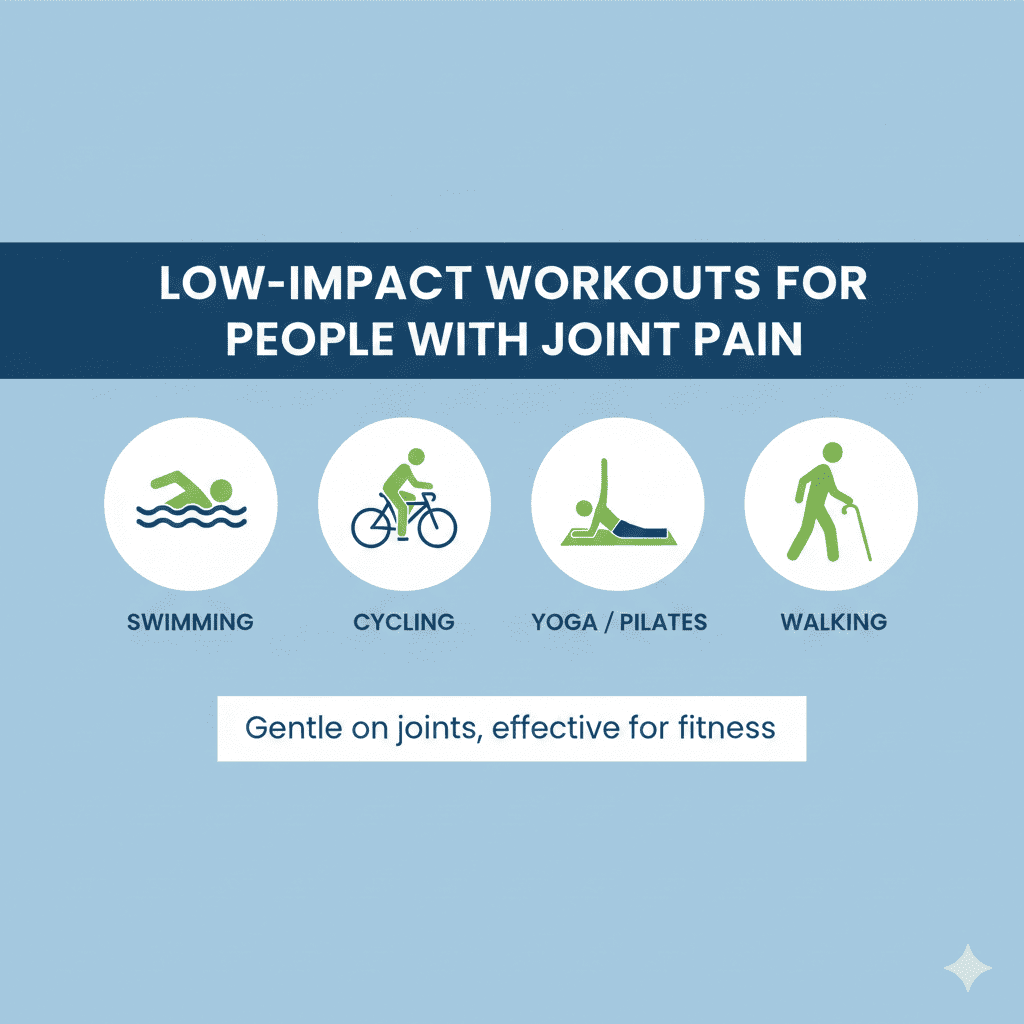
Living with joint pain doesn’t mean giving up on fitness. Whether you’re dealing with arthritis, recovering from an injury, or simply looking for gentler exercise options, low-impact workouts for joint pain offer an effective solution that keeps you active without aggravating your condition. These exercises provide the cardiovascular benefits, strength building, and flexibility improvements your body needs while protecting your joints from unnecessary stress.
The beauty of low-impact workouts for joint pain lies in their accessibility. Regardless of your age, fitness level, or the severity of your joint issues, there’s an exercise option that can work for you. This comprehensive guide explores ten proven low-impact exercises that deliver real results while keeping your joints safe and comfortable.
Understanding Joint Pain and Exercise
Before diving into specific workouts, it’s essential to understand the relationship between exercise and joint health. Many people with joint pain avoid physical activity, fearing it will worsen their condition. However, the opposite is often true. Regular, appropriate exercise can:
- Strengthen the muscles around your joints, providing better support
- Improve flexibility and range of motion
- Reduce inflammation through increased blood flow
- Help maintain a healthy weight, reducing stress on weight-bearing joints
- Boost production of synovial fluid, which lubricates joints
- Enhance overall physical and mental well-being
The key is choosing exercises that minimize jarring movements and excessive impact on your joints. That’s where low-impact workouts for joint pain become invaluable tools in your wellness arsenal.
1. Swimming and Water Aerobics
Water-based exercises reign supreme among low-impact workouts for joint pain, offering unmatched joint protection while delivering full-body conditioning.
Why Swimming Works for Joint Pain
The buoyancy of water reduces stress on your joints by up to 90%, essentially making you weightless while still providing resistance for muscle strengthening. Water’s natural resistance is gentle yet effective, requiring no weights or equipment.
Benefits of Water Exercise
- Supports your body weight, eliminating impact on knees, hips, and spine
- Provides 360-degree resistance for balanced muscle development
- Allows for greater range of motion than land-based exercises
- Reduces swelling through hydrostatic pressure
- Offers temperature-controlled environment that soothes stiff joints
Getting Started with Water Workouts
Begin with 15-20 minutes of water walking in the shallow end. Progress to swimming laps using strokes that feel comfortable for your shoulders and neck. Consider joining a water aerobics class designed for seniors or those with arthritis, where instructors understand joint limitations.
Progression Tips
Start in warmer therapeutic pools (around 83-88°F) if available, as warmth helps relax muscles. Gradually increase duration rather than intensity. Experiment with different strokes to find what works best for your specific joint issues.
2. Cycling and Stationary Biking
Cycling offers excellent cardiovascular benefits while keeping your joints protected through smooth, circular motions that never pound or jar sensitive areas.
Joint-Friendly Cycling Benefits
- Builds leg strength without impact stress
- Improves cardiovascular health significantly
- Enhances joint mobility through controlled movement
- Burns substantial calories for weight management
- Can be adjusted for any fitness level
Proper Bike Setup for Joint Health
Seat height matters tremendously. Your knee should have a slight bend (about 25-30 degrees) when the pedal is at its lowest point. Handlebars should be positioned to prevent excessive forward lean, protecting your lower back and neck.
Indoor vs. Outdoor Cycling
Stationary bikes provide consistent, controlled conditions ideal for those new to cycling or with significant joint issues. Recumbent bikes offer additional back support and reduce pressure on wrists and shoulders. Outdoor cycling provides mental health benefits but requires careful route selection to avoid rough terrain.
Creating an Effective Cycling Routine
Start with 10-15 minutes at low resistance, focusing on maintaining a steady, comfortable pace. Gradually increase duration to 30-45 minutes over several weeks. Keep resistance moderate—you should be able to maintain conversation while cycling.
3. Elliptical Training
The elliptical machine combines the benefits of running with the joint protection of cycling, making it one of the most popular low-impact workouts for joint pain in fitness centers.
Why Ellipticals Protect Your Joints
Your feet never leave the pedals, eliminating the impact that occurs with walking or running. The smooth, gliding motion mimics natural walking patterns while distributing effort across multiple muscle groups.
Full-Body Engagement
Unlike cycling, ellipticals with arm handles engage your upper body simultaneously, providing comprehensive conditioning. This total-body approach burns more calories while maintaining gentle movement on all joints.
Proper Elliptical Technique
Stand upright with core engaged rather than leaning heavily on handles. Keep your weight centered over your feet. Maintain a natural stride length that doesn’t hyperextend your knees or hips.
Customizing Your Elliptical Workout
Begin with zero or minimal incline at low resistance. Focus on smooth, controlled movements rather than speed. As strength improves, gradually increase resistance or incline rather than pace, maintaining joint-safe speeds throughout.
4. Yoga for Joint Health
Yoga provides gentle strengthening, flexibility enhancement, and mindfulness practices that address both physical and emotional aspects of living with joint pain.
Joint-Specific Yoga Benefits
- Increases flexibility gradually without forcing movements
- Strengthens stabilizing muscles around joints
- Improves balance, reducing fall risk
- Teaches body awareness for better movement patterns
- Reduces stress, which can amplify pain perception
Best Yoga Styles for Joint Pain
Hatha yoga offers slower-paced, gentle poses perfect for beginners. Restorative yoga uses props extensively to support your body, allowing deep relaxation. Chair yoga adapts traditional poses for those with significant mobility limitations. Avoid hot yoga and aggressive vinyasa flows that may stress inflamed joints.
Essential Poses for Joint Pain Relief
Child’s pose gently stretches the spine and hips. Cat-cow sequences mobilize the spine without compression. Bridge pose strengthens legs and core while opening hip flexors. Gentle twists improve spinal mobility. Legs-up-the-wall pose reduces swelling in lower extremities.
Safety Considerations
Never push into pain. Use props liberally—blocks, straps, bolsters, and blankets make poses accessible and safe. Inform instructors about your specific joint issues. Skip or modify poses that aggravate your condition.
5. Tai Chi: Moving Meditation
This ancient Chinese practice combines slow, flowing movements with deep breathing and meditation, creating one of the most therapeutic low-impact workouts for joint pain available.
How Tai Chi Helps Joint Pain
The weight-shifting movements strengthen legs while improving balance. Continuous, circular motions lubricate joints without jarring. The meditative aspect reduces stress and may lower pain perception.
Scientific Evidence
Research shows tai chi significantly reduces pain and improves function in people with osteoarthritis. Studies demonstrate improvements in balance, reducing fall risk in older adults. Regular practice may slow cartilage degradation in knee joints.
Learning Tai Chi
Look for classes specifically designed for arthritis or seniors. Many community centers and senior centers offer free or low-cost instruction. Online videos can supplement but shouldn’t replace initial in-person instruction to ensure proper form.
Practicing at Home
Start with 10-15 minutes of basic movements daily. Focus on weight shifting, breathing coordination, and maintaining upright posture. Consistency matters more than duration—daily brief practice yields better results than occasional longer sessions.
6. Walking: The Simplest Solution
Don’t underestimate walking’s power as one of the most accessible low-impact workouts for joint pain. When done correctly with proper footwear and technique, walking provides excellent conditioning without special equipment or facilities.
Making Walking Joint-Friendly
Choose soft surfaces like tracks, grass, or dirt trails over concrete when possible. Invest in high-quality walking shoes with good cushioning and arch support. Use walking poles to reduce stress on hips, knees, and ankles while engaging upper body.
Proper Walking Technique
Strike with your heel and roll through to your toes. Keep your stride natural—overstriding stresses knees. Maintain upright posture with shoulders back and core engaged. Swing arms naturally in opposition to legs.
Building a Walking Program
Begin with 10-minute walks at a comfortable pace. Gradually increase duration by 5 minutes weekly until reaching 30-45 minutes. Focus on consistency—aim for 5-6 days weekly rather than occasional long walks.
Walking Variations
Interval walking alternates regular pace with slightly brisker periods. Mall walking provides climate-controlled environment with restrooms and seating. Nature walking offers mental health benefits beyond physical conditioning.
7. Rowing Machines
Rowing provides full-body, low-impact conditioning that’s particularly effective for those whose joint pain is concentrated in legs and feet rather than upper body.
Joint Benefits of Rowing
The seated position removes weight-bearing stress. The smooth pulling motion is naturally low-impact. Rowing distributes effort across legs, core, back, and arms, preventing overuse of any single joint group.
Proper Rowing Form
The movement should be legs-back-arms on the drive and arms-back-legs on the recovery. Keep your back straight throughout. Avoid hunching shoulders or hyperextending knees. Maintain smooth, controlled movements rather than jerky pulls.
Starting a Rowing Routine
Set resistance low initially. Focus on mastering form before increasing intensity or duration. Begin with 5-10 minute sessions, gradually building to 20-30 minutes as conditioning improves.
Modifications for Joint Issues
If shoulder issues exist, limit arm pull range. For knee problems, don’t fully extend legs. Adjust foot straps to avoid excessive ankle flexion if needed.
8. Pilates for Core Strength
Pilates focuses on controlled movements that strengthen your core, which provides crucial support for your entire skeletal system, reducing joint strain throughout your body.
How Pilates Protects Joints
By strengthening core muscles, Pilates improves posture and body mechanics. Better alignment means joints track properly during movement, reducing abnormal wear. Controlled, precise movements never jar or impact joints.
Pilates Principles for Joint Health
Concentration on proper form ensures safe movement patterns. Centering movements from your core distributes effort appropriately. Control prevents momentum-based movements that can stress joints. Precision develops efficient movement patterns. Breathing facilitates relaxation and endurance.
Mat Pilates vs. Reformer
Mat Pilates requires no equipment and can be done anywhere. Reformer Pilates uses specialized equipment that provides assistance and resistance simultaneously, often easier for those with limited mobility or significant joint issues.
Essential Pilates Exercises for Joint Pain
Pelvic tilts mobilize the spine safely. The hundred builds core endurance. Leg circles strengthen hips without impact. Spine stretch forward improves flexibility. Side leg lifts strengthen hip stabilizers.
9. Strength Training with Resistance Bands
Building muscle strength is crucial for joint health, as strong muscles better support and protect joints. Resistance bands provide this conditioning without the joint stress of heavy weights.
Advantages of Band Training
Bands provide variable resistance that accommodates your strength throughout the movement range. They’re incredibly portable and inexpensive. The stretchy resistance is gentler on joints than fixed weights. Progressive resistance is simple—just use a stronger band.
Full-Body Band Workout
Upper body exercises include chest presses, rows, shoulder presses, and bicep curls. Lower body work includes squats, leg presses, hip abductions, and hamstring curls. Core exercises include rotations, pallof presses, and resisted crunches.
Proper Band Training Technique
Move slowly through both pulling and releasing phases. Maintain tension in the band throughout movements. Choose resistance that allows 12-15 repetitions with good form. Stop if you feel sharp pain in any joint.
Creating a Band Routine
Perform full-body workouts 2-3 times weekly with rest days between. Complete 1-3 sets of each exercise. Focus on proper form over repetition count. Gradually progress by using stronger bands or increasing sets.
10. Gentle Dance and Movement Classes
Dance-based fitness classes designed for seniors or those with mobility limitations combine cardiovascular exercise with joy and social connection, making them sustainable low-impact workouts for joint pain.
Types of Joint-Friendly Dance
Chair dancing allows participation while seated, perfect for severe joint limitations. Line dancing provides low-impact choreography with social elements. Ballroom dancing offers partnered support and elegant, controlled movements. Zumba Gold is a modified version with simpler moves and lower impact than regular Zumba.
Benefits Beyond Physical Fitness
Social interaction combats isolation common among those with chronic pain. Music and rhythm make exercise feel less like work. Learning choreography provides cognitive benefits. Group accountability increases exercise adherence.
Finding the Right Class
Look for classes specifically marketed for seniors or arthritis. Visit classes before committing to observe intensity levels. Speak with instructors about your specific limitations. Don’t be discouraged if the first class isn’t right—keep trying different options.
Adapting Dance Movements
Modify any movement that causes discomfort. Take breaks as needed without guilt. Focus on upper body movements if lower body joints are problematic. Stay hydrated and monitor how you feel during and after class.
Creating Your Personal Low-Impact Exercise Program
Successfully incorporating low-impact workouts for joint pain into your life requires a personalized approach that considers your specific condition, preferences, and lifestyle.
Consulting Healthcare Providers
Before starting any new exercise program, discuss your plans with your doctor or physical therapist. They can identify movements to avoid based on your specific joint issues. Professional guidance helps you start safely and progress appropriately.
Building a Balanced Routine
Combine cardiovascular exercise, strength training, and flexibility work throughout your week. A sample week might include swimming twice, yoga twice, and strength training with bands twice, with one full rest day. Variety prevents overuse while maintaining engagement.
Listening to Your Body
Distinguish between general muscle soreness from exercise and joint pain from overexertion. Some discomfort during and immediately after exercise is normal as deconditioned muscles wake up. However, sharp pain, significant swelling, or pain lasting more than two hours after exercise signals you’ve overdone it.
Progression Principles
Increase only one variable at a time—duration, frequency, or intensity, never all three simultaneously. Follow the 10% rule: increase total weekly exercise time by no more than 10% week-over-week. Build rest days into your schedule to allow recovery.
Additional Strategies for Joint Pain Management
While low-impact workouts for joint pain form the foundation of an active lifestyle despite joint issues, complementary strategies enhance their effectiveness.
Warm-Up and Cool-Down Importance
Never skip warming up. Begin with 5-10 minutes of gentle movement to increase blood flow and warm muscles and joints. End sessions with 5-10 minutes of gentle stretching while muscles are warm. Both reduce injury risk and may decrease post-exercise soreness.
Timing Exercise Strategically
Many people with arthritis find morning stiffness makes early exercise challenging. Mid-morning or early afternoon often provides optimal joint function. However, gentle morning movement can help work through stiffness. Experiment to find your optimal exercise time.
Anti-Inflammatory Nutrition
Diet significantly impacts joint inflammation. Omega-3 fatty acids from fish reduce inflammatory markers. Colorful fruits and vegetables provide antioxidants that combat inflammation. Adequate hydration supports synovial fluid production. Limiting processed foods, excess sugar, and certain oils may reduce inflammatory responses.
Weight Management Through Exercise
Maintaining healthy weight dramatically reduces joint stress, particularly on hips, knees, and ankles. Each pound of excess weight creates four pounds of pressure on knee joints. The combination of regular low-impact workouts for joint pain and mindful eating creates sustainable weight management.
Overcoming Common Exercise Barriers
Understanding obstacles that prevent consistent exercise helps you develop strategies to overcome them, ensuring low-impact workouts for joint pain become lasting habits rather than abandoned attempts.
Dealing with Pain Flares
Bad pain days don’t mean abandoning exercise entirely. Reduce intensity or duration significantly. Focus on gentle stretching or breathing exercises. Remember that complete rest often increases stiffness. Even five minutes of gentle movement maintains the habit.
Financial Constraints
Many effective options cost nothing. Walking, home yoga using free videos, and bodyweight exercises require zero investment. Community centers often offer low-cost classes. Resistance bands cost less than a single month of gym membership. Prioritize consistency over fancy facilities.
Motivation and Accountability
Exercise partners increase adherence significantly. Join classes for built-in community and accountability. Track progress in a journal, noting not just exercise but how you feel afterward. Set process goals (exercise three times this week) rather than outcome goals (lose 10 pounds), as you control the former directly.
Time Management
Exercise doesn’t require hour-long blocks. Three 10-minute sessions provide similar benefits to one 30-minute session. Wake 30 minutes earlier or use lunch breaks. View exercise as essential healthcare, not optional luxury.
The Long-Term Benefits of Consistent Low-Impact Exercise
Committing to regular low-impact workouts for joint pain creates profound changes that extend far beyond immediate pain management.
Slowing Joint Degeneration
While you cannot reverse arthritis, appropriate exercise can slow its progression. Strengthened muscles better support joints, reducing abnormal wear patterns. Improved flexibility maintains range of motion. Regular movement promotes cartilage health through nutrient delivery.
Maintaining Independence
Physical function directly relates to independence as we age. Regular exercise preserves ability to perform daily activities like climbing stairs, carrying groceries, and getting up from chairs. This independence dramatically impacts quality of life and mental health.
Mental Health Benefits
Chronic pain frequently coexists with depression and anxiety. Exercise releases endorphins, natural mood elevators. Physical activity provides sense of control over your condition rather than helplessness. Social exercise opportunities combat isolation. Better sleep from regular activity improves overall wellbeing.
Healthcare Cost Reduction
Prevention through exercise reduces medical costs significantly. Stronger muscles and better balance prevent falls and related injuries. Improved cardiovascular health reduces related disease risks. Better weight management prevents numerous obesity-related conditions.
Conclusion
Joint pain doesn’t have to end your active lifestyle. The ten low-impact workouts for joint pain presented here offer varied, accessible options that protect your joints while building strength, flexibility, and endurance. From the weightless freedom of swimming to the mindful movements of tai chi, from the simplicity of walking to the core strengthening of Pilates, there’s an exercise modality that fits your needs, preferences, and limitations.
The key to success lies in starting gradually, listening to your body, and maintaining consistency. Work with healthcare providers to create a safe, effective program. Combine different exercise types for balanced conditioning. Remember that some discomfort as you build fitness is normal, but sharp pain signals the need to modify or stop.
These low-impact workouts for joint pain represent more than just exercise—they’re investments in your long-term health, independence, and quality of life. Every session strengthens not just your body but your resilience and determination. Joint pain may be part of your life, but with the right approach to movement and exercise, it doesn’t have to define your life or limit your potential.
Start today with just one of these activities. Begin small, stay consistent, and watch as your body responds with increased strength, reduced pain, and renewed confidence in your physical abilities. Your joints—and your future self—will thank you for taking action now.
Also read this:
How to Stay Fit With a Busy Schedule: Daily 10-Minute Routine That Actually Works
Healthy Eating Plan for Weight Loss Without Dieting — Easy, Sustainable & Beginner-Friendly
How to Increase Body Strength at Home: Simple No-Equipment Exercises for Beginners