
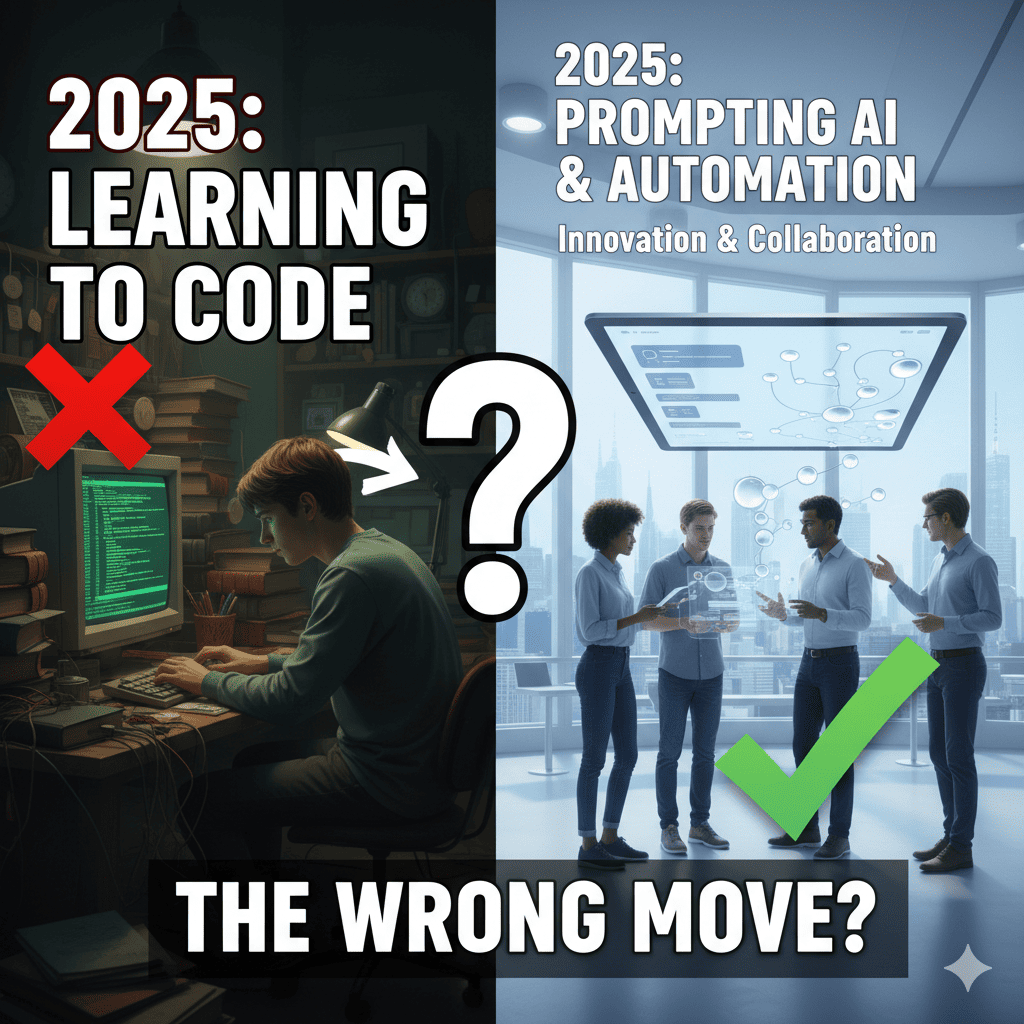
For over a decade, “learn to code” has been the default career advice. Bootcamps proliferated. Online courses multiplied. Parents pushed their children toward computer science degrees. The message was clear and consistent: learning to code was your ticket to a high-paying, future-proof career.
But something fundamental has shifted in 2025. The landscape that made learning to code such valuable advice is transforming at breakneck speed. AI coding assistants write functions in seconds. No-code platforms build sophisticated applications without a single line of code. The entry-level developer market is oversaturated while demand shifts toward entirely different skill sets.
This isn’t an anti-technology manifesto. Technology skills remain valuable—perhaps more valuable than ever. But the specific advice to spend months or years learning to code as your primary career strategy might be fundamentally misguided for many people in 2025.
Let’s explore why the traditional path of learning to code may no longer be the golden ticket it once was—and what you should consider instead.
The Dramatic Shift in the Coding Landscape
Before diving into why learning to code might be the wrong move, we need to understand how radically the landscape has changed.
The AI Revolution in Software Development
In 2025, AI coding assistants have become astonishingly capable:
- GitHub Copilot and similar tools write entire functions from natural language descriptions
- ChatGPT, Claude, and specialized AI models debug code, explain algorithms, and suggest optimizations
- AI-powered IDEs catch errors in real-time and suggest improvements continuously
- Automated testing tools generate comprehensive test suites without manual coding
- Code generation platforms translate requirements directly into working applications
What used to require hours of coding now takes minutes of prompting. The skill of writing syntax has been partially automated—and the automation is accelerating.
The No-Code and Low-Code Explosion
Simultaneously, platforms have emerged that bypass traditional coding entirely:
- Webflow and Framer create production-ready websites with visual interfaces
- Bubble and Adalo build full-stack web applications without code
- Zapier and Make automate complex workflows across hundreds of applications
- Airtable and Notion create custom databases and business tools
- Shopify and WordPress power millions of e-commerce sites with minimal technical knowledge
These aren’t toy platforms—they’re powering billion-dollar businesses and handling millions of users.
The Market Saturation Problem
The advice to start learning to code was so effective that it created its own problem:
- Coding bootcamps graduated hundreds of thousands of junior developers
- Computer science became one of the most popular college majors
- Online courses produced millions of self-taught programmers
- The entry-level market became intensely competitive
- Companies now receive hundreds of applications for each junior position
The supply of junior developers has vastly outpaced demand, fundamentally changing the risk-reward calculation of learning to code from scratch.
1. The Junior Developer Market Is Brutally Competitive
One of the biggest reasons learning to code might be the wrong move is the harsh reality of the current job market.
The Oversaturation Crisis
The numbers tell a sobering story:
- Entry-level positions receive 200-500+ applications regularly
- Many companies have eliminated junior roles entirely, seeking only mid-level and senior developers
- Internships that once led to jobs are now dead-ends as companies tighten budgets
- Geographic arbitrage allows companies to hire experienced developers globally at competitive rates
- AI tools reduce the need for junior developers who primarily write boilerplate code
The Experience Paradox
Learning to code gets you to the starting line, but the race has become much harder:
- Most positions require 2-3 years of “professional experience”
- Portfolio projects don’t carry the weight they once did (everyone has them now)
- Contributing to open source is expected, not exceptional
- You need specialized knowledge in specific frameworks, not just general programming ability
- Soft skills, system design, and architecture understanding matter more than syntax knowledge
The Reality Check
Spending 6-12 months learning to code through a bootcamp or self-study now often leads to:
- 6-12 additional months of job searching
- Hundreds of rejected applications
- Growing debt or opportunity cost
- Questioning whether the investment was worth it
- Competing against thousands with identical backgrounds
This doesn’t mean it’s impossible—but the risk profile has changed dramatically.
2. AI Is Commoditizing Basic Coding Skills
The second major reason to reconsider learning to code is that the skills you’d spend months acquiring are being automated.
What AI Already Does Well
In 2025, AI coding assistants excel at:
Boilerplate Generation: Creating standard CRUD operations, API endpoints, database schemas Language Translation: Converting code between programming languages Bug Detection: Identifying syntax errors, logic problems, and security vulnerabilities Documentation: Writing comprehensive comments and technical documentation Test Creation: Generating unit tests and integration tests Code Refactoring: Improving code structure and performance Learning New Frameworks: Quickly generating examples in unfamiliar technologies
These are precisely the tasks that junior developers traditionally handled—the entry point for those learning to code.
The Narrowing Window of Human Advantage
Human developers still excel at:
- Understanding complex business requirements and translating them into technical specifications
- Making architectural decisions with long-term implications
- Navigating ambiguous problems without clear solutions
- Collaborating with non-technical stakeholders
- Considering security, scalability, and maintenance implications
- Debugging complex, interconnected systems
Notice what’s missing? Basic syntax, writing simple functions, and implementing straightforward algorithms—exactly what beginners spend their time learning to code.
The Acceleration Factor
AI capabilities aren’t static—they’re improving exponentially:
- What AI couldn’t do in 2023, it does competently in 2025
- What requires careful human oversight today may be fully automated by 2026
- The half-life of newly learned coding skills is shrinking rapidly
By the time you complete a year of learning to code, the skills you’ve acquired may already be partially obsolete.
3. The Value Has Shifted to Orchestration and Judgment
Instead of learning to code line by line, the premium skill in 2025 is knowing what to build and how to direct AI and no-code tools to build it.
The New High-Value Skills
Prompt Engineering for Development: Knowing how to describe requirements to AI in ways that generate optimal code Tool Selection and Integration: Understanding which platforms solve which problems and how to connect them System Architecture: Designing how different components interact, regardless of implementation method Business Logic Translation: Converting real-world problems into technical specifications Quality Assurance: Evaluating whether AI-generated code meets requirements and standards Strategic Technical Decisions: Choosing between building, buying, or integrating solutions
The Builder vs. Coder Distinction
2025 rewards builders more than coders:
A coder writes functions, implements algorithms, debugs syntax errors A builder identifies problems, designs solutions, orchestrates tools, ships products
You can become a builder much faster than you can become a proficient coder—and in many contexts, builders create more value.
Real-World Application
Consider two people building a SaaS product:
Person A spends 12 months learning to code, then 6 months building their product from scratch Person B spends 2 months learning no-code tools and AI prompting, then 2 months building using Bubble, Zapier, and AI assistance
Person B launches 14 months earlier, validates their idea, potentially builds a profitable business, and learns what matters by building—not by studying syntax.
4. Specialized Knowledge Trumps General Coding Ability
The fourth reason learning to code might be wrong is that deep domain expertise often creates more value than broad programming skills.
The Domain Expert Advantage
Someone who deeply understands healthcare compliance, financial regulations, logistics optimization, or legal workflows can create more value with AI-assisted coding than a general programmer can.
The Traditional Path:
- Learn to code (1-2 years)
- Learn a domain (5-10 years)
- Build solutions combining both
The 2025 Path:
- Master a complex domain (5-10 years)
- Learn to use AI coding tools and no-code platforms (2-6 months)
- Build solutions combining both
The second path is faster and often produces better results because domain expertise is harder to replicate than coding ability.
Examples of High-Value Domain + Tech Combinations
Healthcare Professional + No-Code: Building patient management systems that actually work for clinical workflows Financial Analyst + AI Coding: Creating sophisticated models and automation tools Supply Chain Expert + Low-Code: Developing logistics optimization platforms Legal Professional + Automation: Building contract analysis and compliance tools Marketing Specialist + Integrations: Creating attribution and analytics systems
In each case, the domain knowledge is the scarce resource—the technical implementation is increasingly commoditized.
The Validation Advantage
Domain experts can validate solutions effectively:
- They know whether the code solves the actual problem
- They understand edge cases that pure programmers miss
- They can iterate based on real-world constraints
- They have distribution channels through industry connections
Learning to code without domain expertise leaves you building solutions to problems you don’t truly understand.
5. The Opportunity Cost Is Higher Than Ever
Time spent learning to code has significant opportunity costs that are often overlooked.
Alternative Skill Investments
The 1,000+ hours required to become proficient at coding could instead develop:
Sales and Persuasion: Learning to close deals, communicate value, build relationships Product Management: Understanding user research, prioritization, go-to-market strategy Content Creation and Audience Building: Developing followers who care about your work Business Strategy and Operations: Learning how to run profitable companies Specialized Technical Skills: Cloud architecture, AI/ML implementation, cybersecurity, data engineering
Many of these skills combine better with AI-assisted coding than traditional programming does.
The Direct Path to Value Creation
Consider these scenarios:
Scenario A: Spend 12 months learning to code, then seek employment Scenario B: Spend 12 months building an audience and offering services using existing tools
Scenario B often generates revenue faster and builds assets (audience, reputation, portfolio) that compound over time.
Scenario C: Spend 12 months mastering sales, then join a tech company in business development Scenario D: Spend 12 months learning to code, then compete for junior developer roles
Scenario C often leads to higher compensation faster with less competition.
The Entrepreneurial Calculation
If your goal is entrepreneurship:
Traditional approach: Learn to code → build product → learn business → go to market Modern approach: Validate idea → build with no-code/AI → learn to market → scale with tools
The modern approach ships products faster, validates sooner, and learns what actually matters through market feedback rather than theoretical study.
6. The Credential Inflation Problem
Learning to code through bootcamps or online courses no longer provides the differentiation it once did.
The Bootcamp Bubble
When coding bootcamps were new:
- They provided credible alternative credentials
- Graduates stood out from traditional candidates
- Completion itself demonstrated initiative and ability
By 2025:
- Hundreds of bootcamps have graduated millions of students
- Completion is unremarkable, not exceptional
- Employers are skeptical of variable bootcamp quality
- The credential carries minimal signaling value
The Portfolio Paradox
Every junior developer now has:
- A portfolio website (often using the same templates)
- GitHub repositories (with similar beginner projects)
- A personal blog (with low traffic)
- Contributions to open source (often minor documentation fixes)
When everyone has identical credentials, nobody has differentiation. Learning to code gets you to baseline, but baseline no longer opens doors.
Alternative Credentials That Matter More
In 2025, what actually differentiates candidates:
Shipped Products: Real applications with actual users and metrics Business Results: Revenue generated, users acquired, problems solved Specialized Certifications: AWS, Azure, specialized frameworks (not generic coding) Domain Expertise: Professional experience in specific industries Network and Referrals: Connections who vouch for your abilities Public Presence: Recognized contributions to communities, content, or open source
Notice that most of these aren’t acquired by simply learning to code in isolation.
7. The Risk-Reward Profile Has Shifted
The final major consideration is that the risk-reward calculation for learning to code has fundamentally changed.
The Investment Analysis
Traditional Programming Career (2015-2020):
- Investment: 3-12 months learning, modest financial cost
- Risk: Relatively low—strong demand, many opportunities
- Reward: $60-100K starting salary, excellent growth trajectory
- Timeline: Job within 3-6 months of completion
Traditional Programming Career (2025):
- Investment: 3-12 months learning, plus 6-12 months job searching
- Risk: Higher—saturated market, AI competition, uncertain future
- Reward: $50-80K starting salary (if hired), uncertain growth with AI
- Timeline: Potentially 18+ months to first role
The Alternative Paths
Product Builder Using No-Code + AI:
- Investment: 2-4 months learning tools
- Risk: Moderate—depends on business skills and idea validation
- Reward: Direct revenue potential, ownership, faster iteration
- Timeline: Can generate revenue within 3-6 months
Technical Specialist with Domain Expertise:
- Investment: 2-6 months learning technical tools in your domain
- Risk: Lower—leveraging existing expertise and network
- Reward: Higher compensation, less competition, clear value proposition
- Timeline: Can transition within 3-6 months
AI-Assisted Developer with Business Skills:
- Investment: 3-6 months learning AI tooling and prompt engineering
- Risk: Moderate—requires self-direction and problem-solving
- Reward: High productivity, can build solo, entrepreneurial options
- Timeline: Can ship products within months
What You Should Consider Instead of Learning to Code
If traditional learning to code isn’t the answer for many people in 2025, what should you do instead?
Option 1: Learn AI-Assisted Development
Focus on becoming highly proficient at using AI coding tools:
Key Skills:
- Prompt engineering for code generation
- Understanding code well enough to evaluate AI output
- Debugging and refining AI-generated code
- Combining multiple AI tools effectively
- Rapid prototyping and iteration
Learning Path:
- 1-2 months learning basic programming concepts (enough to read code)
- 2-3 months mastering AI coding assistants (GitHub Copilot, Claude, ChatGPT)
- 1-2 months building progressively complex projects
- Ongoing: shipping real products and learning by doing
This path gets you productive in 4-6 months instead of 12-24.
Option 2: Master No-Code and Low-Code Platforms
Become an expert in the tools that bypass traditional coding:
Platform Specialization:
- Webflow or Framer (web design)
- Bubble or Adalo (web applications)
- FlutterFlow (mobile apps)
- Zapier or Make (automation)
- Airtable or Notion (databases)
Value Proposition:
- Build production-ready applications quickly
- Offer services to businesses that need solutions fast
- Ship your own products without technical co-founders
- Combine platforms to create sophisticated systems
Learning Path:
- 2-3 weeks per platform mastering fundamentals
- 1-2 months building real projects
- Ongoing: staying current with platform updates
Option 3: Develop Technical Product Management Skills
Learn to bridge business needs and technical implementation:
Core Competencies:
- User research and requirement gathering
- Technical specification writing
- Understanding system architecture (without writing code)
- Working with developers and designers
- Prioritization and roadmap management
- Data analysis and metrics
Why This Works:
- High demand, less competition than development
- Higher compensation than many junior developer roles
- Combines business and technical thinking
- Positions you to direct AI and human developers
- Natural career progression to leadership
Learning Path:
- 2-3 months studying product management frameworks
- 1-2 months learning technical concepts at high level
- Ongoing: building products and learning from outcomes
Option 4: Combine Domain Expertise with Technical Tools
Leverage existing professional knowledge with new technical capabilities:
Application:
- Healthcare professional learning HIPAA-compliant automation
- Accountant mastering financial modeling and API integrations
- Marketer becoming expert in analytics and attribution systems
- Operations manager learning supply chain optimization tools
- Legal professional building contract and compliance workflows
Advantage:
- Domain expertise is your competitive moat
- Technical tools amplify your existing value
- Less competition from pure technologists
- Direct path to high-value consulting or employment
- Can charge premium rates for specialized knowledge
Option 5: Focus on Emerging Technical Specializations
Instead of general learning to code, specialize in cutting-edge areas:
High-Growth Specializations:
- AI/ML Implementation: Not building models, but deploying and integrating them
- Cloud Architecture: Designing systems using AWS, Azure, or GCP
- Cybersecurity: Protecting systems rather than building them
- Data Engineering: Creating pipelines and infrastructure, not just analysis
- DevOps and Infrastructure: Automation and deployment, not application code
Why This Works:
- These roles require understanding code but not writing it constantly
- AI hasn’t commoditized these skills yet
- Demand exceeds supply in these specializations
- Higher compensation than general development
- More defensible against automation
When Learning to Code Still Makes Sense
This article isn’t suggesting that nobody should learn to code. There are still scenarios where traditional learning to code is the right move.
You Should Still Learn to Code If:
You’re genuinely passionate about computer science: If you find algorithms, data structures, and system design intellectually fascinating, pursue that passion. Career optimization isn’t everything.
You want to work on cutting-edge technical problems: Building AI models, creating new languages, or developing novel algorithms still requires deep programming knowledge.
You’re young with time to invest: If you’re in high school or early college, learning fundamentals positions you for evolving opportunities even as the landscape changes.
You have a clear path to employment: If you have connections, referrals, or guaranteed opportunities, the risk calculation changes significantly.
You want to understand technology deeply: If your goal is comprehensive technical literacy rather than just employment, traditional learning has value.
You’re building something specific: If you have a product vision that requires custom code beyond what no-code tools provide, learning to build it yourself makes sense.
The Key Question to Ask
Before committing to learning to code, ask yourself:
“Is my goal to become a professional programmer, or is my goal to build things and solve problems?”
If the answer is the former, traditional coding education makes sense. If the answer is the latter, the alternatives discussed in this article may be better paths.
The Future-Proof Approach: Hybrid Technical Literacy
The optimal strategy for most people in 2025 isn’t choosing between learning to code or avoiding technology—it’s developing what I call “hybrid technical literacy.”
What Hybrid Technical Literacy Means
Understanding Code: Read and comprehend code, even if you don’t write it from scratch AI Fluency: Expert at directing AI tools to generate and modify code Tool Mastery: Deep knowledge of no-code, low-code, and automation platforms System Thinking: Understanding how different components interact and integrate Problem Decomposition: Breaking complex challenges into solvable pieces Technical Communication: Translating between business needs and technical requirements
Why This Approach Wins
This combination provides:
- Flexibility: Multiple paths to solving problems
- Speed: Faster than traditional coding for many use cases
- Resilience: Not dependent on one skill that might be automated
- Value: Combines strengths of coding, AI, and no-code
- Accessibility: Faster to acquire than traditional programming mastery
Building Your Hybrid Technical Literacy
Phase 1 (Months 1-2): Learn programming fundamentals
- Basic Python or JavaScript
- Understand variables, functions, loops, conditionals
- Read and comprehend code, even if you can’t write it fluently
Phase 2 (Months 2-4): Master AI-assisted development
- GitHub Copilot, Claude, ChatGPT for coding
- Prompt engineering for code generation
- Debugging and refining AI output
- Building progressively complex projects
Phase 3 (Months 4-6): Learn no-code platforms
- Choose 2-3 platforms relevant to your goals
- Build real projects, not just tutorials
- Understand when to use code vs. no-code
Phase 4 (Months 6+): Ship and iterate
- Build real products for real users
- Learn business, marketing, and distribution
- Continuously update technical skills as tools evolve
This path creates competent builders in 6 months instead of job-seeking programmers in 18+ months.
Conclusion: Rethinking Technology Career Advice
The advice to start learning to code was brilliant for a specific era—roughly 2010 to 2020. During that decade, demand for developers exploded, bootcamps provided accessible education, and basic coding skills opened lucrative career doors.
But 2025 is fundamentally different. AI assists and sometimes replaces junior developers. No-code tools create production-ready applications. The market is saturated with entry-level programmers. The skills you’d spend months acquiring are being commoditized in real-time.
This doesn’t mean technology careers are dead—quite the opposite. Technology is more important than ever. But the specific path of spending months intensively learning to code from scratch, hoping to land a junior developer job, may no longer be the optimal strategy for most people.
Instead, consider:
- Learning to direct AI rather than writing code manually
- Mastering no-code platforms that bypass traditional programming
- Combining domain expertise with technical tools
- Developing product management and technical leadership skills
- Specializing in areas that aren’t yet commoditized
The goal isn’t to avoid technology—it’s to acquire technical capabilities in ways that create more value, faster, with less risk than traditional learning to code now offers.
Before you enroll in that bootcamp or commit to a year of self-study, pause and ask: “Is this the highest-leverage way to achieve my actual goals?” For many people in 2025, the honest answer might be no.
The future belongs not to those who can write the most lines of code, but to those who can most effectively direct technology—human, AI, and automated—to solve real problems for real people. That’s a fundamentally different skill set than what traditional learning to code develops.
Choose your path wisely. The landscape has shifted beneath our feet, and yesterday’s golden advice might be today’s strategic mistake.
Also read this:
How to Spot the Next Big Trend Before It Blows Up