
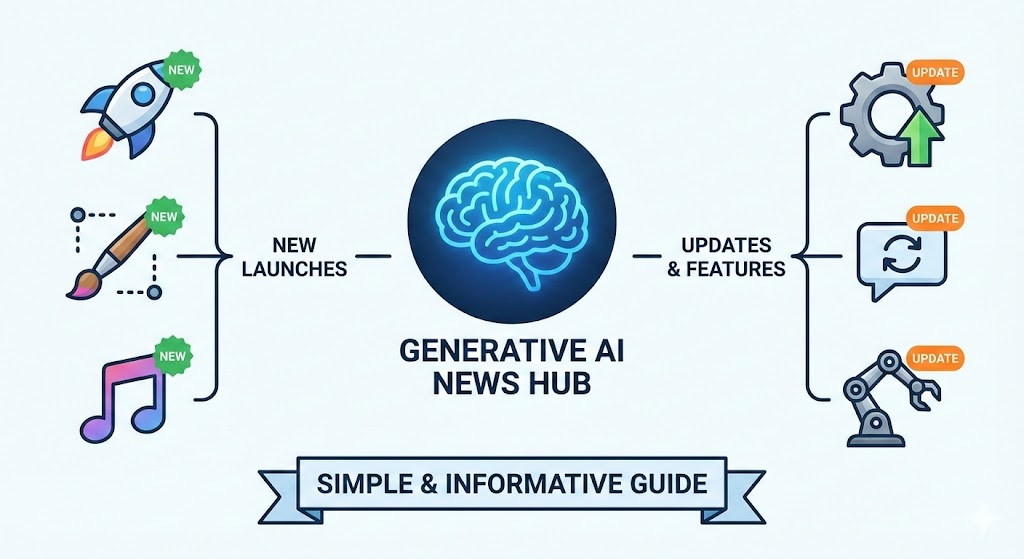
Latest Generative AI Tools News The artificial intelligence landscape continues to evolve at breakneck speed, with 2025 marking a transformative year for generative AI technologies. As we approach the end of the year, the Latest Generative AI Tools News reveals unprecedented advancements that are reshaping how businesses operate, how creators produce content, and how professionals approach problem-solving. From sophisticated language models to groundbreaking video generation platforms, the AI ecosystem has witnessed remarkable innovations that demand attention from technology enthusiasts, business leaders, and creative professionals alike.
This comprehensive guide explores the most significant launches, updates, and developments in the Latest Generative AI Tools News, providing you with actionable insights into tools that are defining the future of artificial intelligence. Whether you’re a marketer seeking efficiency, a developer building next-generation applications, or a business leader strategizing for competitive advantage, understanding these emerging technologies is no longer optional—it’s essential.
1. Revolutionary Language Models Transforming Communication
The foundation of generative AI rests on large language models, and 2025 has introduced game-changing advancements in this domain. These sophisticated systems have evolved beyond simple text generation to offer nuanced understanding, improved reasoning capabilities, and seamless multimodal interactions.
OpenAI’s GPT-5.2: The Evolution of Conversational AI
OpenAI launched GPT-5 earlier in 2025, but December brought the upgraded GPT-5.2, which represents a significant leap in AI capabilities. This iteration features human-expert level reasoning, enhanced visual interpretation, and optimization for agentic workflows. The model competes directly with Google’s Gemini 3, showcasing improvements in contextual understanding and faster response generation.
The Latest Generative AI Tools News confirms that GPT-5.2 users can now choose between Auto, Fast, and Thinking modes, providing unprecedented control over how the AI processes requests. This flexibility allows users to balance speed with depth of analysis depending on their specific needs.
Google Gemini 3: Multimodal Intelligence Reaches New Heights
Google’s December announcement of Gemini 3 marked one of the year’s most significant milestones. This advanced model delivers deeper reasoning capabilities, improved multimodal understanding, and seamless integration across Google Search, Workspace, and Android platforms. Gemini 3 Deep Think, available to AI Ultra subscribers, focuses on long-form, high-precision reasoning across mathematics, science, and multi-step logic problems.
The model currently performs at frontier levels on complex benchmarks and explores parallel hypothesis paths before providing answers. This approach makes it particularly valuable for high-stakes applications in engineering, quantitative analysis, and research workflows where accuracy is paramount.
Anthropic’s Claude Evolution
Among the Latest Generative AI Tools News, Anthropic’s Claude has emerged as a strong competitor, offering cutting-edge generative AI models that challenge even established tech giants. Claude’s focus on safety, reliability, and nuanced understanding has positioned it as a preferred choice for enterprise applications requiring careful consideration of ethical implications.
DeepSeek: The Open-Source Challenger
DeepSeek represents a fascinating development in the Latest Generative AI Tools News, emerging from China as a cost-efficient, open-source alternative to proprietary models. Unlike closed AI systems, DeepSeek embraces transparency, allowing the AI community to freely explore, develop, and enhance its technology. The DeepSeek V3.2 release introduced sophisticated reasoning capabilities while maintaining accessibility for teams working with limited budgets.
This approach has democratized access to advanced AI capabilities, enabling robotics teams, edge computing applications, and organizations requiring offline AI functionality to leverage cutting-edge technology without dependency on closed APIs.
Microsoft Copilot: Integration Across Productivity Suite
Microsoft Copilot has evolved into a comprehensive AI assistant that integrates directly into Word, Excel, Teams, and other productivity applications. The Latest Generative AI Tools News highlights Copilot’s ability to transform natural language commands into powerful actions, significantly boosting workplace productivity by automating routine tasks and providing intelligent suggestions.
2. Next-Generation Video Creation Platforms
Video generation technology has matured dramatically in 2025, with multiple platforms offering capabilities that eliminate traditional production barriers such as expensive equipment, lengthy editing processes, and specialized technical expertise.
Synthesia: Leading AI Video Generation
Synthesia continues to dominate the AI video generation space, enabling users to create realistic AI human avatar videos from simple text inputs. The platform supports over 240 digital avatars and more than 140 languages, making it invaluable for global businesses creating training modules, internal communications, onboarding materials, and customer support videos.
The Latest Generative AI Tools News confirms that Synthesia offers 36 free minutes of video generation annually, with paid plans starting at accessible price points. Its customization capabilities allow organizations to tailor avatars, languages, tones, and backgrounds to match specific audience requirements.
Google Veo 3: Audio-Visual Generation Breakthrough
Google’s Veo platform has evolved significantly, with Veo 3 introducing true audio-visual generation capabilities. This breakthrough allows creators to produce not just video content but also synchronized audio, including dialogue, ambient sounds, and sound effects in a single generation step. The platform proves particularly valuable for social media marketers requiring creative b-roll content and developers building multimedia applications.
Veo 3 offers more realistic physics simulation compared to earlier iterations, though it operates at a higher price point than Veo 2. Users can access Veo 3 through Google AI Pro subscription or integrate it into broader creative workflows.
Runway Gen-4.5: Cinematic Quality at Scale
Runway has pushed text-to-video generation closer to production-ready quality with Gen-4.5, focusing on physics fidelity, prompt adherence, and visual consistency. The platform now generates videos where objects move with believable weight and momentum, liquids flow naturally, and overall motion captures cinematic realism.
The Latest Generative AI Tools News emphasizes Runway’s improvements in handling complex scenarios such as running scenes with motion blur, neon lighting effects, and camera movement that previously challenged AI video generators. These enhancements make it suitable for VFX pre-visualization, storyboarding, and high-quality brand content creation without requiring full production teams.
Kling 2.6: Comprehensive Audio-Visual Production
Kling 2.6 represents another advancement in unified media generation, capable of producing video, dialogue, ambient sound, and sound effects simultaneously. This holistic approach streamlines content creation workflows, particularly for creators producing short-form content for platforms like YouTube Shorts, Instagram Reels, and TikTok.
OpenAI’s Sora and Meta’s Movie Gen
While OpenAI announced Sora earlier in 2024, the platform continues evolving with enhanced capabilities. Similarly, Meta entered the AI video landscape with Movie Gen, which generates realistic video and audio clips from user prompts. These major players joining the video generation space signals the technology’s maturation and growing importance across entertainment, marketing, and educational sectors.
3. Advanced Image Generation and Editing Solutions
Image generation technology has achieved remarkable sophistication in 2025, with tools offering photorealistic creation, artistic interpretation, and powerful editing capabilities that democratize visual content production.
Midjourney: Artistic Excellence in AI Imagery
Midjourney remains a leading platform for AI-generated images, particularly excelling in artistic and stylized visual content. The platform offers extensive customization options and continues refining its models to produce increasingly sophisticated outputs that capture nuanced artistic styles and complex compositions.
DALL-E 3: OpenAI’s Image Generation Powerhouse
OpenAI’s DALL-E 3 provides powerful text-to-image generation capabilities with improved understanding of complex prompts and better adherence to user specifications. The model generates high-quality images suitable for professional applications while maintaining accessibility for casual users exploring creative possibilities.
Adobe Firefly: Enterprise-Grade Creative AI
Adobe announced significant updates to its Firefly suite, including the Firefly Image Model 5 for enhanced AI image generation. The Latest Generative AI Tools News highlights Adobe’s introduction of complementary tools such as Generate Soundtrack, Generate Speech, and Firefly Video Editor, creating a comprehensive creative ecosystem.
Adobe also launched the Photoshop Express AI Assistant, a conversational interface that performs edits on users’ behalf through natural language commands. This approach lowers the barrier to advanced image manipulation, making professional-grade editing accessible to broader audiences.
Nano Banana: Efficient Image Processing
Nano Banana has emerged as a specialized tool for efficient image editing and processing, particularly valuable for teams requiring quick turnaround on visual content modifications. Its streamlined interface and focused feature set make it ideal for specific use cases where speed and simplicity outweigh comprehensive editing suites.
Canva AI: Democratizing Design
Canva’s AI-powered design tools have expanded significantly, adding new styles and improved text rendering models. The platform’s integration of generative AI capabilities enables users with limited design experience to create professional-quality graphics, presentations, and marketing materials quickly.
4. Specialized Enterprise AI Applications
Beyond general-purpose tools, 2025 has witnessed the emergence of sophisticated enterprise-focused AI solutions addressing specific business challenges across various departments and industries.
Glean AI: Enterprise Knowledge Assistant
Glean has established itself as an enterprise-ready digital workplace assistant that harnesses AI to provide precise answers based on company-specific internal data while maintaining robust security and governance protocols. The platform connects to over 100 business applications, offering comprehensive search coverage and generating AI-powered summaries that save time by delivering relevant information quickly.
Glean’s personalized search capabilities use knowledge graphs to deliver results tailored to individual users’ needs, with real-time indexed updates ensuring access to current information. This makes it particularly valuable for large organizations where knowledge management presents significant challenges.
GitHub Copilot: Revolutionary Developer Assistant
GitHub Copilot continues evolving as an AI-powered code completion tool that integrates with popular development environments including Xcode, VS Code, and JetBrains. The Latest Generative AI Tools News confirms that the platform now offers enhanced code suggestions, documentation assistance, and automated completion that streamline development workflows significantly.
The latest macOS ChatGPT app integration allows direct code editing within supported developer tools, expanding functionality beyond suggestions to active code manipulation. This evolution represents a significant shift in how developers interact with AI assistance during the coding process.
Superhuman: AI-Enhanced Email Management
Superhuman leverages generative AI to transform email management, offering intelligent sorting, automated responses, and context-aware suggestions that reduce the time professionals spend managing communications. The platform’s AI capabilities learn from user behavior to provide increasingly relevant assistance over time.
Gong AI: Sales Intelligence Platform
Gong AI applies generative AI to sales coaching and intelligence, analyzing customer conversations to provide actionable insights that improve deal closure rates and team performance. The platform captures nuances in customer interactions that human analysis might miss, offering data-driven recommendations for sales strategy refinement.
5. Healthcare AI Innovations
Healthcare has emerged as a crucial frontier for AI application, with 2025 bringing specialized tools addressing clinical documentation, patient care, and medical research.
McCrae Tech’s Orchestral: Health-Native AI Orchestrator
McCrae Tech announced Orchestral in December 2025, described as the world’s first health-native AI orchestrator. This platform unifies disparate healthcare data sources and connects them with governed AI agents and workflows. By standardizing medical data and providing a registry of AI building blocks, Orchestral aims to help healthcare providers deploy AI at scale while reducing diagnostic errors and clinician burnout.
Suki for Nurses: Workflow-Focused Documentation
Suki formed a nursing consortium to co-develop Suki for Nurses, a specialized AI tool integrating with major EHR systems including Epic, MEDITECH, and Oracle Health. The solution streamlines patient assessments, intake forms, and documentation, with hands-free documentation capabilities that alleviate administrative burdens during patient visits.
Tempus AI’s Olivia: Personal Health Concierge
Launched in January 2025, Olivia represents an AI-enabled personal health concierge app that centralizes health-related data into one accessible location. The app integrates with devices like Apple Watch and Google Fit to monitor daily health metrics, summarizes clinical histories, and transcribes doctors’ appointments, serving as a proactive partner for patients navigating their healthcare journey.
Market Growth Projections
According to the Latest Generative AI Tools News, the generative AI in healthcare market is projected to expand from USD 1.1 billion in 2024 to USD 14.2 billion by 2034, representing a compound annual growth rate of approximately 29.3%. Key drivers include growing adoption in drug discovery, medical imaging, clinical documentation, and synthetic data generation for research purposes.
6. Creative Writing and Content Generation Tools
AI-powered writing assistants have become indispensable for content creators, marketers, and businesses requiring high-volume, quality content production.
Jasper: Comprehensive Writing Assistant
Jasper stands out as a powerful AI writing assistant capable of generating content across diverse styles and formats. The platform summarizes articles, creates reports, assists with academic writing, and simplifies documentation of complex tasks. Its versatility makes it valuable for customer support teams, creative writers, and marketing professionals requiring consistent content output.
Copy.ai: Marketing-Focused Content Creation
Copy.ai specializes in optimizing end-to-end marketing and sales content, generating high-converting copy for emails, social media posts, advertisements, and promotional materials. The platform analyzes user input to create highly engaging material that resonates with target audiences, though it works best for shorter-form content requiring subsequent refinement for long-form applications.
Cohere: NLP-Powered Text Generation
Cohere provides API access for text generation, embeddings, and classification, supporting natural language processing applications across various industries. The platform enables developers to build sophisticated chatbots, marketing content systems, and search optimization tools with customizable AI models tailored to specific use cases.
7. AI-Powered Presentation and Design Platforms
Visual communication tools have incorporated AI capabilities that streamline creation processes while maintaining professional quality standards.
AI Presentation Applications
Modern AI presentation tools leverage machine learning to generate visually compelling slides based on content input, suggest improvements to structure and flow, and provide data-driven insights for enhanced audience engagement. These platforms enable users without design expertise to create professional presentations quickly.
Canva’s Expanded AI Features
Canva has significantly expanded its AI capabilities, incorporating generative features that assist with layout suggestions, color palette selection, and content arrangement. The Latest Generative AI Tools News highlights these enhancements as particularly valuable for social media managers and marketing teams requiring consistent brand presentation across multiple channels.
8. Voice and Music Generation Technologies
Audio AI has achieved remarkable sophistication, with tools generating realistic human voices and original music compositions from text prompts.
Advanced Voice Synthesis
Voice synthesis technology reached new heights in 2025, delivering speech quality that approaches human naturalness. OpenAI’s Advanced Voice Mode for ChatGPT enabled real-time spoken interactions, shifting conversations from text-based exchanges to seamless dialogue. This advancement proves particularly valuable for accessibility applications, customer service automation, and interactive educational content.
AI Music Creation
AI-powered music generation tools now create original compositions across various genres, offering functionality for content creators requiring background music, game developers needing adaptive soundtracks, and musicians exploring new creative directions. These platforms analyze musical patterns to generate coherent, emotionally resonant compositions.
9. Robotics and Specialized AI Applications
Beyond traditional software applications, AI has advanced into robotics and specialized domains requiring sophisticated understanding of physical interactions and complex decision-making.
ElliQ Caregiver Solution
Intuition Robotics launched the ElliQ Caregiver Solution in 2025, an AI-driven platform assisting caregivers in monitoring and supporting homebound seniors. The system includes the ElliQ companion robot, which engages seniors in proactive wellness conversations and offers assistance with health, entertainment, and daily tasks. AI-powered monitoring detects behavioral and health changes, sending real-time alerts to caregivers.
Industrial and Edge Computing Applications
AI deployment in robotics, manufacturing, and edge computing environments has accelerated, with specialized models optimized for resource-constrained environments where cloud connectivity proves unreliable or impractical. These implementations demonstrate AI’s expanding reach beyond traditional computing environments.
10. Business Intelligence and Analytics Tools
Data-driven decision-making has been revolutionized by AI tools that transform raw information into actionable insights with minimal technical expertise requirements.
Tableau GPT: Conversational Analytics
Tableau introduced Tableau GPT in 2024, an AI-powered enhancement allowing users to ask complex analytical questions in natural language and receive visualized, actionable insights instantly. This feature simplifies data exploration, enabling businesses to uncover trends and make informed decisions without requiring advanced technical skills.
Perplexity: AI-Powered Research Assistant
Perplexity has established itself as an AI-powered search and research platform that generates structured responses with source citations. The tool proves particularly valuable for researchers, journalists, and professionals requiring comprehensive information gathering with verifiable sources.
11. Development Platforms and Infrastructure
The infrastructure supporting AI development has matured significantly, with comprehensive platforms simplifying model deployment, management, and optimization.
Google Workspace Studio: No-Code AI Automation
Google launched Workspace Studio, an AI automation hub enabling users to build powerful agents for Gmail, Drive, and Chat using simple English commands without requiring scripts or workflow engines. This democratization of AI agent creation empowers non-technical users to automate complex business processes.
Cloud Provider AI Services
Major cloud platforms including AWS Generative AI, Google Generative AI, IBM Watsonx, and Microsoft Azure AI Fundamentals have rolled out comprehensive suites of generative AI capabilities. These platforms help enterprises develop, deploy, and manage AI models with integrated security, governance, and scalability features.
Hugging Face and Nvidia Platforms
Third-party development platforms from Hugging Face and Nvidia provide extensive model libraries, training resources, and deployment tools that accelerate AI application development. These ecosystems foster innovation by lowering barriers to entry for developers and researchers exploring cutting-edge AI technologies.
12. Market Dynamics and Adoption Trends
Understanding the broader context of AI adoption provides valuable perspective on individual tool significance and industry trajectory.
Global Adoption Statistics
According to the Latest Generative AI Tools News, over 80% of companies plan to adopt generative AI by 2025, as reported by the World Economic Forum. This widespread adoption reflects recognition of AI’s transformative potential across virtually all business functions.
McKinsey & Company estimates that generative AI holds potential to generate between $2.6 trillion and $4.4 trillion in value across industries, driving unprecedented growth in banking, healthcare, retail, and other sectors. These projections underscore why understanding and implementing appropriate AI tools has become a strategic imperative.
Regional Developments
Different regions are approaching AI adoption with varying strategies and priorities. The Latest Generative AI Tools News reveals that countries like India, Pakistan, Brazil, and China show high levels of trust in AI technologies, with over 50% of Indian respondents expressing significant confidence in autonomous systems.
Conversely, advanced economies demonstrate more cautious approaches, with 51% of U.S. respondents expressing reluctance to fully trust self-driving cars and similar autonomous technologies. These divergent attitudes reflect different risk tolerances, regulatory environments, and historical relationships with emerging technologies.
Australian Business Adoption
AWS research indicates that between 2024 and 2025, approximately 1.3 million Australian businesses—about 50% of the total—adopted AI solutions, with one business adopting AI every three minutes. Startups lead adoption at 81% compared to 61% for larger enterprises, with AI users reporting 34% average revenue growth and 38% cost savings.
13. Industry-Specific AI Applications
Different industries have developed specialized AI tools addressing unique challenges and opportunities within their domains.
Financial Services
Banking and financial services leverage AI for risk assessment, fraud detection, personalized customer service, and automated trading strategies. Generative AI enhances financial reporting, regulatory compliance documentation, and customer communication.
Retail and E-Commerce
Retail applications include personalized product recommendations, automated customer service, inventory optimization, and marketing content generation. AI analyzes consumer behavior patterns to predict trends and optimize pricing strategies.
Education and Training
Educational institutions and corporate training programs employ AI for personalized learning paths, automated content creation, assessment generation, and student performance analysis. Tools like NotebookLM assist with research and note organization.
Legal Services
Legal professionals use AI for document review, contract analysis, legal research, and case outcome prediction. These applications significantly reduce time spent on routine tasks while improving accuracy in complex document analysis.
14. Emerging Trends and Future Directions
The Latest Generative AI Tools News points toward several trends that will shape AI development and adoption in coming years.
Agentic AI Systems
AI agents capable of autonomously executing complex workflows represent a significant evolution beyond simple query-response interactions. These systems can plan multi-step processes, interact with multiple tools and data sources, and adapt strategies based on results.
Google Workspace Studio and similar platforms democratize agent creation, enabling business users to build sophisticated automation without programming expertise. This trend suggests a future where AI agents handle increasingly complex business processes with minimal human intervention.
Multimodal Integration
AI systems increasingly process and generate multiple content types simultaneously—text, images, audio, and video—within unified workflows. This multimodal capability enables more natural interactions and richer content creation possibilities.
Hybrid Human-AI Collaboration
Research comparing fully autonomous AI workflows with hybrid approaches reveals that human-AI collaboration often produces superior outcomes for complex creative and analytical tasks. The Stanford-Carnegie Mellon study examining this dynamic suggests future systems will emphasize complementary strengths rather than replacement.
Specialized Domain Models
While general-purpose models continue improving, specialized models trained for specific industries or use cases deliver superior performance for domain-specific applications. Examples include medical imaging analysis, legal document review, and financial forecasting models that outperform general models through focused training.
15. Ethical Considerations and Responsible AI Development
The Latest Generative AI Tools News increasingly emphasizes responsible development practices and ethical considerations as AI capabilities expand.
Copyright and Content Attribution
Adobe faced a proposed class-action lawsuit in December 2025 regarding allegations of misusing creators’ work to train Firefly generative AI models. This case highlights ongoing tensions between AI development and intellectual property rights, with implications for how companies source training data.
The Hollywood Creators Coalition on AI launched officially in December 2025, advocating for ethical technology use in entertainment. The organization seeks industry-wide protections against unauthorized use of digital likenesses and automation of creative roles, emphasizing that AI should assist rather than replace human artistry.
Patent and Inventorship Questions
The United States Patent and Trademark Office issued guidance in November 2025 clarifying that AI-assisted inventions qualify for patent protection only when a human meets inventor requirements under existing standards. This guidance treats generative AI systems as tools rather than inventors, maintaining traditional inventorship tests regardless of AI involvement.
Bias and Fairness
Addressing model bias, data privacy concerns, and ensuring fair outcomes across diverse populations remain critical challenges. Healthcare AI applications particularly require rigorous validation to prevent biased diagnostic recommendations that could harm patients.
Environmental Impact
Training large AI models consumes significant computational resources with associated environmental costs. Researchers and developers increasingly focus on efficiency improvements that maintain performance while reducing energy consumption.
Conclusion: Navigating the AI-Powered Future
The Latest Generative AI Tools News reveals a technology landscape undergoing rapid transformation, with new capabilities emerging monthly that fundamentally alter how professionals approach creative work, analytical tasks, and business operations. From revolutionary language models like GPT-5.2 and Gemini 3 to sophisticated video generation platforms like Runway Gen-4.5 and Google Veo 3, these tools offer unprecedented possibilities for automation, creativity, and efficiency.
The projected market growth—from $356.10 billion by 2030 according to Statista—reflects recognition that generative AI represents not a passing trend but a fundamental shift in computing capabilities. Organizations that strategically adopt appropriate tools while maintaining ethical considerations and responsible practices position themselves for competitive advantage in increasingly AI-integrated markets.
Understanding which tools address specific needs, how they integrate with existing workflows, and what limitations they present enables informed decision-making. Whether you’re a content creator leveraging Synthesia for video production, a developer using GitHub Copilot for code assistance, or a business leader implementing Glean for enterprise knowledge management, the key lies in matching tool capabilities with organizational requirements.
As we move forward, staying informed about the Latest Generative AI Tools News becomes not merely advantageous but essential for professionals across all industries. The tools discussed in this comprehensive guide represent the current state of AI technology, but continuous monitoring of emerging developments ensures you remain positioned to leverage new capabilities as they become available.
The AI revolution is not coming—it’s here, actively reshaping industries and creating new possibilities daily. By understanding and thoughtfully implementing these powerful tools, you can harness their potential while navigating challenges responsibly, positioning yourself and your organization for success in an AI-powered future.
Also read this:
Build an App-Free Productivity System Using AI Commands (Step-by-Step)
Convert Old Content Into Fresh Posts Automatically Using AI
How to Detect Platform Algorithm Changes Before Official Announcements