
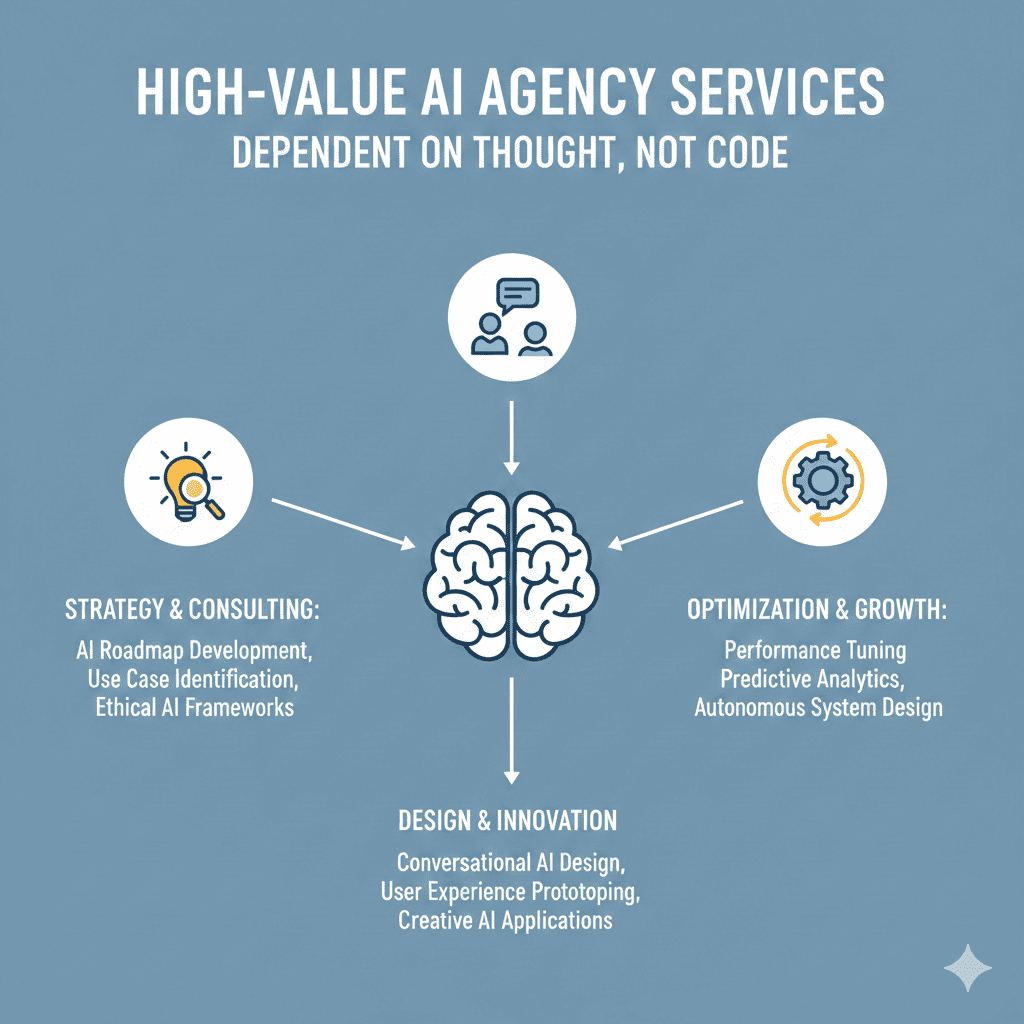
The AI agency landscape is experiencing a seismic shift. While countless agencies compete on technical implementation—racing to master the latest models, frameworks, and coding techniques—the truly lucrative opportunities lie elsewhere. The highest-paid AI consultants aren’t necessarily the best programmers. They’re the best thinkers.
This distinction is critical and increasingly valuable. As AI tools become more accessible and coding becomes partially automated by AI itself, technical skills alone no longer command premium rates. What clients desperately need—and will pay extraordinarily well for—are high-value AI agency services that solve complex strategic, organizational, and decision-making challenges.
This comprehensive guide reveals the most profitable AI services that depend primarily on strategic thinking, business acumen, and consultative expertise rather than coding prowess. These services command premium pricing, face less competition, and build deeper client relationships than pure implementation work.
1. AI Strategy and Roadmap Development
The most valuable service you can provide isn’t building AI systems—it’s helping organizations determine which AI initiatives to pursue and in what sequence.
Why strategic planning commands premium fees
Most organizations are overwhelmed by AI possibilities. They see competitors implementing AI, read about transformative applications, and feel pressure to “do something with AI”—but lack clarity on where to start. This confusion creates decision paralysis that high-value AI agency services resolve through systematic strategic planning.
Strategic consulting commands $15,000-$50,000+ per engagement because it directly impacts millions in capital allocation. A clear roadmap prevents wasted investment in wrong-fit solutions while accelerating returns from correctly prioritized initiatives.
Components of comprehensive AI strategy services
Effective AI strategy engagements include current state assessment of existing capabilities and data, competitive analysis of AI adoption in their industry, opportunity identification across business functions, feasibility analysis considering technical and organizational readiness, prioritization framework balancing impact and complexity, detailed roadmap with phased implementation timeline, resource and budget planning, and risk assessment with mitigation strategies.
The deliverable isn’t code—it’s a strategic document that guides years of AI investment and organizational transformation.
Delivering strategic value without technical implementation
You don’t need to code a single line to deliver extraordinary strategic value. Your expertise lies in asking the right questions, identifying high-impact opportunities, understanding organizational constraints, evaluating vendor solutions objectively, and translating business objectives into AI initiatives.
Clients value this perspective because internal teams are often too close to problems or too focused on specific technologies to see the bigger picture clearly.
Structuring strategy engagements profitably
Offer strategy services as distinct engagements separate from implementation. A typical structure includes discovery phase with stakeholder interviews and data assessment, analysis phase developing options and recommendations, presentation phase delivering roadmap and recommendations, and optional ongoing advisory to guide execution.
Price these engagements based on organizational size and complexity, not time invested. A strategy that guides $2 million in AI investment easily justifies $40,000+ in consulting fees.
2. AI Vendor Selection and Procurement Consulting
Organizations face dizzying arrays of AI vendors, platforms, and solutions. Helping them navigate procurement decisions represents one of the most impactful high-value AI agency services you can offer.
The vendor selection challenge
Every AI category—from customer service automation to predictive analytics—has dozens of competing solutions. Marketing materials all promise transformative results. Sales presentations are persuasive but lack objective comparison. Internal teams often lack experience evaluating complex AI solutions.
Wrong vendor selections cost organizations hundreds of thousands in failed implementations, lost productivity, and sunk switching costs. Your expertise preventing these mistakes is extraordinarily valuable.
Creating objective vendor evaluation frameworks
Develop comprehensive evaluation frameworks covering functional capabilities aligned with requirements, technical architecture and integration considerations, data requirements and compatibility, scalability and performance characteristics, security and compliance features, vendor stability and market position, total cost of ownership analysis, implementation complexity and timeline, and support and training quality.
These frameworks bring objectivity to emotional decisions and create defensible procurement processes that satisfy stakeholders and compliance requirements.
Running competitive vendor evaluations
Manage the entire vendor selection process including defining clear requirements, issuing detailed RFPs to qualified vendors, conducting vendor demonstrations with consistent evaluation criteria, facilitating proof of concept testing, negotiating terms and pricing, and making final recommendations with detailed justification.
This consultative service requires business acumen, negotiation skills, and AI market knowledge—not programming ability.
Pricing procurement consulting
Charge either fixed fees for complete vendor selection processes ($25,000-$75,000 depending on complexity) or percentage of avoided costs/negotiated savings. Many clients happily pay substantial fees when you help them avoid six-figure mistakes or negotiate significantly better terms.
3. AI Use Case Discovery and Opportunity Assessment
Organizations often can’t see their own best AI opportunities. They’re too embedded in current processes to recognize transformative possibilities. High-value AI agency services that identify high-impact use cases create disproportionate value.
Systematic opportunity identification
Rather than asking clients what they want automated, conduct comprehensive discovery that examines repetitive high-volume processes, decisions made with incomplete information, bottlenecks limiting scale or speed, manual analysis of large datasets, customer experience friction points, and revenue opportunities from better predictions or personalization.
This investigative work uncovers opportunities clients never considered but immediately recognize as valuable.
Quantifying opportunity value
Transform identified opportunities into business cases showing cost savings from efficiency gains, revenue increases from improved capabilities, risk reduction from better detection or compliance, competitive advantages from faster or smarter operations, and customer satisfaction improvements with measurable business impact.
These quantified business cases justify AI investments and position your agency as a strategic partner understanding business outcomes, not just technical possibilities.
Prioritization and sequencing recommendations
Identifying fifty opportunities is overwhelming. Your value comes from prioritizing them intelligently considering implementation complexity, organizational readiness, data availability, expected ROI and payback period, strategic importance, and interdependencies between initiatives.
Recommend a specific sequence that builds capability progressively, demonstrates value quickly, and sets foundation for more ambitious initiatives.
Packaging discovery services
Offer discovery as standalone engagement or first phase of longer relationships. A typical discovery engagement spans 2-4 weeks including stakeholder interviews, process observations, data assessment, opportunity analysis, and final presentation with prioritized recommendations.
Charge $20,000-$60,000 for comprehensive discovery depending on organizational complexity. Position this investment as insurance against pursuing wrong initiatives.
4. AI Ethics, Governance, and Compliance Advisory
As AI regulation intensifies and reputational risks grow, organizations desperately need guidance on responsible AI deployment. This creates premium opportunities for high-value AI agency services focused on governance and ethics.
The growing demand for AI governance
Recent legislation like the EU AI Act, increasing regulatory scrutiny, high-profile AI failures and bias incidents, and heightened consumer sensitivity about AI create urgent need for governance expertise. Organizations implementing AI without proper governance frameworks face legal, reputational, and operational risks.
Developing AI governance frameworks
Help organizations create comprehensive governance structures including clear policies for AI development and deployment, decision-making processes for AI initiatives, oversight committees and accountability structures, documentation requirements and audit trails, bias detection and mitigation procedures, privacy protection and data handling standards, and incident response protocols for AI failures.
These frameworks protect organizations while enabling confident AI adoption. They’re essentially “permission structures” that let organizations move forward with AI while managing risk appropriately.
Conducting AI ethics assessments
Evaluate existing or planned AI systems for fairness and bias across demographic groups, transparency and explainability of decisions, privacy implications and data protection, potential for misuse or harm, alignment with organizational values, and compliance with emerging regulations.
Deliver detailed assessment reports identifying risks, recommending mitigations, and documenting due diligence for audit and compliance purposes.
Providing ongoing compliance monitoring
As regulations evolve, organizations need ongoing guidance staying compliant. Offer advisory retainers providing regulatory monitoring and updates, policy updates reflecting new requirements, periodic system audits and assessments, training for teams on governance requirements, and incident investigation and remediation support.
These ongoing relationships generate recurring revenue while positioning you as essential trusted advisor on critical risk management.
5. AI Change Management and Organizational Readiness
Technical implementation is only half the challenge—maybe less. The bigger challenge is organizational adoption. High-value AI agency services that address human and cultural dimensions command premium pricing because they determine actual business impact.
Why organizations fail at AI adoption
Most AI initiatives fail not from technical problems but from organizational resistance, lack of skills and training, misaligned incentives and workflows, poor communication about changes, and leadership not modeling adoption. Without addressing these human factors, even excellent technical implementations deliver minimal value.
Assessing organizational readiness
Before major AI initiatives, assess organizational readiness across leadership commitment and understanding, cultural openness to change and automation, existing technical capabilities and literacy, data maturity and availability, process documentation and clarity, and change management capacity.
This readiness assessment identifies gaps that must be addressed for successful adoption and informs implementation planning.
Developing comprehensive change management plans
Create detailed plans covering stakeholder communication strategies, training programs for different user groups, workflow redesign to incorporate AI capabilities, incentive alignment to encourage adoption, champions and support networks, feedback mechanisms and iteration processes, and success metrics beyond technical performance.
These plans provide implementation roadmaps addressing the full sociotechnical system, not just the technology component.
Facilitating organizational transformation
Some engagements require ongoing facilitation including conducting stakeholder workshops, training delivery and train-the-trainer programs, change champion development and support, resistance identification and resolution, leadership coaching on driving adoption, and progress monitoring with intervention recommendations.
This consultative, hands-on support ensures AI investments deliver intended business value rather than becoming shelfware.
6. AI Data Strategy and Architecture Consulting
Data is the foundation of effective AI, yet most organizations have data challenges that block AI success. Strategic data consulting represents lucrative high-value AI agency services requiring analytical thinking rather than programming.
Diagnosing data readiness gaps
Assess current data landscape including what data exists and where it’s stored, data quality and completeness issues, accessibility and integration challenges, governance and ownership clarity, and compliance with privacy regulations.
Most organizations discover significant gaps between their data reality and AI requirements. Identifying these gaps early prevents failed AI initiatives.
Developing AI-ready data strategies
Create comprehensive strategies covering data collection priorities for AI applications, integration architectures connecting disparate sources, quality improvement processes and standards, governance frameworks defining ownership and access, infrastructure and tooling recommendations, and team development for data capabilities.
These strategies provide multi-year roadmaps transforming data from liability into strategic asset.
Designing data architectures for AI
Recommend specific architectural approaches considering centralized data warehouses versus distributed access, real-time versus batch processing requirements, cloud versus on-premise considerations, and scalability to support growing AI adoption.
You’re not building these systems—you’re designing the blueprint and guiding architectural decisions that implementation teams execute.
Creating data governance frameworks
Help organizations establish clear data ownership and stewardship, access controls and security policies, quality standards and monitoring, metadata management, regulatory compliance procedures, and ethical use guidelines.
Strong data governance enables confident AI deployment while managing risk appropriately.
7. AI Business Model Innovation Consulting
The highest-value consulting doesn’t optimize existing operations—it envisions entirely new business models enabled by AI. This transformative work represents premium high-value AI agency services that reshape organizations.
Identifying AI-enabled business model opportunities
Explore how AI could enable new revenue streams, change pricing or monetization approaches, create network effects or platform dynamics, disrupt industry value chains, or fundamentally alter competitive positioning.
This requires deep understanding of both AI capabilities and business model innovation, making it rare and valuable expertise.
Facilitating business model workshops
Conduct structured workshops using frameworks like Business Model Canvas adapted for AI capabilities. Guide leadership teams exploring questions like what currently impossible services could AI enable, how could AI change unit economics to make new models viable, what data assets could become monetizable products, and how might AI shift where value is captured in the value chain.
These facilitated sessions generate breakthrough ideas that internal teams, focused on operational demands, rarely consider independently.
Developing business cases for new models
Transform conceptual business model ideas into detailed business cases including market sizing and opportunity quantification, competitive analysis and positioning, required capabilities and investments, financial projections and sensitivity analysis, implementation roadmap and milestones, and risk assessment with mitigation strategies.
These business cases help organizations evaluate transformative opportunities with same rigor as operational improvements.
Guiding business model experimentation
Help organizations test new AI-enabled models through minimum viable products, pilot programs with selected customers, partnership exploration, or strategic acquisition assessment.
Provide ongoing advisory as experiments yield data, helping interpret results and determine whether to scale, pivot, or abandon initiatives.
8. AI Ecosystem and Partnership Strategy
Few organizations can build all required AI capabilities internally. Strategic partnership and ecosystem development represents critical high-value AI agency services that accelerate AI adoption.
Mapping AI ecosystem opportunities
Identify potential partnerships including technology vendors providing AI platforms, data providers with complementary datasets, implementation partners with specialized expertise, academic institutions for research collaboration, industry consortiums sharing best practices, and startup partnerships for innovation access.
Create visual ecosystem maps showing how different partnerships advance specific strategic objectives.
Developing partnership strategies
Create frameworks for partnership evaluation, target partner identification and prioritization, value proposition development for each partner type, governance structures for partnerships, and risk management for dependencies.
These strategies help organizations build AI capabilities faster and more cost-effectively than pure internal development while managing partnership risks.
Facilitating partnership negotiations
Guide partnership discussions including defining mutual value creation, negotiating terms and governance, structuring intellectual property agreements, establishing success metrics and review processes, and creating sustainable relationship management.
Your role is strategic facilitator and advisor, not lawyer—you help frame discussions and evaluate proposals, not draft contracts.
Building ecosystem programs
Some organizations need comprehensive ecosystem programs including partner recruitment and onboarding, enablement and training programs, co-innovation initiatives, and partner success management.
Design these programs to leverage external innovation and scale faster than competitors while maintaining strategic control.
9. AI Risk Assessment and Mitigation Planning
As AI deployments grow, so do risks—technical, operational, reputational, and strategic. Comprehensive risk management represents essential high-value AI agency services protecting organizational interests.
Identifying AI-specific risks
Assess risks across multiple dimensions including model accuracy and reliability failures, bias and fairness problems, privacy and security vulnerabilities, regulatory compliance exposure, reputational damage from AI mistakes, operational dependencies on AI systems, and competitive risks from AI strategy missteps.
Comprehensive risk identification prevents blindspots that lead to costly incidents.
Quantifying risk exposure
Help organizations understand not just that risks exist but their potential impact and likelihood. Develop risk registers showing probability of occurrence, potential financial impact, reputational consequences, and current mitigation status.
This quantification enables rational risk management decisions balancing protection costs against exposure.
Developing risk mitigation strategies
Create specific mitigation approaches for identified risks including technical controls and safeguards, process changes and oversight mechanisms, insurance and financial hedging, contractual protections with vendors, and incident response planning.
Effective mitigation reduces risk to acceptable levels without blocking AI innovation entirely.
Establishing ongoing risk monitoring
Help organizations build continuous risk monitoring including leading indicator tracking, regular system audits, vendor risk monitoring, regulatory change tracking, and incident reporting and analysis.
Ongoing monitoring ensures risks stay managed as AI deployments evolve and external environment changes.
10. AI Investment Portfolio Management
Organizations pursuing multiple AI initiatives need portfolio management approaches balancing innovation, risk, and resource allocation. This strategic oversight represents premium high-value AI agency services typically reserved for enterprise clients.
Creating AI initiative portfolios
Help organizations view their AI investments as portfolios requiring balance across short-term wins versus long-term transformation, proven technologies versus experimental approaches, efficiency improvements versus growth initiatives, and different business units and functions.
Portfolio thinking prevents over-concentration in any single area and ensures balanced AI advancement.
Developing portfolio governance
Establish governance structures for portfolio management including investment committees with clear decision authority, stage-gate processes for initiative approval and continuation, resource allocation frameworks, performance measurement and reporting, and portfolio rebalancing processes.
These structures bring discipline to AI investment preventing ad-hoc decision-making and misallocated resources.
Managing portfolio performance
Provide ongoing portfolio management including tracking initiative progress against milestones, identifying underperforming initiatives requiring intervention, recommending resource reallocation, surfacing portfolio-level insights and patterns, and facilitating portfolio review meetings.
This continuous oversight ensures AI investments deliver intended strategic value.
Optimizing portfolio returns
Actively work to improve portfolio performance through identifying synergies between initiatives, recommending initiative combination or termination, suggesting new initiatives filling portfolio gaps, and rebalancing toward higher-return opportunities.
Your strategic perspective across the entire portfolio creates value no individual initiative owner can provide.
Positioning Your Agency for Strategic Success
Successfully delivering high-value AI agency services requires positioning yourself as strategic advisor rather than technical implementer.
Building consultative selling skills
Learn to sell outcomes and insights rather than deliverables and hours. Frame conversations around business impact rather than technical features. Ask questions that uncover strategic challenges rather than rushing to solutions. Position yourself as peer to executive buyers, not vendor to procurement.
Developing business acumen
Deepen your understanding of business strategy, financial analysis, organizational behavior, change management, and industry-specific dynamics. Read business publications, take strategy courses, study successful consultancies, and immerse yourself in client industries.
The more you understand business challenges, the more valuable your AI expertise becomes.
Creating thought leadership positioning
Establish yourself as strategic thinker through publishing articles on AI strategy topics, speaking at business conferences not just tech events, participating in executive roundtables, and building advisory relationships with business leaders.
This visibility attracts strategic engagements rather than technical implementation requests.
Pricing based on value not time
Abandon hourly billing for strategic services. Price based on decision value, risk reduction, or strategic impact. A strategy that prevents a $500,000 mistake or identifies a $2 million opportunity easily justifies $75,000+ in consulting fees regardless of hours invested.
Value-based pricing aligns your incentives with client outcomes and appropriately captures the strategic value you deliver.
Making the Transition
If you’ve been positioning as technical implementer, transitioning to strategic advisor requires deliberate steps.
Start by analyzing which past projects involved strategic thinking beyond implementation. Extract case studies highlighting business impact rather than technical achievements. Rewrite your positioning to emphasize strategic value. Develop frameworks and methodologies for your strategic services. Create educational content demonstrating strategic thinking. Reach out to past clients offering strategic review sessions.
Target your first few strategic engagements with existing clients who trust your capabilities. Use these projects to develop refined processes, create compelling case studies, and build confidence in consultative delivery.
As you successfully deliver strategic value, your positioning naturally shifts. Clients begin engaging you earlier in their decision processes, asking strategic questions rather than technical ones, and referring you for higher-level challenges.
The Strategic Opportunity
The AI industry is maturing beyond pure technical implementation. As tools become more accessible and technical skills commoditize, strategic thinking becomes the scarce, valuable capability.
Organizations drowning in AI possibilities need guides helping them navigate strategic decisions, avoid costly mistakes, and maximize AI investment returns. They’ll pay premium rates for this guidance because strategic mistakes cost millions while strategic wins create sustainable competitive advantages.
The high-value AI agency services outlined here represent the future of profitable AI consulting. They leverage your AI expertise while requiring strategic thinking, business acumen, and consultative skills that won’t be automated away.
Technical implementation will always be necessary, but it’s becoming commodity work suitable for delegation to specialists or eventually automated by AI itself. Strategic thinking—understanding which problems to solve, how to navigate organizational complexity, and where to invest for maximum impact—remains distinctly human and extraordinarily valuable.
The question is whether you’ll position your agency to capture this strategic value or remain competing on technical implementation that faces increasing margin pressure. The opportunity is clear, the demand is growing, and the time to transition is now.
Your AI expertise is valuable, but your strategic thinking about how organizations should leverage AI is transformative. Build your agency around that higher-value proposition, and you’ll command premium pricing while building deeper, more sustainable client relationships. The choice, and the significant rewards that follow, is entirely yours to pursue.
Also read this:
Recurring Revenue for AI Agencies: How to Create Predictable Monthly Income
How to Build Authority as a Niche AI Agency (Step-by-Step Strategy)
Selling AI Services as an Agency: The Complete Client-Acquisition Playbook