
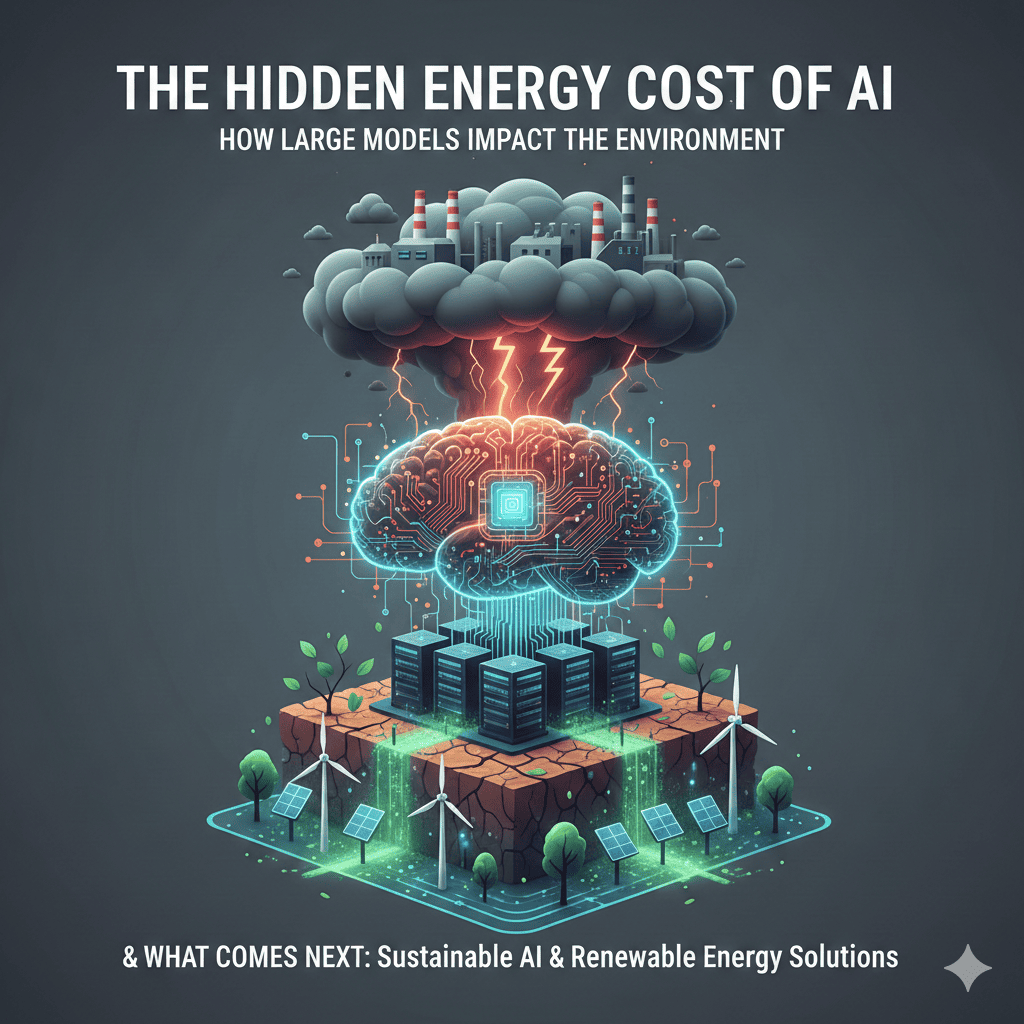
hidden energy cost of AI Artificial intelligence has become the defining technology of our era, powering everything from smartphone assistants to autonomous vehicles and medical diagnostics. Yet beneath the surface of this revolutionary technology lies an uncomfortable truth that few discuss openly: the hidden energy cost of AI threatens to undermine global sustainability efforts just as these models become indispensable to modern life.
Every time you interact with ChatGPT, generate an image with Midjourney, or use AI-powered features in your favorite applications, you’re initiating a chain of computational processes that consume substantial electrical power. The data centers housing these AI models draw electricity equivalent to small cities, generating carbon emissions that rival entire industries. Understanding the hidden energy cost of AI has become essential for technologists, policymakers, and consumers alike as we navigate the tension between technological progress and environmental responsibility.
This deep dive examines the true environmental impact of artificial intelligence, from training massive models to serving billions of daily queries. We’ll explore concrete data on energy consumption, investigate why AI proves so power-hungry, and analyze emerging solutions that could make artificial intelligence sustainable. The future of AI depends not just on making models smarter, but on confronting and solving the hidden energy cost of AI before it becomes environmentally catastrophic.
1. The Staggering Numbers Behind AI Energy Consumption
Quantifying the hidden energy cost of AI requires examining both the training phase, where models learn from vast datasets, and the inference phase, where deployed models respond to user queries billions of times daily.
Training Large Language Models
The process of training state-of-the-art AI models consumes extraordinary amounts of energy, often equivalent to the annual electricity use of hundreds of homes.
GPT-3 and GPT-4 Training Costs
When OpenAI trained GPT-3 in 2020, the process consumed approximately 1,287 megawatt-hours of electricity. To put this in perspective, that’s enough energy to power 120 average American homes for an entire year. The carbon footprint of this single training run equaled roughly 552 metric tons of CO2, equivalent to driving a gasoline car 1.4 million miles.
hidden energy cost of AI GPT-4’s training, while not publicly disclosed in detail, likely consumed significantly more energy given the model’s increased size and capabilities. Industry estimates suggest training costs exceeded 10,000 megawatt-hours, with carbon emissions potentially reaching 5,000 metric tons or more. This represents the climate impact of approximately 1,000 Americans’ annual carbon footprints concentrated into a single training run lasting several months.
Large Vision Models and Multimodal Systems
Computer vision models and multimodal AI systems present their own energy challenges. Training models like DALL-E 2, Stable Diffusion, and Google’s Imagen requires processing billions of image-text pairs across thousands of GPUs running continuously for weeks.
A large-scale image generation model might consume 2,000 to 5,000 megawatt-hours during training. The computational intensity of processing high-resolution images makes these models particularly energy-intensive, with carbon footprints potentially exceeding 1,000 metric tons per training run.
The Cumulative Training Impact
The AI industry doesn’t train just one model. Companies continuously develop, test, and refine dozens or hundreds of experimental models before settling on final versions. Each failed experiment, each hyperparameter search, and each incremental improvement adds to the cumulative energy burden.
When accounting for all experimental runs, failed attempts, and iterative refinements, the true energy cost of bringing a single flagship model to market may be ten to fifty times higher than the final training run alone. This means the real carbon footprint of major AI systems could reach tens of thousands of metric tons before the model ever serves a single user query.
Inference and Operational Energy Costs
While training captures attention due to dramatic numbers, the ongoing hidden energy cost of AI from inference operations ultimately dwarfs training expenses as models scale to billions of users.
Query Processing Energy Demands
Each individual ChatGPT query consumes approximately 0.0029 kilowatt-hours of electricity, roughly equivalent to leaving a LED light bulb on for three minutes. This seems negligible until you consider scale: with an estimated 10 million daily active users generating multiple queries each, ChatGPT alone may consume over 500 megawatt-hours daily, or roughly 180,000 megawatt-hours annually.
That annual inference energy equals the electricity consumption of approximately 16,000 American homes. And ChatGPT represents just one AI service among thousands now operating globally.
Data Center Infrastructure Overhead
The direct computational energy for processing queries tells only part of the story. Data centers housing AI models require massive supporting infrastructure that adds substantial overhead to the hidden energy cost of AI.
Cooling systems to prevent server overheating typically consume 30 to 50 percent additional energy beyond the computing hardware itself. In hot climates, cooling can equal or exceed the power draw of the servers. Power conversion losses, backup systems, networking equipment, and facility operations add another 20 to 40 percent overhead.
When accounting for full infrastructure, the total energy consumption for AI operations may be 1.5 to 2 times the direct computational load. This means that 500 megawatt-hours of computing could require 750 to 1,000 megawatt-hours total facility energy.
Geographic Carbon Intensity Variations
Not all AI energy consumption creates equal environmental impact. The carbon footprint depends heavily on the electricity grid powering each data center.
AI operations in regions with clean energy grids, like Iceland with its geothermal power or Norway with hydroelectric dominance, produce minimal carbon emissions per megawatt-hour. The same computation in coal-dependent regions like certain parts of China or Eastern Europe might generate ten to twenty times more carbon emissions.
hidden energy cost of AI Major AI companies strategically locate data centers in low-carbon regions, but rapid scaling often forces expansion into higher-carbon areas where capacity exists. This geographic reality means the carbon intensity of AI operations varies dramatically and can worsen as demand outpaces renewable energy availability.
2. Why AI Consumes So Much Energy
Understanding the hidden energy cost of AI requires examining the technical reasons why artificial intelligence proves so computationally intensive compared to other software.
The Mathematics of Neural Networks
Modern AI relies on artificial neural networks containing billions of parameters that must perform trillions of mathematical operations for each task.
Matrix Multiplication Intensity
At the heart of neural networks lies matrix multiplication, where large arrays of numbers are multiplied and combined. Processing a single image through a vision model might require hundreds of billions of individual multiplication and addition operations. Language models performing text generation execute similar volumes of calculations for each word produced.
These mathematical operations require specialized hardware, primarily graphics processing units originally designed for rendering video game graphics. While GPUs efficiently handle parallel mathematical operations, they consume substantial power, with high-end AI accelerators drawing 300 to 700 watts continuously during operation.
Parameter Count Escalation
AI capabilities generally improve with model size, driving relentless parameter count growth. GPT-2 contained 1.5 billion parameters in 2019. GPT-3 expanded to 175 billion parameters by 2020. Current frontier models may contain over a trillion parameters, each requiring memory storage and computational manipulation.
More parameters mean more calculations per inference, more memory bandwidth required, and ultimately more energy consumed. The relationship isn’t perfectly linear, but doubling model size typically increases energy consumption by 50 to 100 percent for equivalent tasks.
Attention Mechanism Complexity
The transformer architecture powering modern language models uses attention mechanisms that compare every word against every other word in the context. For a prompt containing 1,000 words, the model performs approximately one million comparison operations just for the attention component.
As context windows expand to handle longer documents, attention calculations scale quadratically. A model processing 10,000 words requires one hundred million attention comparisons, consuming proportionally more energy. This quadratic scaling makes long-context processing particularly energy-intensive.
Hardware Limitations and Efficiency Gaps
Current computing hardware wasn’t optimized for AI workloads, creating inefficiencies that amplify the hidden energy cost of AI.
Memory Bandwidth Bottlenecks
Modern AI operations are often memory-bound rather than compute-bound, meaning the limiting factor is moving data between memory and processors rather than calculation speed itself. This data movement consumes substantial energy, sometimes exceeding the energy required for the actual calculations.
High-bandwidth memory systems required for large models draw significant power. Memory access for a single large language model inference might consume 40 to 60 percent of total energy, with the actual mathematical operations accounting for the remainder.
Underutilized Specialized Hardware
While GPUs and specialized AI accelerators offer better efficiency than general-purpose CPUs, they’re still far from theoretical optimal efficiency. Current hardware achieves perhaps 20 to 40 percent of theoretical maximum performance for typical AI workloads.
This inefficiency gap means AI operations consume three to five times more energy than theoretically necessary, even with specialized hardware. Closing this gap represents a major opportunity for reducing the hidden energy cost of AI without sacrificing capability.
Cooling Requirements for Dense Computing
The concentration of computational power in AI data centers creates intense heat that must be continuously removed. A single AI server rack might generate 30 to 50 kilowatts of heat, requiring sophisticated cooling systems.
Traditional air cooling becomes inadequate for these densities, forcing adoption of liquid cooling and other advanced thermal management techniques. These systems add complexity, cost, and energy overhead that wouldn’t exist for less computationally intensive workloads.
Software and Algorithmic Inefficiencies
Beyond hardware limitations, software design choices and algorithmic approaches contribute substantially to AI’s energy demands.
Overparameterization for Safety Margins
AI developers often design models larger than strictly necessary to ensure robust performance across diverse scenarios. This overparameterization provides safety margins against unexpected inputs but increases energy consumption for all operations.
A model with 70 billion parameters might achieve similar core performance to a carefully optimized 40 billion parameter model, but it consumes 75 percent more energy per inference. The industry’s bias toward larger models exacerbates energy costs.
Redundant Computation in Generation
Language models generate text one word at a time, requiring separate computational passes for each word. Generating a 500-word response requires 500 sequential inference operations, each processing the entire conversation context plus all previously generated words.
This sequential generation means computation grows quadratically with response length. A 500-word response might require 250,000 attention operations, consuming substantially more energy than the equivalent number of operations in a single batch.
Inefficient Deployment Patterns
Many AI deployments maintain models loaded in memory continuously, even during idle periods, consuming baseline energy regardless of actual usage. Poor load balancing, inefficient batching of requests, and suboptimal model serving infrastructure waste energy through operational inefficiency rather than inherent technical limitations.
3. Comparing AI to Other Technology Infrastructure
Contextualizing the hidden energy cost of AI against other technological systems helps assess its relative environmental impact and urgency.
AI Versus Cryptocurrency Mining
Cryptocurrency mining, particularly Bitcoin, has faced intense scrutiny for energy consumption, providing a useful comparison point for understanding AI’s impact.
Absolute Energy Consumption Comparison
Bitcoin mining currently consumes approximately 150 terawatt-hours annually, roughly equivalent to the electricity consumption of Argentina or the Netherlands. This represents one of the largest technology-driven energy demands globally.
Current estimates suggest global AI inference consumes approximately 20 to 40 terawatt-hours annually, significantly less than cryptocurrency mining but growing at 40 to 60 percent annually. At current growth rates, AI could match cryptocurrency’s energy footprint within three to five years.
Growth Trajectories and Future Projections
Bitcoin’s energy consumption has stabilized somewhat as mining difficulty adjusts and efficiency improvements offset growth. AI energy consumption, conversely, shows no signs of stabilization, with exponential growth driven by expanding use cases and improving capabilities attracting more users.
If AI adoption and capability growth continue current trajectories, the technology could consume 150 to 300 terawatt-hours annually by 2030, potentially exceeding cryptocurrency as the single largest technology-driven energy demand globally.
Societal Value Considerations
While both AI and cryptocurrency consume substantial energy, AI arguably provides broader societal value through productivity improvements, medical advances, scientific research acceleration, and accessibility enhancements. This doesn’t negate environmental concerns but contextualizes them within broader cost-benefit analysis.
AI Versus Traditional Data Centers
Comparing AI-specific energy demands to general data center operations illuminates how AI changes the technology sector’s environmental footprint.
Data Center Energy Evolution
Traditional data centers globally consume approximately 200 to 300 terawatt-hours annually, roughly one percent of global electricity demand. This includes all cloud computing, web hosting, enterprise systems, and digital services.
AI workloads currently represent 10 to 15 percent of total data center energy but are projected to reach 30 to 40 percent within five years as AI capabilities embed throughout digital infrastructure. This shift dramatically changes data center energy profiles and sustainability strategies.
Efficiency Trends in Traditional Computing
Traditional data center workloads have seen consistent efficiency improvements, with Power Usage Effectiveness declining from 2.5 in early facilities to 1.1 to 1.3 in modern efficient centers. Cloud consolidation and virtualization have further reduced energy per unit of computing.
AI workloads haven’t followed the same efficiency trajectory. The computational intensity and specialized hardware requirements for AI mean efficiency gains from consolidation and virtualization provide smaller benefits. The hidden energy cost of AI grows even as traditional computing becomes more efficient.
AI Versus Consumer Electronics
Examining AI energy consumption against familiar consumer devices provides intuitive perspective on scale and impact.
Smartphone Comparison Context
A typical smartphone consumes approximately 2 to 5 kilowatt-hours annually for charging. Running AI models locally on smartphones adds minimal energy consumption due to efficient mobile processors and limited computation.
However, cloud-based AI services accessed through smartphones shift energy consumption to data centers. A heavy ChatGPT user might trigger 50 to 100 kilowatt-hours of data center energy annually, equivalent to 20 to 50 smartphones’ worth of electricity, despite the seamless user experience suggesting minimal resource use.
Home Device Energy Footprints
AI-powered smart home devices, voice assistants, and IoT sensors consume minimal energy locally but aggregate to substantial cloud processing demands. Amazon Echo devices individually consume perhaps 10 kilowatt-hours annually, but the cloud AI processing for voice recognition and response generation for millions of devices creates significant cumulative load.
The distributed nature of AI applications obscures the concentrated energy impact in data centers, making the hidden energy cost of AI literally invisible to end users who see only efficient local devices.
4. Environmental Impact Beyond Carbon Emissions
The hidden energy cost of AI extends beyond electricity consumption and carbon emissions to encompass water usage, electronic waste, and resource extraction.
Water Consumption for Cooling
Data centers rely heavily on water for cooling systems, creating substantial freshwater demands that stress local resources.
Direct Water Usage in Cooling Systems
Modern data centers consume approximately 1 to 5 liters of water per kilowatt-hour for cooling, depending on climate and cooling technology. AI data centers with their high heat density often fall on the higher end of this range.
A large AI data center consuming 50 megawatts continuously might use 2 to 10 million liters of water daily, equivalent to the water consumption of 20,000 to 100,000 people. In water-scarce regions, this creates competition with residential and agricultural water needs.
Geographic Water Stress Considerations
AI companies often locate data centers in regions with favorable electricity costs or low-carbon grids, sometimes without adequate consideration of water availability. Facilities in desert regions or areas facing water scarcity exacerbate local resource challenges.
The hidden water cost of AI training a single large model might equal 500,000 to 1,000,000 liters when accounting for both direct data center usage and power plant cooling for electricity generation. This water footprint rarely appears in environmental impact assessments.
Alternative Cooling Technologies
Some facilities adopt air cooling or closed-loop systems that reduce water consumption but increase energy usage or capital costs. The trade-offs between water conservation and energy efficiency complicate efforts to minimize AI’s environmental footprint across multiple dimensions simultaneously.
Electronic Waste from Rapid Hardware Obsolescence
AI’s breakneck pace creates constant hardware refresh cycles that generate substantial electronic waste.
GPU and Accelerator Replacement Cycles
AI hardware typically sees operational lifespans of just 3 to 5 years before performance improvements in newer generations make replacement economically compelling. Unlike general-purpose servers that might operate for 7 to 10 years, AI-specific hardware becomes economically obsolete faster.
A large AI data center might generate hundreds of tons of electronic waste every few years as it replaces GPUs and accelerators. While some components can be repurposed or recycled, specialized AI hardware often contains exotic materials and complex designs that complicate recycling efforts.
Embedded Carbon in Manufacturing
Manufacturing AI accelerators and high-performance GPUs requires substantial energy and creates significant carbon emissions before the hardware even operates. The embedded carbon in a high-end AI accelerator might equal 500 to 1,000 kilograms of CO2, equivalent to several thousand miles of car travel.
Rapid obsolescence means this manufacturing carbon gets amortized over shorter operational periods, increasing the per-computation carbon intensity. The full lifecycle carbon footprint of AI includes not just operational energy but also manufacturing and disposal impacts.
Resource Extraction and Supply Chain Impacts
The rare earth elements and specialized materials required for AI hardware create environmental and social impacts in mining regions.
Rare Earth Element Dependencies
AI accelerators require rare earth elements including neodymium, dysprosium, and terbium for specialized components. Mining these materials creates significant environmental disruption, including soil contamination, water pollution, and habitat destruction.
The geopolitical concentration of rare earth mining in a few regions creates supply chain vulnerabilities while concentrating environmental impacts in specific localities, often in developing nations with less stringent environmental regulations.
Semiconductor Manufacturing Footprint
Fabricating advanced semiconductors for AI requires extremely pure materials, cleanroom environments, and chemical processes that consume enormous quantities of water and energy while generating hazardous waste. A single semiconductor fabrication facility might use 10 to 20 million gallons of water daily.
As AI drives demand for cutting-edge chips, it amplifies these manufacturing environmental impacts. The hidden energy cost of AI encompasses the entire supply chain, not just data center operations.
5. What Leading AI Companies Are Doing
Major AI developers recognize the sustainability challenge and have implemented various strategies to mitigate the hidden energy cost of AI, though progress remains uneven.
Renewable Energy Commitments
Technology giants hosting AI infrastructure have made substantial investments in renewable energy to reduce carbon footprints.
Corporate Power Purchase Agreements
Google, Microsoft, Amazon, and Meta have committed to operating on 100 percent renewable energy, collectively purchasing tens of gigawatts of wind and solar capacity through long-term power purchase agreements. These investments represent billions in capital deployed toward clean energy infrastructure.
However, renewable procurement doesn’t always match instantaneous consumption. Data centers consume power 24/7, while solar generates only during daylight and wind varies with weather. Companies often use renewable energy credits to account for mismatches between generation and consumption timing, drawing grid power that may come from fossil fuels when renewables aren’t generating.
On-Site Generation and Storage
Some facilities incorporate on-site solar arrays and battery storage to directly power operations with renewables. These installations provide genuine carbon reduction but require substantial space and capital investment that limits deployment scalability.
The intermittency challenge remains substantial. Even with batteries, renewable-powered data centers typically require grid connections as backup, limiting the ability to claim 100 percent renewable operation at all times.
Efficiency Innovations and Model Optimization
AI companies are investing in techniques to reduce the computational intensity and energy requirements of model training and inference.
Model Compression Techniques
Researchers have developed methods including pruning, quantization, and distillation that reduce model size and computational requirements while preserving most capabilities. These techniques can reduce inference energy by 50 to 90 percent with acceptable performance trade-offs.
Quantization, which reduces numerical precision from 32-bit to 8-bit or even 4-bit representations, cuts memory bandwidth requirements and energy consumption substantially. Models like Meta’s LLaMA demonstrate that carefully optimized smaller models can match or exceed performance of much larger inefficient models.
Architectural Improvements
New model architectures aim to reduce the quadratic scaling of attention mechanisms. Techniques like sparse attention, linear attention, and hierarchical models reduce computational complexity for long-context processing.
These innovations could reduce the hidden energy cost of AI by 30 to 70 percent for many applications without sacrificing capabilities. However, adoption lags behind research as companies prioritize rapid capability improvements over efficiency optimization.
Inference Optimization
Deploying AI at scale has driven innovations in serving efficiency, including model caching, dynamic batching, and speculative execution. These techniques increase hardware utilization and reduce per-query energy consumption by 20 to 50 percent compared to naive deployment approaches.
Companies like Anthropic, OpenAI, and Google have built sophisticated serving infrastructure that dramatically improves efficiency compared to research implementations, though these optimizations remain proprietary and unavailable to smaller organizations.
Specialized Hardware Development
Custom silicon designed specifically for AI workloads offers substantial efficiency advantages over general-purpose GPUs.
Google’s TPU Evolution
Google’s Tensor Processing Units represent purpose-built AI accelerators optimized for specific workload patterns. TPUs deliver 30 to 80 times better performance per watt than contemporary GPUs for certain AI tasks, dramatically reducing the hidden energy cost of AI for Google’s services.
The latest TPU generations incorporate additional efficiency innovations including liquid cooling, photonic interconnects, and heterogeneous compute architectures that further improve energy efficiency while increasing raw performance.
Other Custom Accelerator Initiatives
Amazon’s Inferentia and Trainium chips, Microsoft’s Azure Maia, and Meta’s MTIA represent similar efforts to optimize silicon specifically for AI workloads. These custom solutions deliver 40 to 60 percent energy savings compared to off-the-shelf GPUs while reducing costs.
However, custom silicon requires enormous upfront investment, with development costs potentially exceeding one billion dollars per generation. Only the largest companies can justify this investment, creating efficiency gaps between tech giants and smaller AI developers.
6. Emerging Solutions and Future Technologies
Addressing the hidden energy cost of AI requires breakthrough innovations across hardware, algorithms, and system architecture.
Next-Generation Hardware Architectures
Novel computing paradigms promise orders-of-magnitude efficiency improvements beyond incremental optimization.
Neuromorphic Computing
Brain-inspired neuromorphic chips mimic biological neural networks’ energy efficiency, potentially reducing AI energy consumption by 100 to 1,000 times. Companies like Intel with Loihi and IBM with TrueNorth have demonstrated neuromorphic systems consuming milliwatts for tasks requiring watts in conventional systems.
These chips use event-driven processing and sparse computation that activates only necessary components, eliminating the constant power draw of traditional architectures. However, neuromorphic computing requires fundamentally different programming models that don’t map cleanly to current AI approaches.
Optical and Photonic Computing
Computing with light instead of electrons offers potential for dramatically lower energy consumption. Photonic chips perform certain mathematical operations using optical interference and diffraction, consuming far less energy than electronic transistors for equivalent calculations.
Research prototypes have demonstrated 100 to 10,000 times better energy efficiency for specific AI operations. Commercial viability remains uncertain, with challenges including integration with electronic systems, manufacturing scalability, and limited programmability compared to electronic computers.
Quantum Machine Learning
Quantum computers exploit quantum mechanical phenomena to perform certain calculations exponentially faster than classical computers. While still experimental, quantum machine learning could potentially train or run certain AI models with vastly reduced energy requirements.
However, current quantum computers require extreme cooling to near absolute zero, consuming significant energy for cryogenic systems. Practical quantum advantage for AI remains theoretical, likely decades away from widespread deployment.
Algorithmic Breakthroughs
Software innovations offer more immediately deployable solutions to reduce the hidden energy cost of AI without hardware replacement.
Sparse Models and Mixture of Experts
Rather than using all parameters for every task, sparse models activate only relevant subsets of the network. Mixture of experts architectures route different inputs to specialized sub-networks, reducing average computational load.
These approaches can reduce inference energy by 60 to 85 percent while maintaining or improving quality. Models like GPT-4 reportedly use mixture of experts techniques to balance capability and efficiency at scale.
Retrieval-Augmented Generation
Instead of encoding all knowledge in model parameters, retrieval-augmented approaches use smaller models that query external knowledge bases. This architecture dramatically reduces model size requirements and associated energy consumption.
Systems combining compact 7 to 20 billion parameter models with efficient retrieval can match capabilities of 100+ billion parameter models while consuming 70 to 90 percent less energy per query. This approach trades storage and retrieval costs for reduced computational intensity.
Continuous Learning and Adaptation
Rather than periodic expensive retraining, continuous learning approaches incrementally update models with new information. This reduces the massive energy spikes from periodic full retraining cycles that contribute substantially to AI’s carbon footprint.
Effective continuous learning remains challenging, with issues including catastrophic forgetting and model drift requiring ongoing research. Successful implementation could reduce training-related energy consumption by 80 to 95 percent.
System-Level Optimization
Beyond individual models, system-wide approaches to AI deployment offer efficiency gains.
Federated Learning and Edge Computing
Training and running models on distributed edge devices rather than centralized data centers reduces data transmission and allows computation powered by local renewable sources. Edge AI also provides privacy benefits alongside energy reduction.
Smartphones and IoT devices with increasingly capable AI accelerators can perform substantial computation locally, reducing cloud energy demands. However, edge computing trades data center efficiency for less efficient but distributed resource utilization.
Model Sharing and Standardization
Rather than every organization training proprietary models, sharing foundation models and fine-tuning for specific needs reduces duplicative energy consumption. Open source models from Meta, Mistral, and others enable this approach.
Industry standardization around model architectures and efficient serving protocols could reduce aggregate energy waste from reinventing similar capabilities repeatedly. However, competitive dynamics and intellectual property concerns limit cooperation.
7. Policy and Regulatory Responses
Governments and international bodies are beginning to address the hidden energy cost of AI through regulation, incentives, and standards.
Emerging Regulatory Frameworks
Policymakers worldwide are developing approaches to ensure AI sustainability alongside safety and ethics considerations.
EU AI Act Energy Provisions
The European Union’s AI Act includes provisions requiring transparency about energy consumption and environmental impact for high-risk AI systems. Developers must document energy efficiency measures and consider environmental sustainability in risk management processes.
While not imposing hard limits, these transparency requirements create pressure for efficiency improvements and enable informed decision-making by AI users and purchasers. Implementation challenges include defining measurement standards and verification mechanisms.
National AI Sustainability Initiatives
Countries including France, Canada, and Japan have launched national AI strategies incorporating sustainability goals. These initiatives fund research into efficient AI, provide incentives for green data centers, and establish voluntary efficiency standards.
Effectiveness varies widely, with programs ranging from modest research grants to comprehensive frameworks linking AI development approval to demonstrated sustainability measures. Coordination across jurisdictions remains limited, creating opportunities for efficiency arbitrage.
Carbon Pricing and Market Mechanisms
Economic instruments offer market-based approaches to incentivize reduced energy consumption and carbon emissions from AI.
Data Center Carbon Taxes
Some jurisdictions have proposed or implemented carbon pricing specifically targeting data center energy consumption. These taxes create direct financial incentives for efficiency improvements and renewable energy adoption.
However, implementation faces challenges including international competitiveness concerns, difficulty distinguishing AI from general computing loads, and political resistance to new taxes on technology infrastructure perceived as economically beneficial.
Renewable Energy Credits and Offsets
Current renewable energy credit markets allow companies to claim green energy use even when consuming fossil fuel power, reducing environmental accountability. Tighter standards requiring temporal and geographic matching of renewable generation to consumption would increase credibility.
Carbon offset markets for AI could fund reforestation, renewable energy projects, or carbon capture, though offset quality and additionality remain contentious issues that undermine confidence in these approaches.
Industry Self-Regulation and Standards
Voluntary industry initiatives complement regulatory approaches with technical standards and best practices.
AI Energy Efficiency Benchmarks
Organizations like MLPerf have established standardized benchmarks measuring AI system performance and energy efficiency. These benchmarks enable objective comparisons and track progress over time.
However, benchmark gaming and optimization specifically for tested scenarios limits real-world applicability. Comprehensive standards covering diverse AI applications and deployment scenarios remain underdeveloped.
Corporate Transparency Initiatives
Some leading AI companies voluntarily publish sustainability reports detailing energy consumption, carbon emissions, and efficiency improvements. This transparency enables stakeholder pressure for continued improvement.
Standardized reporting frameworks would improve comparability and prevent selective disclosure of favorable metrics while obscuring problematic consumption patterns. Current voluntary reporting varies dramatically in methodology and scope.
8. What Users and Organizations Can Do
Individuals and organizations using AI can take practical steps to reduce their contribution to the hidden energy cost of AI while maintaining productivity benefits.
Conscious AI Usage Patterns
User behavior significantly impacts aggregate energy consumption as billions of people interact with AI systems.
Query Efficiency and Intentionality
Using AI purposefully rather than casually reduces unnecessary computation. Crafting clear, specific prompts reduces iteration and regeneration, cutting energy per task completed by 30 to 60 percent.
Avoiding AI for trivial tasks that could be accomplished more efficiently through traditional methods prevents wasteful computation. Not every question requires GPT-4 when web search or simple calculation suffices.
Model Selection and Right-Sizing
When options exist, selecting appropriately sized models for tasks reduces energy waste. Using GPT-3.5 instead of GPT-4 for simple tasks consumes approximately 60 to 75 percent less energy while delivering acceptable results.
Organizations deploying AI should match model capability to task requirements rather than defaulting to the most powerful option for all applications.
Organizational AI Strategy
Enterprises can implement policies and practices that reduce AI environmental impact while capturing productivity benefits.
Sustainability Criteria in Vendor Selection
Including energy efficiency and renewable energy usage in AI vendor evaluation criteria creates market pressure for sustainable practices. Requiring transparency about carbon footprint and efficiency metrics from potential vendors drives industry improvement.
Organizations with significant AI consumption can negotiate renewable energy requirements or carbon neutrality commitments into contracts, leveraging purchasing power for environmental benefit.
Internal Efficiency Standards
Establishing internal guidelines for AI usage, including approval processes for high-consumption applications and efficiency benchmarks for internal AI development, prevents wasteful deployment patterns.
Measuring and reporting AI-related energy consumption as part of corporate sustainability reporting increases accountability and drives continuous improvement.
Supporting Sustainable AI Development
Users can contribute to broader ecosystem development toward more sustainable AI practices.
Preference for Efficient Models
When functionality is comparable, choosing services that prioritize efficiency over raw capability sends market signals valuing sustainability. Supporting open source efficient models like LLaMA and Mistral over closed proprietary alternatives enables transparency and collective improvement.
Advocacy and Engagement
Contacting AI providers to request sustainability information and improvements demonstrates user priorities. Engaging with policymakers to support sensible AI energy regulation balances innovation with environmental responsibility.
Education and Awareness
Discussing the hidden energy cost of AI with colleagues, friends, and professional networks raises awareness that drives behavioral change and policy support. Most AI users remain unaware of environmental implications, creating opportunities for impactful education.
Conclusion: Navigating AI’s Energy Future
The hidden energy cost of AI presents a defining challenge for our technological civilization. We stand at a crossroads where the transformative potential of artificial intelligence collides with urgent climate imperatives. The path forward requires acknowledging uncomfortable truths about AI’s environmental impact while maintaining realistic optimism about technological solutions.
Current trajectories are unsustainable. If AI energy consumption continues growing at 40 to 60 percent annually while capabilities expand into every aspect of digital life, the technology could consume several percent of global electricity within a decade. This would undermine climate progress and force impossible choices between technological advancement and environmental preservation.
Yet despair is premature. The same innovation capacity that created the AI revolution can address its energy challenges. Efficiency improvements, hardware breakthroughs, and algorithmic innovations could reduce AI energy intensity by orders of magnitude. Renewable energy expansion can power AI growth with minimal carbon impact if properly prioritized and deployed.
Also read this:
How to Calculate True Enterprise AI ROI in 2025 (With Real Case Studies & Productivity Benchmarks)
GPT-4o vs Claude vs Gemini: The Ultimate AI Model Showdown (Accuracy, Speed & Real-World Tests)
How to Create AI Workflows That Reduce Manual Work by 70% (Proven Methods)