
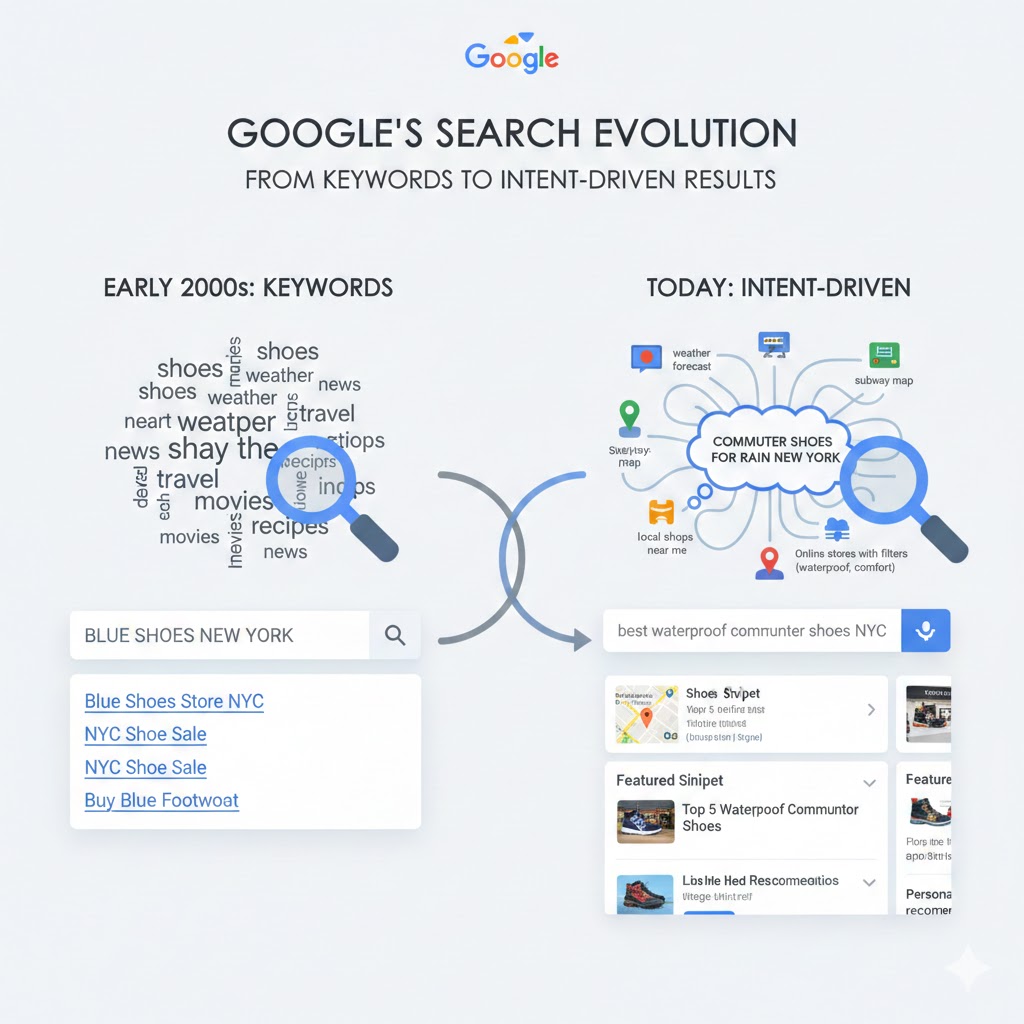
Google’s Search Evolution The transformation of Google Search represents one of the most significant technological achievements of the digital age. What began as a simple keyword-matching system has evolved into a sophisticated artificial intelligence platform that understands context, interprets meaning, and predicts user needs with remarkable accuracy. Google’s Search Evolution has fundamentally altered how billions of people access information, reshaping entire industries and redefining what it means to “search” in the modern era.
For over two decades, Google has continuously refined its search algorithms, introducing groundbreaking innovations that have progressively moved away from literal keyword matching toward understanding genuine user intent. This journey from rudimentary text analysis to advanced natural language processing represents a fundamental shift in information retrieval philosophy. Understanding Google’s Search Evolution is no longer just valuable for SEO professionals—it’s essential for anyone creating content, building websites, or seeking to understand how information flows in the digital ecosystem.
The transition from keywords to intent-driven results reflects broader developments in artificial intelligence, machine learning, and natural language understanding. Each algorithmic update, from PageRank to BERT to MUM, has brought Google closer to the ambitious goal of providing exactly what users need, even when they struggle to articulate their questions clearly. This comprehensive exploration examines how Google’s Search Evolution has transformed search technology, what it means for content creators and businesses, and where the future of search is heading.
1. The Early Days: Keyword-Based Search Foundation
Google’s Search Evolution began with a revolutionary but fundamentally simple concept: ranking web pages based on relevance and authority. The original Google algorithm, launched in 1998, represented a significant improvement over existing search engines, but it still operated primarily through keyword matching and link analysis.
PageRank and the Link Graph Revolution
Larry Page and Sergey Brin’s breakthrough innovation was PageRank, an algorithm that treated the web as a massive citation network. Rather than simply counting keyword frequency, PageRank evaluated the quality and quantity of links pointing to a page. This approach borrowed from academic citation analysis, operating on the principle that important pages receive more citations from other important pages.
The early keyword-based era of Google’s Search Evolution prioritized exact match queries and on-page optimization. Webmasters discovered that including target keywords in titles, headers, and body text improved rankings significantly. Meta keywords tags, keyword density calculations, and exact-match domain names became standard SEO practices. The system worked reasonably well for straightforward informational queries but struggled with complex, nuanced, or conversational searches.
Limitations of Pure Keyword Matching
The keyword-focused approach to search revealed significant limitations as the web expanded. Users searching for “apple” might want information about fruit, technology companies, or the Beatles’ record label. Without context, Google could only guess based on popularity metrics and user behavior patterns. Synonyms posed similar challenges—searches for “automobile repair” and “car fixing” should theoretically return similar results, but keyword matching systems treated them as distinct queries.
Another critical limitation involved natural language queries. Users asking “What is the best restaurant near me?” received inferior results compared to simplified keyword searches like “best restaurant near.” This forced users to adapt their natural communication patterns to accommodate machine limitations—the opposite of ideal user experience design.
The Beginning of Semantic Understanding
Even in its early stages, Google’s Search Evolution showed signs of moving beyond pure keyword matching. The introduction of Google’s synonym system in 2003 marked an important milestone, allowing the algorithm to recognize that “car” and “automobile” represented the same concept. Latent Semantic Indexing and related techniques enabled Google to understand relationships between words and concepts, laying groundwork for more sophisticated semantic analysis.
These early steps toward understanding meaning rather than just matching text foreshadowed the dramatic transformations that would define Google’s Search Evolution over the following decades. The foundation was being laid for algorithms that could truly comprehend user intent rather than simply processing text strings.
2. Major Algorithm Updates Shaping Search Evolution
Google’s Search Evolution accelerated through a series of landmark algorithm updates, each addressing specific weaknesses in the search experience while advancing the broader goal of understanding intent.
Panda: Content Quality Revolution
Launched in 2011, Google Panda fundamentally changed how the algorithm evaluated content quality. This update targeted thin, low-quality, or duplicate content that provided minimal value to users. Panda introduced machine learning techniques to assess content quality at scale, considering factors like originality, depth, expertise, and user engagement signals.
The impact of Panda on Google’s Search Evolution extended beyond simple quality filtering. It represented Google’s first major deployment of machine learning for quality assessment, establishing patterns that would inform future updates. Content farms, article directories, and sites built primarily for search engines rather than users saw dramatic ranking declines. The update forced content creators to prioritize user value over keyword optimization.
Penguin: Link Quality and Manipulation Prevention
Google Penguin, introduced in 2012, addressed manipulative link building practices that had undermined the integrity of PageRank. Webmasters had discovered numerous schemes for artificially inflating link counts—purchasing links, participating in link networks, and creating elaborate linking structures designed solely for search manipulation.
Penguin’s contribution to Google’s Search Evolution involved sophisticated pattern recognition that could identify unnatural link profiles. The algorithm considered link velocity, anchor text distribution, linking domain quality, and numerous other signals to detect manipulation. This update made link quality—rather than link quantity—the primary ranking factor, pushing the industry toward earning genuine editorial links through valuable content.
Hummingbird: The Semantic Search Breakthrough
Released in 2013, Hummingbird represented perhaps the most significant milestone in Google’s Search Evolution to that point. This wasn’t merely an update to existing algorithms—it was a complete rewrite of Google’s core search architecture. Hummingbird enabled Google to focus on the meaning behind queries rather than individual keywords.
The algorithm introduced sophisticated semantic analysis that could understand relationships between concepts, interpret conversational queries, and recognize that different word combinations might express identical information needs. A search for “places to buy fresh bread near me” would now return relevant local bakeries even if their websites never used those exact phrases.
Hummingbird’s impact on Google’s Search Evolution cannot be overstated. It fundamentally transformed search from keyword matching to intent interpretation, setting the stage for even more advanced natural language understanding developments.
RankBrain: Machine Learning Takes Center Stage
Introduced in 2015, RankBrain brought artificial intelligence directly into the ranking process. This machine learning system could interpret queries Google had never seen before—representing approximately fifteen percent of daily searches—by identifying patterns and relationships in previously processed queries.
RankBrain’s role in Google’s Search Evolution involved learning from user interactions to continuously improve result quality. The system analyzes which results users click, how long they engage with content, and whether they refine their searches afterward. These behavioral signals inform ranking adjustments, creating a self-improving system that becomes more accurate over time.
BERT: Understanding Language Context
The 2019 introduction of BERT (Bidirectional Encoder Representations from Transformers) marked another quantum leap in Google’s Search Evolution. BERT uses advanced natural language processing to understand the full context of words in a query by examining surrounding words in both directions—before and after each term.
This bidirectional analysis enables BERT to grasp nuances that previous algorithms missed. The distinction between “2019 brazil traveler to usa need visa” and “2019 usa traveler to brazil need visa” becomes clear when context flows in both directions. Small words like “to” and “for” carry significant meaning that BERT captures but earlier systems often ignored.
3. Understanding Search Intent Categories
Google’s Search Evolution has refined how the algorithm categorizes and responds to different types of search intent. Recognizing these categories is fundamental to understanding modern search behavior and optimization strategies.
Informational Intent: Seeking Knowledge
Informational searches represent the largest category of queries, encompassing users seeking knowledge, answers, or explanations without immediate transaction intent. These queries might be simple facts (“what is the capital of France”), complex explanations (“how does quantum computing work”), or research-oriented investigations (“climate change effects on agriculture”).
The evolution of informational intent handling in Google’s Search Evolution has produced increasingly sophisticated result formats. Knowledge panels extract and display direct answers, featured snippets highlight relevant passages, and “People Also Ask” sections anticipate follow-up questions. Google increasingly attempts to answer informational queries directly in search results rather than requiring clicks to external sites.
Navigational Intent: Finding Specific Destinations
Navigational searches occur when users seek specific websites, pages, or online destinations. These queries typically include brand names (“facebook login,” “amazon customer service”) or specific page types (“youtube watch history”). Users already know where they want to go and use Google as a navigation tool rather than a discovery mechanism.
Google’s Search Evolution has optimized navigational query handling through sitelinks, knowledge panels displaying key company information, and direct access features. The algorithm recognizes when users seek specific brands or websites and prioritizes official properties even when they don’t perfectly match keyword criteria.
Transactional Intent: Ready to Take Action
Transactional searches indicate users prepared to complete specific actions—purchasing products, downloading software, signing up for services, or making reservations. These queries often include action words like “buy,” “order,” “download,” or “subscribe,” though implicit transactional intent appears in product-specific searches without explicit action verbs.
The handling of transactional intent in Google’s Search Evolution has become increasingly sophisticated. Shopping results display product information, prices, and availability directly in search results. Local pack results for service queries show business information, reviews, and contact options. Google understands that transactional searchers want efficient paths to completion rather than extensive information.
Commercial Investigation: Research Before Purchase
Commercial investigation represents an intermediate stage where users research options before making purchase decisions. These searches might compare products (“iphone vs samsung”), seek reviews (“best noise cancelling headphones”), or request recommendations (“top restaurants in seattle”).
Google’s Search Evolution addresses commercial investigation through comparison features, review aggregation, and rich result formats that present multiple options. The algorithm recognizes that these users need comprehensive information presented in comparison-friendly formats rather than single-option recommendations.
4. Natural Language Processing Advancements
Google’s Search Evolution has been propelled by revolutionary advances in natural language processing technology, enabling the search engine to understand queries with human-like comprehension.
From Keywords to Conversational Understanding
The transition from keyword-based to conversational search represents one of the most user-visible aspects of Google’s Search Evolution. Modern Google Search handles natural language queries as fluently as simplified keyword strings. Users can ask “What’s the weather going to be like tomorrow afternoon in my area?” and receive accurate, localized forecasts—something impossible in earlier search generations.
This conversational capability extends to complex, multi-part queries. Google can parse questions with multiple clauses, understand implied context, and maintain coherence across related searches within a session. The algorithm recognizes that “How tall is he?” following a search about a specific person refers to that individual rather than requiring the name to be repeated.
Contextual Understanding and Query Refinement
Context awareness has become central to Google’s Search Evolution. The algorithm now maintains context across search sessions, understanding that sequential queries often build upon each other. Searching for “italian restaurants” followed by “which one has outdoor seating” enables Google to apply the second query specifically to previously shown results.
This contextual understanding extends to personal context—location, search history, device type, and time of day all influence result interpretation. A search for “pizza” on a mobile device at dinnertime triggers different results than the same query on a desktop during work hours, reflecting Google’s understanding of likely user intent in different contexts.
Synonym Recognition and Semantic Relationships
The sophistication of synonym handling in Google’s Search Evolution far exceeds simple word substitution. Modern algorithms understand complex semantic relationships including hypernyms (general categories like “vehicle” for “car”), hyponyms (specific instances like “sedan” within “car”), and related concepts that aren’t direct synonyms but share semantic fields.
This semantic understanding enables Google to return relevant results even when query vocabulary doesn’t match page content. A search for “inexpensive accommodation” successfully retrieves pages about “cheap hotels” and “budget lodging” because the algorithm understands semantic relationships rather than requiring exact phrase matches.
Entity Recognition and Knowledge Graphs
Google’s Search Evolution increasingly operates through entity-based understanding rather than string-based matching. The Knowledge Graph, introduced in 2012, represents Google’s database of entities—people, places, things, concepts—and their relationships. When users search for “Tom Hanks movies,” Google recognizes “Tom Hanks” as an entity (actor/filmmaker) and “movies” as a relationship to other entities (films), returning structured information about his filmography.
This entity-based approach enables more intelligent result generation. Google understands that “the actor who played Forrest Gump” refers to the same entity as “Tom Hanks” and can answer questions by traversing relationship networks in the Knowledge Graph rather than relying solely on text matching.
5. Impact on SEO Strategy and Content Creation
Google’s Search Evolution has necessitated fundamental shifts in search engine optimization philosophy and content creation approaches. The tactics that worked in keyword-focused eras have given way to strategies centered on intent satisfaction and comprehensive topic coverage.
From Keyword Density to Topic Authority
The obsolescence of keyword density as a ranking factor represents a fundamental shift driven by Google’s Search Evolution. Modern algorithms prioritize comprehensive topic coverage over keyword repetition. Content that thoroughly addresses a topic using natural language and semantic variations outperforms text artificially stuffed with exact-match keywords.
This evolution has pushed SEO professionals toward topic modeling and semantic keyword research. Rather than targeting isolated keywords, successful strategies now identify topic clusters—groups of related concepts and questions that comprehensively cover subject areas. Content addressing entire topic clusters signals expertise and authority more effectively than content optimized for individual keywords.
User Experience as Ranking Signal
Google’s Search Evolution has elevated user experience metrics to core ranking factors. Page loading speed, mobile responsiveness, secure connections, and intrusive interstitial avoidance all directly impact rankings. Core Web Vitals—measuring loading performance, interactivity, and visual stability—now constitute explicit ranking factors.
Beyond technical performance, engagement metrics influence rankings through RankBrain and related systems. Content that satisfies user intent generates positive engagement signals: extended time on page, low bounce rates, and lack of immediate return to search results. These behavioral patterns inform algorithmic assessments of content quality and relevance.
E-E-A-T: Expertise, Experience, Authoritativeness, Trustworthiness
The E-E-A-T framework has become central to how Google’s Search Evolution evaluates content quality, particularly for topics affecting health, finances, safety, or well-being (Your Money or Your Life pages). Google’s quality raters use E-E-A-T guidelines to assess content, and these assessments train machine learning systems that influence rankings at scale.
Demonstrating expertise requires clear author credentials, references to authoritative sources, and comprehensive, accurate information. Experience signals involve first-hand knowledge and practical insights. Authoritativeness comes from recognition by other experts and institutions. Trustworthiness encompasses accuracy, transparency, and security. Content optimization now requires attention to all these dimensions rather than simple keyword inclusion.
Structured Data and Schema Markup
The importance of structured data in Google’s Search Evolution reflects the shift toward entity-based understanding. Schema markup helps Google identify entities, relationships, and content types on pages, enabling rich result generation. Properly marked-up content appears in featured snippets, knowledge panels, and specialized result formats more frequently than unmarked equivalents.
Implementing schema for articles, products, recipes, events, reviews, and other content types provides Google with explicit information about page content and structure. This structured approach complements natural language processing by offering machine-readable content descriptions that facilitate accurate intent matching.
6. The Rise of Voice Search and Mobile-First Indexing
Google’s Search Evolution has been profoundly shaped by changing device landscapes and interaction methods, particularly the explosion of voice search and mobile web usage.
Voice Search and Conversational Queries
Voice-activated search through smartphones, smart speakers, and virtual assistants has accelerated Google’s Search Evolution toward natural language understanding. Voice queries tend to be longer, more conversational, and phrased as complete questions rather than keyword fragments. Users speak to devices the way they speak to people, expecting comprehension of natural speech patterns.
This shift has required sophisticated improvements in speech recognition, natural language processing, and contextual understanding. Voice searches often occur in multi-turn conversations where context persists across queries. A user might ask “What’s the weather today?” followed by “How about tomorrow?” requiring Google to maintain conversational context across distinct queries.
The optimization implications for voice search extend beyond keyword targeting. Content structured to answer specific questions directly—using FAQ formats, clear headings, and concise answer paragraphs—performs better in voice results. Featured snippets become particularly valuable as they often serve as voice search responses.
Mobile-First Indexing Philosophy
Google’s Search Evolution officially embraced mobile-first indexing in 2019, fundamentally changing how the algorithm evaluates websites. Rather than primarily indexing desktop versions of sites, Google now predominantly crawls and indexes mobile versions, using mobile content as the baseline for ranking decisions across all devices.
This transition reflects user behavior patterns—the majority of searches now occur on mobile devices. Mobile-first indexing prioritizes sites that deliver excellent mobile experiences: fast loading times, responsive designs, easily tappable elements, and readable text without zooming. Sites that provide degraded mobile experiences now face ranking challenges even for desktop searches.
The mobile-first approach in Google’s Search Evolution extends beyond technical requirements to encompass content presentation. Long paragraphs, excessive sidebars, and complex navigation structures that work acceptably on desktop become problematic on mobile screens. Content optimization now requires mobile-first thinking about readability, scannability, and interaction design.
Local Search and Geographic Intent
Mobile device prevalence has amplified the importance of local search in Google’s Search Evolution. Searches with geographic intent—”restaurants near me,” “plumber in seattle,” “coffee shops open now”—constitute a massive portion of mobile queries. Google has developed sophisticated local ranking algorithms considering proximity, relevance, and prominence.
The local pack format—displaying three local business results with maps—has become a dominant SERP feature for local intent queries. Optimization for local search requires attention to Google Business Profile completeness, review generation and management, local citation consistency, and location-specific content creation.
Geographic understanding in Google’s Search Evolution extends beyond explicit location terms. Google infers local intent from query type and user context, showing local results for queries like “pizza” or “hardware store” when searchers are mobile and location services are enabled.
7. Featured Snippets and SERP Features
Google’s Search Evolution has transformed search engine results pages from simple lists of links into complex interfaces featuring diverse content formats designed to answer queries directly.
The Zero-Click Search Phenomenon
Featured snippets, knowledge panels, and direct answers have created the zero-click search reality—scenarios where users obtain needed information without leaving Google’s results page. This represents a fundamental shift in Google’s Search Evolution from directing users to third-party sites toward providing information directly.
Featured snippets appear at the top of search results, extracting and displaying content that directly answers queries. These position-zero results can include paragraph text, numbered lists, bulleted lists, or tables. Content appearing in featured snippets receives significant visibility despite potentially reducing click-through rates to source pages.
Optimization for featured snippets requires understanding common question patterns within topic areas and structuring content to provide clear, concise answers. Using appropriate header tags, list formatting, and table structures increases featured snippet probability. The relationship between featured snippets and Google’s Search Evolution reflects the algorithm’s increasing emphasis on direct answer provision.
People Also Ask Boxes
The “People Also Ask” feature represents another dimension of Google’s Search Evolution, anticipating related questions users might have about topics. These expandable question boxes appear within search results, each revealing a featured snippet-style answer when clicked. Additional questions often load dynamically, creating nearly infinite exploration paths.
This feature reflects Google’s understanding that single queries rarely capture complete information needs. By surfacing related questions, Google guides users through comprehensive topic exploration while maintaining them within the search environment. Content optimized for PAA inclusion requires addressing question clusters around topics rather than isolated keywords.
Rich Results and Visual Search
Google’s Search Evolution has made search results increasingly visual and interactive. Rich results for recipes show cooking times, ratings, and calorie counts. Product results display prices, availability, and review stars. Event results show dates, venues, and ticket information—all before users click through to source websites.
Image search has evolved dramatically, incorporating visual recognition capabilities that enable users to search using images rather than text. Google Lens extends this further, allowing users to point smartphone cameras at objects and receive relevant search results. This visual dimension of Google’s Search Evolution creates new optimization requirements around image quality, alt text, and structured data markup.
Video Results and Multimedia Integration
Video has become a first-class citizen in Google’s Search Evolution, with YouTube results appearing prominently for many query types. Google identifies queries where video content better serves user intent and prioritizes video results accordingly. Key moments markup enables Google to display specific timestamps for relevant video segments, making long-form video content more searchable.
Optimizing for video results requires attention to video titles, descriptions, transcripts, and thumbnail images. Structured data markup for videos helps Google understand content and context. The integration of video, images, text, and interactive elements into search results reflects Google’s multimodal approach to information delivery.
8. Artificial Intelligence and Future Search Directions
Google’s Search Evolution continues accelerating through artificial intelligence breakthroughs that promise even more dramatic transformations in how search understands and responds to information needs.
MUM: Multimodal Unified Model
Google’s Multitask Unified Model (MUM), introduced in 2021, represents a thousand-fold improvement over BERT in language understanding capability. MUM can simultaneously process and understand information across text, images, and potentially video and audio, breaking down barriers between different information formats.
This multimodal capability in Google’s Search Evolution enables entirely new search experiences. Users could photograph a hiking boot and ask “Can I use these to hike Mount Fuji?” with MUM understanding both the visual information about the boot and contextual requirements for the specific mountain. The model processes multiple languages simultaneously, potentially answering questions by drawing on information available only in foreign languages.
Generative AI Integration and Search Generative Experience
The integration of generative AI into search represents perhaps the most significant phase of Google’s Search Evolution since the original algorithm. Search Generative Experience (SGE) uses large language models to generate comprehensive answers synthesized from multiple sources rather than simply ranking existing web pages.
SGE transforms search results pages into conversational interfaces where AI-generated overviews address complex queries, followed by traditional link results for deeper exploration. This approach combines direct answer provision with source attribution and additional research pathways. The implications for content creators are profound—visibility now depends partly on inclusion in AI-generated summaries rather than solely on ranking position.
Continuous Learning and Real-Time Updates
Google’s Search Evolution increasingly operates through continuous learning systems that update constantly rather than through discrete algorithmic releases. Neural networks trained on billions of searches learn from user behavior patterns, adapting rankings in near-real-time based on engagement signals and outcome satisfaction.
This continuous learning approach enables Google to respond rapidly to emerging topics, trending queries, and shifting user preferences. Content covering breaking news or trending topics can achieve high rankings within minutes based on relevance signals rather than waiting for traditional crawling and indexing cycles.
Personalization and Privacy Balance
The tension between personalization and privacy represents a critical challenge in Google’s Search Evolution. Personalized results based on search history, location, and preferences improve relevance but raise privacy concerns. Google’s shift toward privacy-preserving technologies like federated learning attempts to maintain personalization benefits while reducing individual tracking.
Future developments will likely emphasize on-device processing, where personalization occurs locally rather than requiring comprehensive user profiling on Google’s servers. This represents a technical challenge—delivering personalized experiences while respecting privacy preferences—that will shape the next phase of Google’s Search Evolution.
Predictive Search and Anticipatory Information
The ultimate goal of Google’s Search Evolution may be anticipatory search—providing information before users explicitly request it. Google Discover already moves in this direction, surfacing content based on interests and patterns without requiring queries. Future developments might predict information needs based on context, schedules, and behavioral patterns.
This anticipatory approach raises both excitement and concern. The convenience of receiving needed information proactively must be balanced against autonomy and the filter bubble effect where algorithms limit exposure to unexpected information and perspectives.
Conclusion
Google’s Search Evolution from simple keyword matching to sophisticated intent-driven artificial intelligence represents one of the defining technological achievements of our era. The journey has transformed how billions of people access information, fundamentally reshaping digital communication, commerce, and knowledge distribution.
The transition from keywords to intent reflects a broader philosophical shift—moving machines closer to human-like understanding rather than requiring humans to adapt to machine limitations. Modern Google Search comprehends context, interprets meaning, recognizes entities and their relationships, and increasingly anticipates needs before they’re explicitly articulated. This progression toward natural interaction patterns makes technology more accessible while raising important questions about algorithmic power and information gatekeeping.
For content creators, marketers, and businesses, Google’s Search Evolution demands continuous adaptation. The tactics that worked five years ago may be counterproductive today. Success requires understanding not just how algorithms work but why they work that way—the underlying principles of user intent satisfaction, content quality, and comprehensive topic coverage that drive ranking decisions.
Looking forward, Google’s Search Evolution shows no signs of slowing. Multimodal understanding, generative AI integration, and anticipatory information delivery promise even more dramatic changes. The line between search engine and personal assistant continues blurring as Google evolves from helping users find information to directly providing synthesized answers and recommendations.
The key insight from Google’s Search Evolution is that sustainable optimization strategies align with Google’s fundamental goal: connecting users with the most relevant, highest-quality information that satisfies their underlying needs. As algorithms grow more sophisticated, this alignment becomes more important than technical manipulation tactics. Content that genuinely helps users, demonstrates expertise, provides comprehensive coverage, and delivers excellent user experiences will continue succeeding regardless of specific algorithmic mechanics.
Understanding Google’s Search Evolution provides more than tactical optimization guidance—it offers insight into how information systems can better serve human needs. The progression from keyword matching to intent understanding demonstrates what becomes possible when technology prioritizes user experience over system constraints. This philosophy will likely guide search evolution for years to come, creating both challenges and opportunities for everyone participating in the digital information ecosystem.
The story of Google’s Search Evolution continues unfolding. Each algorithmic advance brings new capabilities while sometimes creating new complications. Staying informed, remaining adaptable, and maintaining focus on creating genuine value for users provides the most reliable foundation for success in this ever-changing landscape. The future of search promises to be even more intelligent, intuitive, and integrated into daily life—a continuation of the remarkable evolution we’ve witnessed over the past two decades.
Also read this:
YouTube’s AI Content Labeling Update: Impact on Monetization & Discovery
Instagram Penalizes Repetitive Text — Improve Your Captions for Better Reach
New YouTube Creator Analytics Dashboard: What’s Changed & Why It Matters