
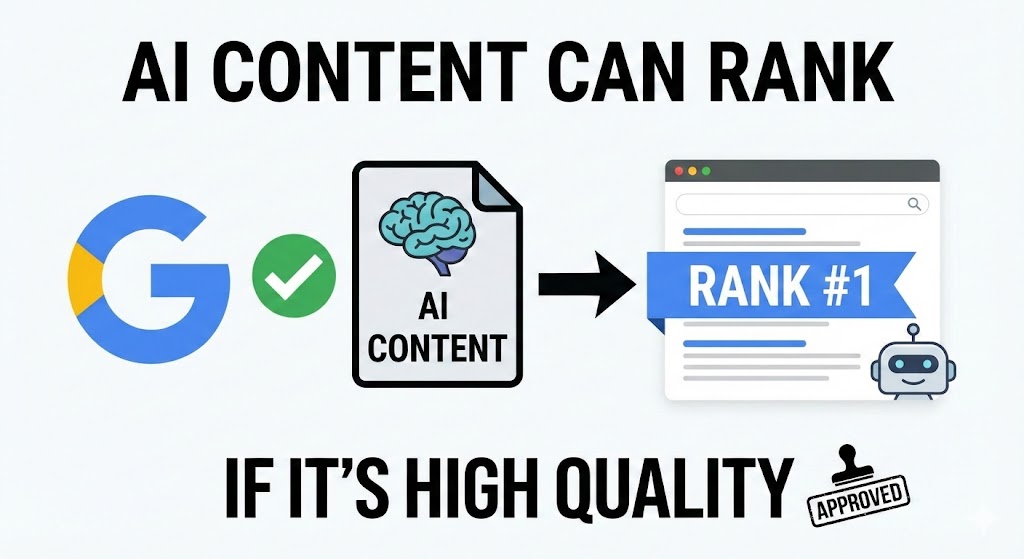
The content creation landscape has been fundamentally transformed by artificial intelligence, sparking intense debate about how search engines evaluate AI-generated material. Google has now definitively settled a question that has consumed the SEO community for months: Google Confirms AI Content Can Rank in search results, provided it meets the same quality standards applied to human-written content. This landmark clarification represents a watershed moment for digital marketers, content creators, and businesses navigating the intersection of artificial intelligence and search engine optimization.
For years, uncertainty surrounded Google’s position on AI-generated content. Early statements suggested automated content violated quality guidelines, creating fear that AI tools would trigger penalties or algorithmic suppression. As AI writing technology advanced and adoption accelerated, the ambiguity became untenable. Content creators needed clear guidance about whether using AI assistance meant sacrificing search visibility. The official confirmation that Google Confirms AI Content Can Rank removes this uncertainty while establishing critical quality benchmarks that determine ranking success.
This policy clarification carries profound implications extending far beyond simple permission to use AI tools. Google’s emphasis on quality standards over creation method signals a philosophical position: how content is created matters less than whether it serves user needs effectively. Understanding what Google Confirms AI Content Can Rank means in practice—including the quality standards, ranking factors, and strategic considerations involved—is essential for anyone creating content in the AI era. This comprehensive analysis examines every dimension of Google’s position, from the official statements to practical implementation strategies.
1. Google’s Official Position on AI-Generated Content
The statement that Google Confirms AI Content Can Rank represents the culmination of evolving policy guidance that reflects both technological advancement and strategic considerations about content quality assessment.
Historical Context and Policy Evolution
Google’s relationship with automated content has evolved significantly over the years. Early Google policies explicitly targeted “automatically generated content” as a spam tactic, establishing precedents that created concern when modern AI writing tools emerged. These legacy policies addressed rudimentary content spinning and keyword stuffing rather than sophisticated language models, but the terminology created confusion about current AI content acceptability.
The breakthrough came through official statements from Google Search representatives clarifying that the company evaluates content quality regardless of production method. Danny Sullivan, Google’s Public Liaison for Search, explicitly stated that helpful content created to serve users can rank well whether written by humans or generated by AI. This marked the formal acknowledgment that Google Confirms AI Content Can Rank when meeting quality standards.
The policy evolution reflects Google’s pragmatic recognition that artificial intelligence has become ubiquitous in content creation workflows. Attempting to prohibit or penalize AI content would be both technically difficult and strategically questionable as AI tools become standard components of professional writing processes. Instead, Google chose quality-focused policies that remain neutral about creation methods while maintaining high content standards.
Key Official Statements and Guidelines
Google’s search quality documentation now explicitly addresses AI content within the framework of helpful content systems. The guidelines emphasize that content should be created primarily for people rather than search engines, regardless of whether humans, AI, or combinations produce it. This principle-based approach focuses on outcomes rather than processes.
John Mueller, Google Search Advocate, reinforced this position by stating that Google’s algorithms don’t specifically look for AI content to penalize it. The systems evaluate content quality through numerous signals unrelated to creation method. When Google Confirms AI Content Can Rank, it means algorithmic evaluation treats AI content identically to human content, assessing both through the same quality frameworks.
The E-E-A-T guidelines—Experience, Expertise, Authoritativeness, Trustworthiness—form the foundation of Google’s quality assessment regardless of content origin. These criteria apply equally to AI-generated material, establishing that AI content must demonstrate the same knowledge depth, accuracy, and reliability as human-written equivalents to achieve comparable rankings.
What Google Actually Detects
An important technical clarification involves what Google can and cannot detect about content creation methods. Despite claims from various AI detection tools, Google has not confirmed using specific AI content detection in ranking algorithms. The focus remains on quality signals that manifest regardless of creation method rather than attempting to identify whether AI tools were involved in production.
This technical reality underlies why Google Confirms AI Content Can Rank without contradiction to quality standards. Google’s systems evaluate readability, information accuracy, source citations, content depth, user engagement signals, and numerous other quality indicators. Content meeting these standards ranks well regardless of whether algorithms or humans wrote it. Content failing these standards struggles regardless of noble human authorship.
The inability to reliably detect AI content at scale also influences policy pragmatism. As AI writing becomes more sophisticated and human-AI collaboration more common, distinguishing pure human writing from AI-assisted or AI-generated content becomes increasingly difficult. Policy focused on creation methods would be unenforceable, making quality-focused approaches the only practical option.
2. Quality Standards for Ranking Success
Understanding that Google Confirms AI Content Can Rank is only the beginning—achieving actual rankings requires meeting specific quality standards that many AI-generated content pieces fail to satisfy without significant human oversight.
Content Depth and Comprehensiveness
Superficial content represents one of the most common failures of AI-generated material. Many AI writing tools default to producing brief, surface-level coverage that lacks the depth Google’s algorithms favor for competitive queries. Quality content thoroughly addresses topics, anticipating and answering related questions while providing insights beyond basic information readily available everywhere.
The ranking implications of content depth are substantial. Google’s algorithms increasingly reward comprehensive topic coverage that fully satisfies user information needs. When Google Confirms AI Content Can Rank, this confirmation applies to AI content that achieves this comprehensiveness, not shallow AI-generated articles that merely reach target word counts without delivering substance.
Achieving sufficient depth with AI content requires strategic prompting and often multiple generation passes. Initial AI drafts frequently need expansion, with human editors adding examples, data, expert perspectives, and nuanced analysis that elevate content beyond generic coverage. This collaborative human-AI approach produces content that meets ranking standards while leveraging AI efficiency advantages.
Originality and Unique Value Addition
Google’s algorithms increasingly emphasize original perspectives and unique value rather than rewarding content that simply reorganizes existing information. This presents challenges for AI systems trained on existing content, which naturally tend toward synthesizing common perspectives rather than generating genuinely novel insights.
The originality requirement when Google Confirms AI Content Can Rank means AI content must provide something beyond what already exists on the topic. This might involve original research, expert interviews, case studies, proprietary data, unique frameworks, or analytical perspectives that distinguish content from competitors. Pure AI generation rarely produces these elements without human direction and supplementation.
Successful AI content strategies combine AI efficiency for structure and initial drafting with human expertise for original insights and differentiation. Humans contribute the unique value—personal experiences, expert analysis, proprietary research—while AI handles organization, expansion, and optimization. This division of labor produces content that ranks well while maximizing creation efficiency.
Accuracy and Factual Reliability
Factual accuracy represents perhaps the most critical quality standard for ranking success, and it’s an area where AI-generated content frequently struggles. Language models can produce plausible-sounding but factually incorrect information—so-called “hallucinations”—that undermine content credibility and ranking potential.
The accuracy requirement means that when Google Confirms AI Content Can Rank, there’s an implicit expectation of rigorous fact-checking regardless of content origin. AI-generated content requires systematic verification of claims, statistics, dates, names, and relationships. Without this verification, AI content risks including errors that damage both user experience and search performance.
Implementing fact-checking workflows for AI content involves multiple verification layers. Automated fact-checking tools can identify obvious errors or inconsistencies. Human reviewers verify claims requiring judgment or recent information beyond AI training data. Citation addition to authoritative sources substantiates claims while enabling readers to verify information independently.
User Experience and Readability
Content ranking increasingly depends on user experience signals including readability, formatting, navigation, and engagement metrics. AI-generated content that reads awkwardly, lacks proper formatting, or fails to engage readers struggles to rank regardless of technical SEO optimization.
Google’s focus on user experience means Google Confirms AI Content Can Rank only when AI content delivers experiences comparable to well-crafted human writing. This requires attention to natural language flow, appropriate vocabulary for target audiences, logical organization, and formatting that enhances rather than impedes comprehension.
Improving AI content user experience often requires significant editing. Raw AI output may contain repetitive phrasing, awkward transitions, or generic expressions that feel robotic. Human editing introduces personality, adjusts tone for audience appropriateness, and ensures content reads naturally. This refinement transforms serviceable AI drafts into engaging content that satisfies both algorithms and readers.
3. E-E-A-T Criteria and AI Content
The Experience, Expertise, Authoritativeness, and Trustworthiness framework represents Google’s core content quality assessment methodology, and understanding how these criteria apply to AI content is essential for ranking success after Google Confirms AI Content Can Rank.
Demonstrating Experience
Experience refers to first-hand, practical involvement with topics covered in content. A restaurant review gains authority from actual dining experiences; a product tutorial benefits from hands-on usage. This criterion presents particular challenges for AI-generated content since language models lack genuine experiences—they synthesize information from training data without direct involvement.
Successfully meeting experience requirements with AI content requires human contribution of experiential elements. Writers share personal anecdotes, observations, outcomes, and insights from direct involvement while leveraging AI for structure, expansion, and optimization. The combination produces content that satisfies experience criteria while benefiting from AI efficiency.
The experience criterion in Google Confirms AI Content Can Rank contexts emphasizes that AI can assist experienced practitioners in sharing their knowledge but cannot substitute for genuine experience. Content about “the best hiking boots” needs actual hiking experience and boot testing—AI can help organize and present this information but cannot generate the underlying experiential foundation.
Establishing Expertise
Expertise involves specialized knowledge, skills, or qualifications in specific subject areas. Medical content requires medical expertise; legal content needs legal knowledge; technical content demands technical understanding. Google’s algorithms assess expertise through content accuracy, depth, terminology usage, and author credentials.
AI content can demonstrate expertise when trained on specialized corpora or guided by expert prompts, but verification remains crucial. The statement that Google Confirms AI Content Can Rank doesn’t mean AI-generated content automatically possesses expertise—it means expert content created with AI assistance can rank if it genuinely demonstrates knowledge depth and accuracy.
Effective expertise demonstration in AI content involves expert human oversight. Subject matter experts direct AI content creation, verify accuracy, add specialized insights, and ensure appropriate technical depth. This expert-guided AI approach produces content that meets expertise standards while accelerating production compared to purely manual writing.
Building Authoritativeness
Authoritativeness reflects recognition by others in the field—citations from authoritative sources, mentions by respected figures, links from quality websites. This criterion extends beyond individual content pieces to encompass overall site and author reputation.
The challenge for AI content involves authoritativeness attribution. When Google Confirms AI Content Can Rank, the content still needs clear authorship with established authority. Anonymous AI-generated content published without credible author attribution struggles to demonstrate authoritativeness regardless of quality.
Building authoritativeness for AI-assisted content requires transparent authorship where qualified individuals claim content ownership. These authors leverage their existing authority while using AI as a writing tool, similar to how authors have historically used research assistants, editors, or transcription services. The key involves maintaining authentic human authorship rather than presenting pure AI output as human work.
Ensuring Trustworthiness
Trustworthiness encompasses accuracy, transparency, security, and ethical practices. Content with verifiable facts, clear sourcing, secure websites, and honest presentation builds trust. Misleading information, undisclosed conflicts of interest, or privacy violations undermine trustworthiness.
AI content faces particular trustworthiness challenges around transparency and accuracy. The position that Google Confirms AI Content Can Rank doesn’t eliminate ethical obligations to disclose AI involvement when relevant, verify factual claims, and ensure content serves user interests rather than purely manipulative SEO goals.
Establishing trustworthiness for AI content requires rigorous editorial processes. Fact-checking verifies accuracy, proper attribution credits sources, author bios establish credentials, and appropriate disclosures maintain transparency. These practices ensure AI-assisted content meets the same trustworthiness standards as traditional content.
4. Practical Implementation Strategies
Understanding that Google Confirms AI Content Can Rank requires translating policy knowledge into practical content creation workflows that leverage AI advantages while meeting Google’s quality standards.
Effective AI-Human Collaboration Models
The most successful AI content strategies involve structured collaboration between artificial intelligence and human expertise. AI handles initial research, outline creation, draft generation, and expansion while humans contribute strategic direction, original insights, fact verification, and refinement.
One effective workflow begins with human topic selection and strategic outlining based on keyword research and user intent analysis. AI then generates initial drafts following the outline structure. Human editors expand sections requiring depth, add original examples and insights, verify factual accuracy, and refine language for engagement. This division optimizes each participant’s strengths.
The collaborative approach underlying successful implementation when Google Confirms AI Content Can Rank recognizes AI as a powerful tool rather than a complete replacement for human creativity and expertise. Organizations achieving the best results maintain strong human oversight while using AI to dramatically accelerate production compared to purely manual processes.
Quality Control and Editorial Processes
Robust quality control systems separate successful AI content operations from those producing low-quality material that fails to rank. Multi-layer review processes catch errors, improve quality, and ensure consistency with brand standards and search engine requirements.
Effective quality control for AI content includes automated checks for plagiarism, readability scores, keyword optimization, and structural completeness. Human editorial review focuses on accuracy verification, originality assessment, tone consistency, and strategic alignment. Senior editors conduct final reviews ensuring content meets publication standards before release.
The quality control emphasis reflects why Google Confirms AI Content Can Rank includes implicit quality requirements. Without systematic quality assurance, AI content risks including the errors, inconsistencies, and shallow coverage that prevent ranking success regardless of creation method.
Content Optimization and Enhancement
Raw AI-generated content typically requires substantial optimization to achieve competitive ranking potential. This optimization addresses technical SEO elements, user experience factors, and content quality dimensions that algorithms evaluate.
Technical optimization includes keyword integration that feels natural rather than forced, proper heading structure that organizes content logically, meta description creation that encourages clicks, and internal linking that distributes page authority effectively. These technical elements complement content quality to maximize ranking potential.
Enhancement beyond basic optimization involves adding rich media elements, improving visual presentation, incorporating data visualization, and creating interactive elements that increase engagement. When Google Confirms AI Content Can Rank, ranking success depends on these holistic optimization efforts that transform adequate AI drafts into exceptional published content.
Scaling AI Content Production Responsibly
Organizations leveraging AI for content scaling must balance production volume with quality maintenance. Publishing large quantities of mediocre AI content damages rather than helps search performance, while strategic AI use enables significant scaling without quality compromise.
Responsible scaling involves establishing clear quality gates that all content must pass regardless of production volume. Content failing quality standards doesn’t publish simply to meet production quotas. This discipline ensures that increased volume through AI assistance maintains the quality standards necessary for ranking success.
The scaling potential when Google Confirms AI Content Can Rank is substantial but not unlimited. Organizations successfully scaling content production through AI maintain proportional scaling of editorial resources, quality control systems, and expertise input. Attempting to scale production without scaling quality oversight inevitably produces content that fails to achieve ranking goals.
5. Common Pitfalls and How to Avoid Them
Despite the confirmation that Google Confirms AI Content Can Rank, numerous pitfalls prevent AI-generated content from achieving ranking success. Understanding and avoiding these common mistakes significantly improves outcomes.
Over-Reliance on Raw AI Output
The most common mistake involves publishing AI-generated content with minimal human review or enhancement. Raw AI output, while potentially serviceable, typically lacks the depth, originality, and polish required for competitive ranking in valuable keyword spaces.
This over-reliance manifests in generic content that reads like dozens of other AI-generated articles on the same topic. Without unique perspectives, original examples, or specialized insights, such content fails to differentiate itself in crowded topic spaces where dozens or hundreds of similar articles already exist.
Avoiding this pitfall requires committing to substantial human involvement in AI content workflows. The fact that Google Confirms AI Content Can Rank doesn’t mean minimal-effort AI content ranks well—it means thoughtfully created, thoroughly edited AI-assisted content can compete with quality human-written content.
Neglecting Fact-Checking and Verification
AI language models occasionally generate plausible-sounding but factually incorrect information. Publishing such content without verification damages credibility, user experience, and ranking potential. This problem particularly affects technical, medical, financial, or legal content where accuracy is critical.
The verification neglect often stems from misplaced confidence in AI accuracy or time pressure to publish quickly. Organizations assume AI-generated information must be correct or skip verification steps to maintain production velocity. These shortcuts consistently produce problematic content.
Preventing verification failures requires mandatory fact-checking protocols for all AI-generated content. Every claim, statistic, date, name, and relationship requires verification against authoritative sources. When Google Confirms AI Content Can Rank, this confirmation assumes content accuracy—a standard unverified AI content frequently fails to meet.
Ignoring User Intent and Search Context
AI tools generate content based on prompts and training data but may miss nuances of user intent and search context that determine content usefulness. Content answering the wrong question or missing important context fails to satisfy users regardless of technical quality.
This misalignment often occurs when AI receives generic prompts without sufficient context about target audience, search intent, or competitive landscape. The resulting content may be grammatically correct and topically relevant while failing to address what users actually need when searching specific queries.
Avoiding intent misalignment requires detailed prompt engineering informed by search intent analysis. Content creators must understand what users genuinely need when searching target keywords, then craft AI prompts that generate content addressing those specific needs. The principle underlying Google Confirms AI Content Can Rank involves content usefulness—AI content must genuinely help users to rank well.
Producing Thin or Duplicate Content
AI makes producing large content volumes easy, tempting organizations to pursue quantity over quality. This leads to thin content lacking sufficient depth or duplicate content that merely restates the same information across multiple pages.
Search engines increasingly penalize thin and duplicate content through algorithmic filters and manual actions. Sites publishing numerous low-quality AI-generated pages often see entire domains suppressed rather than individual pages filtered, making thin content strategies particularly risky.
Preventing thin content problems requires enforcing minimum quality standards that emphasize depth and uniqueness over volume. Content that doesn’t meet these standards shouldn’t publish. While Google Confirms AI Content Can Rank, this doesn’t validate thin AI content strategies—only substantial, unique AI content achieves ranking success.
6. Ethical Considerations and Disclosure
The confirmation that Google Confirms AI Content Can Rank raises important ethical questions about transparency, disclosure, and the broader implications of AI-generated content proliferation.
Transparency About AI Usage
Ethical content creation involves transparency about production methods when relevant to content evaluation. While Google doesn’t require AI disclosure for ranking purposes, readers may want to know when content involved AI generation, particularly for topics where human experience or expertise are expected.
The disclosure question involves balancing transparency against unnecessary complexity. Disclosing every use of AI writing assistance might be excessive—most content today involves some digital assistance from grammar checkers to research tools. However, content heavily generated by AI might warrant disclosure, particularly in contexts where readers assume human authorship.
Organizations developing disclosure policies should consider audience expectations, content types, and competitive practices. The principle that Google Confirms AI Content Can Rank doesn’t address disclosure requirements, leaving these determinations to publisher ethics and audience relationships.
Maintaining Content Authenticity
AI content that mimics human authorship without genuine human involvement raises authenticity concerns. Content attributed to authors who didn’t meaningfully contribute undermines trust when discovered. This authenticity problem extends beyond individual content pieces to affect overall brand credibility.
Maintaining authenticity with AI assistance requires genuine human authorship rather than fictional attribution. Authors claiming bylines should meaningfully contribute strategic direction, original insights, and final approval. Using AI as a writing tool differs from attributing pure AI output to fictitious or uninvolved human authors.
The authenticity consideration when Google Confirms AI Content Can Rank emphasizes that ranking permission doesn’t eliminate ethical obligations. Content should authentically represent claimed authorship regardless of whether AI assistance was involved in production.
Responsibility for Content Quality and Accuracy
Publishers bear full responsibility for content quality and accuracy regardless of creation methods. Using AI generation doesn’t transfer responsibility from publishers to AI developers—organizations publishing AI content remain accountable for accuracy, quality, and compliance with applicable standards.
This responsibility includes ensuring content doesn’t contain misinformation, harmful advice, or legally problematic claims. AI generation might create such problems, but publishers can’t blame AI tools for publishing failures. Editorial oversight must catch and correct problems before publication.
The responsibility principle underlying Google Confirms AI Content Can Rank holds that content quality standards apply equally regardless of creation method. Publishers must maintain quality controls ensuring all content meets standards, with AI assistance potentially increasing the volume requiring oversight but not diminishing quality expectations.
Impact on Content Ecosystem
Widespread AI content generation raises broader questions about impacts on the content ecosystem, information quality, and creative professions. While individual publishers might benefit from AI efficiency, collective AI content proliferation could degrade overall information quality if standards aren’t maintained.
These ecosystem concerns include potential information homogenization as AI systems trained on similar data produce similar content, reduced opportunities for human writers and journalists, and potential feedback loops where AI systems increasingly train on AI-generated content.
Addressing ecosystem concerns requires collective commitment to quality standards and ethical practices. The confirmation that Google Confirms AI Content Can Rank doesn’t eliminate responsibility to consider broader impacts. Publishers should use AI in ways that enhance rather than degrade the information ecosystem.
7. Measuring Success and Performance
After implementing AI content strategies based on understanding that Google Confirms AI Content Can Rank, organizations must systematically measure performance to evaluate effectiveness and guide optimization.
Key Performance Indicators
Success measurement for AI content involves tracking multiple metrics spanning search visibility, user engagement, conversion performance, and content efficiency. Rankings for target keywords provide primary visibility indicators, while organic traffic measures actual search engine referral success.
User engagement metrics including bounce rate, time on page, pages per session, and scroll depth indicate whether content satisfies user needs. High rankings with poor engagement suggest content attracts clicks but fails to deliver value—a pattern that eventually leads to ranking decline as algorithms detect dissatisfaction.
Conversion metrics measure business impact beyond traffic and engagement. Lead generation, newsletter subscriptions, product purchases, or other desired actions demonstrate whether content drives business results. When Google Confirms AI Content Can Rank, ultimate success requires not just ranking but converting traffic into business value.
Comparative Analysis
Comparing AI-assisted content performance against traditional human-written content provides insights about AI strategy effectiveness. Organizations should track whether AI content achieves comparable rankings, engagement, and conversions to human content when controlling for topic competitiveness and targeting.
This comparison reveals whether AI implementation maintains quality standards or creates performance gaps requiring strategy adjustment. If AI content consistently underperforms human content, increased editing, enhanced prompts, or reduced reliance on AI generation may be necessary.
The analytical approach when Google Confirms AI Content Can Rank treats AI as a tool requiring evaluation like any other content strategy. Performance data should drive continuous improvement in AI implementation rather than assuming AI assistance automatically produces optimal results.
Content Quality Assessment
Beyond quantitative metrics, qualitative content assessment evaluates whether AI-assisted content meets editorial standards and competitive benchmarks. Editorial teams should periodically review published AI content against quality criteria including depth, originality, accuracy, and reader value.
This qualitative assessment catches problems that metrics might miss—factual errors that haven’t yet damaged rankings, thin coverage that satisfies searchers only in absence of better alternatives, or tone inconsistencies that subtly undermine brand perception.
The quality focus reflects why Google Confirms AI Content Can Rank emphasizes quality standards. Rankings emerge from quality, making quality assessment foundational to sustainable AI content success rather than an optional enhancement.
Continuous Optimization
AI content strategies require continuous refinement based on performance feedback. Underperforming content might need enhancement, updating, or consolidation. Successful content patterns should inform future content creation, while unsuccessful patterns guide avoidance.
This optimization cycle includes updating AI prompts based on output quality, adjusting editorial processes when quality issues recur, and refining topic selection to focus on areas where AI assistance delivers best results relative to resource investment.
The optimization imperative when Google Confirms AI Content Can Rank recognizes that AI implementation is a journey rather than a destination. Initial results guide iterative improvements that progressively enhance AI content performance and efficiency.
8. Future Outlook and Emerging Trends
The landscape following the confirmation that Google Confirms AI Content Can Rank continues evolving rapidly as AI technology advances and search engines refine evaluation methodologies.
AI Detection and Quality Assessment
Google’s quality assessment systems will likely become more sophisticated in identifying content characteristics associated with low-quality AI generation—repetitive phrasing, generic insights, surface-level coverage. These detection capabilities won’t necessarily identify AI content but will effectively filter low-quality content regardless of creation method.
This evolution means Google Confirms AI Content Can Rank remains true while poorly executed AI content increasingly struggles. The gap between thoughtfully created AI-assisted content and mass-produced low-quality AI content will likely widen as algorithms better distinguish quality levels.
Integration of AI in Search Algorithms
As Google itself integrates AI more deeply into search algorithms through technologies like MUM and generative AI features, the evaluation frameworks for all content will evolve. These changes might include better understanding of context, improved intent matching, and more nuanced quality assessment that benefits high-quality content regardless of creation method.
The algorithmic evolution reinforces that Google Confirms AI Content Can Rank based on quality principles that transcend specific technologies. As both content creation and search evaluation become increasingly AI-powered, quality and user value remain central differentiators.
Content Creation Best Practices Evolution
Industry best practices for AI content creation will continue developing as collective experience accumulates. More sophisticated workflows, better quality control methodologies, and clearer ethical guidelines will emerge, helping organizations maximize AI benefits while minimizing risks.
These evolving practices will define what constitutes responsible AI content creation in the context where Google Confirms AI Content Can Rank. Organizations staying current with emerging best practices will maintain competitive advantages over those using outdated or unsophisticated approaches.
Regulatory and Policy Developments
Regulatory frameworks around AI content disclosure, transparency, and accountability will likely develop, potentially creating mandatory disclosure requirements or quality standards beyond Google’s current guidance. These regulations could significantly affect how organizations implement AI content strategies.
Preparing for potential regulation involves establishing transparent, ethical AI content practices that would satisfy future requirements. The proactive approach ensures compliance regardless of regulatory evolution while building trust with audiences concerned about AI content proliferation.
Conclusion
The definitive statement that Google Confirms AI Content Can Rank resolves longstanding uncertainty about AI-generated content acceptability in search results while establishing clear quality expectations that determine actual ranking success. This clarification enables confident AI adoption for content creation while emphasizing that AI is a tool requiring thoughtful implementation rather than a shortcut to ranking success.
The quality standards underlying successful AI content ranking—depth, originality, accuracy, user experience, and E-E-A-T compliance—remain unchanged from requirements for human content. When Google Confirms AI Content Can Rank, this confirmation applies to AI content meeting these standards through substantial human oversight, strategic editing, and rigorous quality control rather than to raw, minimally edited AI output.
Practical implementation requires structured human-AI collaboration where AI handles efficiency-suited tasks like initial drafting and expansion while humans contribute irreplaceable elements including original insights, experiential knowledge, fact verification, and strategic direction. This collaborative approach produces content that ranks well while delivering production efficiency gains that justify AI investment.
The ethical dimensions of AI content creation extend beyond ranking considerations to encompass transparency, authenticity, accuracy responsibility, and ecosystem impacts. Publishers using AI tools maintain full accountability for content quality regardless of creation method, requiring robust editorial processes and quality standards that ensure published content serves reader needs rather than purely manipulative SEO goals.
Success measurement and continuous optimization are essential for sustainable AI content strategies. Organizations must systematically track performance metrics, compare AI content against human baselines, assess quality against editorial standards, and refine approaches based on accumulated experience. The confirmation that Google Confirms AI Content Can Rank establishes possibility rather than guaranteeing success—outcomes depend on implementation quality.
Looking forward, both AI content creation capabilities and search engine evaluation methodologies will continue advancing. The fundamental principle that quality content ranks well regardless of creation method will likely persist even as specific technologies and techniques evolve. Organizations building AI content strategies on quality foundations position themselves for success regardless of future developments.
Ultimately, the statement that Google Confirms AI Content Can Rank represents an inflection point for digital content creation. AI becomes a legitimate tool in the content creator’s arsenal, comparable to research databases, editing software, or collaboration platforms. Success requires using this powerful tool responsibly, maintaining unwavering focus on content quality and user value while leveraging AI capabilities to enhance efficiency and scale. Publishers achieving this balance will thrive in the AI-augmented content landscape, while those pursuing shortcuts or neglecting quality standards will struggle regardless of the theoretical possibility that AI content can rank.
Also read this:
Instagram Ad-Free Premium Subscription: Early Access & Benefits
WhatsApp’s Monetization Update: Paid Channels, Subscriptions & Ads Inside the App
Google’s Search Evolution: From Keywords to Intent-Driven Results