
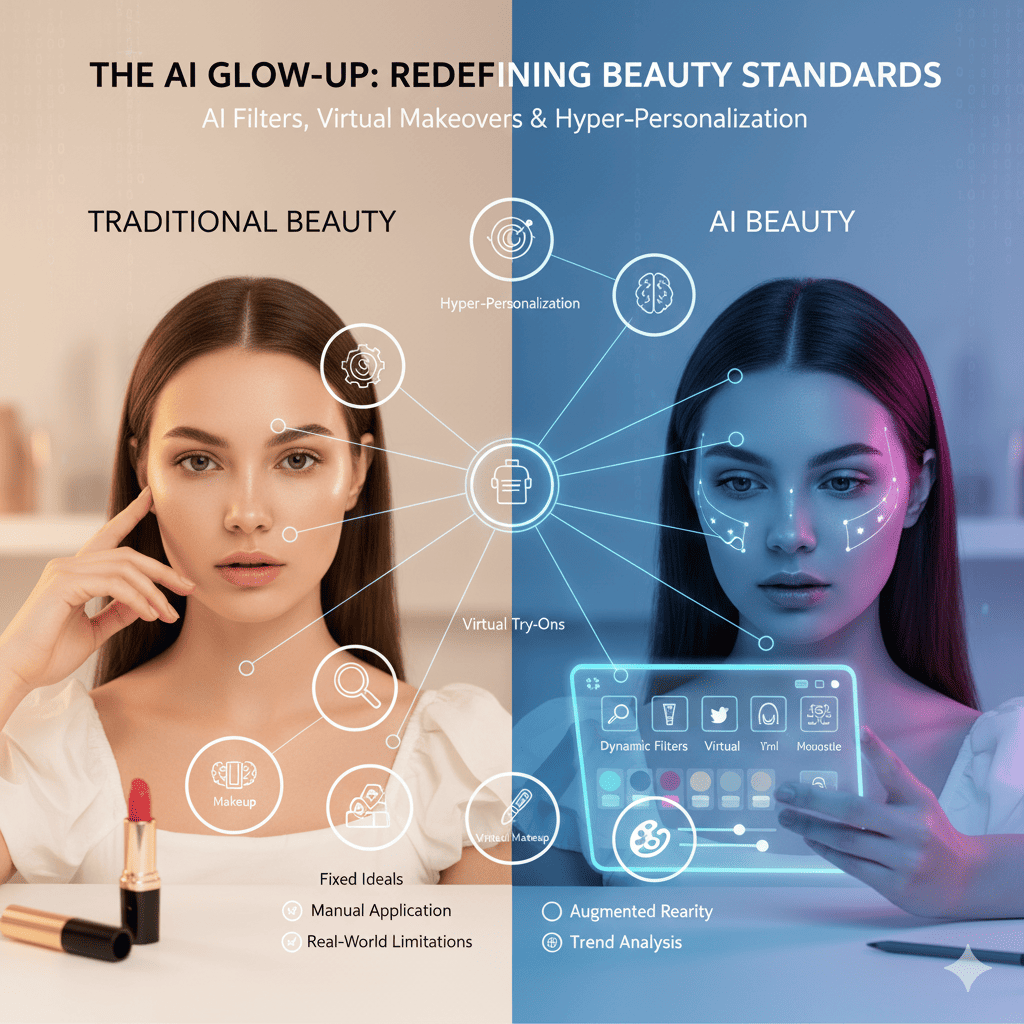
Scroll through social media for just five minutes, and you’ll see it everywhere: dramatic before-and-after transformations, AI-enhanced selfies, and virtual makeovers that look impossibly perfect. The glow-up trend has exploded, and artificial intelligence is at the center of it all.
But here’s the million-dollar question: Is AI democratizing beauty or creating unrealistic standards that nobody can achieve? As someone who’s been deep-diving into this intersection of technology and beauty culture, I’m here to unpack how the glow-up trend is fundamentally changing what we consider beautiful—and whether that’s a good thing.
What Is the Glow-Up Trend?
Let’s start with the basics. The glow-up trend originally referred to a natural transformation—someone improving their appearance, confidence, and lifestyle over time. Think of it as the ultimate personal evolution story.
Traditional glow-ups included:
- Fitness and health improvements
- Skincare routines and lifestyle changes
- Fashion and style evolution
- Confidence building and self-care
- Personal growth and maturity
The AI-powered glow-up trend now includes:
- AI beauty filters showing “potential” transformations
- Virtual cosmetic surgery previews
- AI-generated “ideal” versions of yourself
- Automated photo editing and enhancement
- Predictive beauty analysis tools
The shift from organic transformation to AI-assisted prediction has created a fascinating—and sometimes troubling—new chapter in beauty culture.
How AI Is Fueling the Glow-Up Trend
Artificial intelligence has become the ultimate beauty assistant, and its impact on the glow-up trend is impossible to ignore.
1. AI Beauty Filters: The Double-Edged Sword
Apps like FaceApp, BeautyPlus, and even Instagram filters use sophisticated AI algorithms to instantly transform your appearance.
What AI does:
- Smooths skin to perfection
- Enlarges eyes and reshapes facial features
- Enhances jawlines and cheekbones
- Whitens teeth and brightens eyes
- Changes hair color and style instantly
The psychological impact: Studies show that 90% of young adults use beauty filters regularly. But here’s the catch: many people report feeling less attractive in real life compared to their filtered selves. This phenomenon, called “Snapchat dysmorphia,” has become so prevalent that people are seeking cosmetic surgery to look like their filtered photos.
The glow-up paradox: AI shows you an “improved” version of yourself instantly, but achieving that look naturally becomes the new pressure point.
2. Virtual Cosmetic Surgery Previews
AI-powered apps now let you preview cosmetic procedures before committing.
How it works: Upload a photo, select a procedure (nose job, lip filler, facelift), and AI shows you the predicted results in seconds.
Impact on the glow-up trend:
- Cosmetic surgery consultations have increased 40% since these apps became popular
- People make faster decisions about procedures
- Unrealistic expectations about surgical outcomes have also risen
The reality check: AI predictions aren’t always accurate. Real surgical results depend on individual anatomy, healing, and surgeon skill—factors AI can’t fully account for.
3. AI Skin Analysis and Personalized Beauty
This is where the glow-up trend gets genuinely helpful.
AI-powered tools analyze:
- Skin texture, tone, and elasticity
- Fine lines, wrinkles, and dark spots
- Pore size and skin hydration levels
- Sun damage and hyperpigmentation
Brands using AI effectively:
- L’Oréal’s Skin Genius analyzes your skin and recommends personalized routines
- Neutrogena’s Skin360 tracks skin changes over time
- Proven Skincare uses AI to create custom formulations
Why this matters: Unlike filters that create unrealistic expectations, these tools help people achieve genuine improvements through personalized care. This is the glow-up trend at its best—using technology to enhance natural beauty rather than replace it.
The New Beauty Standards: What AI Considers “Beautiful”
Here’s where things get controversial. AI doesn’t create beauty standards in a vacuum—it learns from existing data. And that data reflects historical biases and cultural beauty ideals.
The AI Beauty Algorithm Problem
What research shows: AI beauty-rating algorithms consistently favor:
- Lighter skin tones
- Eurocentric facial features
- Symmetrical faces
- Youthful appearance
- Slim faces with specific proportions
Why this happens: AI is trained on millions of images tagged as “beautiful,” and these images historically overrepresent certain beauty ideals. The algorithm reinforces these patterns.
Impact on the glow-up trend: When people use AI to “improve” their photos, the AI often subtly alters features toward these narrow standards—lightening skin, enlarging eyes, or thinning noses.
The Diversity Backlash
The beauty industry is fighting back against AI-driven homogenization:
Positive developments:
- Brands training AI on more diverse datasets
- Apps featuring culturally specific beauty standards
- Movements celebrating unique features rather than “correcting” them
- AI tools highlighting distinctiveness as beauty
The challenge: The glow-up trend needs to celebrate transformation without pressuring everyone to transform into the same AI-generated ideal.
AI-Generated Influencers: The Ultimate Glow-Up?
Virtual influencers created entirely by AI represent the logical extreme of the glow-up trend.
Meet the AI beauty icons:
- Lil Miquela: 3 million followers, brand deals with Prada and Calvin Klein
- Shudu: Called “the world’s first digital supermodel”
- Imma: Japanese virtual influencer with a growing fanbase
Why they’re problematic for beauty standards:
- They’re literally perfect because they’re designed that way
- They never age, gain weight, or have bad skin days
- They set impossible standards that real humans compare themselves against
- They blur the line between authentic and artificial
The existential question: If the ultimate glow-up trend is becoming virtually perfect, where does that leave real human beauty?
The Mental Health Impact of AI-Enhanced Beauty
Let’s talk about the elephant in the room: the glow-up trend powered by AI is messing with our heads.
The Statistics Are Alarming
Recent research shows:
- 70% of teens feel pressure to look perfect on social media
- Body dysmorphia diagnoses have increased 300% since 2015
- 55% of people feel anxious posting unfiltered photos
- Cosmetic surgery among young adults has surged 40% since AI filters became mainstream
The Filter Dependence Cycle
How it works:
- You use an AI beauty filter and love how you look
- You post the filtered version because it gets more likes
- You start feeling uncomfortable with your unfiltered appearance
- You use filters more frequently
- Your perception of your real face becomes distorted
Breaking the cycle: Mental health professionals now recommend “filter breaks”—periods where you only post unedited photos to recalibrate your self-image.
The Positive Psychology Approach
Not all aspects of the glow-up trend are harmful. When approached mindfully:
Healthy glow-up practices:
- Using AI skincare analysis to improve actual skin health
- Trying virtual hairstyles before a real change
- Tracking fitness progress with AI body composition tools
- Learning makeup techniques from AI tutorials
The key difference: These use cases focus on achievable real-world transformations, not impossible perfection.
How AI Is Actually Democratizing Beauty
Despite the concerns, there are genuinely positive ways AI is reshaping the glow-up trend for the better.
1. Accessible Beauty Education
AI-powered apps teach makeup application, skincare routines, and styling in ways previously available only through expensive consultations.
Tools making beauty accessible:
- Virtual makeup try-on apps
- AI hair color and style previews
- Personalized skincare education
- Body shape-specific fashion recommendations
2. Inclusive Product Development
Brands are using AI to create products for underserved markets.
Examples:
- Fenty Beauty used AI analysis to identify gaps in foundation shade ranges
- AI helps create products for diverse hair textures
- Adaptive beauty tools for people with disabilities
3. Sustainable Beauty Choices
AI helps people make better purchasing decisions, reducing waste.
How it works:
- Virtual try-on reduces returns and waste
- AI predicts which products will actually work for you
- Personalized formulations mean fewer unused products
This is the glow-up trend serving genuine positive change—technology making beauty more accessible, inclusive, and sustainable.
The Future of the Glow-Up Trend: What’s Coming Next
As we move deeper into 2025 and beyond, here’s where AI and beauty are heading:
Predictive Beauty Aging
AI will soon accurately predict how you’ll age and recommend preventive care.
Potential benefits:
- Early detection of skin conditions
- Personalized anti-aging strategies
- Realistic expectations about aging
Potential concerns:
- Pressure to prevent every sign of aging
- Beauty anxiety about predicted futures
- Discrimination based on predicted appearance
Augmented Reality Beauty
AR glasses and contacts will let you change your appearance in real-time, visible to others wearing the same technology.
Imagine:
- Changing your hair color or makeup instantly
- Different appearances for different social contexts
- Virtual cosmetic enhancements visible only through AR
The question: If you can look however you want through AR, does physical appearance even matter anymore?
AI-Personalized Beauty Standards
Instead of one universal standard, AI might create personalized beauty ideals based on your features.
How this could work:
- AI analyzes your unique features
- Suggests enhancements that work with your natural beauty
- Celebrates distinctiveness rather than conformity
The hope: This approach could make the glow-up trend about becoming your best self, not someone else’s ideal.
Navigating the Glow-Up Trend Responsibly
Whether you’re embracing AI beauty tools or worried about their impact, here’s how to navigate this new landscape:
For Users: Healthy Engagement Strategies
Do:
- Use AI tools for realistic transformation planning
- Take regular breaks from filters and edited photos
- Follow diverse beauty content creators
- Focus on health and confidence, not just appearance
- Remember that AI-enhanced photos aren’t reality
Don’t:
- Compare your unfiltered self to AI-enhanced images
- Seek cosmetic surgery based solely on AI predictions
- Use filters on every single photo
- Let AI define your beauty standards
- Forget that beauty is subjective and culturally diverse
For Content Creators: Ethical Considerations
Best practices:
- Disclose when using AI enhancement
- Share unfiltered content regularly
- Discuss the reality behind your glow-up trend posts
- Promote realistic transformations
- Highlight the work behind real changes (fitness, skincare, etc.)
For Parents: Protecting Young People
Important conversations:
- Explain how AI filters work
- Discuss unrealistic beauty standards
- Monitor signs of body dysmorphia
- Encourage diverse beauty content consumption
- Model healthy self-image behavior
The Glow-Up Trend Bottom Line: Empowerment or Pressure?
After analyzing how AI is reshaping beauty standards through the glow-up trend, here’s my honest take:
The empowering aspects:
- Accessible beauty education and tools
- Personalized skincare and makeup recommendations
- Virtual experimentation without commitment
- Diverse beauty options and representations
- Technology helping people feel confident
The concerning aspects:
- Unrealistic beauty standards becoming normalized
- Mental health impacts from constant comparison
- Loss of authenticity in beauty content
- Pressure to achieve AI-generated perfection
- Homogenization of beauty ideals
The verdict: Like most technology, AI in beauty is neither inherently good nor bad—it’s how we use it that matters.
The most sustainable approach to the glow-up trend is viewing it as a tool for enhancement, not replacement. Use AI to learn, experiment, and improve your actual appearance and health. But never forget that your unfiltered, authentic self has value that no algorithm can measure.
Finding Your Authentic Glow-Up in an AI World
Here’s what a healthy glow-up trend journey looks like in 2025:
Step 1: Define your own beauty goals (not AI’s version of you)
Step 2: Use AI tools for education and realistic planning
Step 3: Focus on achievable, health-focused transformations
Step 4: Document your real journey, filters optional
Step 5: Celebrate progress without chasing perfection
Step 6: Remember that confidence is the best glow-up
Final Thoughts: Beauty in the Age of AI
The glow-up trend powered by AI represents a fascinating moment in human history. We have unprecedented tools to transform our appearance, but we’re also grappling with unprecedented pressure to meet impossible standards.
The key is maintaining perspective. AI can analyze your skin, suggest hairstyles, and show you possibilities—but it can’t define your worth. Your real glow-up isn’t about looking like an AI-generated ideal. It’s about feeling confident in your skin, taking care of your health, and expressing your unique beauty.
As AI continues evolving, so will beauty standards. The question isn’t whether we should use these tools—they’re here to stay—but how we can use them mindfully, ethically, and in ways that celebrate human diversity rather than erase it.
The ultimate glow-up? Learning to see your own beauty without needing AI to validate it.
Also read this:
How Creators Use Auto-Content Bots to Grow 10x Faster
The Psychology Behind Viral Couple Content (Why We Can’t Stop Watching)
5 Websites That Pay You to Use AI (Earn Money Online in 2025)