
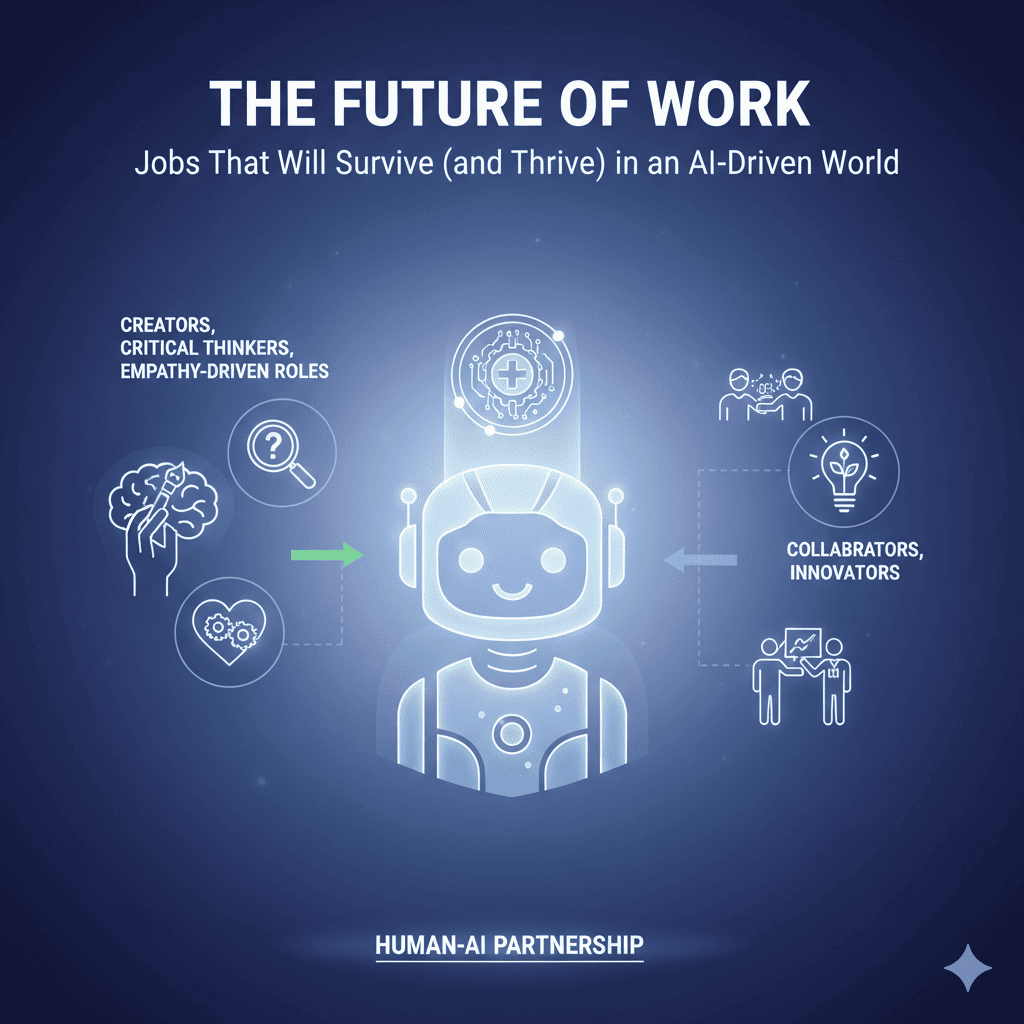
The workplace is transforming faster than ever before. As artificial intelligence continues to reshape industries, one question dominates every conversation: which careers will not only survive but actually flourish in this new era?
Why The Future of Work Demands Our Attention Now
We’re standing at a pivotal moment in human history. The Future of Work isn’t some distant concept—it’s unfolding right before our eyes. AI is automating tasks at an unprecedented rate, but here’s the surprising truth: this technological revolution is creating as many opportunities as it’s disrupting.
Jobs That Will Thrive in The Future of Work
1. AI Trainers and Ethicists
Someone needs to teach AI systems, set ethical boundaries, and ensure these technologies serve humanity responsibly. The Future of Work will see explosive demand for professionals who can bridge the gap between human values and machine learning.
2. Healthcare Professionals with a Human Touch
While AI can diagnose diseases and analyze medical data, it cannot replace empathy, bedside manner, and the nuanced decision-making that complex patient care requires. Nurses, therapists, and specialized physicians will remain indispensable in The Future of Work.
3. Creative Professionals and Strategists
AI can generate content, but it struggles with original thinking, emotional resonance, and strategic vision. Designers, writers, marketers, and creative directors who can harness AI as a tool—rather than compete with it—will dominate The Future of Work.
4. Skilled Trades and Technical Specialists
Electricians, plumbers, HVAC technicians, and specialized repair workers perform complex, hands-on tasks in unpredictable environments. These roles are extremely difficult to automate and will remain crucial in The Future of Work.
5. Data Scientists and Cybersecurity Experts
As our world becomes increasingly digital, professionals who can make sense of massive datasets and protect our digital infrastructure will be among the most sought-after talents in The Future of Work.
6. Sustainability and Environmental Specialists
Climate change isn’t slowing down. The Future of Work will see tremendous growth in careers focused on renewable energy, sustainable agriculture, environmental engineering, and green technology development.
Skills That Define The Future of Work
To thrive in this evolving landscape, focus on developing:
- Emotional Intelligence: The uniquely human ability to understand, empathize, and connect
- Adaptability: Being comfortable with constant learning and change
- Complex Problem-Solving: Tackling challenges that require creativity and critical thinking
- Tech Literacy: Understanding how to work alongside AI, not against it
- Cross-Disciplinary Knowledge: Combining expertise from multiple fields
Preparing for The Future of Work Today
The key to success isn’t resisting change—it’s embracing it strategically. The Future of Work belongs to those who:
- View AI as a collaborative tool, not a threat
- Commit to lifelong learning and skill development
- Cultivate uniquely human capabilities that machines cannot replicate
- Stay curious about emerging technologies and industry trends
The Bottom Line on The Future of Work
The Future of Work isn’t about humans versus machines—it’s about humans working with machines to achieve what neither could accomplish alone. The jobs that will thrive are those that emphasize creativity, emotional intelligence, complex decision-making, and skilled craftsmanship.
Rather than fearing obsolescence, this is your invitation to evolve. The professionals who will succeed in The Future of Work are those who start preparing today, building skills that complement rather than compete with AI capabilities.
The future isn’t something that happens to us—it’s something we create. And The Future of Work? It’s looking remarkably human after all.Retry
C
make it attractive and 3k words
The Future of Work: Jobs That Will Survive (and Thrive) in an AI-Driven World
The alarm clock rings. You roll over, check your phone, and scroll through news headlines about another company implementing AI to automate jobs. Your stomach tightens. Will your career survive the next decade? Will your children enter a job market where opportunities have evaporated?
Take a deep breath. The Future of Work isn’t the dystopian nightmare many fear—it’s actually far more nuanced, complex, and surprisingly optimistic than the headlines suggest.
We’re standing at the precipice of the most dramatic workplace transformation in human history. Artificial intelligence, machine learning, and automation are reshaping every industry imaginable. But here’s what the doomsday prophets won’t tell you: The Future of Work isn’t about machines replacing humans. It’s about an unprecedented evolution where human creativity, emotional intelligence, and strategic thinking become more valuable than ever before.
Understanding The Future of Work: Beyond the Headlines
Let’s address the elephant in the room: yes, AI will eliminate certain jobs. Just as the automobile displaced horse carriage drivers and the internet transformed journalism, AI will fundamentally alter how we work. But history teaches us a crucial lesson—technological revolutions don’t destroy work; they transform it.
The Future of Work will be defined not by what disappears, but by what emerges. When ATMs were introduced in the 1970s, everyone predicted bank tellers would become extinct. Instead, the number of bank tellers actually increased because banks could open more branches at lower costs, and tellers shifted from cash-counting machines to relationship-building advisors.
This pattern will repeat itself across industries. The question isn’t whether your job will exist in The Future of Work—it’s whether you’re preparing for how that job will evolve.
The Future of Work: The Skills That Money Can’t Buy (But AI Can’t Replicate)
Before we dive into specific careers that will thrive, let’s understand the fundamental shift happening in The Future of Work. The value of routine, predictable tasks is plummeting toward zero. Meanwhile, the value of distinctly human capabilities is skyrocketing.
Emotional Intelligence: Your Secret Weapon
AI can process data faster than any human brain. It can identify patterns, make predictions, and execute tasks with perfect consistency. But here’s what it cannot do: understand the tremor in someone’s voice that signals hidden anxiety. Read the body language in a tense boardroom. Know when a patient needs reassurance more than medication. Sense when a student is struggling not with the material, but with problems at home.
The Future of Work belongs to those who master emotional intelligence—the ability to recognize, understand, and influence emotions in yourself and others. This isn’t a soft skill anymore; it’s the hardest skill to replicate and the most valuable asset in an AI-driven economy.
Creative and Strategic Thinking: Where Humans Still Reign Supreme
AI is remarkable at optimization—finding the best solution within defined parameters. But who defines those parameters? Who asks the questions that haven’t been asked before? Who connects seemingly unrelated ideas to create breakthrough innovations?
In The Future of Work, creative problem-solving becomes the ultimate differentiator. AI can generate a thousand marketing slogans, but it cannot understand the cultural zeitgeist that makes one resonate while others fall flat. It can compose music, but it cannot capture the raw emotion of human experience in a way that moves millions to tears.
Adaptability: The Only Constant is Change
If you’re looking for career stability in The Future of Work, here’s the paradox: the most stable position is being comfortable with instability. The half-life of skills is shrinking rapidly. What you learned five years ago might be obsolete today. What you master today might be automated tomorrow.
The professionals who will thrive aren’t those with the most knowledge—they’re those with the greatest capacity to learn, unlearn, and relearn. Adaptability isn’t just a nice-to-have trait; it’s the foundation of survival in The Future of Work.
Careers That Will Dominate The Future of Work
Now let’s get specific. Which careers will not only survive but actually flourish as AI transforms the workplace? Here are the roles where human capability remains irreplaceable—and in many cases, becomes exponentially more valuable.
1. AI Specialists, Trainers, and Ethics Officers
The irony isn’t lost on anyone: the rise of AI creates massive demand for human workers. But not just any workers—humans who can teach, guide, correct, and constrain artificial intelligence.
AI Trainers are the professionals who feed AI systems the right data, correct their mistakes, and help them understand context and nuance. Think of them as teachers for the world’s most powerful (and sometimes dangerously literal) students. The Future of Work will see millions of these positions emerge across every industry.
AI Ethics Officers represent an even more critical role. As AI systems make increasingly consequential decisions—who gets a loan, who gets hired, who receives medical treatment—we need human guardians ensuring these systems remain fair, unbiased, and aligned with human values. These professionals will command premium salaries in The Future of Work because the cost of getting AI ethics wrong is catastrophic.
Machine Learning Engineers and Data Scientists will continue their meteoric rise. Companies are drowning in data but starving for insights. These professionals translate business problems into AI solutions and AI outputs into business strategies. In The Future of Work, they’re the bilingual translators between human needs and machine capabilities.
2. Healthcare Professionals: Where Empathy Meets Expertise
Walk into any hospital, and you’ll see the future and past colliding. AI can read X-rays with superhuman accuracy, predict patient deterioration before symptoms appear, and process medical literature faster than any doctor. Yet patients don’t want a diagnosis from an algorithm—they want healing from a human.
Nurses, Physicians, and Specialized Surgeons will remain absolutely central to The Future of Work in healthcare. While AI handles routine analysis, human professionals tackle the complex, ambiguous cases that require judgment calls, ethical reasoning, and that indefinable “clinical intuition” developed over years of experience.
Mental Health Professionals—therapists, counselors, psychologists—will see exploding demand in The Future of Work. As our world accelerates and anxiety rises, the need for genuine human connection and empathetic support becomes more acute. AI chatbots can provide resources and track symptoms, but they cannot provide the healing presence of another human who truly understands your pain.
Physical Therapists and Occupational Therapists work in the messy reality of human bodies—each unique, each healing differently, each requiring customized treatment plans that adapt in real-time based on subtle feedback. This level of personalized, responsive care remains firmly in human hands for The Future of Work.
Elderly Care Specialists will become increasingly vital as populations age globally. While robots might help with lifting or monitoring, the emotional support, dignity, and human connection that elderly individuals need cannot be automated. The Future of Work in healthcare recognizes that healing is as much about presence as it is about prescriptions.
3. Creative Professionals Who Harness AI as a Tool
Here’s where The Future of Work gets really interesting. AI isn’t replacing creative professionals—it’s separating the mediocre from the exceptional.
Designers, Writers, and Visual Artists who view AI as a collaborative tool rather than a competitor will dominate their fields. Imagine a graphic designer who uses AI to generate a hundred layout options in seconds, then applies their refined aesthetic judgment to select and perfect the one that truly resonates. They accomplish in hours what previously took weeks, delivering exponentially more value to clients.
Content Strategists and Creative Directors become more valuable, not less, in The Future of Work. AI can generate content, but it cannot determine which stories need to be told, how to position a brand in a crowded marketplace, or what emotional chord will resonate with a specific audience at a specific cultural moment.
UX/UI Designers who understand human psychology, accessibility, and the subtle art of guiding user behavior will thrive. AI can suggest layouts based on data, but designing experiences that feel intuitive, delightful, and human requires a level of empathy that remains uniquely human.
Copywriters and Brand Strategists who can craft messages that cut through the noise, capture attention, and build genuine emotional connections will command premium rates in The Future of Work. AI produces words; exceptional humans produce meaning.
4. Skilled Trades: The Hands-On Heroes of Tomorrow
While everyone obsesses over artificial intelligence, there’s a massive shortage of real intelligence in the skilled trades—human intelligence applied to complex, hands-on problems in unpredictable environments.
Electricians, Plumbers, and HVAC Technicians work in the chaotic reality of the physical world. Every building is different. Every problem has unique constraints. The ability to troubleshoot a mysterious electrical issue in a 100-year-old building while adapting to unexpected complications? That’s pure human problem-solving that AI cannot replicate in The Future of Work.
Specialized Repair Technicians—for everything from industrial equipment to luxury automobiles—will be increasingly valuable. As products become more complex and sophisticated, the expertise required to diagnose and repair them becomes rarer and more valuable.
Precision Manufacturing Specialists who work with advanced materials, custom projects, or small-batch production will thrive. While AI and robotics excel at mass production of identical items, creating bespoke solutions or working with novel materials requires adaptability and craftsmanship that remain firmly human.
Construction Project Managers who can coordinate complex projects involving dozens of variables, weather disruptions, supply chain issues, and human workers with different skills and personalities are irreplaceable in The Future of Work. Their value lies not in following a plan, but in adapting when plans inevitably fall apart.
5. Educators and Trainers: Guiding Human Development
The Future of Work will be a future of constant learning, and that means educators become more critical than ever. But the role of teacher is transforming dramatically.
Teachers and Professors who view their role as facilitating learning rather than delivering information will thrive. AI can provide personalized instruction, immediate feedback, and unlimited patience for repetition. But AI cannot inspire a love of learning, recognize when a student needs encouragement, or mentor someone through the messy process of intellectual growth.
Corporate Trainers and Learning & Development Specialists will be in massive demand as companies race to reskill their workforces. These professionals don’t just teach skills—they design learning experiences that stick, motivate adults to embrace change, and build cultures of continuous improvement.
Career Coaches and Transition Specialists will become essential navigators in The Future of Work. As career paths become less linear and people change industries multiple times throughout their lives, the need for guides who can help people identify transferable skills, rebrand themselves, and navigate transitions will surge.
6. Sustainability and Environmental Professionals
Climate change isn’t a future problem—it’s a present crisis. The Future of Work will see explosive growth in careers focused on environmental sustainability, renewable energy, and climate adaptation.
Renewable Energy Engineers and Technicians are building the infrastructure that will power The Future of Work. Solar, wind, geothermal, and emerging technologies need human experts to design, install, maintain, and optimize these systems.
Sustainability Consultants help organizations reduce their environmental impact while remaining profitable. This requires understanding complex systems, navigating regulations, changing organizational culture, and balancing competing priorities—quintessentially human work.
Environmental Scientists and Conservation Specialists are the researchers and protectors working to understand and preserve our planet’s ecosystems. Their work combines hard science with fieldwork in unpredictable environments where AI would struggle to function.
Urban Planners and Green Architects are reimagining how we build cities and structures to be sustainable, resilient, and livable. This work requires creativity, understanding of human behavior, and the ability to balance aesthetic, functional, and environmental considerations.
7. Cybersecurity and Data Privacy Experts
As our lives migrate online and AI systems access increasingly sensitive information, the humans who protect our digital world become invaluable.
Cybersecurity Specialists are locked in an endless arms race with hackers and bad actors. This isn’t a game where rules are clear—it’s constant adaptation, creative problem-solving, and staying one step ahead of adversaries who are equally motivated and creative. The Future of Work demands these digital guardians in ever-increasing numbers.
Data Privacy Officers and Compliance Specialists ensure organizations handle personal information ethically and legally. As regulations proliferate globally and public awareness of privacy issues grows, these professionals become essential to organizational survival.
Ethical Hackers and Penetration Testers think like criminals to protect against them. Their work requires creativity, deep technical knowledge, and the ability to anticipate threats that don’t yet exist—quintessentially human capabilities.
8. Human Resources and Organizational Development
Ironically, as workplaces become more technologically advanced, managing the human element becomes more complex and critical.
HR Professionals who focus on culture-building, conflict resolution, and talent development will thrive in The Future of Work. While AI can screen resumes and schedule interviews, building a healthy organizational culture requires emotional intelligence, ethical judgment, and understanding of complex human motivations.
Organizational Change Management Specialists help companies and their employees navigate the massive transitions that The Future of Work demands. They don’t just implement new systems—they manage the human side of change, addressing fears, building buy-in, and ensuring transitions succeed.
Leadership Coaches and Executive Mentors work with leaders navigating unprecedented complexity. AI can provide data and suggestions, but helping someone grow as a leader requires understanding their unique context, blind spots, and potential in ways that remain deeply human.
Preparing for The Future of Work: Your Action Plan
Understanding which careers will thrive is only half the battle. The question is: how do you position yourself—or your children—for success in The Future of Work?
Embrace Lifelong Learning
The days of learning a skill once and coasting for 40 years are over. The Future of Work belongs to voracious learners who stay curious, seek out new knowledge, and aren’t afraid to be beginners again.
Invest in online courses, certifications, and workshops. Read broadly, not just in your field. Attend conferences. Join professional communities. The most successful people in The Future of Work will be those who treat learning as a lifestyle, not an event.
Develop Your Uniquely Human Capabilities
Double down on the skills AI cannot replicate: emotional intelligence, creativity, ethical reasoning, and complex communication.
Practice active listening. Take an improv class to improve your adaptability. Study philosophy to sharpen your ethical thinking. Join a book club to enhance your empathy and understanding of human nature. These “soft skills” are actually the hardest skills to develop and the most valuable in The Future of Work.
Learn to Collaborate with AI
The professionals who will thrive in The Future of Work aren’t those who resist AI, but those who learn to leverage it effectively.
Experiment with AI tools in your field. Learn prompt engineering. Understand the strengths and limitations of different AI systems. View AI as your tireless assistant that handles routine tasks while you focus on strategy, creativity, and high-value work that requires human judgment.
Build a Portfolio of Skills, Not Just a Resume
The Future of Work is less about job titles and more about capabilities. Develop a diverse skill set that makes you adaptable across multiple roles and industries.
The marketing professional who also understands data analysis becomes invaluable. The engineer who can communicate complex ideas simply becomes indispensable. The healthcare worker who understands both clinical care and healthcare technology becomes a bridge between worlds.
Network Like Your Career Depends On It (Because It Does)
In The Future of Work, opportunities increasingly come through relationships, not job boards. The AI-resistant nature of your work often depends on trust, reputation, and personal connections.
Build genuine relationships in your industry. Share your knowledge generously. Collaborate on projects. Show up consistently in professional communities. Your network isn’t just a safety net—it’s a launch pad for The Future of Work.
Develop Business Acumen
Understanding how businesses create value, make money, and serve customers will be crucial in The Future of Work, regardless of your role.
Learn to think like an entrepreneur even if you’re an employee. Understand your organization’s business model. Identify problems and propose solutions. Demonstrate how your work contributes to the bottom line. The professionals who understand business context will always be more valuable than those who simply execute tasks.
The Future of Work: A Human-Centered Vision
Here’s the truth that too few people are saying: The Future of Work will be more human, not less.
As AI handles routine tasks, humans are freed to focus on what we do best—create, connect, care, and solve complex problems that require judgment and empathy. The work that remains will be more meaningful, more creative, and more focused on uniquely human capabilities.
Yes, the transition will be uncomfortable. Change always is. Some careers will disappear, and some people will face difficult transitions. But throughout human history, we’ve navigated technological revolutions and emerged with more prosperity, not less. More opportunity, not less. More meaningful work, not less.
The Future of Work isn’t something that happens to us—it’s something we create together. It’s being written right now by the choices we make: the skills we develop, the values we prioritize, the technologies we embrace or constrain, and the type of society we decide to build.
The jobs that will survive and thrive in The Future of Work are those that amplify human capability rather than replace it. They’re roles that combine technical proficiency with emotional intelligence, leverage AI as a tool rather than fear it as a competitor, and focus on solving the complex, ambiguous, deeply human problems that machines cannot address.
Your career in The Future of Work doesn’t depend on fighting against change—it depends on evolving with it, developing the capabilities that become more valuable as technology advances, and positioning yourself at the intersection of human creativity and technological capability.
The Future of Work is arriving whether we’re ready or not. The question isn’t whether you’ll have a place in it—it’s whether you’re preparing yourself to thrive in it.
Start today. Start now. The Future of Work is already here, and it’s looking for people exactly like you—people who are willing to learn, adapt, and grow into the remarkable humans that no AI could ever replace.
The future belongs to those who prepare for it. Welcome to The Future of Work.
Also read this:
The Top 15 AI Side Hustles That Replace Full-Time Jobs
AI for Students: Free Tools That Write, Solve & Present Everything
Top Earning Freelancers Reveal Their Hidden AI Tools That Generate $10K+ Monthly