
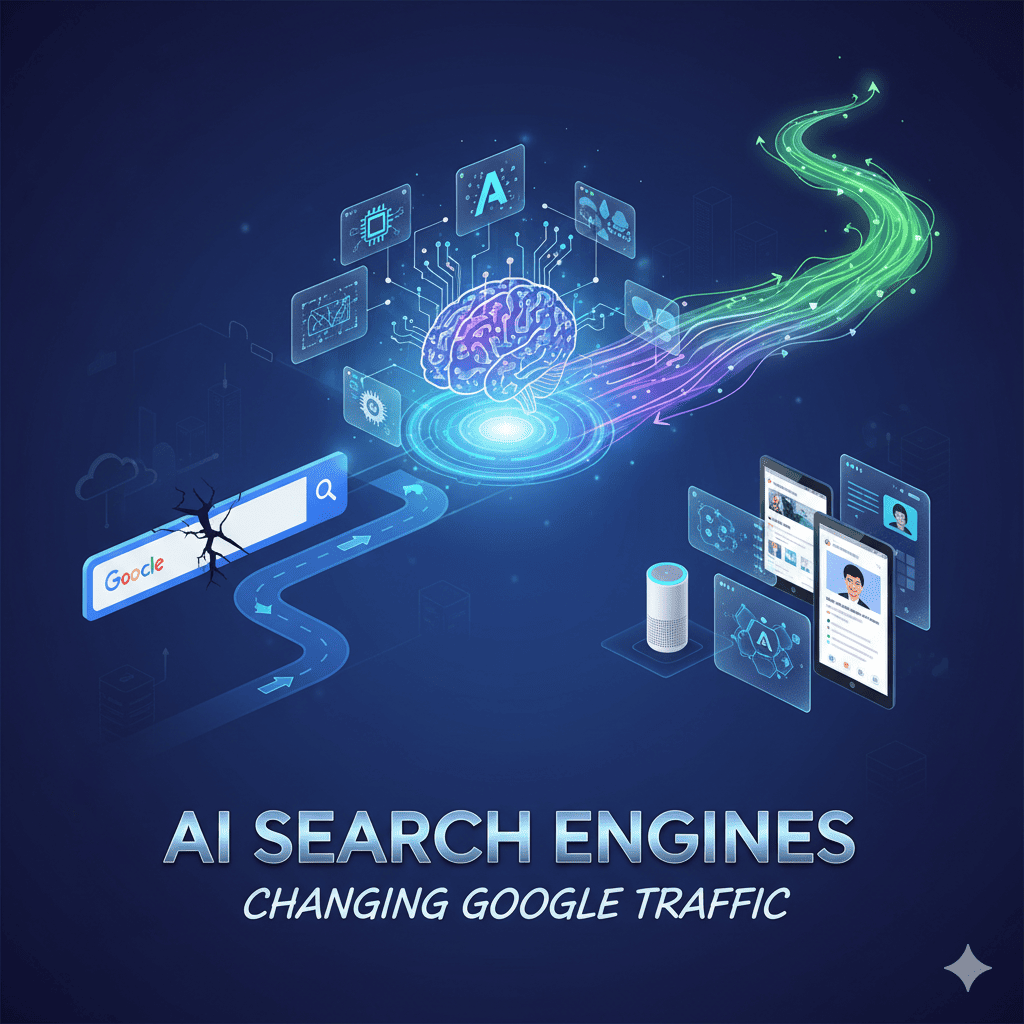
The digital landscape is experiencing a seismic shift. As artificial intelligence continues to evolve at breakneck speed, the very foundation of search engine optimization is being rewritten. The future of SEO is no longer about gaming algorithms or stuffing keywords—it’s about understanding how AI-powered search engines are fundamentally transforming the way people discover content online.
For over two decades, Google has been the undisputed king of search. But today, we’re witnessing something unprecedented: the rise of AI search engines that are challenging traditional search paradigms and forcing marketers to completely rethink their strategies. If you’re not preparing for this transformation, you’re already falling behind.
The AI Search Revolution: What’s Actually Happening
The introduction of ChatGPT in late 2022 didn’t just create a viral sensation—it sparked a revolution in how people seek information online. Within months, Microsoft integrated GPT-4 into Bing, Google launched Bard (now Gemini), and a wave of AI-powered search alternatives emerged, from Perplexity to You.com.
The future of SEO is being shaped by these AI search engines that don’t just return a list of blue links. Instead, they synthesize information from multiple sources and provide direct answers, complete with conversational context and follow-up capabilities. This fundamental shift is already impacting Google traffic patterns in ways that would have seemed impossible just two years ago.
How AI Search Engines Differ from Traditional Search
Traditional search engines like Google have always used algorithms to rank pages based on hundreds of factors. You type a query, you get a list of results, and you click through to find your answer. Simple, predictable, and the foundation of modern SEO.
AI search engines work differently. They:
- Understand context and intent with unprecedented accuracy
- Synthesize information from multiple sources into coherent responses
- Enable conversational follow-ups without starting new searches
- Provide direct answers rather than just links
- Learn from interactions to improve future responses
This isn’t just an incremental improvement—it’s a paradigm shift that fundamentally changes the relationship between users and search technology.
The Future of SEO: Key Trends Reshaping the Industry
1. Zero-Click Searches Are Becoming the Norm
We’re rapidly approaching a world where users get their answers without ever clicking through to a website. Google has been moving in this direction for years with featured snippets, knowledge panels, and direct answers. AI search engines have accelerated this trend exponentially.
According to recent industry data, zero-click searches already account for a significant portion of all Google searches. With AI-generated answers appearing directly in search results through features like Google’s Search Generative Experience (SGE), this percentage is only growing.
What this means for your SEO strategy:
The traditional goal of “rank number one” is becoming obsolete. Instead, the future of SEO demands that you focus on being the source that AI engines cite and reference. Your content needs to be so authoritative, well-structured, and valuable that AI algorithms choose to pull from your site when generating responses.
2. E-E-A-T Is More Critical Than Ever
Google’s E-E-A-T guidelines (Experience, Expertise, Authoritativeness, Trustworthiness) have always been important, but in the AI era, they’re becoming the primary differentiator between content that gets referenced and content that gets ignored.
AI search engines are trained to identify and prioritize high-quality, trustworthy sources. They can detect when content is thin, derivative, or lacks genuine expertise. The future of SEO belongs to brands and creators who can demonstrate real authority in their niches.
This means:
- Publishing content written by genuine experts with verifiable credentials
- Building comprehensive author profiles and entity associations
- Earning citations and mentions from other authoritative sources
- Creating content based on original research and firsthand experience
- Maintaining consistent quality across your entire content ecosystem
3. Conversational Content Is King
AI search engines excel at understanding natural language and conversational queries. People are no longer limited to typing stilted keyword phrases—they can ask questions the same way they’d ask a knowledgeable friend.
The future of SEO requires optimizing for these conversational queries. This means:
Creating FAQ-style content that directly answers common questions in your industry. But not generic FAQs—in-depth, nuanced answers that provide real value.
Structuring content for featured snippets and AI extraction. Use clear headings, concise paragraphs, and well-formatted lists that AI engines can easily parse and understand.
Thinking beyond keywords to topics and themes. Google’s AI algorithms understand semantic relationships and topic clusters far better than simple keyword matching.
Anticipating follow-up questions and addressing them within your content. When someone asks one question, what are they likely to ask next? Address the entire information journey.
4. Technical SEO Is Evolving Rapidly
While AI is changing how content is discovered and consumed, technical SEO fundamentals remain crucial—though they’re evolving to meet new requirements.
Schema markup and structured data have become more important than ever. AI search engines rely heavily on structured data to understand and categorize content. Implementing comprehensive schema markup helps ensure your content is correctly interpreted and referenced.
Page experience signals continue to matter. Core Web Vitals, mobile optimization, and page speed all affect how AI engines evaluate and prioritize content. If your site provides a poor user experience, AI algorithms will be less likely to recommend it.
Entity optimization is emerging as a critical factor. The future of SEO involves helping AI engines understand the entities (people, places, things, concepts) on your site and how they relate to each other and to broader knowledge graphs.
5. Content Quality Over Quantity—Finally
For years, SEO advice has wavered between “publish more content” and “focus on quality.” AI search engines have settled this debate definitively: quality wins, and it’s not even close.
AI can instantly detect thin content, keyword stuffing, and low-value pages. It can identify when content is genuinely useful versus when it’s been created primarily to manipulate search rankings. The future of SEO rewards depth, originality, and genuine value.
This means:
Publishing comprehensive, authoritative content that fully addresses topics rather than churning out dozens of shallow articles targeting long-tail keywords.
Updating existing content to keep it accurate, relevant, and comprehensive rather than constantly creating new pages.
Focusing on user intent at every stage of the customer journey, from awareness through decision.
Creating content that deserves to be cited by AI search engines because it offers unique insights, original research, or exceptional clarity.
Google’s Response: Search Generative Experience and Beyond
Google hasn’t been sitting idle while AI search competitors emerged. The company has been aggressively integrating AI into its search experience through SGE (Search Generative Experience) and continuous updates to its core algorithms.
SGE represents the future of SEO from Google’s perspective. When activated, it provides AI-generated summaries at the top of search results, synthesizing information from multiple sources and offering conversational follow-up options.
What SGE Means for Your Traffic
Early data from SGE’s testing phase reveals concerning trends for traditional SEO:
Reduced click-through rates for many queries, as users get their answers directly from AI-generated summaries.
Increased importance of being cited as a source within SGE responses, which provides some traffic but fundamentally changes the relationship between searchers and content creators.
New opportunities for niche and expert content that provides depth beyond what AI summaries can offer, potentially increasing traffic for truly exceptional content.
Changed user behavior patterns as people learn to interact with search results in new ways, including asking follow-up questions and exploring topics more deeply within the search interface.
Adapting Your SEO Strategy for the AI Era
Understanding how AI is changing search is only the first step. The future of SEO requires concrete, actionable strategies that position your content for success in this new landscape.
Strategy 1: Build Topical Authority
Rather than targeting individual keywords, focus on establishing comprehensive authority in specific topic areas. Create content clusters that cover every aspect of your core subjects, from beginner concepts to advanced nuances.
AI search engines recognize topical authority and are more likely to reference content from sites that demonstrate deep expertise in specific domains. This means:
- Creating pillar content that serves as comprehensive guides to major topics
- Developing supporting content that explores subtopics in detail
- Internal linking that shows the relationships between related content
- Regular updates that keep your content current and comprehensive
Strategy 2: Optimize for AI Visibility
Just as you once optimized for Google’s crawlers, you now need to optimize for AI engines that read and interpret your content. This includes:
Using clear, logical content structures with descriptive headings and subheadings that help AI understand your content hierarchy.
Implementing comprehensive schema markup that provides explicit signals about your content’s meaning and context.
Writing in clear, accessible language that AI can easily parse and understand, while still maintaining the depth that establishes expertise.
Creating dedicated answer sections for common questions that AI engines can easily extract and cite.
Including data, statistics, and original research that AI engines value when generating authoritative responses.
Strategy 3: Focus on User Experience Signals
AI search engines are increasingly sophisticated at evaluating whether users find content genuinely helpful. This goes beyond traditional engagement metrics to include:
Comprehensive coverage that fully answers questions without requiring users to visit multiple sources.
Clear, scannable formatting that helps users quickly find the specific information they need.
Fast loading times and smooth technical performance that don’t frustrate users.
Mobile optimization that works flawlessly across all devices and screen sizes.
Multimedia elements like images, videos, and interactive content that enhance understanding.
Strategy 4: Develop a Brand Presence Beyond Search
The future of SEO isn’t just about search engines—it’s about being known and trusted across multiple channels. AI engines consider brand signals and mentions across the web when evaluating authority.
This means:
- Building a strong social media presence that establishes thought leadership
- Earning mentions and citations in industry publications and on other authoritative sites
- Creating shareable content that naturally earns backlinks and references
- Engaging in your community through comments, forums, and industry discussions
- Developing author profiles that build personal and brand authority
Strategy 5: Embrace AI as a Tool, Not a Threat
Many SEO professionals see AI as a threat to their livelihoods. Smart ones see it as the most powerful tool to ever emerge for content creation and optimization.
AI can help you:
Research topics comprehensively by analyzing what questions people are asking and what information gaps exist.
Generate content outlines that ensure comprehensive topic coverage.
Identify optimization opportunities in existing content.
Analyze competitor content to understand what’s working in your niche.
Create variations and test different approaches to see what resonates with both AI engines and human readers.
The key is using AI to enhance your expertise and efficiency, not to replace genuine knowledge and insight. AI-generated content without human expertise, editing, and oversight is easily detected and undervalued by AI search engines.
The Changing Nature of Keywords in AI Search
Keywords aren’t dead—but the future of SEO requires a completely different approach to keyword research and targeting.
From Keywords to Topics and Entities
AI search engines don’t think in terms of individual keywords. They understand topics, entities, and the relationships between them. This means your keyword research should evolve to:
Identify core topics rather than just high-volume keywords. What broad subjects does your audience care about?
Map entity relationships. What people, places, things, and concepts are related to your topics? How do they connect?
Understand semantic relationships. What related terms, synonyms, and conceptually linked ideas should your content address?
Focus on question-based queries. What specific questions do people ask about your topics, and how do those questions relate to each other?
Optimizing for Semantic Search
Semantic search has been Google’s direction for years, but AI has made it the dominant force in how search works. The future of SEO demands that you:
Use natural language that flows conversationally rather than awkwardly incorporating keyword phrases.
Cover topics comprehensively rather than targeting specific keyword density percentages.
Include related terms and concepts naturally throughout your content.
Address user intent at every stage of the customer journey.
Create content relationships through internal linking and topic clustering that help AI understand your site’s expertise.
The Impact on Different Types of Content
AI search engines affect different content types in different ways, and the future of SEO looks different depending on what kind of content you create.
Informational Content
Blog posts, guides, and educational content face the biggest disruption from AI search. When AI can synthesize information from multiple sources and provide direct answers, why would users click through to individual articles?
The winning strategy: Create content so comprehensive, well-researched, and authoritative that it becomes the primary source AI engines reference. Focus on:
- Original research and data that can’t be found elsewhere
- Unique expert insights based on real experience
- Comprehensive coverage that goes beyond surface-level information
- Multimedia elements that provide value beyond text
- Regular updates that keep information current and accurate
Commercial Content
Product pages, category pages, and transactional content actually have advantages in the AI era. Users still need to click through to make purchases, compare specific products, and see current pricing and availability.
The winning strategy: Optimize for AI engines to recommend your products and services by:
- Providing detailed, accurate product information with comprehensive schema markup
- Including expert reviews and user-generated content that establishes trust
- Offering unique value propositions that differentiate you from competitors
- Maintaining excellent user experience that converts visitors once they arrive
- Building brand authority that AI engines recognize and trust
Local Content
Local businesses have unique opportunities in the future of SEO. AI search engines still need to direct users to physical locations and local service providers.
The winning strategy: Dominate local AI search by:
- Maintaining accurate, comprehensive business information across all platforms
- Earning reviews and mentions that establish local authority
- Creating location-specific content that addresses local search intent
- Building relationships with local entities that boost your knowledge graph presence
- Optimizing for voice search and mobile queries that often have local intent
Measuring Success in the AI Search Era
Traditional SEO metrics are becoming less meaningful as AI changes how people interact with search results. The future of SEO requires new ways of measuring success.
Beyond Rankings and Click-Through Rates
While rankings and organic traffic remain important, they tell an incomplete story in the AI era. You also need to track:
Brand mentions and citations in AI-generated responses, even when they don’t result in direct clicks.
Branded search volume as an indicator of growing awareness and authority.
Engagement quality rather than just quantity—are visitors finding your content valuable enough to spend time with it?
Conversion rates from organic traffic, which may be lower in volume but higher in quality.
Share of voice in your industry, including mentions across social media and other platforms.
Attribution Challenges
As AI search engines provide direct answers without clear attribution, tracking which content influences customer decisions becomes more complex. The future of SEO requires sophisticated attribution models that account for:
- Multiple touchpoints across different channels
- The influence of brand awareness and authority
- Assisted conversions that don’t show up in traditional analytics
- Long-term relationship building rather than immediate conversions
Preparing for What’s Next
The transformation of search isn’t finished—it’s just beginning. The future of SEO will continue to evolve as AI technology advances and user behavior adapts.
Emerging Trends to Watch
Multimodal search that combines text, images, video, and voice in sophisticated ways. AI engines are getting better at understanding and generating responses across multiple formats.
Personalized AI assistants that remember user preferences and provide increasingly tailored responses. This could fragment search into thousands of individual experiences rather than universal rankings.
Real-time information synthesis that pulls from current sources to provide up-to-the-minute answers, making content freshness more critical than ever.
Voice-first interactions as AI assistants become the primary search interface for many users, especially on mobile devices.
Integration with productivity tools where AI search becomes embedded in the software people use daily, from email to project management to content creation.
Building a Future-Proof SEO Strategy
Rather than trying to game the next algorithm update, the future of SEO requires building a foundation that will remain valuable regardless of how search technology evolves:
Prioritize genuine expertise and value creation above all else. If your content wouldn’t be helpful to real people, it won’t succeed with AI search engines.
Build brand authority and recognition that extends beyond search. The strongest SEO position is being the recognized expert in your field.
Stay technically excellent by maintaining fast, secure, accessible websites that provide great user experiences.
Embrace experimentation and be willing to adapt as new AI search features and competitors emerge.
Focus on building relationships with your audience rather than just attracting clicks. Email lists, social followings, and community engagement provide stability as search continues to evolve.
Conclusion: Thriving in the AI Search Era
The future of SEO isn’t about fighting against AI search engines—it’s about understanding how to succeed in a landscape where AI mediates the relationship between content creators and audiences.
The businesses and creators who will thrive are those who recognize that AI search rewards the same things that have always made content valuable: genuine expertise, comprehensive coverage, clear communication, and real value to readers. The difference is that AI is far better at detecting these qualities than traditional algorithms ever were.
This might seem daunting, but it’s actually good news. The playing field is leveling. You can’t game AI search engines with tricks and shortcuts. Success requires actually being good at what you do and communicating that expertise effectively.
The future of SEO demands more from content creators, but it also offers unprecedented opportunities to those willing to adapt. By focusing on quality over quantity, authority over optimization tricks, and genuine value over search engine manipulation, you can position yourself to not just survive the AI search revolution—but to thrive in it.
The question isn’t whether AI will transform search—it already has. The question is whether you’ll transform your approach to keep pace. The businesses making that transformation now will be the ones dominating search results, AI citations, and customer attention in the years to come.
Also read this:
Micro-Niches That Are Exploding in 2025: How to Get In Early & Become Highly Profitable
Top Emerging Side Hustles You Can Start in 2025 Using Zero Investment