
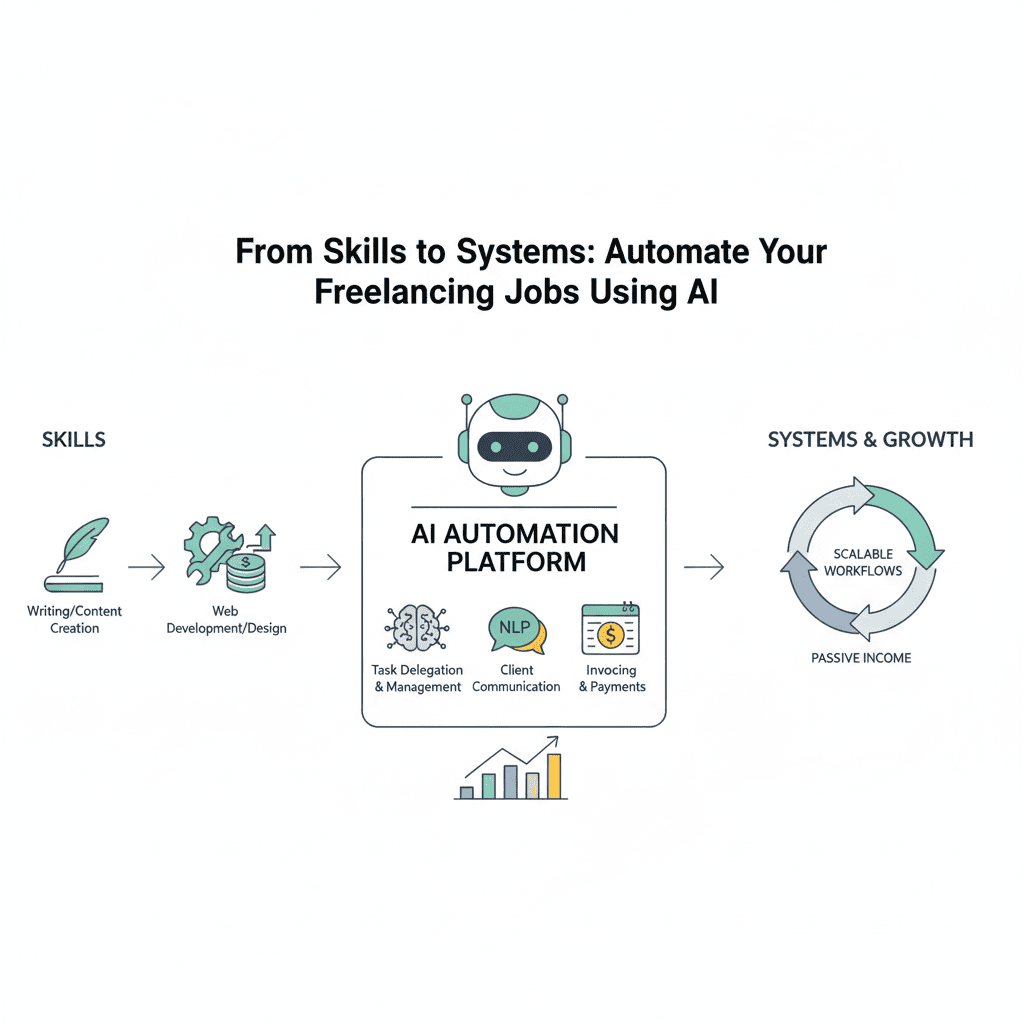
The Freelancer’s Evolution: From Trading Time to Building Systems
For decades, freelancing has operated on a simple principle: you trade your time and skills for money. You write an article, design a logo, code a website, or manage social media—and you get paid for each deliverable. But this model has a fundamental limitation: there are only so many hours in a day. Your income is directly capped by the time you can personally invest.
The AI revolution is changing everything. Freelancers who understand how to transition From Skills to Systems are discovering they can serve more clients, deliver faster results, maintain higher quality, and earn significantly more—all while working fewer hours. This isn’t about replacing your skills with AI; it’s about amplifying them through intelligent automation.
The shift From Skills to Systems represents a fundamental mindset change. Instead of asking “How can I personally complete this task?” you ask “How can I create a system that produces this result?” Instead of being the person who does the work, you become the architect who designs processes that leverage AI to handle repetitive, time-consuming tasks while you focus on strategy, creativity, and client relationships.
This comprehensive guide reveals how freelancers across industries are making the transformation From Skills to Systems, building automated workflows that multiply their productivity, income, and impact. Whether you’re a writer, designer, developer, marketer, or consultant, AI-powered automation can revolutionize your freelancing business.
Understanding the Skills to Systems Paradigm
Before diving into specific automation strategies, let’s clarify what moving From Skills to Systems actually means for freelancers.
The Skills-Based Approach
Traditional freelancing is purely skills-based. You possess expertise in your field, clients hire you for that expertise, and you personally execute every aspect of the work. If you’re sick, on vacation, or simply too busy, you can’t serve additional clients. Your revenue scales linearly with your available time.
This approach works—millions of freelancers build successful careers this way. But it’s inherently limited and exhausting. You’re perpetually trading time for money, and there’s always a ceiling on what you can earn.
The Systems-Based Approach
Systems-based freelancing transforms how you deliver value. You identify the repeatable components of your work, create processes and frameworks for handling them, and leverage AI tools to automate execution. You shift your role from executor to orchestrator.
This doesn’t mean removing yourself entirely. It means strategically applying your expertise where it creates maximum value—strategy, creative direction, quality control, client relationship management—while AI handles data processing, initial drafts, repetitive tasks, and routine optimization.
The freelancer who makes the transition From Skills to Systems can serve five, ten, or twenty times as many clients as their skills-only counterparts, often delivering superior results because systematic approaches eliminate human inconsistency and fatigue.
The Hybrid Reality
In practice, successful freelancers don’t completely abandon skills for systems. They develop a hybrid approach: using AI systems to handle the scalable, repetitive elements of their work while applying personal expertise to customization, strategic thinking, and high-value tasks that AI can’t yet handle.
This combination creates a competitive advantage that pure AI cannot replicate and traditional freelancers cannot match. You deliver the speed and consistency of automation with the insight and creativity that only human expertise provides.
1. Writing and Content Creation: From Blank Pages to Content Systems
Writers and content creators are experiencing the most dramatic transformation in the journey From Skills to Systems. AI writing tools have evolved from curiosity to indispensable productivity multipliers.
Blog Post and Article Automation
The traditional writing process involves extensive research, outlining, drafting, editing, and formatting—consuming hours per article. Freelance writers moving From Skills to Systems now create structured workflows:
Research Phase: AI tools like Perplexity or ChatGPT rapidly gather background information, statistics, and relevant data points on any topic. What once took an hour of reading now takes ten minutes of strategic querying.
Outline Generation: AI generates comprehensive outlines based on target keywords, audience needs, and content goals. You review, adjust, and approve—transforming hours of structural planning into focused fifteen-minute sessions.
First Draft Creation: AI produces initial drafts following your approved outlines. These aren’t final products but solid foundations containing properly structured arguments, relevant examples, and appropriate tone. What once required three hours now takes twenty minutes of prompting.
Editorial Enhancement: You apply your expertise to elevate AI drafts—adding unique insights, refining arguments, incorporating personal stories, optimizing flow, and ensuring authentic voice. This strategic editing delivers value AI cannot while completing in a fraction of traditional writing time.
SEO Optimization: AI tools analyze content for keyword density, readability, semantic relevance, and optimization opportunities. They suggest improvements that might take hours to identify manually.
Writers who successfully navigate From Skills to Systems report producing 3-5x more content while maintaining or improving quality. Instead of writing two articles weekly, they complete ten—dramatically multiplying income without proportionally increasing hours.
Social Media Content Systems
Social media management traditionally involves brainstorming ideas, writing captions, finding or creating images, scheduling posts, and engagement monitoring—extraordinarily time-consuming when managing multiple clients.
Systematized social media management uses AI to:
- Generate month-long content calendars in minutes
- Create platform-optimized captions with appropriate hashtags
- Suggest trending topics relevant to each client
- Draft engagement responses
- Analyze performance and recommend adjustments
Freelancers managing five social media clients can now handle fifteen, delivering consistent content that would be impossible to produce manually.
Email Newsletter Automation
Newsletter writers create systematic workflows where AI handles research aggregation, initial draft creation, formatting, and even subject line optimization. The writer focuses on curating the most relevant information, adding editorial perspective, and ensuring brand voice—completing newsletters in 30% of traditional time.
Copywriting Systems
Direct response copywriters develop AI-powered systems for generating ad copy variations, headline options, email sequences, and landing page content. They use frameworks like AIDA, PAS, or the Hero’s Journey, prompting AI to generate multiple versions following proven formulas. The copywriter then applies expertise to select, refine, and optimize the strongest options.
2. Graphic Design and Visual Content: From Photoshop to Automated Design
Designers embracing the transition From Skills to Systems leverage AI design tools to handle routine design work while focusing creative energy on conceptual thinking and brand strategy.
Template-Based Design Systems
Instead of creating every design from scratch, systematized designers build comprehensive template libraries using tools like Canva Pro, Adobe Express, or Figma with AI plugins. They create branded template systems for clients covering:
- Social media posts in multiple formats
- Blog graphics and featured images
- Presentation templates
- Marketing collateral
- Email headers and graphics
AI-powered design tools then enable rapid customization. Changing colors, swapping images, adjusting layouts, and generating variations happens in seconds rather than hours. What once required thirty minutes per graphic now takes three.
AI-Generated Visual Assets
Tools like Midjourney, DALL-E, and Stable Diffusion enable designers to generate custom illustrations, photography, backgrounds, and visual elements on demand. Designers moving From Skills to Systems use AI for:
- Stock photography alternatives
- Custom illustration creation
- Background generation
- Icon and element design
- Mood board development
Instead of spending hours searching stock sites or manually creating elements, they generate exactly what they need in minutes, then apply design expertise to integration, refinement, and cohesive execution.
Automated Brand Identity Systems
AI tools assist in generating logo concepts, color palette suggestions, typography pairings, and brand style directions. The designer’s role shifts from manual exploration of every possibility to quickly evaluating AI-generated options and applying expertise to refinement and strategic selection.
This accelerates the brand identity process dramatically. Initial concepts that once required a full day now generate in an hour, allowing designers to serve more clients while maintaining quality through strategic curation and customization.
Batch Processing and Variations
AI-powered design systems excel at creating variations. Need the same design in ten different sizes? Thirty different color schemes? Fifteen language versions? Automated systems handle this instantly—work that would consume hours manually.
3. Web Development and Technical Services: From Coding to Configuration
Developers transitioning From Skills to Systems leverage AI coding assistants, no-code platforms, and automated workflows to build websites and applications faster than ever imagined.
AI-Assisted Development
Tools like GitHub Copilot, ChatGPT, and Claude transform development from purely manual coding to collaborative creation with AI assistance. Developers describe desired functionality, and AI generates initial code implementations.
This doesn’t eliminate the need for development expertise—quite the opposite. Developers must understand code to evaluate, debug, customize, and integrate AI-generated solutions. But the speed improvement is transformative. Functions that required hours of coding now generate in minutes, requiring only review and refinement.
Component and Template Libraries
Systematized developers build extensive libraries of reusable components, templates, and code snippets. Combined with AI tools that help customize these elements for specific client needs, they assemble sophisticated websites in fractions of traditional development time.
No-Code and Low-Code Amplification
Platforms like Webflow, Bubble, and WordPress with AI plugins enable developers to build functional websites and applications without writing code from scratch. Developers moving From Skills to Systems use these platforms strategically:
- Handling straightforward projects entirely through no-code platforms
- Using no-code for rapid prototyping before custom development
- Combining no-code foundations with custom code for specific functionality
- Training AI systems to generate configurations for common requirements
Automated Testing and Debugging
AI tools assist with identifying bugs, suggesting fixes, writing test cases, and optimizing performance. Tasks that once required dedicated testing time now happen continuously, improving quality while reducing development time.
4. Digital Marketing: From Campaign Management to Marketing Automation
Digital marketers embracing the shift From Skills to Systems automate campaign creation, optimization, and reporting while focusing strategy and creative direction.
Automated Campaign Creation
AI tools generate complete marketing campaigns including:
- Ad copy across multiple platforms
- Targeting recommendations
- Budget allocation strategies
- A/B testing variations
- Optimization suggestions
Marketers who once spent days creating campaigns now complete initial setups in hours, then apply expertise to strategic refinement and performance optimization.
SEO Automation Systems
SEO services traditionally involve extensive manual research, analysis, and optimization. Systematized SEO leverages AI for:
- Keyword research and opportunity identification
- Content gap analysis
- Competitive analysis
- Technical SEO auditing
- Content optimization recommendations
- Link building prospect identification
The SEO specialist shifts from manual execution to strategic orchestration—reviewing AI analysis, prioritizing opportunities, and ensuring implementation aligns with broader business goals.
Reporting and Analytics Automation
Client reporting consumes enormous time for digital marketers. Automated reporting systems pull data from multiple platforms, generate visualizations, identify trends, and draft performance summaries. Marketers review, add strategic insights, and deliver comprehensive reports in minutes rather than hours.
Email Marketing Systems
AI-powered email marketing automation includes:
- Segmentation strategy development
- Subject line generation and testing
- Email copy creation
- Send time optimization
- Performance analysis and improvement recommendations
Marketers managing email for five clients can scale to fifteen without proportionally increasing workload.
5. Video Production and Editing: From Hours to Minutes
Video creators moving From Skills to Systems leverage AI video tools to handle editing, production, and optimization tasks that traditionally consumed days.
Automated Video Editing
AI editing tools like Descript, Runway, and CapCut dramatically accelerate video production:
- Automatic transcription and caption generation
- Filler word removal with one click
- Scene detection and automatic cutting
- Background removal without green screens
- Audio enhancement and noise reduction
- Color correction and grading
What once required hours of manual editing now happens automatically, with creators focusing time on creative decisions rather than technical execution.
Script-to-Video Systems
AI tools transform scripts into complete videos:
- AI-generated voiceovers in natural-sounding voices
- Automated B-roll selection and integration
- Dynamic caption and text overlay generation
- Music selection and integration
- Template-based animation
Video producers focusing on script quality and strategic direction can produce 5-10x more videos using these automated systems.
Content Repurposing Automation
Long-form videos automatically transform into:
- Short-form clips for social media
- Audio podcasts
- Blog post transcriptions
- Quote graphics
- Email newsletter content
AI identifies the most engaging moments, generates appropriate formats, and optimizes for each platform—multiplication of content that would be prohibitively time-consuming manually.
6. Virtual Assistance and Administrative Services: From Task Execution to Workflow Management
Virtual assistants transitioning From Skills to Systems orchestrate AI-powered workflows rather than manually executing every administrative task.
Email Management Systems
AI email assistants draft responses, categorize messages, schedule follow-ups, and flag priorities. Virtual assistants review and approve rather than composing every response from scratch—handling 3x more email volume with the same time investment.
Scheduling and Calendar Automation
AI scheduling tools handle back-and-forth coordination, optimize meeting times, prepare briefing documents, and manage cancellations automatically. Virtual assistants focus on relationship management and strategic coordination rather than calendar tetris.
Data Entry and Processing
AI tools extract information from documents, populate databases, generate reports, and identify patterns—tasks that once consumed hours of manual work now happen instantly, requiring only quality assurance review.
Research and Information Gathering
AI research assistants gather information, summarize findings, identify relevant sources, and organize results. Virtual assistants moving From Skills to Systems assign research tasks to AI tools, then apply judgment to evaluate and synthesize results for clients.
7. Consulting and Strategy: From Analysis to Insight Orchestration
Consultants shifting From Skills to Systems use AI to handle data analysis, research, and initial recommendations, focusing their expertise on strategic insight and implementation guidance.
Data Analysis Automation
AI tools analyze business data, identify trends, generate visualizations, and suggest interpretations. Consultants focus on validating insights, adding contextual understanding, and translating findings into actionable strategies.
Competitive Research Systems
Instead of manually researching competitors, systematized consultants use AI to:
- Monitor competitor activities across channels
- Analyze competitive positioning and messaging
- Identify market trends and opportunities
- Benchmark performance metrics
- Generate strategic recommendations
Proposal and Report Generation
AI assistants create initial drafts of proposals, reports, presentations, and strategic documents based on research and analysis. Consultants refine these drafts, adding proprietary frameworks, custom insights, and strategic perspective.
Client Communication Automation
Automated systems handle routine client communications, scheduling, follow-ups, and status updates. Consultants focus conversation time on strategic discussions, problem-solving, and relationship building rather than administrative coordination.
8. Building Your Automation Stack: Tools and Technologies
Successfully transitioning From Skills to Systems requires assembling the right technology toolkit for your specific freelancing niche.
Essential AI Writing Tools
- ChatGPT/Claude: Comprehensive writing assistance for drafts, editing, research
- Jasper/Copy.ai: Specialized copywriting and content generation
- Grammarly: AI-powered editing and optimization
- Hemingway: Readability analysis and improvement
Design and Visual Tools
- Midjourney/DALL-E: AI image generation
- Canva Pro: Template-based design with AI features
- Adobe Firefly: AI-powered creative tools
- Remove.bg: Automated background removal
Development and Technical Tools
- GitHub Copilot: AI pair programming
- Cursor: AI-powered code editor
- Webflow: Visual development platform
- Zapier/Make: Workflow automation
Marketing and Analytics Tools
- Surfer SEO: Content optimization
- Semrush: SEO research and analysis
- AdCreative.ai: Ad generation and testing
- Notion AI: Documentation and planning
Video and Audio Tools
- Descript: AI video and audio editing
- ElevenLabs: AI voice generation
- Runway: AI video creation and editing
- OpusClip: Automated short-form video creation
Organization and Workflow Tools
- Notion: Documentation and project management
- Airtable: Database and workflow automation
- Calendly: Scheduling automation
- Slack: Communication with AI integrations
9. Implementation Strategy: Making the Transition Successfully
Understanding tools is valuable, but successfully transitioning From Skills to Systems requires strategic implementation.
Phase 1: Audit Your Current Workflows
Document every task you regularly perform for clients. Identify:
- Time-consuming repetitive tasks
- Work that follows predictable patterns
- Tasks that don’t require your highest expertise
- Bottlenecks that limit your capacity
- Quality control checkpoints
This audit reveals automation opportunities and helps prioritize where AI integration creates maximum impact.
Phase 2: Start with One High-Impact Process
Don’t attempt to automate everything simultaneously. Choose one frequently performed, time-consuming task and build a systematic approach:
- Define the desired outcome clearly
- Identify AI tools that address this task
- Experiment with different approaches
- Refine prompts and processes
- Document your system
- Measure time savings and quality
Success with one process builds confidence and skills for automating additional workflows.
Phase 3: Create Standard Operating Procedures
Document your AI-powered systems as step-by-step procedures. Include:
- Specific tools used
- Exact prompts or inputs
- Decision points requiring human judgment
- Quality control checkpoints
- Common problems and solutions
These SOPs enable consistency, allow delegation, and ensure you can replicate success across projects.
Phase 4: Train Your AI Systems
Many AI tools improve with use and feedback. Invest time in:
- Refining prompts based on outputs
- Building custom instructions or style guides
- Creating example libraries that demonstrate desired results
- Providing feedback that improves future generations
This training multiplies efficiency gains over time as your systems become increasingly aligned with your standards.
Phase 5: Iterate and Optimize
Your initial automation systems won’t be perfect. Commit to continuous improvement:
- Track time saved versus traditional approaches
- Monitor quality compared to manual work
- Gather client feedback on deliverables
- Identify remaining bottlenecks
- Test new tools and approaches
- Update SOPs based on learning
The transition From Skills to Systems is ongoing—technology evolves, your skills develop, and optimization never ends.
10. Scaling Your Systemized Freelancing Business
Once you’ve established AI-powered systems, strategic scaling multiplies the benefits of automation.
Serving More Clients Without Proportional Time Increase
Automated systems enable capacity multiplication. If AI reduces task time by 70%, you can theoretically serve 3-4x as many clients. Strategic scaling means:
- Gradually increasing client load while monitoring quality
- Setting clear capacity limits based on systematic capabilities
- Pricing to reflect value delivered rather than hours worked
- Being selective about ideal clients for your systems
Moving Upmarket with Premium Pricing
Systematized freelancers deliver faster results with consistent quality—attributes clients pay premium rates for. Many freelancers transitioning From Skills to Systems successfully raise rates 50-100% because they provide superior value despite lower time investment.
Creating Productized Services
Systems naturally evolve into productized services—standardized offerings with defined deliverables, timelines, and pricing. This eliminates custom scoping for every project, accelerates sales cycles, and creates predictable operations.
Building a Team Around Your Systems
Your documented SOPs enable delegation. Hire junior freelancers or virtual assistants to handle portions of your systematic workflows while you focus on client relationships, strategic direction, and quality assurance.
This transforms you from freelancer to agency owner, multiplying capacity beyond even AI-enhanced personal productivity.
Developing Passive Income Streams
Your expertise in systematic automation itself becomes valuable. Consider:
- Creating courses teaching others your systems
- Selling templates, prompts, or SOPs
- Offering consulting on automation strategies
- Building software tools that package your approaches
These income streams leverage your systemization expertise beyond direct client work.
The Ethical Considerations of AI-Powered Freelancing
Transitioning From Skills to Systems raises important ethical questions every freelancer must consider.
Client Disclosure
Should you tell clients you use AI? There’s no universal answer, but consider:
- Clients hire you for results, not specific methods
- Most industries use tools to enhance productivity
- Disclosure might unnecessarily complicate relationships
- However, some clients may specifically request or prohibit AI use
Develop your own ethics around transparency while recognizing that your expertise in orchestrating AI effectively is itself valuable skill.
Quality Assurance Responsibility
You remain fully responsible for quality regardless of AI involvement. Systems must include rigorous quality control ensuring outputs meet professional standards. Never blindly deliver AI-generated work without thorough review.
Maintaining Professional Development
Don’t let AI make you lazy. Continue developing core skills, stay current with industry trends, and deepen expertise. AI amplifies skills—it doesn’t replace the need for competence.
Fair Pricing Practices
Using AI to reduce your time investment doesn’t mean you should proportionally reduce prices. Value-based pricing reflects the result delivered, not hours worked. Your systems represent investment in efficiency that benefits both you and clients.
Conclusion: Your Journey From Skills to Systems
The transformation From Skills to Systems represents one of the most significant opportunities in freelancing history. AI automation enables serving more clients, earning higher income, delivering better results, and working fewer hours—benefits that seem too good to be true but are being realized by forward-thinking freelancers across industries.
This transition isn’t about replacing your expertise with AI. It’s about strategically applying your skills where they create maximum value while delegating routine, repetitive, and time-consuming tasks to automated systems. You become an orchestrator of processes rather than merely an executor of tasks.
The freelancers who thrive in coming years won’t necessarily be those with the strongest traditional skills. They’ll be those who most effectively combine human expertise with AI capabilities, building systems that multiply their impact. They’ll make the shift From Skills to Systems, transforming how they deliver value and what’s possible in their freelancing businesses.
Starting this journey doesn’t require mastering every AI tool or automating everything immediately. It begins with identifying one time-consuming task, finding an AI tool that addresses it, experimenting with systematic approaches, and measuring results. Small wins build momentum for larger transformations.
The shift From Skills to Systems also requires mindset changes. You must overcome the notion that working fewer hours means you’re lazy or that AI assistance diminishes your expertise. You must embrace value-based pricing that reflects outcomes rather than time. You must commit to continuous learning as AI capabilities rapidly evolve.
But for freelancers willing to make this transition, the rewards are transformative. Imagine delivering twice the results in half the time. Imagine serving your dream clients without the constant pressure of capacity limits. Imagine building a freelancing business that provides both financial success and personal freedom.
This future isn’t theoretical—it’s being created right now by freelancers who understand that the path From Skills to Systems leads to freedom, profitability, and impact that purely skills-based approaches can never achieve.
The tools are available. The strategies are proven. The opportunity is real. Your journey From Skills to Systems begins with a single automated workflow. Start today, and you’ll be amazed by what becomes possible when you amplify your expertise with systematic AI-powered automation.
Also read this:
Subscription Micro-Brands: Tiny Businesses Making Massive Profit
Post-AI Jobs: What Careers Will Emerge After Automation
Personal Branding with AI: How Founders Clone Themselves Online