
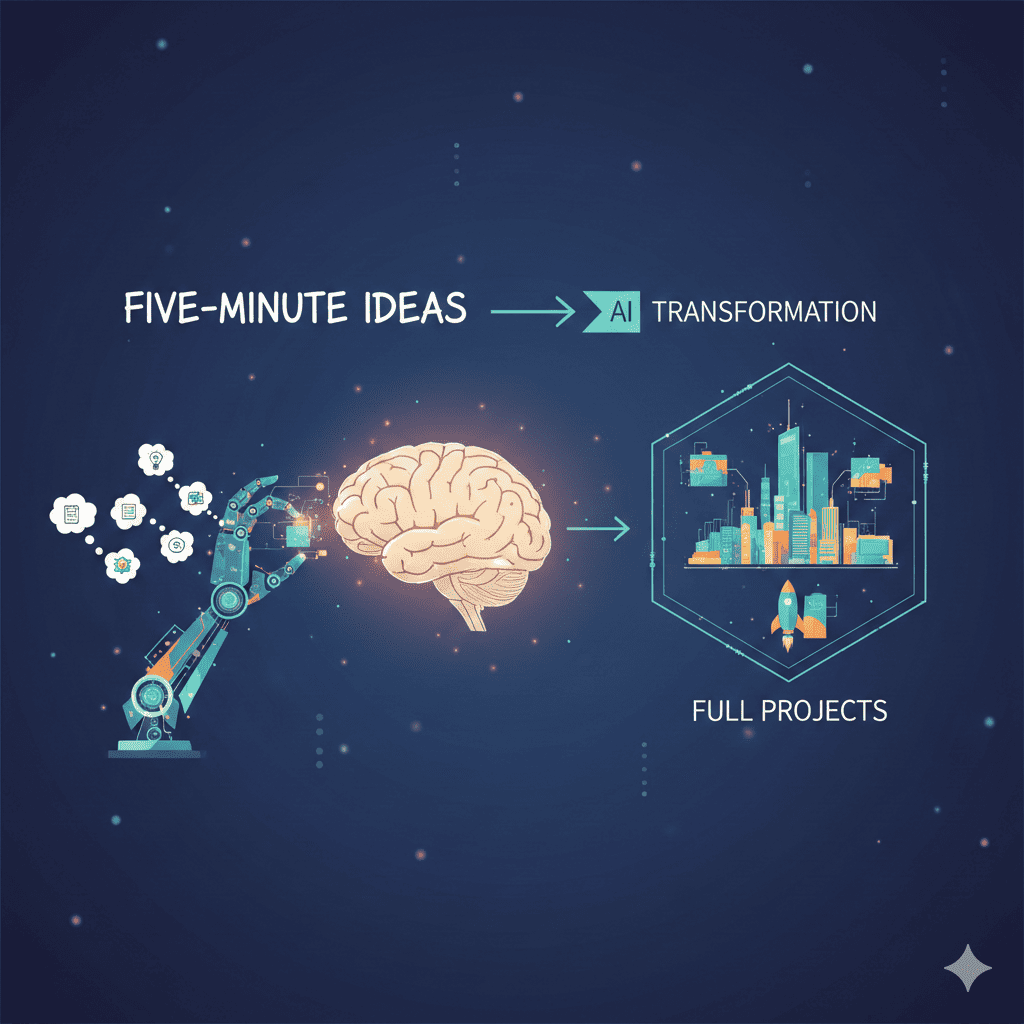
Five-Minute Ideas Into Full Projects The gap between inspiration and execution has always been the graveyard of great ideas. You have a brilliant concept during your morning coffee, sketch it on a napkin, and then reality hits. The coding, the design work, the research, the endless iterations—suddenly, your five-minute spark of genius requires months of specialized work. But artificial intelligence is fundamentally changing this equation, transforming how quickly we can move from concept to completion.
The traditional project development cycle was built on the assumption that creation requires extensive technical knowledge, substantial time investment, and often a team of specialists. AI is now proving that Five-Minute Ideas Into Full Projects isn’t just possible—it’s becoming the new normal. What once took development teams weeks to prototype can now be roughed out in an afternoon. What required hiring designers, writers, and analysts can now be accomplished by a single person with the right AI tools.
This shift represents more than just increased efficiency. It’s democratizing creation itself, allowing anyone with vision to build, test, and refine their ideas without the traditional gatekeepers of technical expertise or substantial capital. The question is no longer whether you have the skills to build something, but whether you have the imagination to conceive it and the judgment to guide its development.
1. The Traditional Project Development Bottleneck
Before understanding how AI accelerates project creation, we need to recognize why project development has historically been so slow and resource-intensive.
The Expertise Barrier
Traditional project development required assembling specialized knowledge across multiple domains. Building even a simple web application meant understanding front-end development, back-end architecture, database design, user experience principles, and deployment infrastructure. Each of these areas represents years of learning and practice. For most people with great ideas, this expertise gap was insurmountable without hiring expensive professionals or spending years in self-education.
The Time Investment Problem
Five-Minute Ideas Into Full Projects Even for skilled professionals, projects consumed enormous amounts of time. A custom website might take 40-80 hours to build from scratch. A marketing campaign required days of research, copywriting, design work, and revision cycles. Data analysis projects could stretch for weeks as analysts cleaned data, built models, and generated reports. This time investment made experimentation costly—you couldn’t afford to test ten ideas to find the one that worked.
The Iteration Penalty
Perhaps most limiting was the cost of iteration. In traditional development, making significant changes meant revisiting multiple layers of work. Changing a website’s design meant rewriting HTML, CSS, and possibly JavaScript. Pivoting a business strategy meant redoing market research, financial models, and planning documents. This made projects rigid—once you committed to a direction, changing course became prohibitively expensive.
The Collaboration Overhead
Complex projects required coordination across multiple specialists, each with their own schedules, communication styles, and tool preferences. Project managers spent substantial time simply keeping everyone aligned. Handoffs between team members created delays and opportunities for miscommunication. The more people involved, the slower progress became.
2. How AI Compresses Development Time
AI is revolutionizing how we transform Five-Minute Ideas Into Full Projects by addressing each of these traditional bottlenecks with fundamentally new approaches to creation.
Instant Expertise on Demand
Five-Minute Ideas Into Full Projects AI systems trained on vast amounts of code, design work, and professional documentation can now provide expert-level assistance across dozens of domains simultaneously. Need to build a database schema? AI can design it based on your requirements description. Want to implement a complex algorithm? AI can write and explain the code. Require market analysis? AI can synthesize research and generate insights in minutes.
This doesn’t mean AI replaces deep expertise for complex problems, but it does mean that for the vast majority of common project needs, you can access competent assistance instantly. You’re no longer limited by what you personally know how to do.
Parallel Processing of Tasks
Where human teams must work sequentially or coordinate carefully to work in parallel, AI can tackle multiple aspects of a project simultaneously. While generating code for one component, it can simultaneously draft documentation, create test cases, and suggest architectural improvements. This parallel processing dramatically compresses timelines that would traditionally stretch across days or weeks.
Rapid Iteration Without Penalty
One of AI’s most powerful capabilities is making iteration nearly free. Don’t like the design? Generate ten alternatives in minutes. Want to try a different approach to your data analysis? Reframe the problem and get new results immediately. This transforms project development from a careful, linear process into an exploratory, iterative one where you can experiment freely until you find what works.
Automated Tedious Work
AI excels at the repetitive, time-consuming tasks that traditionally consumed the bulk of project time. Formatting documents, writing boilerplate code, resizing images, cleaning datasets, generating variations of content—these tasks that might take hours can now be completed in seconds. This frees human effort for the truly creative and strategic decisions that determine project success.
3. Real-World Applications: From Concept to Completion
The abstract promise of AI becomes concrete when you see how Five-Minute Ideas Into Full Projects actually works across different domains and use cases.
Software and Web Development
A non-technical entrepreneur can now sketch out an idea for a web application and use AI to generate working code within hours. The AI can create the front-end interface, build the back-end logic, set up database structures, and even deploy the application to the cloud. While the result might not match what a senior development team would produce, it’s often sufficient for testing market interest, gathering user feedback, or even launching a minimum viable product.
The traditional path from idea to working software measured in months now measures in days or even hours. Founders can test multiple product concepts before committing significant resources. Developers can prototype experimental features without derailing their main projects. The feedback loop between idea and implementation has shrunk from months to minutes.
Content Creation and Marketing
Content that traditionally required writers, editors, designers, and strategists can now be produced end-to-end with AI assistance. A business owner can conceive a content marketing campaign in the morning and have blog posts, social media content, email sequences, and landing pages ready for review by afternoon. AI handles research, writing, optimization for search engines, and even generates accompanying images.
This doesn’t eliminate the need for human judgment—someone still needs to ensure the content aligns with brand voice and business goals—but it removes the production bottleneck. The limiting factor becomes strategy and quality control rather than the mechanical work of content creation.
Data Analysis and Business Intelligence
Business analysts traditionally spent 80% of their time cleaning data and only 20% actually analyzing it. AI inverts this ratio. Feed raw data to AI systems and they can clean it, identify patterns, generate visualizations, and produce insights in a fraction of the time. A market analysis that might have taken a week can now be completed in an afternoon.
More importantly, AI makes sophisticated analysis accessible to non-specialists. Small business owners without statistical training can now conduct customer segmentation analysis, forecast demand, and optimize pricing strategies using AI tools that guide them through the process and interpret results in plain language.
Design and Creative Work
Graphic designers once spent hours creating multiple design concepts for client review. AI can now generate dozens of variations in minutes, allowing designers to focus on refinement and strategic direction rather than initial creation. Product designers can rapidly prototype different user interface approaches. Architects can visualize building concepts before investing in detailed technical drawings.
The creative process becomes more exploratory and less constrained by production time. Instead of committing to a single design direction early, creators can explore widely and iterate rapidly until they find the optimal solution.
Research and Learning
Academic researchers and students can now accelerate literature reviews, summarize complex papers, and identify connections across different fields of study. What might have required weeks in the library can now happen in an afternoon with AI assistance. This doesn’t replace deep reading and critical thinking, but it makes the initial exploration phase dramatically more efficient.
Educators can generate customized learning materials, practice problems, and explanations tailored to individual student needs. The creation of educational content—traditionally one of the most time-consuming teaching tasks—can now be accelerated significantly while maintaining or improving quality.
4. The New Skill Set: Directing AI Rather Than Doing Everything Yourself
Transforming Five-Minute Ideas Into Full Projects with AI requires a different skill set than traditional project development, one focused more on direction and judgment than technical execution.
Prompt Engineering and Communication
Five-Minute Ideas Into Full Projects The primary skill in working with AI is learning to communicate your intent clearly and effectively. Vague instructions produce mediocre results. Specific, well-structured prompts generate excellent output. This means learning to break down your vision into clear requirements, provide relevant context, and iterate on your requests as you see what the AI produces.
Good prompt engineering is part technical specification, part creative direction. You’re not just describing what you want built—you’re establishing constraints, setting quality standards, and guiding the AI’s approach to problem-solving.
Quality Evaluation and Refinement
While AI can generate content, code, and designs rapidly, human judgment remains essential for evaluating quality. You need to develop the ability to recognize when AI output meets your standards and when it requires revision. This means understanding enough about your domain to make informed judgments, even if you can’t personally produce the work at that level.
The skill isn’t in creating every element yourself but in recognizing excellence, identifying problems, and directing improvements. You become more curator than creator, though the curation role requires substantial expertise in its own right.
Strategic Thinking and Vision
With AI handling execution, human effort shifts heavily toward strategy and vision. What should we build? Why will it matter? Who is it for? How does it fit into broader goals? These questions become more important because they can’t be delegated to AI. The AI can tell you how to build something, but only you can determine what’s worth building.
This strategic layer includes understanding your audience, recognizing market opportunities, anticipating challenges, and making judgment calls on trade-offs. These distinctly human capabilities become the primary value-add in AI-assisted project development.
Integration and Systems Thinking
Most real projects involve multiple components that need to work together coherently. AI might generate excellent code, copy, and designs independently, but someone needs to ensure these elements integrate into a cohesive whole. This requires systems thinking—the ability to see how parts relate to each other and to the broader project goals.
You’re orchestrating multiple AI interactions toward a unified outcome, maintaining consistency in tone, style, and functionality across all project elements. This coordination role requires you to hold the complete project vision in mind while directing work on individual components.
5. Limitations and Realistic Expectations
While AI dramatically accelerates project development, understanding its limitations is crucial for setting realistic expectations about turning Five-Minute Ideas Into Full Projects.
The Quality Ceiling for Complex Work
AI excels at competent, conventional work but struggles with truly innovative or highly specialized projects. If your idea requires cutting-edge technical solutions, deep domain expertise, or genuinely novel approaches, AI assistance will be helpful but insufficient. You’ll still need human experts for the most challenging aspects.
Five-Minute Ideas Into Full Projects The sweet spot for AI-accelerated development is projects that combine well-understood components in new ways, rather than projects that require fundamentally new solutions to unprecedented problems.
The Revision and Refinement Reality
While AI can produce initial versions rapidly, polishing these to professional standards still requires time and expertise. The first draft from AI might be 70-80% of the way to your goal, but that final 20-30% often requires substantial human effort. The promise isn’t zero-effort project completion but rather compressed timelines and reduced resource requirements.
For many applications, AI output is immediately usable. For others—particularly those where brand reputation or user safety is critical—significant refinement remains necessary.
The Creativity and Originality Question
AI generates content based on patterns in its training data, which means its output tends toward conventional, mainstream solutions. If your project requires genuine originality, unexpected creative leaps, or solutions that challenge existing paradigms, you’ll need to provide that creative direction yourself. AI amplifies and executes your creativity but doesn’t replace it.
This isn’t necessarily a limitation for most projects—conventional, well-executed solutions work perfectly well for most business needs—but it’s important to recognize that breakthrough innovation still requires human imagination.
The Domain Knowledge Requirement
While AI reduces the technical expertise barrier, it doesn’t eliminate the need for domain knowledge entirely. You still need to understand enough about your field to evaluate whether AI outputs make sense, whether they align with industry standards, and whether they’ll actually solve your problem. A medical AI tool might generate plausible-sounding clinical content that contains subtle errors only an expert would catch.
The requirement isn’t to be an expert at execution, but you do need enough knowledge to be an informed client and intelligent evaluator of the work AI produces for you.
6. Best Practices for AI-Accelerated Project Development
Successfully converting Five-Minute Ideas Into Full Projects requires following certain principles that maximize AI’s strengths while compensating for its limitations.
Start with Clear, Specific Goals
AI works best when given precise direction. Instead of “build me a website,” specify “create a three-page portfolio website with a modern, minimalist design, featuring a project gallery with hover effects, a contact form, and mobile responsiveness.” The more specific your initial direction, the better your starting point will be.
This doesn’t mean you need a complete specification upfront—iteration is cheap with AI—but clarity about your ultimate goals helps guide the development process effectively.
Iterate in Layers, Not All at Once
Rather than trying to perfect everything simultaneously, work in iterative layers. First, establish basic structure and functionality. Then refine the design. Then optimize performance. Then polish details. This layered approach lets you validate core concepts before investing time in refinement that might be wasted if you need to change direction.
Each iteration builds on the previous one, allowing you to course-correct based on what you learn without discarding all your work.
Maintain a Clear Vision Document
As your project evolves through multiple AI interactions, maintain a central document describing your vision, requirements, and decisions. This serves as your project’s memory and ensures consistency across different components. Without this, you risk having AI generate contradictory elements because it lacks context from previous interactions.
Your vision document becomes increasingly valuable as projects grow more complex, serving as the source of truth that guides all AI assistance.
Test and Validate Continuously
Don’t wait until a project is “complete” to test whether it works. If you’re building software, test functionality at each stage. If you’re creating content, get feedback from your target audience early. If you’re analyzing data, validate results against known benchmarks. Early testing catches problems when they’re still easy to fix.
The rapid iteration AI enables makes continuous testing practical. You can generate new versions quickly enough that test-driven development becomes the natural workflow.
Combine AI Tools Strategically
Five-Minute Ideas Into Full Projects Different AI tools excel at different tasks. Use specialized coding AI for software development, creative AI for design work, and analytical AI for data work. Learn the strengths and weaknesses of your tool ecosystem and route tasks to whichever tool handles them best. This multi-tool approach produces better results than trying to force a single AI to handle everything.
Strategic tool selection becomes part of your skill set as you learn which tools produce the best results for which tasks.
Keep Humans in Critical Decision Points
While AI can handle execution, keep humans responsible for strategic decisions, quality validation, and anything with significant consequences. AI might recommend a project direction, but you should decide whether to pursue it. AI can generate user-facing content, but you should review it before publication. The judgment calls remain your responsibility.
This human-in-the-loop approach ensures accountability and allows you to catch issues that automated systems might miss.
7. The Economic Impact: Democratizing Creation
The ability to rapidly transform Five-Minute Ideas Into Full Projects has profound economic implications beyond individual productivity gains.
Lowering Barriers to Entrepreneurship
Starting a business traditionally required significant capital to hire specialists or years of self-education to acquire necessary skills. AI reduces both requirements dramatically. A solo entrepreneur can now launch products, create marketing materials, build business systems, and analyze performance data without a team or extensive training. This democratizes entrepreneurship, particularly benefiting those from communities traditionally excluded from venture capital funding.
The implications extend beyond tech startups. Local businesses can now create sophisticated digital presences. Non-profits can produce professional marketing materials on tiny budgets. Artists and creators can handle the business side of their work without sacrificing creative time.
Enabling Rapid Experimentation
When project development is expensive and slow, businesses must be conservative, betting on a few carefully chosen initiatives. When AI makes experimentation cheap and fast, businesses can test dozens of ideas to find what works. This shift from commitment-heavy to experiment-friendly development changes the entire innovation process.
Companies can maintain portfolios of experiments, rapidly killing what doesn’t work and doubling down on what does. The cost of failure drops dramatically, encouraging more ambitious innovation.
Shifting Competitive Dynamics
In markets where AI-accelerated development is common, competitive advantage increasingly comes from strategy, taste, and understanding customer needs rather than execution speed alone. Anyone can build a competent website or create decent marketing materials quickly. Success comes from knowing what to build and for whom, not from the ability to build it.
This potentially increases competition in established markets while creating opportunities in niches previously too small or complex to serve profitably. The same tools that help startups challenge incumbents also help established companies move faster and serve customers better.
Creating New Economic Roles
As AI handles execution, new roles emerge around AI direction, quality curation, and strategic oversight. We’re seeing the rise of “AI project managers” who orchestrate multiple AI systems toward complex goals, “prompt engineers” who specialize in getting optimal output from AI tools, and “AI quality analysts” who evaluate and refine AI-generated work.
These roles often pay well because they combine technical understanding with strategic thinking and domain expertise—capabilities that remain distinctly human and valuable.
8. Looking Forward: The Evolution of AI-Assisted Creation
The current capability to turn Five-Minute Ideas Into Full Projects represents just the beginning of AI’s impact on how we create and build.
Increasing Sophistication and Capability
AI systems continue to improve rapidly, handling increasingly complex projects with less human guidance. Today’s AI might require detailed instructions for building a web application. Tomorrow’s might need only a description of the business problem and will independently determine the appropriate technical solution. The trajectory points toward AI handling not just execution but increasingly sophisticated planning and problem-solving.
This doesn’t necessarily eliminate human roles but continues shifting human effort toward higher-level strategy and judgment.
Multimodal Integration
Current AI tools largely work with text, code, or images independently. Emerging systems integrate these capabilities, allowing you to describe a concept and receive a complete project including working software, documentation, marketing materials, and training content—all from a single request. This multimodal integration will further compress project timelines and reduce the coordination effort required to build complex projects.
Personalization and Learning
AI systems are becoming better at learning from your preferences, understanding your style, and adapting to your working methods. Over time, your AI assistants will understand your goals, anticipate your needs, and produce output that requires less refinement because it already incorporates your feedback from previous interactions. This personalization will make AI assistance increasingly efficient and valuable.
Collaborative AI Systems
Rather than individual AI tools working in isolation, we’re moving toward AI systems that collaborate with each other and with humans in sophisticated workflows. One AI might handle research while another drafts content and a third creates supporting materials, all coordinated toward your project goals. These collaborative AI ecosystems will handle larger, more complex projects with less human direction required.
Conclusion
The transformation of Five-Minute Ideas Into Full Projects through AI assistance represents one of the most significant shifts in how humans create and build. What once required teams of specialists working for weeks can now be accomplished by individuals working for days or even hours. This isn’t just about efficiency—it’s about fundamentally expanding who can create, what they can build, and how quickly they can bring ideas to life.
The implications reach across every domain where creation matters. Entrepreneurs can test business ideas rapidly. Artists can focus on creative vision while AI handles technical execution. Researchers can accelerate discovery. Educators can personalize learning. Small businesses can compete with resource-rich competitors. The playing field isn’t perfectly level—advantages of capital, network, and expertise still matter—but it’s far more level than it’s ever been.
Success in this new environment requires developing new skills around AI direction, quality curation, and strategic thinking. The work shifts from doing everything yourself to orchestrating AI systems toward your goals while maintaining high standards and clear vision. Those who master this transition will find themselves capable of ambitious projects that would have been impossible working alone just a few years ago.
Five-Minute Ideas Into Full Projects The technology continues evolving rapidly, and what seems remarkable today will seem routine tomorrow. But the fundamental shift has already occurred: the ability to turn Five-Minute Ideas Into Full Projects is no longer fantasy or marketing hype but practical reality for anyone willing to learn the new tools and approaches. The question now isn’t whether AI will transform how we create—it already has. The question is how we’ll adapt to this new landscape of possibility and what we’ll choose to build with these powerful new capabilities.
The future belongs not to those with the most technical skills but to those with the best ideas, clearest vision, and strongest judgment about what’s worth creating. AI has made execution accessible to everyone. What you do with that accessibility will define your success in the age of AI-accelerated creation.
Also read this:
How AI Creates Cinematic Scenes Without a Film Crew: The Future of Visual Storytelling