
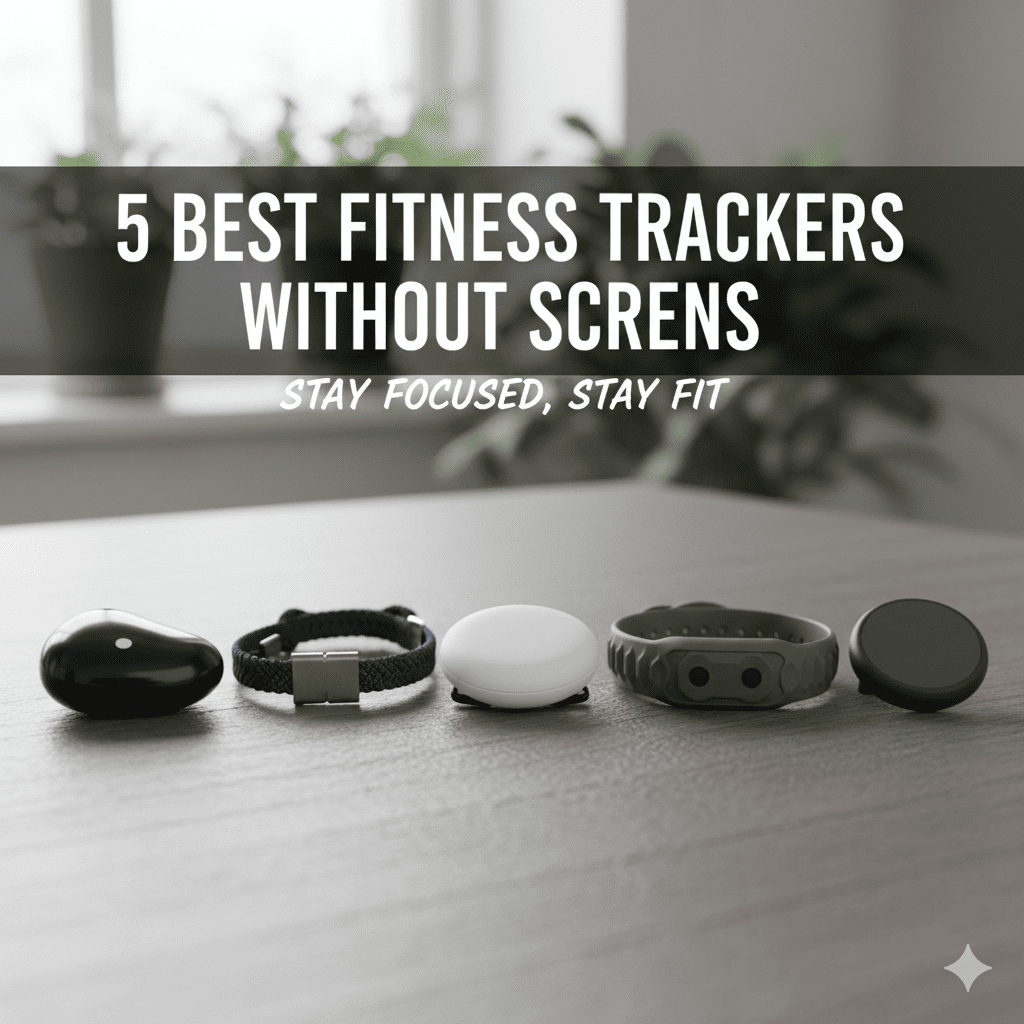
In an age where every device seems to demand our attention, a new trend is emerging among health-conscious individuals: fitness trackers without screens. These minimalist devices represent a refreshing departure from the constant notifications, endless scrolling, and digital distractions that have come to define modern wearable technology. Instead, they offer something increasingly rare and valuable—the ability to track your health data while maintaining focus on the present moment.
Fitness trackers without screens are not simply stripped-down versions of smartwatches; they’re purposefully designed devices that prioritize function over features, wellness over distraction. Whether you’re an athlete seeking distraction-free training, a professional wanting to disconnect from constant notifications, or someone committed to digital minimalism, fitness trackers without screens provide comprehensive health monitoring without compromising your mental clarity.
This comprehensive guide explores the five best fitness trackers without screens available today, examining why this category is gaining momentum, what features truly matter, and how to choose the perfect device for your lifestyle and fitness goals.
1. Why Choose Fitness Trackers Without Screens?
Before diving into specific product recommendations, it’s essential to understand the compelling reasons why fitness trackers without screens are becoming the preferred choice for an growing number of fitness enthusiasts and health-conscious individuals.
The Distraction Dilemma
Modern smartwatches and screen-equipped fitness trackers have become miniature smartphones on our wrists. While they offer impressive functionality, they also bring significant downsides:
Constant Interruptions: Every notification, message, and app alert pulls your attention away from whatever you’re doing. During workouts, this breaks focus and reduces exercise quality. During daily life, it contributes to the attention fragmentation that characterizes modern existence.
Compulsive Checking: The presence of a screen creates an irresistible urge to check it. Studies show people with smartwatches check their wrist displays 50-100 times daily, often unconsciously. This habitual behavior fragments concentration and reduces productivity.
Sleep Disruption: Screens emit blue light that suppresses melatonin production, potentially disrupting sleep patterns. Many people check their wrist displays before bed or during nighttime wake-ups, interfering with quality rest.
Exercise Distraction: During workouts, screen-based trackers tempt users to constantly monitor metrics, disrupting the mind-muscle connection and reducing exercise effectiveness. True fitness often requires being present in your body, not obsessing over real-time data.
Fitness trackers without screens eliminate these distractions by design. They collect comprehensive health data silently and invisibly, allowing you to review metrics when it’s convenient rather than having information constantly demanding attention.
Enhanced Battery Life
One of the most practical advantages of fitness trackers without screens is dramatically extended battery life:
Typical Screen-Based Trackers: 1-5 days between charges, depending on usage and features.
Fitness Trackers Without Screens: 5-14 days or even longer, with some models lasting weeks or months.
This extended battery life means:
- Less frequent charging interruptions
- Greater reliability for multi-day activities like hiking or traveling
- Reduced environmental impact from frequent charging cycles
- Lower likelihood of missing data due to dead batteries
Minimalist Aesthetic
Fitness trackers without screens often feature sleek, understated designs that:
Professional Appropriateness: Unlike bulky smartwatches that can appear casual or unprofessional, screenless trackers resemble traditional jewelry or minimalist watches, suitable for any environment from boardrooms to black-tie events.
Timeless Design: Without screens displaying dated interfaces, these devices maintain aesthetic relevance longer. A well-designed screenless tracker looks as modern five years after purchase as the day you bought it.
Versatility: Many fitness trackers without screens come with interchangeable bands and subtle designs that complement any outfit or occasion, unlike conspicuous tech-forward smartwatches.
Focus on What Matters
By removing screens, these devices refocus attention on fundamental health metrics that truly matter:
Core Wellness Data: Sleep quality, activity levels, heart rate patterns, and recovery metrics—the foundational data that impacts long-term health.
Mindful Movement: Without constant metric display, users develop intuitive understanding of their bodies rather than becoming enslaved to numbers.
Reduced Data Obsession: Fitness trackers without screens discourage the unhealthy obsession with hitting arbitrary daily goals that can make fitness feel like work rather than wellness.
Privacy and Security
Fitness trackers without screens often offer enhanced privacy:
Reduced Functionality: Without displays showing notifications or messages, there’s less risk of sensitive information being visible to others.
Limited Connectivity: Many screenless trackers have minimal smart features, reducing potential security vulnerabilities associated with extensive app ecosystems.
Data Control: Some fitness trackers without screens offer more user control over data sharing and storage compared to fully-connected smartwatch ecosystems.
2. Essential Features in Fitness Trackers Without Screens
When evaluating fitness trackers without screens, certain features differentiate excellent devices from mediocre ones. Understanding these features helps you make informed purchasing decisions.
Comprehensive Activity Tracking
Quality fitness trackers without screens should accurately monitor:
Step Counting: Basic but essential—using accelerometers to track daily movement. Look for devices with proven accuracy (within 5-10% of actual steps).
Distance Tracking: Calculating distance traveled based on steps and stride length. More advanced models use GPS for precise outdoor tracking.
Calorie Estimation: Approximating calories burned based on activity level, heart rate, and personal metrics. While imperfect, good algorithms provide useful estimates.
Active Minutes: Distinguishing between sedentary time, light activity, and vigorous exercise. This metric often matters more than raw step counts.
Automatic Activity Recognition: Detecting specific activities (running, swimming, cycling) without manual input. Premium fitness trackers without screens offer sophisticated activity detection.
Heart Rate Monitoring
Continuous heart rate tracking has become standard even in fitness trackers without screens:
Resting Heart Rate: Morning resting heart rate is a key health indicator—decreases suggest improving fitness while increases may indicate overtraining, stress, or illness.
Heart Rate Zones: Tracking time spent in different heart rate zones helps optimize training intensity. Look for devices that calculate personalized zones based on your maximum heart rate.
Heart Rate Variability (HRV): Elite fitness trackers without screens measure HRV, which indicates recovery status and stress levels. HRV is increasingly recognized as one of the most valuable health metrics.
Continuous Monitoring: The best devices monitor heart rate 24/7, providing comprehensive data rather than spot checks during workouts.
Sleep Tracking
Quality sleep tracking is a hallmark of premium fitness trackers without screens:
Sleep Stages: Distinguishing between light sleep, deep sleep, and REM sleep provides insights into sleep quality beyond just duration.
Sleep Score: Comprehensive metrics synthesizing multiple factors into an easily understood score helps you understand overall sleep quality trends.
Disturbance Detection: Tracking wake-ups, restless periods, and time awake provides context for how restorative your sleep actually is.
Sleep Trends: Long-term trend analysis helps identify patterns and correlations between daily habits and sleep quality.
Water Resistance
For versatile use, fitness trackers without screens should offer substantial water resistance:
Minimum Rating: 5 ATM (50 meters) allows swimming and showering without removal.
Swim Tracking: Advanced devices detect swimming and track laps, strokes, and swimming-specific metrics.
Durability: Water resistance also indicates overall build quality and durability in challenging conditions.
Companion App Quality
While the tracker itself has no screen, the smartphone app is crucial for fitness trackers without screens:
Intuitive Interface: Well-designed apps make reviewing data effortless and insightful.
Data Visualization: Clear graphs, trends, and comparisons help identify patterns and progress.
Export Capabilities: The ability to export data to other platforms (Apple Health, Google Fit, Strava, etc.) provides flexibility.
Insights and Coaching: Premium apps offer personalized insights, recommendations, and coaching based on your data.
Sync Reliability: Automatic, reliable syncing ensures data is always current without requiring manual intervention.
Vibration Feedback
Without screens, fitness trackers without screens rely on haptic feedback:
Goal Celebrations: Gentle vibrations when achieving daily targets provide positive reinforcement.
Reminders: Movement reminders after prolonged sitting encourage regular activity.
Alarms: Silent vibrating alarms wake you or remind you of scheduled activities without disturbing others.
Communication: Some devices vibrate for critical smartphone notifications (calls, messages) even without displaying content.
3. The 5 Best Fitness Trackers Without Screens
Now let’s examine the top fitness trackers without screens available today, each excelling in different areas and catering to different user needs.
#1: Whoop 4.0 – The Performance Optimizer
Key Features:
- Completely screenless design
- Advanced recovery and strain tracking
- Continuous heart rate and HRV monitoring
- Respiratory rate tracking
- Skin temperature monitoring
- 5-day battery life with portable charging
- Waterproof design
- Subscription-based model
Why It Excels:
The Whoop 4.0 tops our fitness trackers without screens list because it’s purpose-built for serious athletes and performance optimization. Unlike devices that prioritize step counting, Whoop focuses on three key metrics: strain (how much you’re exerting yourself), recovery (how prepared your body is for activity), and sleep (the foundation of recovery).
Strain Tracking: Whoop calculates a daily strain score (0-21) based on cardiovascular load throughout the day. This helps athletes understand training intensity and avoid overtraining.
Recovery Score: Each morning, Whoop provides a recovery score (0-100%) based on HRV, resting heart rate, sleep quality, and respiratory rate. This score guides training decisions—whether to push hard or prioritize recovery.
Sleep Performance: Detailed sleep analysis including time in each sleep stage, sleep efficiency, and disturbances. Whoop also recommends optimal sleep amounts based on recent strain.
Coaching Features: The app provides personalized recommendations about training, recovery, and lifestyle factors affecting performance.
Best For: Serious athletes, fitness enthusiasts focused on optimization, anyone training for specific performance goals, biohackers interested in deep health data.
Considerations: Requires monthly subscription ($30/month or less with annual plans). Hardware is free with membership. More expensive than one-time purchase trackers but includes unlimited hardware replacements and regular updates.
The Whoop Experience: Users report that Whoop fundamentally changes how they approach training and recovery. The data-driven insights help prevent overtraining while maximizing performance gains. The screenless design means you check metrics intentionally rather than compulsively, fostering healthier relationships with fitness data.
#2: Oura Ring Generation 3 – The Sleek Sophisticate
Key Features:
- Stylish ring form factor
- Advanced sleep tracking
- Readiness and activity scores
- Heart rate and HRV monitoring
- Body temperature monitoring
- 7-day battery life
- Waterproof (100m)
- Premium materials (titanium)
Why It Excels:
The Oura Ring represents the pinnacle of discrete health tracking among fitness trackers without screens. Worn on your finger, it’s virtually invisible while collecting comprehensive health data with remarkable accuracy.
Sleep Mastery: Oura’s sleep tracking is considered industry-leading, with validation studies showing accuracy comparable to medical-grade sleep labs. The ring tracks sleep stages, efficiency, timing, and disturbances with exceptional precision.
Readiness Score: Each morning, Oura provides a readiness score indicating how recovered you are and how much you should exert yourself. This score synthesizes sleep quality, HRV, resting heart rate, body temperature, and previous activity.
Activity Tracking: While not as exercise-focused as Whoop, Oura tracks daily movement, active calorie burn, and encourages balanced activity with rest days recognized as important as training days.
Temperature Monitoring: Continuous body temperature tracking helps identify potential illness early, track menstrual cycles, and monitor general health trends.
Discrete Design: The ring form factor is unmatched for discretion. Available in multiple finishes (silver, black, gold, rose gold), it looks like jewelry rather than technology.
Best For: Professionals wanting discrete tracking, sleep optimization enthusiasts, those who find wrist trackers uncomfortable, style-conscious individuals, anyone prioritizing recovery over performance metrics.
Considerations: Requires monthly subscription ($5.99/month after free trial period). Ring sizing is crucial—order sizing kit before purchasing. Activity tracking during upper-body exercises may be less accurate than wrist-worn devices.
The Oura Experience: Users praise the ring’s invisibility—you genuinely forget you’re wearing it. The focus on readiness and sleep encourages sustainable lifestyle changes rather than obsessive metric-chasing. Many users report significantly improved sleep habits after seeing objective data about how various factors affect their rest.
#3: Fitbit Inspire 3 – The Accessible All-Rounder
Key Features:
- Minimalist design with optional display hiding
- Comprehensive fitness tracking
- Sleep monitoring with sleep score
- Active Zone Minutes
- 10-day battery life
- Water resistant (50m)
- Stress management tools
- Affordable pricing
Why It Excels:
While the Fitbit Inspire 3 technically has a small screen, it earns a place on our fitness trackers without screens list because the display can remain off, functioning essentially as a screenless tracker while retaining the option for occasional metric checks.
Comprehensive Tracking: Fitbit’s algorithms, refined over years, provide accurate tracking of steps, distance, calories, active minutes, and automatic exercise recognition for over 20 activities.
Sleep Tools: Detailed sleep stage tracking plus a personalized Sleep Score helps you understand and improve sleep quality. Premium subscribers get additional sleep insights.
Active Zone Minutes: Instead of arbitrary step goals, Fitbit emphasizes Active Zone Minutes—time spent in elevated heart rate zones. This metric better reflects actual fitness benefit.
Stress Management: Includes stress management score, guided breathing exercises, and mindfulness content (with Premium subscription).
Affordability: At around $99, the Inspire 3 is the most affordable tracker on our fitness trackers without screens list while maintaining strong feature set and accuracy.
Best For: Budget-conscious buyers, first-time tracker users, those who want optional screen access without constant distraction, Fitbit ecosystem users, people who appreciate guided health programs.
Considerations: Full feature access requires Fitbit Premium subscription ($9.99/month). Screen presence may tempt compulsive checking despite ability to keep it off. Less sophisticated than Whoop or Oura for advanced metrics.
The Fitbit Experience: Users appreciate the flexibility—during focused work or workouts, keep the screen dark; when convenient, tap for quick metrics. The Fitbit app’s social features and challenges motivate some users, though others prefer the solitary focus of screenless alternatives.
#4: Motiv Ring – The Security-Conscious Choice
Key Features:
- Ring form factor
- Heart rate and activity tracking
- Sleep monitoring
- 3-day battery life
- Waterproof (165 feet)
- Two-factor authentication capabilities
- Premium titanium construction
- Compact charging case
Why It Excels:
Motiv Ring distinguishes itself among fitness trackers without screens with unique security features alongside comprehensive health tracking. The titanium ring tracks essential health metrics while doubling as a hardware security key for two-factor authentication.
Health Tracking: Monitors heart rate continuously, tracks steps, distance, calories, active minutes, and sleep duration with decent accuracy for a ring-based device.
Security Integration: Can function as a two-factor authentication token for compatible services, making it valuable beyond fitness tracking for security-conscious professionals.
Discrete Profile: At just 2.5mm thick, the Motiv Ring is remarkably thin and comfortable for 24/7 wear. Available in rose gold or slate gray finishes.
Activity Goals: Uses “active minutes” as its primary metric—time spent with elevated heart rate—rather than arbitrary step counts.
Sleep Basics: Tracks sleep duration and resting heart rate during sleep, though less detailed than Oura’s sleep staging.
Best For: Security-conscious professionals, minimalists who value multi-functionality, those who want fitness tracking without extensive health data, people who find Oura too expensive but want ring form factor.
Considerations: Shorter battery life (3 days) requires more frequent charging than competitors. Less advanced health metrics than Whoop or Oura. Fewer third-party integrations. No subscription required (benefit or drawback depending on preference).
The Motiv Experience: Users love the multipurpose functionality—one device for fitness tracking and security. The simple approach appeals to those overwhelmed by extensive health data from more sophisticated fitness trackers without screens. Perfect for someone who wants core tracking without complexity.
#5: Amazfit Band 7 (Display-Off Mode) – The Budget Champion
Key Features:
- Minimal design with always-off display option
- 120+ sports modes
- Blood oxygen monitoring
- Sleep quality tracking
- 18-day battery life
- 5 ATM water resistance
- Affordable pricing (~$50)
- Extensive workout tracking
Why It Excels:
The Amazfit Band 7 rounds out our fitness trackers without screens list as the ultimate budget option. While it includes a display, display-off mode transforms it into an essentially screenless tracker at a fraction of competitors’ costs.
Exceptional Battery: At 18 days of typical use, the Band 7 offers the longest battery life on this list, reducing charging hassles and ensuring reliable data collection.
Sports Versatility: With 120+ sport modes, the Band 7 tracks virtually any activity imaginable—from common exercises to niche sports like parkour or e-sports.
Health Monitoring: Tracks heart rate, blood oxygen, stress levels, breathing quality, and provides sleep analysis including sleep stages and quality scores.
Value Proposition: At approximately $50, it’s less than one-sixth the cost of premium fitness trackers without screens while covering essential tracking needs.
App Ecosystem: The Zepp app (formerly Amazfit) provides data visualization, health insights, and exports to popular platforms like Google Fit and Apple Health.
Best For: Budget-conscious users, students, casual fitness enthusiasts, those wanting to try fitness trackers without screens before investing in premium options, people who engage in diverse activities, travelers who need long battery life.
Considerations: Display presence requires discipline to keep off. Less accurate than premium trackers. Build quality is adequate but not premium. Limited advanced metrics like HRV. No subscription services or coaching features.
The Amazfit Experience: Users appreciate the incredible value—comprehensive tracking at minimal cost. The display-off mode works well for those committed to distraction-free tracking. While lacking the sophistication of Whoop or Oura, it delivers core functionality that satisfies most users’ needs.
4. Comparing Key Specifications
To help you choose among the best fitness trackers without screens, here’s a detailed comparison of key specifications:
Battery Life Comparison
Amazfit Band 7: 18 days (longest) Fitbit Inspire 3: 10 days Oura Ring: 7 days Whoop 4.0: 5 days (but portable battery pack provides additional charges) Motiv Ring: 3 days (shortest)
Analysis: Longer battery life means less frequent charging interruptions but often correlates with less continuous monitoring intensity. Whoop’s shorter battery is offset by battery pack convenience and superior data collection.
Price Comparison
Amazfit Band 7: ~$50 (most affordable) Fitbit Inspire 3: ~$99 Motiv Ring: ~$199 Oura Ring Gen 3: ~$299 (plus $5.99/month subscription) Whoop 4.0: $0 hardware (but requires $30/month subscription)
Analysis: Cost varies dramatically. Budget options provide solid basic tracking while premium devices offer advanced metrics, better accuracy, and superior apps. Consider total cost including subscriptions over 2-3 years.
Water Resistance Comparison
Motiv Ring: 165 feet / 50m (best) Oura Ring: 100m Amazfit Band 7: 5 ATM / 50m Fitbit Inspire 3: 5 ATM / 50m Whoop 4.0: Waterproof (unspecified depth)
Analysis: All models support swimming and showering. Differences matter primarily for serious swimmers or water sports enthusiasts.
Accuracy Comparison
Based on independent testing and user reports:
Heart Rate Accuracy: Whoop 4.0 > Oura Ring > Fitbit Inspire 3 > Amazfit Band 7 > Motiv Ring Sleep Tracking Accuracy: Oura Ring > Whoop 4.0 > Fitbit Inspire 3 > Amazfit Band 7 > Motiv Ring Activity Tracking Accuracy: Whoop 4.0 > Fitbit Inspire 3 > Amazfit Band 7 > Oura Ring > Motiv Ring
Analysis: Generally, you get what you pay for in accuracy. Whoop and Oura justify their costs with superior sensors and algorithms. Budget options are adequate for general trends but less precise.
5. Choosing the Right Fitness Tracker Without Screen for Your Needs
With five excellent fitness trackers without screens to choose from, how do you select the ideal one for your specific situation?
For Serious Athletes and Performance Optimization
Recommended: Whoop 4.0
If you’re training for competitions, optimizing performance, or deeply invested in athletic improvement, Whoop’s comprehensive strain, recovery, and sleep metrics provide unmatched insights. The subscription model ensures continuous hardware updates and evolving features.
Why It’s Best: Whoop treats fitness tracking as a science, providing actionable data that directly informs training decisions. The recovery score prevents overtraining while encouraging maximum effort when your body is prepared. Professional athletes across sports use Whoop, testament to its effectiveness.
Alternative: Oura Ring if you prioritize sleep and recovery over strain metrics or prefer the ring form factor.
For Sleep Optimization Focus
Recommended: Oura Ring
No device matches Oura’s sleep tracking sophistication among fitness trackers without screens. If improving sleep quality is your primary goal—whether for health, performance, or managing conditions like insomnia—Oura provides unparalleled insights.
Why It’s Best: Oura’s sleep algorithms are validated against polysomnography (medical sleep studies) with impressive accuracy. The readiness score helps you make daily decisions based on sleep quality. The ring’s comfort makes it ideal for nighttime wear without disruption.
Alternative: Whoop 4.0 if you also want detailed exercise and recovery metrics alongside sleep tracking.
For Professional Environments
Recommended: Oura Ring or Motiv Ring
In professional settings where bulky smartwatches or obvious fitness trackers seem inappropriate, ring-based fitness trackers without screens offer the perfect solution.
Why They’re Best: Rings are indistinguishable from jewelry, completely appropriate in any professional environment from client meetings to formal events. They track comprehensively while maintaining professional aesthetics.
Choose Oura if you want advanced health metrics and comprehensive tracking. Choose Motiv if you value the two-factor authentication feature for professional security.
For Budget-Conscious Users
Recommended: Amazfit Band 7
If budget is a primary concern but you still want comprehensive tracking, the Amazfit Band 7 delivers remarkable value among fitness trackers without screens.
Why It’s Best: At around $50, it costs less than many dinner dates but provides years of health tracking. The display-off mode approximates screenless functionality while retaining optional metric checking. Eighteen-day battery life means minimal charging hassles.
Alternative: Fitbit Inspire 3 if you can stretch budget to ~$100 and want better accuracy, ecosystem integration, and optional guided programs.
For Beginners and First-Time Tracker Users
Recommended: Fitbit Inspire 3
Starting your fitness tracking journey with one of these fitness trackers without screens? The Fitbit Inspire 3 offers the best balance of simplicity, guidance, and flexibility.
Why It’s Best: Fitbit’s app is extremely user-friendly with excellent onboarding. The optional screen access helps beginners learn their patterns before committing to fully screenless usage. Strong community features provide motivation. Comprehensive but not overwhelming data presentation.
Alternative: Amazfit Band 7 if budget is especially tight or you prefer learning through exploration rather than guided programs.
For Travelers and Outdoor Enthusiasts
Recommended: Amazfit Band 7
If you’re frequently traveling, camping, hiking, or spending extended time away from charging infrastructure, battery life becomes paramount among fitness trackers without screens.
Why It’s Best: Eighteen days of battery life means you can complete multi-week adventures without needing to charge. The 120+ sport modes cover virtually any outdoor activity. Affordable price reduces worry about loss or damage during adventures.
Alternative: Fitbit Inspire 3 if you want better accuracy and don’t venture beyond 10 days between charging opportunities.
6. Maximizing Your Fitness Tracker Without Screen Experience
Owning one of the best fitness trackers without screens is just the beginning. These practices help you maximize the benefits while avoiding common pitfalls.
Establishing Healthy Data Review Habits
The screenless design of these fitness trackers without screens encourages healthier relationships with your data:
Scheduled Review Times: Rather than compulsively checking throughout the day, designate specific times for data review—perhaps mornings for assessing readiness and evenings for evaluating the day’s activity.
Focus on Trends, Not Daily Fluctuations: Single days rarely matter. Weekly and monthly trends reveal meaningful patterns. Resist overreacting to individual data points.
Action-Oriented Analysis: When reviewing data, ask “What does this tell me about my habits?” and “What action should I take?” rather than passively consuming numbers.
Periodic Breaks: Even with fitness trackers without screens, occasional tracker-free weeks can be healthy, helping you reconnect with intuitive body awareness rather than relying solely on data.
Optimizing Wearing Position and Fit
Proper wearing ensures accurate data from fitness trackers without screens:
Wrist Trackers: Wear snug but not tight, positioned one finger-width above the wrist bone. Too loose reduces heart rate accuracy; too tight causes discomfort.
Ring Trackers: Choose the correct size carefully—rings should be comfortable for 24/7 wear including temperature fluctuations that cause finger size changes. Most people wear on index, middle, or ring finger depending on comfort and size availability.
Consistency: Wear on the same position consistently for accurate trend tracking. Switching positions can introduce artificial variations in data.
Integrating with Broader Health Practices
Fitness trackers without screens work best as part of comprehensive wellness approaches:
Sleep Hygiene: Use sleep data to identify patterns, then implement science-based sleep hygiene practices: consistent schedules, dark cool rooms, limited evening screen time, morning light exposure.
Exercise Programming: Let recovery metrics guide training intensity. On high-readiness days, push hard; on low-readiness days, do recovery work or rest.
Stress Management: Use heart rate variability and resting heart rate trends to gauge stress levels, implementing stress-reduction practices when indicators show elevated stress.
Nutrition Connections: Correlate data with dietary habits. Many users discover specific foods affect sleep quality or recovery, enabling evidence-based nutrition decisions.
Troubleshooting Common Issues
Even the best fitness trackers without screens occasionally have problems:
Syncing Issues: Ensure Bluetooth is enabled, apps are updated, and the tracker is within range. Most syncing problems resolve by restarting both the tracker and smartphone.
Accuracy Concerns: Ensure proper fit, keep sensors clean, and update firmware regularly. Some activities (cycling, rowing) may be less accurately tracked by wrist devices—consider heart rate chest straps for those activities.
Battery Drain: Excessive battery drain often indicates issues with continuous syncing or features like GPS. Disable unnecessary features, check for app updates, and contact support if problems persist.
Skin Irritation: Rotate wearing position, clean the device and your skin regularly, and ensure proper fit (not too tight). Consider hypoallergenic bands if irritation persists.
7. The Science Behind Screenless Fitness Tracking
Understanding the technology and research supporting fitness trackers without screens helps you interpret and trust your data.
How Wrist-Based Optical Heart Rate Sensing Works
Most fitness trackers without screens use photoplethysmography (PPG) for heart rate detection:
The Technology: LEDs shine light into your skin; photodiodes detect light reflected back. Blood absorbs more light than surrounding tissue, so changes in blood volume (heartbeats) create detectable changes in reflected light.
Factors Affecting Accuracy:
- Skin tone (darker skin absorbs more light, requiring sensor adjustments)
- Tattoos over the sensor (can block or scatter light)
- Fit (movement between sensor and skin reduces accuracy)
- Activity type (irregular movements during activities like boxing challenge algorithms)
- Environmental factors (extreme cold reduces skin blood flow)
Improving Accuracy: Premium fitness trackers without screens use multiple wavelengths of light, more sophisticated algorithms, and machine learning to improve accuracy across diverse conditions and users.
Sleep Staging Technology
Advanced fitness trackers without screens don’t just detect sleep—they identify sleep stages:
Accelerometer Data: Movement patterns distinguish wake from sleep and indicate restless periods.
Heart Rate Patterns: Heart rate decreases and becomes more stable during deep sleep, increases during REM sleep, and varies more during light sleep.
Heart Rate Variability: HRV increases during deeper sleep stages and decreases during lighter sleep and REM.
Respiratory Rate: Breathing patterns vary across sleep stages, providing additional classification signals.
Machine Learning: Algorithms trained on thousands of nights of sleep data (validated against polysomnography) learn patterns that distinguish sleep stages with 70-80% accuracy—impressive for wrist-worn devices.
Heart Rate Variability and Recovery
HRV is increasingly important in fitness trackers without screens, particularly Whoop and Oura:
What HRV Measures: The variation in time between heartbeats. Counterintuitively, greater variability generally indicates better health and recovery.
Autonomic Nervous System: HRV reflects the balance between sympathetic (fight-or-flight) and parasympathetic (rest-and-digest) nervous system activity.
Recovery Indicator: High HRV suggests the parasympathetic nervous system is dominant—your body is recovered and ready for stress. Low HRV suggests continued stress, incomplete recovery, or sympathetic dominance.
Individual Variability: HRV varies enormously between individuals. What matters is your personal trend and deviation from your baseline, not absolute numbers.
Activity and Calorie Estimation
Fitness trackers without screens estimate calories and activity through sophisticated algorithms:
Basal Metabolic Rate: Starting with your age, sex, height, and weight, devices estimate your resting calorie burn.
Activity Recognition: Accelerometers detect movement patterns, using machine learning to identify specific activities (walking, running, cycling, etc.).
Heart Rate Integration: Heart rate data refines calorie estimates—higher heart rates indicate greater effort and energy expenditure.
Personalization: Over time, devices learn your individual patterns, improving estimation accuracy. Some systems incorporate VO2 max estimates for further personalization.
Limitations: Calorie estimation remains imperfect. Accuracy varies by activity type and typically ranges from 70-90%. Use estimates as general guides rather than precise measurements.
8. Privacy and Data Security Considerations
As fitness trackers without screens collect intimate health data, privacy and security deserve careful consideration.
What Data Is Collected?
Understanding what fitness trackers without screens record helps you make informed privacy decisions:
Health Metrics: Heart rate, HRV, sleep patterns, activity levels, skin temperature, blood oxygen (some models), respiratory rate—comprehensive physiological data.
Location Data: Models with GPS track your location during workouts. Others use smartphone GPS when connected.
Usage Patterns: When you sync, which features you use, how you interact with apps—behavioral data that profiles your habits.
Personal Information: Age, sex, height, weight, health conditions, fitness goals—demographic and personal data that contextualizes health metrics.
How Data Is Used
Different companies handling data from fitness trackers without screens have varying policies:
Whoop: Emphasizes member privacy, doesn’t sell personal data, uses aggregated anonymized data for research and algorithm improvement with explicit consent.
Oura: Collects data to provide services, uses anonymized aggregated data for research, doesn’t sell personal identifiable information to third parties.
Fitbit (Google): Integration with Google ecosystem raises privacy questions. Data used for personalization and advertising targeting within Google services. More extensive data sharing than independent companies.
Amazfit: Chinese company subject to different privacy regulations. Data practices less transparent than US/European companies.
Motiv: Strong emphasis on security given two-factor authentication functionality. Privacy-focused policies with minimal data sharing.
Protecting Your Privacy
Steps to maximize privacy with fitness trackers without screens:
Review Privacy Policies: Actually read the privacy policy before choosing a tracker. Understand what data is collected and how it’s used.
Minimize Sharing: Disable optional data sharing, social features, and third-party integrations you don’t need.
Strong Passwords: Secure your account with strong, unique passwords and enable two-factor authentication where available.
Regular Reviews: Periodically review connected apps and revoke access for services you no longer use.
Consider Jurisdiction: European GDPR provides stronger privacy protections than US regulations. Companies with European operations often extend GDPR protections more broadly.
Also read this:
Top 10 Non-Toxic Air Fryers for Healthy Cooking in 2025
AI Rendering Explained: Faster, Smarter & More Realistic Than Ever
AI-Generated Voices That Sound 100% Human — The Ethics Debate