
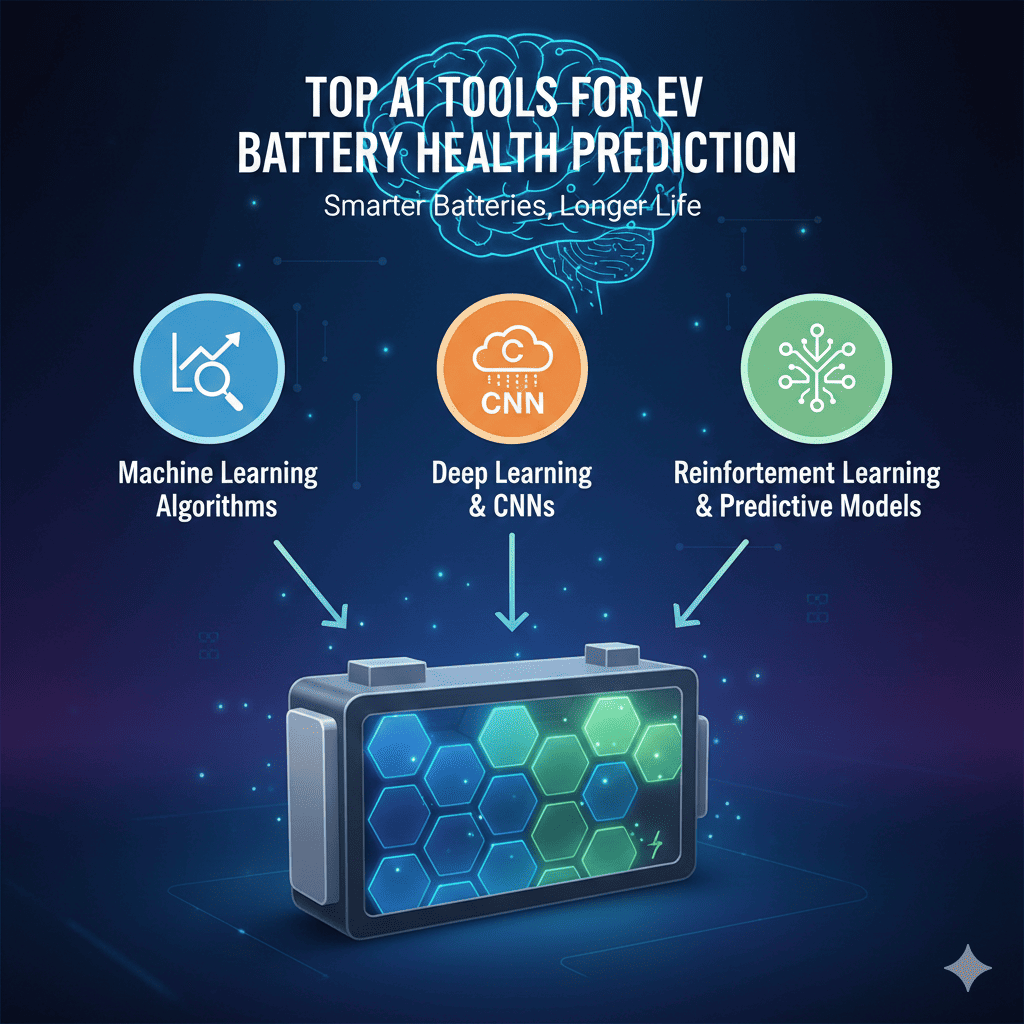
The electric vehicle revolution is accelerating faster than ever, but there’s one critical component that determines the success or failure of every EV on the road: the battery. As electric vehicles become mainstream, EV Battery Health Prediction has emerged as one of the most crucial technological challenges facing the automotive industry. Fortunately, artificial intelligence is stepping up to solve this complex problem, offering unprecedented accuracy in forecasting battery performance, lifespan, and maintenance needs.
In this comprehensive guide, we’ll explore the cutting-edge AI tools transforming EV Battery Health Prediction, helping manufacturers, fleet operators, and individual owners maximize battery life while minimizing unexpected failures and costly replacements.
Why EV Battery Health Prediction Matters
Before diving into the AI tools revolutionizing this space, it’s essential to understand why EV Battery Health Prediction has become such a critical priority. Electric vehicle batteries represent 30-40% of a vehicle’s total cost, making them the single most expensive component. Unlike traditional combustion engines, battery degradation is complex, non-linear, and influenced by dozens of variables including charging habits, temperature exposure, driving patterns, and manufacturing variations.
Accurate battery health prediction enables:
- Cost savings through optimized maintenance scheduling
- Extended battery lifespan via proactive care recommendations
- Enhanced resale value with documented battery health data
- Reduced range anxiety through reliable performance forecasting
- Improved safety by identifying potential failures before they occur
1. Tesla’s Neural Network Battery Management System
Tesla has pioneered the integration of AI into EV Battery Health Prediction through its sophisticated neural network-based Battery Management System (BMS). This proprietary system continuously monitors over 7,000 individual battery cells in real-time, using machine learning algorithms to predict degradation patterns and optimize charging strategies.
Key Features:
- Real-time cell monitoring with microsecond-level precision
- Predictive analytics that forecast battery capacity loss over time
- Adaptive charging algorithms that adjust based on battery health status
- Over-the-air updates that improve prediction accuracy continuously
- Temperature management optimization using AI-driven thermal control
Tesla’s system collects data from millions of vehicles worldwide, creating a massive dataset that continuously improves prediction accuracy. The neural networks learn from actual degradation patterns across diverse climates, driving conditions, and usage profiles, making Tesla’s EV Battery Health Prediction capabilities among the most advanced in the industry.
What sets Tesla apart is their fleet learning approach. Every Tesla vehicle contributes anonymized battery performance data to the central AI system, which then distributes improved prediction models back to all vehicles. This creates a positive feedback loop where prediction accuracy improves exponentially as more vehicles join the network.
2. BATEMO (Battery Modeling)
BATEMO represents a new generation of specialized AI platforms designed specifically for EV Battery Health Prediction. This German-based company has developed sophisticated machine learning models that can predict battery behavior with remarkable precision, even accounting for complex electrochemical processes occurring within battery cells.
Core Capabilities:
- Physics-informed neural networks that combine AI with electrochemical principles
- Digital twin technology creating virtual replicas of physical batteries
- Multi-scale modeling from cell level to full pack simulation
- Degradation mechanism identification pinpointing specific failure modes
- Remaining useful life estimation with confidence intervals
BATEMO’s approach bridges the gap between pure data-driven AI and traditional physics-based models. By incorporating fundamental battery chemistry principles into their neural networks, they achieve prediction accuracy that surpasses purely statistical approaches. This hybrid methodology makes their EV Battery Health Prediction tools particularly effective for new battery chemistries where historical data is limited.
The platform allows battery engineers to simulate thousands of scenarios virtually, testing how different charging protocols, temperature exposures, and usage patterns affect long-term battery health. This accelerates battery development cycles and enables manufacturers to optimize battery management strategies before vehicles reach production.
3. Voltaiq Enterprise Battery Intelligence
Voltaiq has established itself as the leading enterprise solution for EV Battery Health Prediction, serving major automotive manufacturers, battery suppliers, and energy storage companies. Their cloud-based platform processes massive volumes of battery test data, applying sophisticated machine learning algorithms to extract actionable insights.
Platform Highlights:
- Automated data ingestion from diverse battery testing equipment
- Advanced pattern recognition identifying subtle degradation signatures
- Comparative analytics benchmarking battery performance across designs
- Failure prediction algorithms with early warning capabilities
- Collaborative workflows enabling team-based battery analysis
Voltaiq’s strength lies in its ability to harmonize data from multiple sources, including lab testing, field deployments, and simulation environments. Their AI models can correlate laboratory accelerated aging tests with real-world degradation patterns, dramatically improving the accuracy of EV Battery Health Prediction for batteries still in development.
The platform has processed over 15 petabytes of battery data, making it one of the largest battery intelligence databases in existence. This extensive training data enables Voltaiq’s machine learning models to recognize degradation patterns that would be invisible to human analysts, predicting failures weeks or months before they occur.
4. TWAICE Battery Analytics Platform
TWAICE has carved out a unique position in the EV Battery Health Prediction landscape by focusing on operational applications. Their AI-powered platform is designed for fleet operators, leasing companies, and battery second-life businesses that need accurate, real-time battery health assessments.
Distinctive Features:
- API-first architecture enabling easy integration with existing fleet systems
- Predictive maintenance scheduling optimizing service intervals
- Battery passport creation documenting complete health history
- Second-life value assessment for battery repurposing decisions
- Mobile apps for field technicians and vehicle operators
TWAICE’s AI models excel at processing noisy, incomplete field data—the reality of most operational environments. Unlike laboratory conditions where every variable is controlled, real-world EV Battery Health Prediction must contend with missing data points, sensor drift, and unpredictable usage patterns. TWAICE’s algorithms are specifically trained to handle these challenges, providing reliable predictions even with imperfect inputs.
Their platform has gained particular traction in commercial fleet applications, where downtime directly impacts profitability. By predicting battery issues before they cause vehicle failures, fleet operators can schedule maintenance during off-peak periods, minimizing operational disruptions while extending battery life.
5. Gaussian Process Models for Battery Health
While not a commercial product per se, Gaussian Process (GP) models represent a powerful AI technique increasingly adopted for EV Battery Health Prediction by research institutions and forward-thinking manufacturers. These probabilistic machine learning models offer unique advantages for battery health assessment.
Technical Advantages:
- Uncertainty quantification providing confidence bounds on predictions
- Data efficiency requiring fewer training samples than deep learning
- Interpretability offering insights into prediction reasoning
- Transfer learning capability adapting models across battery types
- Online learning continuously updating predictions with new data
Gaussian Process models shine in scenarios where data is scarce or expensive to obtain. Traditional deep learning approaches require thousands or millions of training examples, but GP models can make reliable predictions with just dozens of carefully selected data points. This makes them ideal for EV Battery Health Prediction in emerging battery technologies where extensive historical data doesn’t yet exist.
Several automotive companies have integrated GP models into their battery management systems, particularly for premium vehicles where the additional computational overhead is justified by improved prediction accuracy. The uncertainty quantification feature is especially valuable, allowing systems to flag predictions with low confidence for human review.
6. Recurrent Neural Networks (RNN) and LSTM Solutions
Long Short-Term Memory (LSTM) networks, a specialized form of recurrent neural networks, have become increasingly popular for EV Battery Health Prediction due to their ability to model time-dependent degradation processes. Several commercial and open-source implementations leverage these powerful architectures.
Why LSTMs Excel at Battery Prediction:
- Sequential data processing naturally handling time-series battery data
- Long-term dependency modeling capturing degradation trends over months or years
- Attention mechanisms identifying critical degradation periods
- Multi-variate input handling processing dozens of simultaneous sensor readings
- State memory retaining historical context for better predictions
LSTMs address a fundamental challenge in EV Battery Health Prediction: batteries don’t degrade linearly. A battery might perform consistently for thousands of cycles before entering accelerated degradation. LSTM networks can identify these transition points by maintaining memory of previous states, recognizing patterns that indicate imminent performance decline.
Research teams at leading universities have published numerous LSTM implementations for battery health prediction, many available as open-source tools. These have been successfully applied to predict remaining useful life with errors under 5%, significantly outperforming traditional statistical methods.
7. Gradient Boosting Machines for Battery Diagnostics
Gradient Boosting Machines (GBM), particularly implementations like XGBoost and LightGBM, have emerged as highly effective tools for EV Battery Health Prediction. These ensemble learning methods combine multiple weak prediction models to create robust, accurate forecasting systems.
GBM Strengths:
- Feature importance analysis identifying key degradation drivers
- Handling non-linear relationships capturing complex battery behaviors
- Computational efficiency enabling edge device deployment
- Missing data tolerance working with incomplete sensor readings
- Categorical variable support incorporating factors like battery chemistry or manufacturer
XGBoost models have won numerous battery prediction competitions and are widely deployed in production systems. Their ability to automatically identify which factors most influence battery degradation provides valuable engineering insights beyond pure prediction. For instance, GBM analysis might reveal that rapid charging events above 80% capacity are disproportionately harmful to battery health, informing charging protocol optimization.
The computational efficiency of gradient boosting makes it particularly suitable for EV Battery Health Prediction at the edge—running directly on vehicle computers rather than requiring cloud connectivity. This enables real-time predictions even in areas with poor cellular coverage, while also addressing privacy concerns about sending battery data to external servers.
8. Convolutional Neural Networks for Battery Image Analysis
An innovative frontier in EV Battery Health Prediction involves applying Convolutional Neural Networks (CNNs) to battery imaging data. While less common than time-series analysis, this approach offers unique capabilities for detecting physical degradation not visible in electrical measurements alone.
Imaging-Based Prediction:
- Thermal imaging analysis detecting hotspot patterns indicating cell degradation
- X-ray tomography interpretation identifying internal structural damage
- Electrode surface imaging quantifying degradation at the material level
- Anomaly detection spotting manufacturing defects before deployment
- Failure mode classification categorizing degradation types for targeted interventions
CNNs trained on thermal camera data can predict battery failures weeks in advance by recognizing subtle temperature distribution changes invisible to rule-based systems. Some research facilities have demonstrated that thermal imaging combined with AI can identify failing cells with over 90% accuracy before any electrical symptoms appear.
This imaging approach is particularly valuable for EV Battery Health Prediction in safety-critical applications. By detecting physical anomalies like lithium plating or dendrite formation, CNN-based systems can predict thermal runaway events—the catastrophic failures that occasionally make headlines—with enough warning time to prevent dangerous situations.
9. Ensemble Methods and Hybrid AI Systems
The most sophisticated EV Battery Health Prediction systems don’t rely on a single AI technique but instead combine multiple approaches in ensemble or hybrid architectures. These meta-models leverage the strengths of different algorithms while compensating for individual weaknesses.
Hybrid Architecture Benefits:
- Improved accuracy by combining diverse prediction sources
- Robustness reducing sensitivity to data quality issues
- Adaptability performing well across varied battery types and conditions
- Confidence scoring identifying predictions requiring human verification
- Graceful degradation maintaining functionality when individual models fail
A typical hybrid system might combine LSTM networks for time-series forecasting, gradient boosting for feature importance analysis, and Gaussian Processes for uncertainty quantification. The system then uses another AI layer—often a simple neural network—to optimally weight each component’s predictions based on current conditions.
Major automotive manufacturers are increasingly adopting this ensemble approach for EV Battery Health Prediction. While more complex to develop and maintain, hybrid systems consistently outperform single-model approaches in production environments, particularly when dealing with the diverse conditions encountered across global vehicle fleets.
10. Cloud-Based Battery Analytics Platforms
The final category of AI tools transforming EV Battery Health Prediction comprises comprehensive cloud-based platforms that aggregate data from thousands or millions of batteries. These systems apply AI at unprecedented scales, uncovering patterns invisible in individual vehicle analysis.
Cloud Platform Capabilities:
- Fleet-wide pattern recognition identifying systematic issues
- Predictive maintenance optimization across thousands of vehicles
- Battery chemistry benchmarking comparing performance across manufacturers
- Warranty cost prediction for financial planning
- Regulatory compliance supporting battery passport requirements
Companies like Amazon Web Services (AWS), Microsoft Azure, and Google Cloud offer specialized IoT and machine learning services tailored for EV Battery Health Prediction. These platforms provide the computational infrastructure needed to train sophisticated AI models on massive datasets, then deploy those models at scale across vehicle fleets.
Cloud platforms enable capabilities impossible with on-vehicle computing alone. For instance, a cloud-based system can correlate battery degradation patterns with weather data, traffic patterns, and charging infrastructure characteristics across entire regions, identifying environmental factors that accelerate battery aging. This intelligence then flows back to vehicles as optimized charging strategies tailored to local conditions.
Implementing AI-Driven EV Battery Health Prediction
Successfully deploying AI tools for EV Battery Health Prediction requires more than just selecting the right technology. Organizations must consider data infrastructure, model maintenance, and integration with existing systems.
Implementation Best Practices:
Start with comprehensive data collection infrastructure. AI models are only as good as their training data, so invest in high-quality sensors and reliable data pipelines. Prioritize data that captures the full battery lifecycle, including manufacturing data, operational telemetry, and end-of-life testing.
Establish clear prediction objectives. Are you optimizing for maximum battery life, predicting catastrophic failures, or estimating residual value for second-life applications? Different goals may require different AI approaches and training data.
Plan for continuous model improvement. Battery technology evolves rapidly, and AI models must adapt. Implement MLOps practices enabling systematic model updates as new data becomes available and battery chemistries change.
Consider regulatory and privacy implications. Battery data may be subject to privacy regulations in some jurisdictions, and emerging battery passport requirements will mandate specific health tracking capabilities. Ensure your EV Battery Health Prediction system addresses these concerns from the outset.
The Future of AI in Battery Health Prediction
The field of EV Battery Health Prediction is advancing rapidly, with several exciting developments on the horizon. Federated learning approaches will enable AI models trained across multiple manufacturers’ data while preserving proprietary information. Physics-informed neural networks will combine first-principles battery chemistry with data-driven learning for unprecedented accuracy.
Edge AI capabilities will continue improving, enabling sophisticated EV Battery Health Prediction to run entirely on vehicle processors without cloud connectivity. This will reduce latency, enhance privacy, and enable real-time optimization of charging and thermal management strategies.
Perhaps most intriguingly, reinforcement learning techniques are beginning to show promise for not just predicting battery health but actively optimizing usage patterns to maximize lifespan. These systems learn optimal charging, discharging, and thermal management strategies through trial and error, continuously improving battery longevity based on real-world performance.
Conclusion
Artificial intelligence has transformed EV Battery Health Prediction from an inexact science into a precise, actionable discipline. The tools covered in this article—from Tesla’s neural network systems to cloud-based analytics platforms—demonstrate the breadth and sophistication of AI applications in this critical domain.
For automotive manufacturers, accurate EV Battery Health Prediction reduces warranty costs and enhances brand reputation. Fleet operators gain operational efficiency through predictive maintenance and optimized asset utilization. Individual EV owners benefit from extended battery life, maintained vehicle value, and peace of mind.
As electric vehicles continue their rapid market adoption, the importance of EV Battery Health Prediction will only grow. The AI tools available today represent just the beginning of what’s possible. Organizations that invest in these technologies now will be best positioned to lead the electric vehicle revolution, delivering superior battery performance, reliability, and longevity to customers worldwide.
Also read this:
Top AI Tools for Hotel Check-In Automation: Revolutionizing Guest Experiences in 2025
Best AI Tools for Resume Shortlisting in HR: Revolutionize Your Recruitment Process
Top AI Tools for NFT Art Generation: Transform Your Creative Vision into Digital Assets