
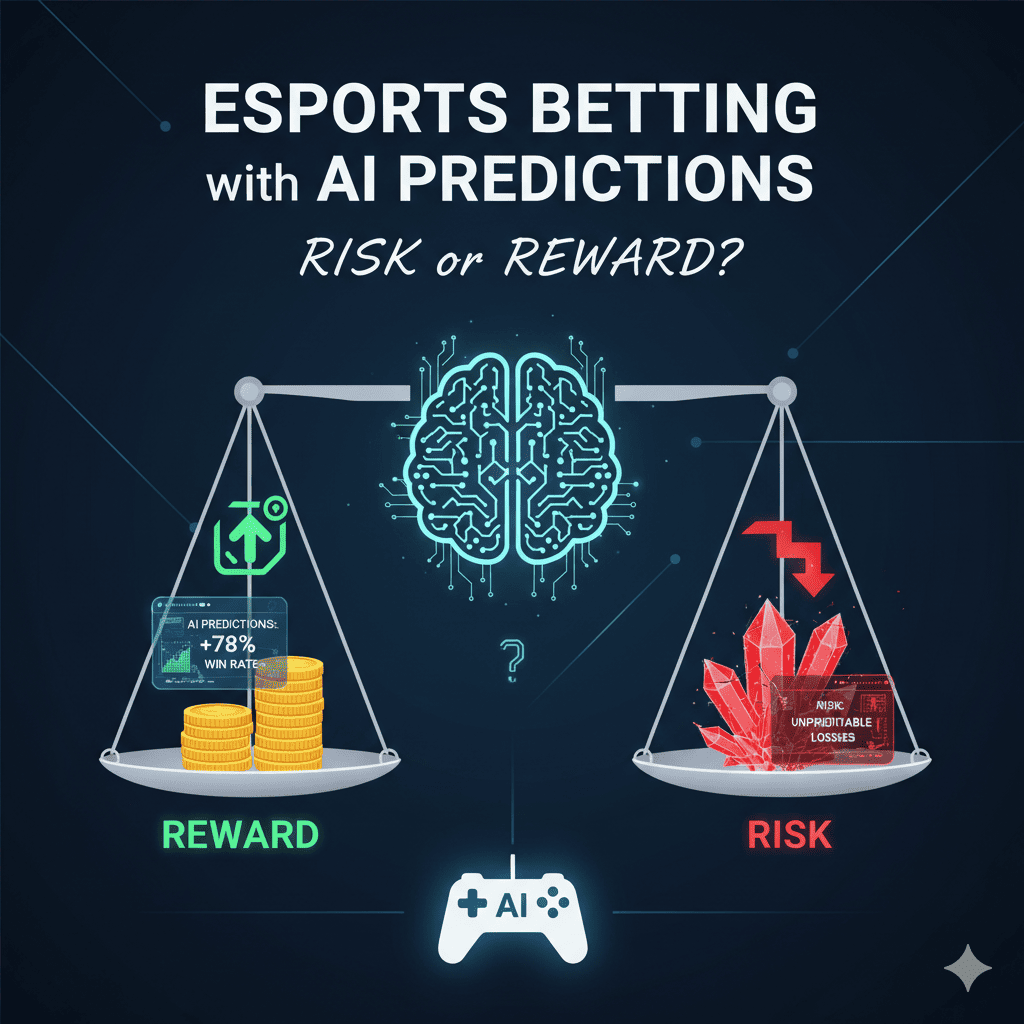
Esports Betting with AI Predictions intersection of artificial intelligence and esports betting has created one of the most controversial and rapidly evolving sectors in both gaming and gambling industries. As AI systems become increasingly sophisticated at analyzing player performance, team dynamics, and game mechanics, millions of bettors worldwide are turning to machine learning algorithms for competitive advantages. But does AI truly offer the edge that promises massive rewards, or does it represent a dangerous illusion that amplifies financial risks?
The Rise of AI in Esports Betting: A Data-Driven Revolution
Esports has evolved from basement gaming sessions to a multi-billion dollar industry with global audiences exceeding traditional sports viewership. Parallel to this growth, esports betting has exploded, with markets now covering everything from League of Legends world championships to Counter-Strike major tournaments. The introduction of AI prediction systems has fundamentally changed how both casual and professional bettors approach these markets.
The Numbers Behind the Phenomenon The global esports betting market reached $14.9 billion in 2024, with AI-assisted betting platforms capturing approximately 35% of this market share. These platforms process thousands of data points per match, analyzing everything from individual player statistics to meta-game trends and historical performance patterns.
Why Esports Appeals to AI Analysis Unlike traditional sports, esports generates massive amounts of digital data naturally. Every click, movement, and decision is recorded, creating rich datasets that AI systems can analyze with unprecedented depth. This data abundance makes esports particularly suitable for machine learning applications.
How AI Prediction Systems Actually Work
Real-Time Data Processing Modern AI betting systems monitor live game data, processing information faster than human analysts could ever manage. These systems track individual player performance metrics, team coordination patterns, economic management within games, and tactical adaptations in real-time.
Machine Learning Algorithm Types Different AI approaches serve various prediction needs. Neural networks excel at pattern recognition in player behavior, while ensemble methods combine multiple prediction models for more robust forecasting. Reinforcement learning algorithms even simulate game scenarios to predict likely outcomes.
Historical Analysis and Pattern Recognition AI systems analyze years of competitive match data, identifying subtle patterns that human analysts might miss. These patterns include performance trends under pressure, team chemistry indicators, and meta-game adaptation speeds that correlate with match outcomes.
Integration with External Factors Advanced systems incorporate external variables like player health reports, recent roster changes, patch updates that affect game balance, and even social media sentiment analysis to create comprehensive prediction models.
The Promise: AI’s Potential Advantages
Superior Data Processing Speed AI systems can analyze thousands of matches and millions of data points in seconds, identifying opportunities that manual analysis would take days or weeks to uncover. This speed advantage is crucial in fast-moving betting markets where odds change rapidly.
Emotion-Free Decision Making Unlike human bettors who may be influenced by team loyalty, recent memorable performances, or emotional reactions, AI systems make purely data-driven predictions based on statistical probabilities.
Pattern Recognition at Scale Machine learning algorithms excel at identifying complex patterns across massive datasets, potentially discovering correlations between seemingly unrelated factors that influence match outcomes.
Continuous Learning and Adaptation Well-designed AI systems improve their predictions over time, learning from both successes and failures to refine their models continuously.
The Reality: Limitations and Risks
The Unpredictability Factor Esports, like all competitive activities, contains elements of randomness and human unpredictability that no algorithm can fully account for. A player’s sudden illness, a critical misclick, or an innovative strategy can completely invalidate statistical predictions.
Overfitting and False Confidence AI systems can become overly specialized to historical data patterns that may not persist in future matches. This overfitting can create false confidence in predictions while missing fundamental shifts in the competitive landscape.
Market Efficiency Concerns As more bettors use similar AI tools, the potential advantages diminish. When everyone has access to similar predictions, the betting markets become more efficient, reducing opportunities for consistent profits.
Technical Failures and System Errors AI systems are not infallible. Software bugs, data feed interruptions, or model errors can lead to catastrophically wrong predictions, resulting in significant financial losses.
Case Studies: Success Stories and Spectacular Failures
The Algorithm That Beat the Bookmakers In 2024, a team of data scientists developed an AI system that achieved a 64% success rate in League of Legends betting over six months, generating substantial returns. Their system combined player micro-performance analysis with macro-strategic trend recognition, identifying value bets that conventional wisdom missed.
The Million-Dollar Mistake Conversely, a prominent AI betting platform suffered massive losses during the 2024 World Championship when their algorithm failed to account for a major patch update that fundamentally altered the game’s meta. The system continued making predictions based on outdated strategic assumptions, resulting in catastrophic losses for users who trusted its recommendations.
Individual Success Stories Professional bettor Marcus Chen credits AI analysis tools with transforming his approach to esports betting, helping him achieve consistent profitability over three years. However, he emphasizes that AI tools complement rather than replace human judgment and risk management strategies.
The Psychology of AI-Assisted Betting
False Sense of Security Many bettors develop overconfidence when using AI predictions, mistaking sophisticated analysis for guaranteed outcomes. This psychological trap can lead to increased bet sizes and poor risk management decisions.
Addiction Amplification AI tools can make betting feel more “scientific” and legitimate, potentially enabling gambling addiction by providing seemingly rational justification for continued betting despite losses.
Decision Paralysis vs. Over-Reliance Some bettors become paralyzed by conflicting AI predictions, while others abandon critical thinking entirely, blindly following algorithm recommendations without understanding their limitations.
Legal and Ethical Considerations
Regulatory Landscape The legal status of AI-assisted betting varies significantly across jurisdictions. Some regions embrace technological innovation in gambling, while others impose strict restrictions or outright bans on automated betting systems.
Fair Play Concerns Questions arise about whether AI-assisted betting creates unfair advantages that undermine the integrity of esports betting markets. Some argue that sophisticated algorithms give wealthy bettors disproportionate advantages over casual participants.
Data Privacy and Security AI betting platforms collect vast amounts of user data, raising privacy concerns about how this information is stored, processed, and potentially shared with third parties.
Responsible Gambling Measures The gambling industry faces pressure to implement AI systems that identify problem gambling behaviors and intervene appropriately, balancing profit motives with social responsibility.
Platform Comparison: Leading AI Betting Services
Established Operators Traditional betting companies like Bet365 and William Hill have integrated AI prediction tools into their esports offerings, leveraging their extensive experience in sports betting to create sophisticated esports analysis systems.
Specialized AI Platforms Newer companies like Rivalry and Unikrn focus specifically on esports betting with AI-driven features, offering more specialized tools and analysis specifically designed for gaming markets.
Algorithm Transparency Some platforms provide detailed explanations of their prediction methodologies, while others treat their algorithms as proprietary trade secrets. Transparency levels significantly affect user trust and decision-making capabilities.
Track Record Analysis Evaluating platform performance requires examining long-term success rates, not just promotional statistics that may cherry-pick favorable time periods or specific markets.
Risk Management Strategies for AI-Assisted Betting
Diversification Principles Successful AI-assisted bettors typically diversify across multiple games, tournaments, and prediction systems rather than relying on a single algorithm or market.
Bankroll Management Even with AI assistance, proper bankroll management remains crucial. Experts recommend never risking more than 1-2% of total funds on any single bet, regardless of AI confidence levels.
Understanding Model Limitations Educated users study their chosen AI systems’ strengths and weaknesses, learning when to trust predictions and when to exercise independent judgment.
Combining Human and Artificial Intelligence The most successful approaches often combine AI analysis with human expertise, using algorithms to identify opportunities while applying human judgment to assess their validity.
The Technical Infrastructure Behind AI Betting
Data Sources and Quality AI betting systems rely on high-quality, real-time data feeds from game developers, tournament organizers, and third-party statistics providers. Data quality directly impacts prediction accuracy.
Computing Requirements Sophisticated AI analysis requires substantial computing power, with leading platforms investing millions in server infrastructure and cloud computing resources to process data in real-time.
Model Training and Validation Effective AI systems undergo rigorous training processes using historical data, with validation techniques that test prediction accuracy across various scenarios and time periods.
Continuous Updates and Maintenance The esports landscape changes rapidly with new patches, meta shifts, and roster changes. AI systems require constant updates to maintain relevance and accuracy.
Economic Impact on the Esports Ecosystem
Increased Betting Volume AI predictions have contributed to significant growth in esports betting volume, with more accurate predictions encouraging greater participation from both casual and professional bettors.
Market Efficiency Effects As AI systems become more prevalent, betting markets become more efficient, reducing opportunities for easy profits while increasing the overall sophistication of price discovery.
Investment in Technology The success of AI betting platforms has attracted significant venture capital investment, funding further technological development and innovation in the space.
Impact on Teams and Players Increased betting volume affects team valuations, sponsorship deals, and player salaries, creating economic incentives that influence the competitive landscape.
Future Technological Developments
Advanced Prediction Models Next-generation AI systems will likely incorporate even more sophisticated analysis techniques, including real-time sentiment analysis, biometric data integration, and advanced game theory applications.
Integration with Virtual Reality As VR technology advances, AI systems may analyze player behavior in virtual environments, providing unprecedented insights into performance factors and psychological states.
Blockchain and Transparency Blockchain technology could provide transparent, immutable records of AI prediction performance, allowing bettors to verify system accuracy claims independently.
Cross-Game Analysis Future AI systems may identify skills and patterns that transfer across different esports titles, providing insights that current game-specific models cannot achieve.
Professional Perspectives: Industry Expert Opinions
Data Scientists’ Views Leading researchers in sports analytics generally view esports as an ideal testing ground for AI prediction systems, while cautioning against overconfidence in algorithmic approaches.
Professional Bettors’ Experiences Experienced esports bettors report that AI tools are most valuable for identifying potential opportunities rather than providing definitive predictions, emphasizing the continued importance of human judgment.
Esports Industry Professionals Team managers and players express mixed feelings about AI betting systems, appreciating increased interest in their matches while concerning themselves with potential manipulation or unfair advantages.
Regulatory Officials Gaming regulators worldwide are still developing frameworks for AI-assisted betting, balancing innovation encouragement with consumer protection and market integrity concerns.
Practical Guide: Getting Started with AI Esports Betting
Choosing the Right Platform New users should prioritize platforms with transparent methodologies, strong track records, and robust customer support rather than focusing solely on promotional offers or flashy interfaces.
Education and Learning Understanding basic esports terminology, game mechanics, and competitive formats is crucial before relying on AI predictions, as context knowledge helps evaluate algorithm outputs effectively.
Starting Small and Learning Beginners should start with small stakes while learning how to interpret AI predictions and develop personal risk management strategies.
Monitoring and Adjustment Successful AI-assisted betting requires continuous monitoring of results, regular strategy adjustments, and honest assessment of both wins and losses.
The Dark Side: Potential Dangers and Warnings
Financial Ruin Stories Numerous cases exist of individuals who lost substantial sums following AI predictions without proper risk management, highlighting the dangers of overconfidence in algorithmic approaches.
Addiction and Mental Health The sophistication of AI betting tools can exacerbate gambling addiction by providing seemingly rational justification for continued betting despite mounting losses.
Scams and Fraudulent Systems The AI betting space attracts fraudulent operators who make exaggerated claims about their systems’ capabilities, targeting inexperienced bettors with promises of guaranteed profits.
Market Manipulation Concerns Questions persist about whether sophisticated AI systems could be used to manipulate betting markets or gain unfair advantages through information asymmetries.
Regulatory Response and Industry Standards
Government Initiatives Various governments are developing specific regulations for AI-assisted gambling, with approaches ranging from complete prohibition to carefully controlled legalization with strict oversight requirements.
Industry Self-Regulation Leading betting platforms are developing industry standards for AI transparency, responsible gambling measures, and fair market practices to prevent regulatory crackdowns.
International Coordination Cross-border nature of online esports betting requires international cooperation on regulatory frameworks, with several organizations working to develop coordinated approaches.
Consumer Protection Measures New regulations increasingly focus on protecting consumers through mandatory risk warnings, algorithm transparency requirements, and problem gambling identification systems.
Conclusion: Navigating the AI Betting Landscape
The question of whether AI predictions in esports betting represent risk or reward doesn’t have a simple answer. Like any powerful tool, artificial intelligence can provide genuine advantages for informed users while creating significant dangers for those who misunderstand its limitations or mismanage their approach.
The potential rewards are real:
- Superior data analysis capabilities
- Emotion-free decision making
- Pattern recognition at unprecedented scale
- Continuous learning and improvement
But the risks are equally substantial:
- Overconfidence in algorithmic predictions
- Technical failures and system errors
- Market efficiency reducing profit opportunities
- Amplified gambling addiction risks
Key principles for success:
- Treat AI as a tool, not a guarantee
- Maintain strict risk management practices
- Understand system limitations and assumptions
- Combine algorithmic analysis with human judgment
- Never bet more than you can afford to lose
The future of AI in esports betting will likely see continued technological advancement alongside increased regulatory oversight. Success in this environment will require not just sophisticated tools, but wisdom in their application, discipline in risk management, and honest recognition of both possibilities and limitations.
For those considering AI-assisted esports betting, the most crucial advice is to approach it with the same caution you would any form of gambling, enhanced by careful study of the tools you choose to use. The algorithms may be sophisticated, but the fundamental principles of responsible gambling remain unchanged: know your limits, understand your tools, and never risk more than you can afford to lose.
Whether AI predictions in esports betting represent risk or reward ultimately depends not on the technology itself, but on how wisely and responsibly it’s employed by the humans who choose to use it.
Also read this :
NPC Streamers: When AI Characters Start Livestreaming