
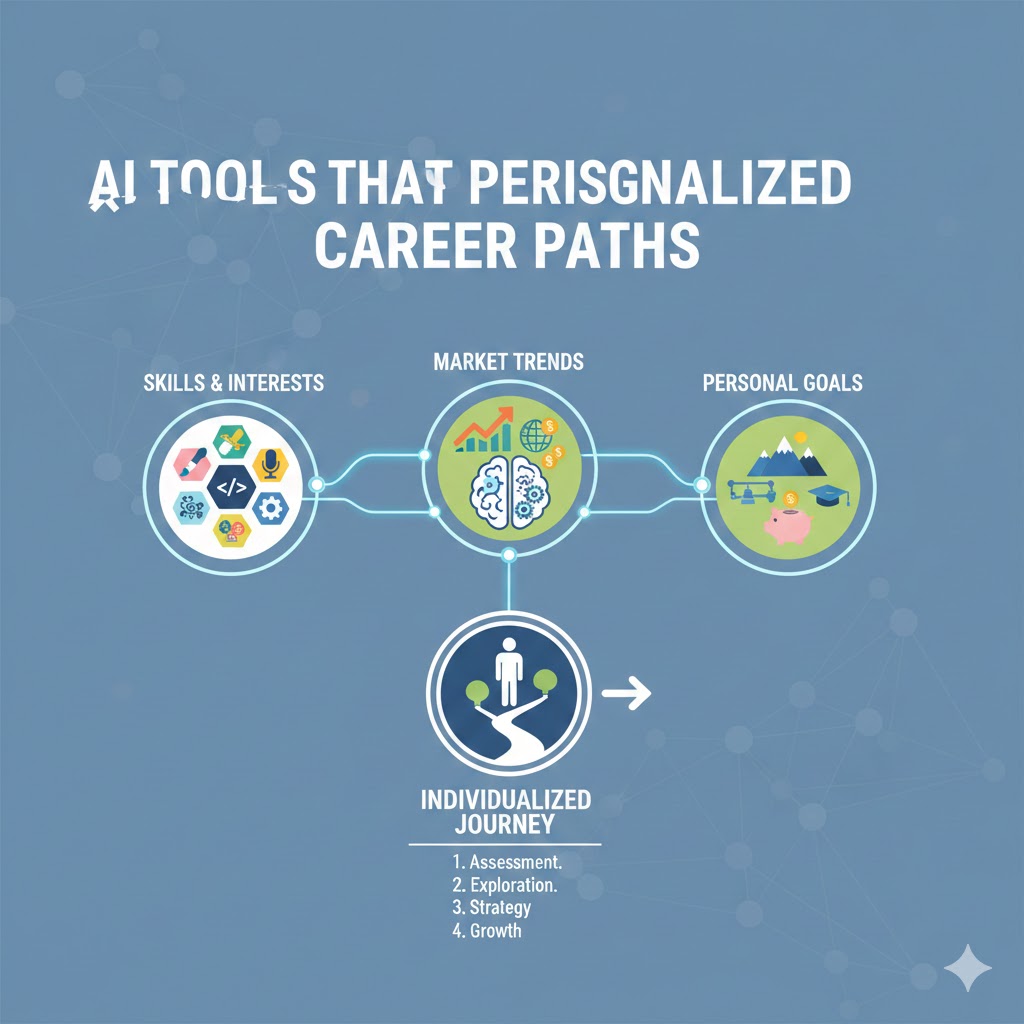
The professional landscape has transformed dramatically over the past decade. Gone are the days when career trajectories followed predictable, linear paths. Today’s workforce navigates a complex ecosystem of opportunities, requiring strategic planning and continuous adaptation. Enter artificial intelligence: a revolutionary force reshaping how professionals discover, plan, and pursue their ideal careers.
AI-powered career planning tools have emerged as sophisticated navigators in this complex terrain, offering personalized guidance that was once available only through expensive career coaches or years of trial and error. These intelligent systems analyze your unique combination of skills, experience, aspirations, and market dynamics to design personalized career paths that align with both your potential and your goals.
1. Understanding AI-Powered Career Planning Technology
The foundation of modern career planning AI rests on sophisticated machine learning algorithms that process vast amounts of data to generate meaningful insights. These systems don’t simply match keywords or suggest generic paths; they understand the nuanced relationships between skills, industries, roles, and career progression patterns.
How AI Analyzes Your Professional Profile
AI career tools employ natural language processing to parse your resume, LinkedIn profile, and professional history. They identify not just the obvious skills listed in bullet points, but also implicit competencies demonstrated through your projects and achievements. The technology recognizes patterns in your career choices, identifying strengths you might not have recognized yourself.
Advanced systems use neural networks trained on millions of career trajectories to understand how different skills combine to create unique professional profiles. They can identify transferable skills that open doors to unexpected opportunities and recognize emerging skill combinations that position you for future market demands.
The Data Behind Personalized Career Paths
These AI platforms continuously ingest data from multiple sources: job market trends, salary information, skills demand forecasts, industry growth patterns, and educational pathways. They analyze company hiring patterns, career progression timelines, and success indicators across different roles and industries.
The systems learn from vast professional networks, understanding which career transitions are common, which are rare but successful, and which combinations of experience lead to particular outcomes. This data-driven approach enables AI to design personalized career paths that are both ambitious and achievable, grounded in real-world patterns rather than generic advice.
Machine Learning Models That Power Career Recommendations
Recommendation engines use collaborative filtering to identify professionals with similar starting points who achieved desirable outcomes. Predictive models forecast which skills will become valuable and which roles will experience growth. Classification algorithms categorize your profile to identify the career clusters most aligned with your background.
These models continuously improve through feedback loops, learning from user interactions and outcomes to refine their recommendations. The technology adapts to changing market conditions, ensuring suggestions remain relevant in a dynamic employment landscape.
2. Leading AI Tools That Design Personalized Career Paths
The market offers diverse AI-powered platforms, each with unique approaches to career guidance. Understanding their capabilities helps you select tools that best serve your specific needs and career stage.
Comprehensive Career Planning Platforms
Several platforms offer end-to-end career planning experiences. LinkedIn’s Career Explorer uses its vast professional network data to suggest roles based on your profile and show career paths others have taken. The tool highlights skills gaps and recommends learning resources to bridge them.
PathSource combines assessment tools with AI-driven career matching, helping users explore careers through virtual reality experiences while receiving personalized recommendations. The platform considers personality traits, values, and interests alongside hard skills to design personalized career paths that align with who you are, not just what you can do.
Pymetrics takes a neuroscience-based approach, using games that measure cognitive and emotional attributes. The AI matches these traits with job requirements, identifying roles where you’re likely to excel and find fulfillment. Companies use the same platform for talent matching, creating a two-way marketplace for optimal career fits.
Skills Assessment and Gap Analysis Tools
Specialized tools focus on understanding your current capabilities and identifying development opportunities. Degreed’s AI evaluates your skills through multiple data points: completed courses, projects, articles read, and peer endorsements. It maps these against industry requirements to reveal skill gaps and suggest targeted learning paths.
Skillsoft’s Percipio platform uses AI to create personalized learning journeys that align with career goals. The system identifies the most efficient path to acquire needed skills, considering your learning style and available time. It continuously adjusts recommendations based on your progress and changing career objectives.
Eightfold.ai offers talent intelligence that works for both job seekers and employers. Its AI analyzes your complete professional profile to suggest roles you’re qualified for today and positions you could grow into. The platform reveals non-obvious career possibilities by understanding deep skill relationships and transferability patterns.
Industry-Specific Career Navigation Tools
Certain sectors have spawned specialized AI career tools. In technology, platforms like Hired and Triplebyte use AI to match developers with opportunities based on coding assessments and project portfolios. These tools design personalized career paths within the tech ecosystem, suggesting specializations and growth trajectories.
Healthcare professionals benefit from platforms that understand medical credentials, specializations, and career ladders unique to clinical and administrative roles. These systems navigate complex licensing requirements and continuing education needs while mapping career advancement possibilities.
Creative professionals find value in portfolio-based AI tools that analyze their work quality, style evolution, and market demand. These platforms suggest which skills to develop, which niches to pursue, and how to position creative expertise for maximum career impact.
3. Key Features That Make AI Career Tools Effective
The most valuable AI career planning platforms share certain characteristics that distinguish them from simple job boards or static career resources. Understanding these features helps you maximize the technology’s potential.
Dynamic Skills Mapping and Future-Proofing
Effective AI tools don’t just catalog your current skills; they project their future relevance. Advanced platforms monitor emerging technologies, industry disruptions, and automation trends to identify which capabilities will remain valuable and which risk obsolescence.
These systems map skill trajectories, showing how foundational abilities in one area can pivot to adjacent fields. They identify “gateway skills” that unlock multiple career possibilities and “multiplier skills” that dramatically increase your professional value when combined with your existing expertise.
The technology considers automation vulnerability, alerting you when roles in your field face displacement risk while suggesting alternative paths that leverage your experience in more secure directions. This proactive approach helps you design personalized career paths that remain viable as industries evolve.
Personalized Learning Pathway Integration
Modern AI career tools seamlessly integrate with learning platforms, creating actionable development plans. Rather than simply listing skills you need, they curate specific courses, certifications, projects, and experiences that efficiently build those competencies.
The systems consider your learning preferences, available time, and budget constraints when recommending educational resources. They sequence learning in optimal order, ensuring foundational concepts precede advanced applications. Progress tracking features adjust recommendations as you complete coursework, maintaining alignment between learning and career objectives.
Some platforms gamify skill development, creating achievement systems that maintain motivation during lengthy educational journeys. They connect you with mentors, study groups, and professional communities relevant to your target career path, recognizing that learning extends beyond formal coursework.
Market Intelligence and Timing Recommendations
AI career tools provide valuable market intelligence that informs strategic decisions. They reveal which industries are hiring, which skills command premium compensation, and where supply-demand imbalances create opportunities. Geographic analyses show where your target roles are concentrated and which locations offer optimal career prospects.
Timing recommendations help you understand when to make moves. The AI might suggest remaining in your current role to complete a valuable project or earn a forthcoming promotion, or it might identify a narrow window to transition into an emerging field before competition intensifies.
Salary projections and negotiation guidance use real compensation data to set realistic expectations. The tools show how different choices affect lifetime earnings, helping you weigh short-term sacrifices against long-term gains when considering career transitions or additional education.
Networking and Mentorship Connection
Advanced platforms leverage AI to facilitate strategic relationship building. They identify professionals in your target field whose backgrounds align with yours, making introductions more relevant and valuable. The technology suggests networking events, conferences, and online communities where you’ll find concentrated populations of useful contacts.
Mentorship matching algorithms consider not just career similarities but also communication styles, availability, and specific expertise areas. They facilitate connections with individuals positioned to provide the exact guidance you need at your current career stage.
Some systems analyze your network gaps, revealing types of connections you lack but need to achieve your goals. They might identify that you know many individual contributors but few executives, or that your network is strong in your current industry but weak in adjacent fields you’re considering.
4. How AI Creates Your Personalized Career Roadmap
Understanding the process AI uses to design personalized career paths demystifies the technology and helps you provide better inputs for more accurate guidance. The journey from initial assessment to actionable roadmap involves several sophisticated steps.
Comprehensive Profile Analysis
The process begins with deep analysis of your professional identity. AI tools examine your resume, but they look beyond job titles and dates. Natural language processing extracts insights from achievement descriptions, identifying skills demonstrated through specific accomplishments even when not explicitly listed.
The systems analyze career velocity: how quickly you’ve progressed, the nature of your growth trajectory, and patterns in your job transitions. They identify what drives your career decisions—compensation, challenge, work-life balance, impact—based on choices you’ve made and expressed preferences.
Assessment modules may ask you to complete personality inventories, values questionnaires, and interest surveys. The AI synthesizes these psychological dimensions with hard skills data, creating a holistic profile that captures not just what you can do but what will genuinely satisfy and motivate you long-term.
Multi-Dimensional Opportunity Matching
With your profile established, AI algorithms search for career opportunities across multiple dimensions simultaneously. They consider role fit, industry alignment, company culture compatibility, growth potential, compensation expectations, and geographic preferences in parallel.
The matching process isn’t binary—the AI doesn’t simply mark opportunities as suitable or unsuitable. Instead, it calculates match scores across different criteria, explaining why certain paths score higher and identifying which aspects of a career option align well with your profile and which present challenges.
Advanced systems model multiple potential futures, showing how different choices compound over time. They might reveal that accepting a lower-paying role in a high-growth field positions you better five years hence than maximizing current compensation in a stable but slow-growing sector.
Gap Analysis and Development Planning
Once target career destinations emerge, AI performs detailed gap analysis. It identifies missing skills, lacking experience types, needed credentials, and underdeveloped competencies that separate your current state from your goal state.
The technology prioritizes these gaps, distinguishing between critical requirements that must be addressed immediately, important capabilities that strengthen your candidacy, and nice-to-have attributes that provide competitive advantage. This prioritization prevents overwhelm and ensures you focus development efforts where they matter most.
Development plans include realistic timelines based on how long similar professionals typically need to acquire comparable capabilities. The AI accounts for your available time and resources, creating aggressive but achievable schedules that maintain momentum without setting unrealistic expectations.
Continuous Recalibration and Adaptation
The most sophisticated aspect of AI career planning is its dynamic nature. These systems don’t provide static advice; they continuously monitor your progress, market changes, and evolving goals to refine recommendations.
As you complete courses, gain new experiences, or shift priorities, the AI adjusts your personalized career path accordingly. If target industries face unexpected headwinds, the system alerts you and suggests alternative trajectories. When new opportunities emerge that weren’t visible initially, the technology flags them for consideration.
This adaptive approach acknowledges that career planning isn’t a one-time exercise but an ongoing process of navigation through changing conditions. The AI serves as a persistent guide, ensuring your path remains optimal even as circumstances evolve.
5. Maximizing Results From AI Career Planning Tools
Technology alone doesn’t guarantee success. How you engage with AI career tools significantly impacts the quality of guidance you receive and your ultimate career outcomes. Strategic use amplifies the technology’s value.
Providing Comprehensive and Honest Inputs
The accuracy of AI recommendations depends entirely on input quality. Provide complete work history, even experiences that seem tangential. The AI might identify valuable transferable skills in unexpected places that you would have overlooked.
Be honest about your goals, constraints, and preferences. If work-life balance matters more than maximizing compensation, acknowledge that. If you’re unwilling to relocate, make it clear. The AI can only design personalized career paths that truly fit your life if it understands your real parameters and priorities.
Update your profile regularly as you acquire new skills, complete projects, or shift priorities. Stale data produces increasingly irrelevant recommendations over time. Treat your profile as a living document that evolves with your professional growth.
Combining AI Insights With Human Judgment
AI provides data-driven recommendations, but you bring irreplaceable human context. The algorithms might suggest a career path that’s statistically optimal but doesn’t align with your personal values or life circumstances. Your judgment about what matters in your specific situation remains essential.
Use AI guidance as a starting point for exploration rather than definitive direction. The tools reveal possibilities you might not have considered and identify efficient paths to various destinations, but you decide which journey to undertake based on the complete picture of your life.
Discuss AI recommendations with mentors, colleagues, and career counselors. Human advisors provide perspective the algorithms can’t, sharing experiential wisdom about what various career paths actually feel like day-to-day. They help you interpret AI insights through the lens of lived experience.
Implementing Recommendations Systematically
Transform AI recommendations into concrete action plans with specific milestones and deadlines. The technology might suggest acquiring particular skills, but you must schedule learning time, select courses, and commit to completion. Create accountability systems—study groups, progress tracking, milestone rewards—that maintain momentum.
Start with quick wins that build confidence and demonstrate progress. If the AI suggests ten skill gaps, identify two you can address rapidly and begin there. Early success sustains motivation for longer-term development efforts.
Document your journey, recording which recommendations you’ve implemented and their outcomes. This data helps you refine your engagement with AI tools, teaching you which types of guidance prove most valuable for your situation. It also provides evidence of growth for future job applications and performance reviews.
Leveraging Network Effects and Community Features
Many AI career platforms include community elements—forums, user groups, mentorship programs. Active participation multiplies the tool’s value. Other users share experiences with recommended paths, providing ground truth about what transitions actually entail.
Contribute your own insights as you progress. Sharing your experiences helps others while reinforcing your learning and building your professional reputation within the community. The visibility can lead to unexpected opportunities and valuable connections.
Some platforms reward engagement with enhanced features or preferential matching. Regular use signals commitment, which the AI interprets when prioritizing your recommendations and potentially increases your visibility to employers using the same platform.
6. Real-World Success Stories and Use Cases
Abstract descriptions of AI capabilities become tangible through concrete examples. These scenarios illustrate how professionals across different situations have used AI tools to design personalized career paths that transformed their trajectories.
Career Pivot From Declining to Growth Industry
Consider a retail manager whose sector faced accelerating automation and declining employment. Traditional job searches returned primarily similar retail positions with uncertain futures. An AI career tool analyzed her profile and identified strong transferable skills in operations management, team leadership, and customer experience design.
The platform revealed that her capabilities aligned well with roles in logistics operations and customer success management within technology companies. These fields valued her front-line experience while offering stronger growth prospects. The AI designed a personalized career path that involved completing a supply chain certificate and a customer relationship management course, both achievable within four months.
The tool connected her with a mentor who had made a similar transition and recommended networking events where she could meet logistics professionals. Within six months, she secured a logistics coordinator position at a growing e-commerce company at comparable compensation, with significantly better advancement potential than her previous field offered.
Accelerated Advancement for Mid-Career Professional
A mid-level accountant felt stuck in his career progression, uncertain how to reach senior leadership. AI analysis revealed that while his technical accounting skills were strong, he lacked strategic business acumen and change management experience that characterized successful CFO trajectories.
The system designed a personalized career path involving an executive MBA focused on strategic finance, supplemented by volunteer treasurer positions with nonprofits to gain board exposure. It suggested seeking project leadership opportunities in his current role, particularly initiatives involving process improvement or system implementations.
The AI identified specific companies known for promoting accountants to CFO positions and mapped the typical timelines and intermediate roles involved. With this roadmap, he strategically pursued experiences that addressed his gaps. Three years later, he secured a finance director role, a critical stepping stone toward his CFO aspiration, having followed the AI-guided development plan.
Recent Graduate Finding Initial Direction
A liberal arts graduate with a philosophy degree felt lost in the job market, unsure how her education translated to employment. AI analysis of her coursework and extracurricular activities identified strong analytical thinking, written communication, and ethical reasoning capabilities.
The platform revealed that these skills aligned well with careers in user experience research, market research, and business analysis—fields she hadn’t considered because they weren’t obvious extensions of her major. The AI designed personalized career paths for each option, showing entry points, required additional skills, and growth trajectories.
She chose user experience research and followed the AI’s recommendation to complete a UX certification and build a portfolio through volunteer projects. The tool connected her with UX professionals for informational interviews and identified companies known for hiring candidates from non-traditional backgrounds. Within four months of graduation, she secured a junior UX researcher position.
Technical Professional Expanding to Management
A software engineer excelling in technical work received AI feedback that his career plateau was approaching. The analysis showed that his deep technical skills would remain valuable, but advancement to senior levels required leadership capabilities he hadn’t developed.
The AI designed two personalized career paths: one deepening technical expertise toward distinguished engineer or architect roles, another pivoting toward engineering management. After exploring both options, he chose the management track. The system prescribed specific development: completing a technical leadership course, seeking mentorship from engineering managers, and pursuing team lead or tech lead opportunities in his current role.
The platform provided conversation scripts for discussing these aspirations with his manager and identified companies with strong technical leadership tracks. Within a year, he transitioned to a tech lead position with direct reports, following the roadmap the AI had created for his management aspirations.
7. The Future of AI-Powered Career Development
The current generation of AI career tools represents just the beginning. Emerging capabilities will make personalized career planning even more sophisticated, accessible, and effective in coming years.
Predictive Career Analytics and Proactive Guidance
Next-generation systems will predict career disruptions before they occur, alerting professionals to threats and opportunities years in advance. They’ll model how specific technologies, economic shifts, and demographic changes will affect individual career trajectories, enabling proactive rather than reactive adaptation.
These tools will forecast your optimal career moves with greater accuracy, considering not just current market conditions but predicted states years hence. They’ll recommend timing for major transitions, identifying windows when your skills will be most valuable or when particular opportunities will be most accessible.
Integration with broader life planning will help design personalized career paths that harmonize with personal milestones like starting families, caring for aging parents, or pursuing passion projects. The AI will understand careers as one element of holistic life design rather than isolated professional trajectories.
Immersive Career Exploration and Simulation
Virtual and augmented reality integration will allow you to “try before you buy” in career exploration. You’ll experience simulated days in various roles, gaining visceral understanding of what different careers actually entail. This experiential learning will help you make more informed decisions about which paths to pursue.
AI will create personalized simulations that test your aptitude and interest in various fields through realistic scenarios. These experiences will generate additional data points about your capabilities and preferences, enabling even more accurate career matching and guidance.
Enhanced Human-AI Collaboration
Rather than replacing human career counselors, AI will augment their capabilities. Counselors will use AI-generated insights as foundations for deeper exploratory conversations, focusing their expertise on the uniquely human elements of career planning: values clarification, emotional processing, and meaning-making.
This collaboration model will democratize access to high-quality career guidance. Individuals who couldn’t afford dedicated career coaching will receive AI-powered initial guidance, with human counselors available for complex decisions or emotionally charged transitions.
Continuous Learning and Just-In-Time Skill Development
AI will blur the boundaries between career planning and skill development. Rather than separating “planning” from “learning,” systems will provide ongoing micro-learning recommendations that continuously align your capabilities with your evolving career path.
Just-in-time skill development will become more prominent, with AI identifying exactly which capabilities you need for upcoming opportunities and providing targeted, efficient learning resources. This approach minimizes time invested in skills you won’t use while ensuring you’re prepared when opportunities arise.
Conclusion
The emergence of AI tools that design personalized career paths represents a democratization of career planning expertise. What was once accessible only to those who could afford executive coaches or career counselors is now available to anyone with internet access. These platforms combine vast data resources with sophisticated algorithms to provide guidance tailored to your unique profile and aspirations.
However, technology is an enabler, not a solution in itself. The most successful professionals use AI tools as sophisticated compasses that reveal possible directions and efficient routes, while retaining ownership of their career decisions and taking consistent action toward their goals. They combine AI insights with human wisdom, data-driven recommendations with personal values, and algorithmic efficiency with relationship-building and experiential learning.
As you engage with AI career planning tools, remember that they’re most powerful when you provide honest, comprehensive inputs and act systematically on the recommendations they generate. Design personalized career paths that align not just with market opportunities but with your authentic self—your values, interests, and vision for your life beyond professional achievement.
The future of career development is neither purely human nor purely artificial, but rather a collaboration that leverages the strengths of both. AI brings unmatched analytical power and pattern recognition, while you bring irreplaceable context, judgment, and the commitment to transform plans into reality. Together, this partnership creates opportunities for more fulfilling, successful careers than either could achieve alone.
Also read this:
AI Creates Personal Knowledge Graphs From Daily Work
AI Tools That Turn Handwritten Notes Into Digital Documents
AI Review Detection: How Shopping Websites Fight Fake Reviews