
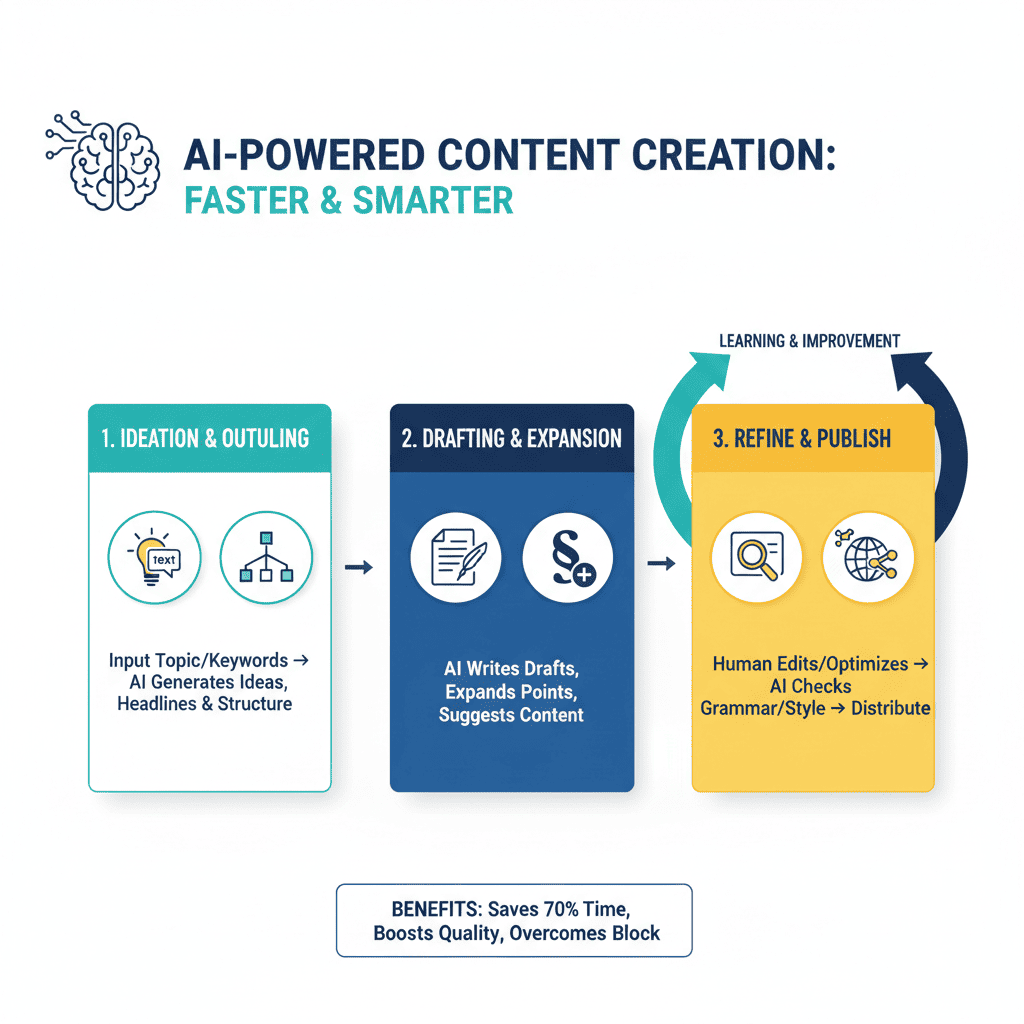
Content creation has become the currency of modern business and personal branding. Whether you’re a blogger, marketer, entrepreneur, or social media influencer, the demand for fresh, engaging content never stops. The challenge? Creating quality content at scale traditionally requires enormous time investments that most creators simply don’t have. The solution lies in learning how to create content faster using AI—a game-changing approach that’s revolutionizing how content gets produced across every platform and format.
Artificial intelligence has evolved from experimental technology to essential content creation infrastructure. The barriers that once made AI tools accessible only to tech-savvy early adopters have disappeared. Today, anyone can create content faster using AI regardless of technical expertise, budget constraints, or creative background. These tools don’t just speed up existing workflows—they fundamentally reimagine what’s possible when human creativity combines with machine efficiency.
The most successful content creators in 2025 aren’t those who resist AI adoption out of fear it will replace them. They’re the ones who’ve mastered the art of creating content faster using AI while maintaining authenticity, quality, and strategic direction. They’ve discovered that AI isn’t a replacement for human creativity but rather an amplifier that multiplies output without sacrificing the unique voice and perspective that makes content resonate.
This comprehensive guide reveals exactly how to create content faster using AI across every major content format. From written articles and social media posts to videos, graphics, and podcasts, you’ll discover proven strategies, specific tools, and practical workflows that will transform your content creation process from time-consuming struggle to efficient, scalable system.
Understanding the AI Content Creation Revolution
Before diving into specific tactics for how to create content faster using AI, it’s essential to understand the landscape of AI content tools and why this moment represents a fundamental shift in content creation.
The Evolution of AI Content Tools
The journey from early AI writing assistants to today’s sophisticated content platforms illustrates remarkable progress:
First Generation (2015-2020): Basic AI tools offered grammar checking, simple text generation, and template-based content. Results were mediocre, requiring extensive human editing to become usable.
Second Generation (2020-2022): GPT-3 and similar models introduced natural language capabilities producing coherent, contextually appropriate content. Quality improved dramatically but still required significant human oversight.
Third Generation (2023-Present): Current AI tools like GPT-4, Claude, and specialized content platforms generate professional-quality content across multiple formats. The line between AI-generated and human-created content has become increasingly blurred.
This evolution means that creating content faster using AI now produces results indistinguishable from traditional methods while requiring a fraction of the time.
Why Speed Matters in Content Creation
Content velocity directly impacts success across multiple dimensions:
Algorithm Favorability: Platforms like Google, YouTube, Instagram, and TikTok reward consistent publishing schedules with increased visibility and reach.
Audience Engagement: Regular content keeps audiences engaged, building habits around your content consumption and strengthening community bonds.
SEO Performance: More content means more keywords, more pages indexed, and more opportunities to rank for valuable search terms.
Competitive Advantage: Outpacing competitors in content volume and quality establishes market dominance and thought leadership.
Testing and Optimization: Higher content velocity enables more experimentation, faster learning, and quicker optimization of what resonates.
Learning to create content faster using AI isn’t about cutting corners—it’s about gaining the competitive advantages that content velocity provides.
The Human-AI Collaboration Model
The most effective approach to creating content faster using AI embraces collaboration rather than replacement:
AI Handles: Research, first drafts, ideation, formatting, optimization, repurposing, and repetitive tasks.
Humans Provide: Strategic direction, unique insights, brand voice, quality control, emotional intelligence, and creative vision.
This partnership leverages each party’s strengths, resulting in content that’s both efficiently produced and authentically human.
1. Accelerate Written Content Creation with AI Writing Tools
Written content forms the foundation of most content strategies. Learning to create content faster using AI for blogs, articles, and copy can multiply your output exponentially while maintaining quality.
Choosing the Right AI Writing Platform
Different platforms excel at different content types:
ChatGPT: Versatile conversational AI excellent for brainstorming, drafting, editing, and general writing tasks. Free tier available with paid options for advanced features.
Claude: Strong at long-form content, nuanced writing, and maintaining consistency across extended pieces. Excellent for blog posts and articles.
Jasper: Specifically designed for marketers and content creators with templates for ads, emails, blog posts, and social content.
Copy.ai: Focuses on marketing copy, product descriptions, and sales-oriented content with optimization features.
Writesonic: Offers article writing, blog posts, and content optimization with SEO integration.
The Efficient AI Writing Workflow
Follow this systematic process to create content faster using AI:
Step 1 – Strategic Planning: Define topic, target audience, key points, desired tone, and target length. AI works best with clear direction.
Step 2 – Outline Generation: Use AI to create detailed outlines. Prompt example: “Create a detailed outline for a 2,000-word blog post about [topic] targeting [audience] that covers [key points].”
Step 3 – Section Drafting: Generate content section by section rather than all at once. This maintains quality and coherence while allowing refinement.
Step 4 – Human Refinement: Edit AI output to match your voice, add personal insights, verify facts, and inject personality that makes content uniquely yours.
Step 5 – Optimization: Use AI to suggest improvements, enhance SEO, strengthen headlines, and optimize for engagement.
This workflow enables you to create content faster using AI while maintaining the quality and authenticity your audience expects.
Advanced AI Writing Techniques
Prompt Engineering: Master the art of crafting prompts that generate exactly what you need. Specific, detailed prompts produce better results than vague requests.
Iterative Refinement: Generate multiple versions, combine the best elements, and progressively refine until perfect.
Voice Consistency: Feed AI examples of your writing to help it match your style. The more context provided, the better it mimics your voice.
Fact-Checking Integration: Always verify AI-generated facts, statistics, and claims. AI can hallucinate information confidently.
Content Types Perfect for AI Acceleration
Blog Posts: Full articles from ideation through first draft in minutes rather than hours.
Product Descriptions: Hundreds of unique descriptions generated from basic specifications.
Email Campaigns: Personalized email sequences, subject lines, and body content optimized for engagement.
Social Media Captions: Platform-specific captions tailored to character limits and audience preferences.
Meta Descriptions: SEO-optimized descriptions for every page on your website.
Ad Copy: Multiple headline and body variations for A/B testing across advertising platforms.
Mastering these applications helps you create content faster using AI across your entire content ecosystem.
2. Generate Visual Content at Lightning Speed with AI Image Tools
Visual content drives engagement across social media, blogs, and marketing materials. AI image generation tools enable you to create content faster using AI without design skills or expensive software.
Leading AI Image Generation Platforms
Midjourney: Produces stunning, artistic images from text descriptions. Excellent for creative, stylized visuals.
DALL-E 3: OpenAI’s image generator integrated with ChatGPT. Great for conceptual images and illustrations.
Stable Diffusion: Open-source option offering flexibility and customization. Requires more technical knowledge but provides complete control.
Adobe Firefly: Integrated with Adobe Creative Cloud, offering commercial-safe AI generation with professional editing tools.
Canva AI: User-friendly platform combining templates with AI generation, perfect for social media graphics.
Creating Images Efficiently with AI
Detailed Prompts: Specific descriptions produce better results. Instead of “a cat,” try “a fluffy orange tabby cat sitting on a windowsill at sunset, photorealistic style, warm lighting.”
Style Specification: Include artistic style references—”in the style of [artist]” or “photorealistic,” “watercolor painting,” “digital art,” etc.
Iterative Generation: Create multiple variations, then refine the best ones with additional prompts.
Aspect Ratio Consideration: Specify dimensions appropriate for intended use—square for Instagram, vertical for Stories, horizontal for blog headers.
Visual Content Applications
Blog Featured Images: Generate unique header images perfectly matching article topics.
Social Media Graphics: Create eye-catching visuals for posts, stories, and ads without design experience.
Product Mockups: Visualize products in various settings and contexts for marketing materials.
Infographic Elements: Generate icons, illustrations, and visual elements for data visualization.
Thumbnail Creation: YouTube thumbnails, podcast cover art, and other attention-grabbing visuals.
Presentation Visuals: Custom images and graphics enhancing slide decks and presentations.
Learning to create content faster using AI image tools eliminates the bottleneck of sourcing stock photos or hiring designers for routine visual needs.
Combining AI with Traditional Design
AI for Ideation: Generate concept visuals that human designers refine and perfect.
Rapid Prototyping: Create multiple design directions quickly before committing to final designs.
Asset Generation: Produce supporting visual elements that designers incorporate into larger compositions.
Background Creation: Generate backgrounds and scenes that traditional design elements overlay.
This hybrid approach maximizes the ability to create content faster using AI while maintaining professional quality for high-stakes applications.
3. Produce Video Content Rapidly with AI Video Tools
Video content dominates engagement metrics but traditionally requires enormous time investments. AI video tools enable you to create content faster using AI video formats without extensive production skills or equipment.
AI Video Creation Platforms
Descript: Text-based video editing that allows cutting video by editing transcripts. Includes AI voices, filler word removal, and studio sound enhancement.
Pictory: Converts scripts or blog posts into videos automatically, selecting stock footage and adding captions.
Synthesia: Creates videos with AI avatars that speak your script, eliminating the need for on-camera talent or recording.
Runway ML: Advanced AI video editing with special effects, green screen removal, and creative tools.
Opus Clip: Automatically creates short clips from long videos, perfect for social media content from podcasts or webinars.
Efficient Video Production Workflows
Script to Video: Write or generate scripts with AI, then use video tools to transform text into complete videos with visuals, voice-over, and music.
Repurposing Long-Form: Record one long-form video or podcast, then use AI to automatically create dozens of short clips optimized for different platforms.
Template-Based Creation: Use templates for common video types (tutorials, announcements, reviews) and simply swap content rather than starting from scratch.
Batch Production: Record multiple videos in one session, then use AI tools to edit, caption, and optimize all simultaneously.
Video Content Types Enhanced by AI
Social Media Videos: Short-form content for TikTok, Instagram Reels, YouTube Shorts created from longer content.
Explainer Videos: Educational content with AI avatars delivering information without camera presence required.
Product Demonstrations: Show products in use with AI-generated scenarios and voice-over explanations.
Testimonial Videos: Transform written testimonials into video format with text overlays and stock footage.
Video Ads: Create multiple ad variations quickly for testing across platforms.
The ability to create content faster using AI video tools levels the playing field for creators who lack video production resources.
4. Streamline Audio and Podcast Content with AI Tools
Podcasts and audio content require significant production time traditionally. AI tools help you create content faster using AI audio workflows while maintaining professional quality.
AI Audio Production Tools
Descript: Comprehensive audio editing through text manipulation, plus AI voices and enhancement features.
Adobe Podcast: AI-powered audio enhancement making home recordings sound studio-quality.
Cleanvoice: Automatically removes filler words, mouth sounds, and stutters from recordings.
Podcastle: All-in-one platform with recording, AI enhancement, and editing capabilities.
ElevenLabs: Advanced AI voice synthesis for narration, voice-overs, or podcast content.
Podcast Production Acceleration
Episode Planning: Use AI to generate episode outlines, talking points, and research summaries on topics.
Script Writing: Create scripts or detailed outlines ensuring comprehensive topic coverage without rambling.
Editing Automation: AI removes silences, filler words, and verbal tics, performing hours of manual editing in seconds.
Enhancement: Professional audio quality from home recordings through AI noise reduction and voice enhancement.
Show Notes Generation: Automatically create episode descriptions, key points, and timestamps from audio transcripts.
Audio Content Applications
Podcast Episodes: Complete production workflow from planning through final export.
Audiobook Creation: Convert written content to spoken audio using AI voices.
Voice-Overs: Add professional narration to videos, presentations, or e-learning content.
Audio Articles: Create audio versions of blog posts for accessibility and audience preference.
Sound Design: Generate background music and sound effects appropriate to content mood.
Learning to create content faster using AI audio tools reduces podcast production time by 70-80% while improving consistency and quality.
5. Optimize Social Media Content Creation with AI
Social media demands constant content creation across multiple platforms. AI tools enable you to create content faster using AI social strategies that maintain presence without burnout.
AI-Powered Social Media Tools
Buffer AI Assistant: Generates post ideas and draft content for scheduled publishing.
Hootsuite AI: Content suggestions, caption generation, and optimal posting time recommendations.
Copy.ai: Platform-specific social content generation with hashtag suggestions.
Lately: Transforms long-form content into dozens of social posts automatically.
Predis.ai: Creates social media posts complete with captions, hashtags, and visuals.
Efficient Social Content Workflows
Content Batching: Generate a month of social content in one session using AI tools and templates.
Repurposing Strategy: Transform one piece of core content (blog, video, podcast) into 20+ social posts across platforms.
Platform Optimization: Use AI to adapt content for each platform’s format, tone, and audience expectations.
Engagement Optimization: Generate multiple caption variations and use analytics to identify what resonates.
Platform-Specific Strategies
Twitter/X: Generate thread ideas, craft engaging tweets, and create conversation starters.
LinkedIn: Professional content, thought leadership posts, and engagement-driving questions.
Instagram: Captions, hashtag strategies, and story ideas tailored to visual content.
TikTok: Video scripts, trending topic integration, and hook generation for short videos.
Facebook: Community-building posts, longer-form updates, and discussion prompts.
The ability to create content faster using AI social tools solves the overwhelming challenge of maintaining consistent presence across platforms.
Maintaining Authenticity in AI-Generated Social Content
Personal Touch: Add personal anecdotes, opinions, and voice to AI-generated foundations.
Engagement Response: Always respond to comments personally rather than using AI responses.
Brand Voice Consistency: Train AI on your existing content to match your established voice.
Strategic Balance: Mix AI-assisted content with purely human posts for authentic connection.
6. Create Email Marketing Content Efficiently with AI
Email marketing requires consistent content creation for campaigns, newsletters, and automation sequences. AI helps you create content faster using AI email strategies that convert.
AI Email Marketing Tools
Jasper: Specialized email templates and conversion-optimized copy generation.
Copy.ai: Email subject lines, body content, and sequence creation.
Writesonic: Complete email campaign generation from concept to execution.
ChatGPT/Claude: Custom email content with personalization and segmentation considerations.
Email Content Creation Workflow
Subject Line Generation: Create 10-20 subject line variations using AI, then A/B test the most promising.
Body Content: Generate email body copy tailored to segment, objective, and brand voice.
Personalization Tokens: Incorporate dynamic content that adapts to recipient data and behavior.
Sequence Automation: Build complete email sequences (welcome, nurture, sales) in single sessions.
Template Creation: Develop email templates AI can populate with fresh content regularly.
Email Content Types
Newsletter Content: Weekly or monthly updates pulling from recent blog posts, news, and insights.
Promotional Emails: Product launches, sales announcements, and special offers with urgency and benefits highlighted.
Educational Sequences: Onboarding series, courses, or training delivered via automated emails.
Re-engagement Campaigns: Win-back sequences for inactive subscribers with personalized messaging.
Transactional Content: Order confirmations, shipping updates, and post-purchase communications.
Mastering how to create content faster using AI email strategies increases campaign volume and testing velocity without proportional time investment.
7. Repurpose and Multiply Content Across Formats
The ultimate efficiency in content creation comes from repurposing—creating once and distributing everywhere. AI tools supercharge your ability to create content faster using AI repurposing workflows.
Content Multiplication Strategy
Core Content Creation: Start with one comprehensive piece—long-form blog post, video, or podcast episode.
Format Transformation: Use AI to transform that core content into multiple formats:
- Blog post → social media posts, email content, infographics, short videos
- Video → blog article, social clips, quotes, audiograms, transcript
- Podcast → show notes, quote graphics, short videos, blog posts, social content
Platform Optimization: Adapt each format for specific platform requirements and audience expectations.
Distribution Schedule: Space repurposed content across days or weeks, maximizing value from single creation effort.
AI Repurposing Tools
Repurpose.io: Automatically distributes and reformats content across multiple platforms.
Opus Clip: Creates short clips from long videos with AI-selected highlights.
Descript: Transforms videos into blogs, social posts, and audiograms.
ChatGPT/Claude: Manual but powerful repurposing through prompts like “Transform this blog post into 10 Twitter threads.”
Maximizing Content Value
One 2,000-word blog post can become:
- 20+ social media posts (various platforms)
- 5-10 email newsletter items
- 1 video script
- 10+ quote graphics
- 1 infographic
- 1 podcast episode script
- Multiple short-form videos
This multiplication effect means you create content faster using AI not by creating more but by extracting more value from each piece created.
Quality Control in Repurposing
Contextual Adaptation: Ensure repurposed content fits the platform and audience, not just copying and pasting.
Fresh Angles: Present the same information from different perspectives for variety.
Value Addition: Each format should add unique value, not simply duplicate information.
Attribution: When repurposing across your own properties, maintain consistent messaging while avoiding redundancy that annoys audiences.
8. Implement AI-Powered Content Planning and Strategy
Beyond individual content creation, AI transforms strategic planning, helping you create content faster using AI strategic workflows that align with goals.
AI Strategy and Planning Tools
ChatGPT/Claude: Generate content calendars, topic ideas, and strategic frameworks.
SEMrush/Ahrefs AI Features: Keyword research, content gaps, and optimization recommendations.
MarketMuse: Content planning based on competitive analysis and search intent.
Frase: Topic research, outline generation, and content brief creation.
Strategic Content Workflows
Content Calendar Creation: Generate 3-6 months of content ideas aligned with marketing goals, seasons, and audience needs.
Keyword Research: Use AI to identify high-opportunity keywords and related topics.
Competitor Analysis: Analyze competitor content to identify gaps and opportunities.
Content Briefs: Create detailed briefs for each content piece covering keywords, structure, and key points.
Performance Prediction: Use AI to estimate content performance based on topic, keywords, and competitive landscape.
Ideation at Scale
Topic Generation: Prompt example: “Generate 50 blog post ideas for [audience] interested in [topic] covering [subtopics].”
Angle Variation: Take one topic and generate 10 different angles or approaches to cover it.
Trend Integration: Use AI to monitor trends and suggest timely content opportunities.
Question Mining: Extract common questions from forums, social media, and search data to address in content.
The strategic application of AI helps you create content faster using AI planning processes while ensuring content aligns with business objectives rather than creating for creation’s sake.
Best Practices for AI-Accelerated Content Creation
To maximize effectiveness while maintaining quality when you create content faster using AI, follow these essential principles:
Maintain Your Unique Voice
Feed AI Your Writing: Provide examples of your best work to help AI match your style.
Edit for Personality: Add personal anecdotes, opinions, and humor that AI cannot generate.
Consistency Checks: Ensure all content sounds like it comes from one coherent brand voice.
Verify Accuracy
Fact-Check Everything: AI can confidently state incorrect information. Verify facts, statistics, and claims.
Source Attribution: Ensure proper attribution for ideas, quotes, and data.
Update Information: AI training data has cutoff dates. Update time-sensitive information.
Optimize for Your Audience
Audience Understanding: AI needs context about your specific audience to generate relevant content.
Feedback Integration: Use audience engagement data to refine AI prompts and outputs.
Personalization: Segment content for different audience groups with tailored messaging.
Balance Efficiency with Quality
Speed vs. Quality: Use AI for speed but maintain quality standards through human review.
Strategic Application: Use AI for appropriate tasks—first drafts, ideation, optimization—not final outputs without review.
Continuous Improvement: Refine your AI workflows based on what works best for your content and audience.
Ethical AI Content Use
Disclosure When Appropriate: Consider transparency about AI assistance, especially in regulated industries.
Original Value Addition: Ensure content provides unique value, not just AI-regurgitated common knowledge.
Respect Copyrights: Don’t use AI to plagiarize or closely imitate others’ protected work.
Conclusion: Your Content Creation Transformation Starts Now
Learning to create content faster using AI isn’t about cutting corners or sacrificing quality—it’s about leveraging technology to multiply your creative capacity while maintaining the authentic voice and strategic direction only you can provide. The content creators dominating their niches aren’t necessarily more talented or creative than others; they’re simply more efficient at turning ideas into published content that reaches their audiences.
The tools and strategies outlined in this guide provide everything you need to transform your content creation process. What once took hours now takes minutes. What once required teams of specialists can now be accomplished by solo creators with the right AI tools and workflows. What once limited your content output to a few pieces per week can now become dozens without burning out.
The key to successfully creating content faster using AI lies in embracing the human-AI partnership model. You bring strategy, creativity, expertise, and voice. AI brings speed, scale, research capability, and tireless execution. Together, this partnership produces more and better content than either could alone.
Start today by choosing one content format where speed would provide the greatest advantage. Implement one AI tool and master it before adding others. Develop systematic workflows that incorporate AI at appropriate points. Measure results—both in time saved and content performance—to continuously optimize your approach.
The content demands facing creators, marketers, and businesses will only intensify. Competition for attention grows fiercer daily. The creators who thrive will be those who create content faster using AI while maintaining quality and authenticity. The choice is clear: adapt and accelerate, or fall behind competitors who’ve mastered AI-augmented content creation.
Your content transformation begins with a single piece created using these AI-powered methods. Experience the efficiency gains firsthand. Feel the relief of publishing quality content without the traditional time investment. Discover the competitive advantage that content velocity provides.
The future of content creation is here. It’s faster, more efficient, and more accessible than ever before. The question isn’t whether to embrace AI-accelerated content creation—it’s how quickly you’ll implement it to gain the advantages it provides. Start creating content faster using AI today, and watch your content output, audience growth, and competitive positioning transform before your eyes.
Also read this:
15 AI Tools That Will Replace Traditional Jobs