
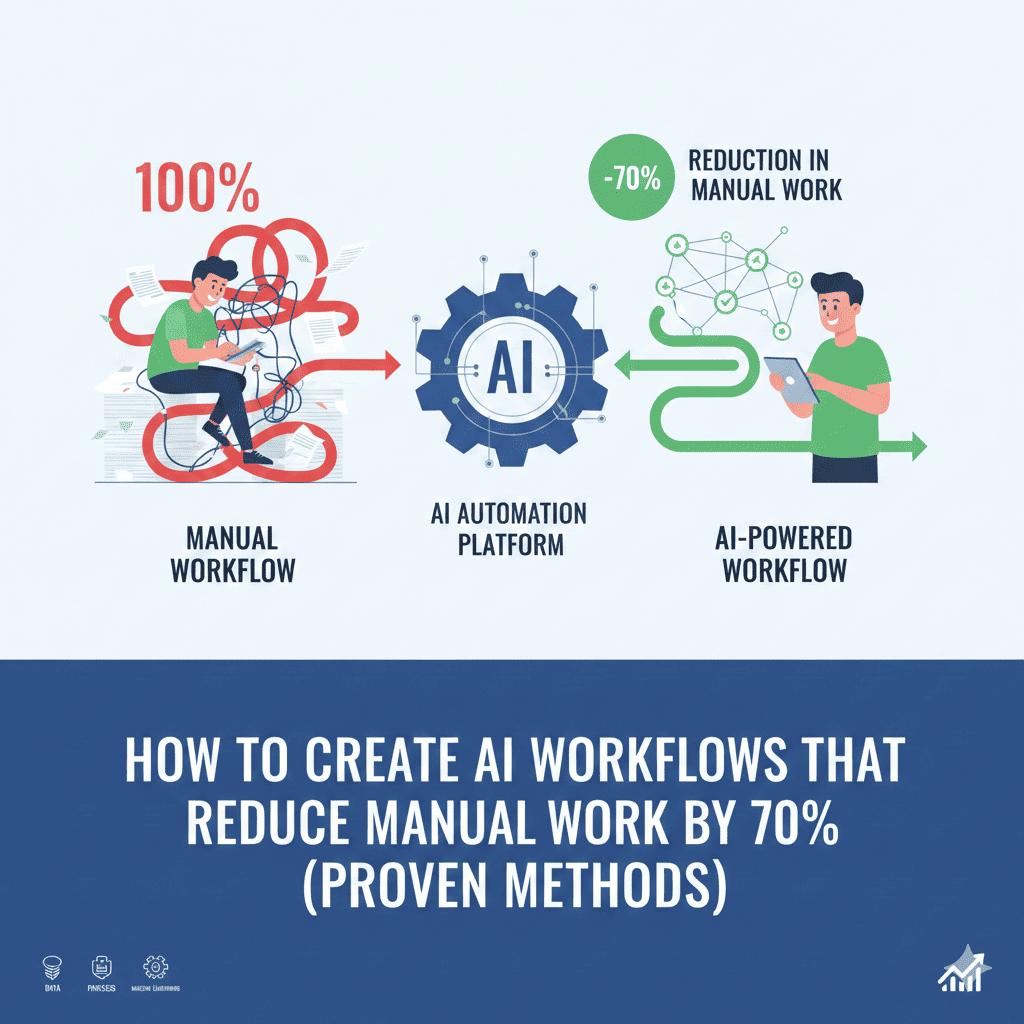
Manual work is the silent killer of productivity. Every day, professionals spend hours on repetitive tasks that drain energy and steal time from meaningful work. Data entry, email sorting, report generation, scheduling coordination, file organization—these routine activities consume 60-70% of the average knowledge worker’s day. The cruel irony is that while you’re buried in busy work, strategic projects languish and creative opportunities pass by.
But there’s a solution that’s both powerful and accessible. When you Create AI Workflows That Reduce Manual Work, you’re not just saving time—you’re fundamentally transforming how work gets done. Organizations implementing comprehensive AI workflows report consistent reductions of 70% or more in manual task time, freeing teams to focus on innovation, strategy, and growth. These aren’t theoretical gains or future possibilities. They’re proven results happening right now across industries and company sizes.
This comprehensive guide reveals the exact methods successful organizations use to design, implement, and optimize AI workflows that deliver dramatic reductions in manual work. You’ll learn proven frameworks, avoid common pitfalls, and discover step-by-step processes for transforming your most time-consuming tasks into automated workflows that run reliably in the background.
Understanding the Manual Work Crisis and AI’s Solution
Before diving into workflow creation, it’s critical to understand why manual work dominates modern workplaces and how AI uniquely solves this problem.
Manual work isn’t inherently valuable—it’s simply unavoidable without better tools. Nobody dreams of copying data between spreadsheets or formatting reports. These tasks exist because they connect systems, transform information, or fulfill process requirements. They’re necessary but not valuable. Traditional automation helped but required complex programming and broke easily when processes changed.
AI workflows differ fundamentally from traditional automation. Rule-based automation follows rigid if-then logic: if this exact condition occurs, then perform this specific action. Change the input format slightly, and everything breaks. AI workflows handle variation, understand context, and adapt to changes. They can read unstructured emails, interpret ambiguous requests, and make judgment calls based on learned patterns.
The 70% reduction threshold represents the sweet spot between ambitious and achievable. Eliminating all manual work is unrealistic—some tasks genuinely require human judgment. But 70% represents the vast majority of truly repetitive, rule-based work that AI handles excellently. This level of reduction transforms daily experience from overwhelmed to manageable.
Successful implementation requires systematic approach, not random tool adoption. Many organizations buy AI tools but see minimal results because they haven’t designed cohesive workflows. Tools are ingredients; workflows are recipes. When you Create AI Workflows That Reduce Manual Work systematically, the same tools that delivered 10% gains in ad-hoc use suddenly eliminate entire categories of manual tasks.
1. Conducting a Comprehensive Manual Work Audit
You can’t optimize what you don’t measure. Before building AI workflows, map exactly where manual work occurs, how much time it consumes, and which tasks offer the biggest automation opportunities.
Track every manual task for two complete weeks. Have team members log all activities taking more than five minutes. Include task name, duration, frequency, and brief description. This creates an accurate baseline showing where time actually goes versus where people think it goes. The gap is often shocking.
Categorize tasks by automation potential and impact. Not all manual work is equally suitable for AI automation. High-frequency, rule-based tasks with clear inputs and outputs are ideal candidates. Complex judgment calls requiring extensive context are poor candidates. Create a matrix plotting automation difficulty against time savings to identify your highest-value targets.
Identify data handoffs and system disconnections. Manual work often exists because information needs to move between systems that don’t communicate. Every time someone copies data from email to CRM, or from spreadsheet to database, that’s an automation opportunity. Map these information flows to reveal workflow possibilities.
Calculate the true cost of manual work. Multiply task duration by frequency and hourly labor cost. A five-minute task performed three times daily doesn’t seem significant until you calculate it consumes 65 hours annually per person. Across a team, seemingly minor tasks represent thousands of dollars in labor cost.
Survey pain points beyond time consumption. Some manual tasks are particularly error-prone, create bottlenecks, or cause excessive stress. These qualitative factors should influence prioritization alongside pure time metrics. Eliminating a bottleneck task might have multiplicative effects across the entire workflow.
Document current process steps in explicit detail. For priority automation targets, write out every single step including decision points, data sources, and success criteria. This documentation becomes your automation blueprint. Vague understanding of “how we do things” won’t translate into effective workflows.
2. Designing Your AI Workflow Architecture
With manual work mapped, you’re ready to design the AI workflow architecture that will replace repetitive tasks with intelligent automation.
Start with end-to-end process thinking, not point solutions. Many automation efforts fail because they optimize individual tasks without considering the complete process. When you Create AI Workflows That Reduce Manual Work, design flows that handle entire processes from trigger to completion, eliminating all manual handoffs along the way.
Identify clear workflow triggers and endpoints. Every workflow needs a starting condition and a defined completion state. Triggers might be new email arrivals, form submissions, scheduled times, or data changes. Endpoints might be updated databases, sent notifications, or generated reports. Explicit triggers and endpoints prevent workflows from running unnecessarily or stopping prematurely.
Map decision points and create AI-powered logic trees. Complex processes involve decisions: if the email contains a refund request, route here; if it’s a product question, route there. Modern AI can make these classifications far more accurately than rigid keyword matching. Design decision trees where AI handles categorization and routing based on content understanding.
Plan for exception handling and human escalation. No workflow is perfect. Design explicit paths for edge cases that AI can’t handle confidently. Rather than failing silently or processing incorrectly, workflows should flag uncertain situations for human review. This maintains quality while still automating the vast majority of straightforward cases.
Design data transformation and enrichment steps. Information often needs reformatting or enhancement as it moves through workflows. AI can extract key details from unstructured text, standardize formatting, lookup additional information from databases, and prepare data for downstream systems. Plan these transformation steps explicitly.
Create feedback loops for continuous improvement. Build mechanisms for tracking workflow success rates and capturing correction data when AI makes mistakes. This feedback trains the system over time, steadily improving accuracy and reducing exceptions requiring human intervention.
3. Selecting and Configuring the Right AI Tools
With workflow architecture designed, select and configure tools that execute your automation vision effectively.
Choose workflow automation platforms as your foundation. Zapier, Make, Power Automate, or similar platforms serve as the backbone connecting different applications and orchestrating multi-step processes. These platforms increasingly incorporate AI capabilities, making them ideal foundations for intelligent workflows.
Integrate AI processing engines for complex tasks. For tasks requiring document analysis, content generation, or complex decision-making, connect tools like Claude, GPT-4, or specialized AI services. These engines handle the “intelligence” while automation platforms handle the “plumbing” that moves data between systems.
Add specialized AI tools for specific functions. OCR tools extract data from images and PDFs. Natural language processing tools classify and extract entities from text. Computer vision tools analyze visual content. Select specialized tools that excel at specific tasks in your workflows rather than trying to force general-purpose AI to handle everything.
Prioritize tools with robust API access and integration options. The power of AI workflows comes from connecting multiple systems seamlessly. Verify that critical business applications in your workflow have API access or existing integrations with your automation platform before committing to an architecture.
Consider enterprise versus consumer tools based on requirements. Consumer AI tools often lack the security, compliance, and customization features enterprises require. Conversely, enterprise tools may be overkill for small businesses. Match tool sophistication to your actual requirements rather than over-engineering or under-preparing.
Test tools thoroughly with representative data before full deployment. AI performance varies significantly based on input characteristics. Test with actual examples from your workflows, including edge cases and problematic scenarios. A tool that works perfectly on clean demo data might struggle with your real-world messiness.
4. Building Your First High-Impact Workflow
Theory transforms into results when you build your first working workflow. Start with a high-value, medium-complexity task to build confidence and demonstrate value quickly.
Select a workflow that saves significant time but isn’t mission-critical. Your first automation should deliver visible benefits without creating catastrophic risk if something goes wrong. Email categorization, basic data entry, or routine report generation are excellent starting points. Avoid payroll processing or customer-facing systems for initial projects.
Break the workflow into discrete, testable steps. Rather than building the entire workflow at once, create and test each component independently. Verify that your AI correctly classifies emails before building the routing logic. Confirm data extraction works before adding database updates. This modular approach simplifies troubleshooting when issues arise.
Implement robust error handling from the beginning. Don’t wait until problems occur to add error handling. Build in logging, notification systems for failures, and graceful degradation from the start. When workflows fail silently, they create bigger problems than they solve. When they fail loudly with clear diagnostic information, issues get resolved quickly.
Start with supervised automation before going fully autonomous. Initially, have workflows flag recommended actions for human approval rather than executing automatically. This builds confidence in AI decision-making and catches tuning needs before they cause problems. As accuracy proves itself, gradually increase autonomy.
Document the workflow comprehensively. Future you—or future team members—will need to understand, maintain, and modify this workflow. Document what it does, why decisions were made, how to monitor it, and what common issues look like. Good documentation turns fragile automation into durable systems.
Measure baseline metrics before and after implementation. Track time spent on the manual task before automation, then measure time savings, error rates, and user satisfaction after deployment. These metrics prove value, identify remaining problems, and inform future automation priorities.
5. Scaling AI Workflows Across Your Organization
Once your first workflow succeeds, strategic scaling multiplies your manual work reduction across the entire organization.
Create a workflow library and reusable components. Many workflows share common patterns: data extraction, classification, routing, database updates. Build these as reusable modules that new workflows can leverage. When you Create AI Workflows That Reduce Manual Work at scale, reusability accelerates development and ensures consistency.
Establish a center of excellence for automation knowledge. Designate individuals or a team as automation experts who develop best practices, provide training, and support other departments in creating workflows. This prevents every team from making the same mistakes and discovering the same solutions independently.
Prioritize workflows with the broadest impact. After initial successes, target workflows that benefit multiple teams or departments. Automating procurement request processing helps everyone, while automating a niche sales report helps one team. Broad impact builds organizational support and justifies continued investment.
Build integration layers for commonly-used systems. If your organization heavily uses Salesforce, Slack, and Google Workspace, create standard integration components that all workflows can use. This standardization dramatically accelerates new workflow development and simplifies maintenance.
Implement governance without stifling innovation. As workflows proliferate, some coordination prevents chaos. Establish lightweight approval processes for workflows accessing sensitive data or critical systems, but allow teams to freely automate routine tasks. The goal is enabling automation, not creating bureaucracy.
Train power users across departments. Rather than centralizing all workflow development, train motivated individuals across the organization to create automations for their areas. Provide templates, best practices, and support while empowering distributed innovation. This scales automation far beyond what a central team could achieve alone.
6. Optimizing Workflows for Maximum Efficiency
Initial workflows reduce manual work significantly, but optimization pushes results from good to exceptional.
Monitor workflow performance continuously. Track execution time, success rates, error frequencies, and resource consumption. Modern automation platforms provide analytics showing which workflows run most frequently, which fail most often, and where performance bottlenecks exist. Regular monitoring reveals optimization opportunities before they become problems.
Refine AI models with production data. As workflows process real data, they generate examples of correct and incorrect behavior. Use this feedback to retrain or fine-tune AI components, steadily improving accuracy. A workflow that’s 80% accurate initially might reach 95% accuracy after months of learning from corrections.
Eliminate unnecessary steps and redundancies. Initial workflow designs often include extra validation steps or redundant data processing out of caution. After workflows prove reliable, audit for inefficiencies. Removing unnecessary steps reduces execution time, resource costs, and failure points.
Optimize trigger conditions to reduce unnecessary executions. Workflows that run on every email arrival but only process 5% create wasted computation. Refine trigger conditions to more precisely identify when workflows should run, reducing costs and improving system responsiveness.
Implement caching and data reuse strategies. If multiple workflows lookup the same information repeatedly, cache results and share them. If daily reports could run once and distribute to multiple recipients, consolidate execution. These optimizations multiply as workflows scale.
Parallelize independent processing steps. When workflow steps don’t depend on each other’s outputs, run them simultaneously rather than sequentially. This dramatically reduces total execution time, especially for workflows involving multiple API calls or database queries.
7. Handling Complex Scenarios and Edge Cases
Real-world workflows encounter situations that don’t fit standard patterns. Robust automation handles complexity gracefully rather than failing unpredictably.
Build confidence scoring into AI decision points. Rather than binary decisions, have AI provide confidence levels. High-confidence classifications proceed automatically while low-confidence cases flag for review. This balances automation benefits with quality assurance, ensuring edge cases receive appropriate attention.
Create escalation paths for ambiguous situations. When AI can’t confidently process a request, route it to humans with context about why it’s ambiguous. This maintains service quality while capturing examples that improve future AI performance. Over time, escalations decrease as AI learns from these edge cases.
Design fallback workflows for system failures. External APIs go down. Databases become temporarily unavailable. Rate limits get exceeded. Robust workflows detect these failures and either retry intelligently, switch to alternative processing methods, or gracefully degrade functionality rather than failing completely.
Handle data quality issues proactively. Real-world data is messy: missing fields, inconsistent formatting, unexpected characters, and corrupted files. When you Create AI Workflows That Reduce Manual Work, build validation and cleaning steps that handle common data issues automatically while flagging unusual problems for investigation.
Implement version control and rollback capabilities. Workflows evolve over time as requirements change and improvements are made. Maintain version history so you can identify when changes introduced problems and quickly revert to previous working versions if updates cause issues.
Plan for seasonal and volume variations. Workflows handling holiday order processing or tax season inquiries face dramatically different volumes at different times. Design workflows that scale appropriately, potentially using different processing strategies for high-volume periods versus normal operations.
8. Ensuring Security, Privacy, and Compliance
AI workflows often process sensitive information and must maintain security and regulatory compliance throughout automation.
Implement principle of least privilege for workflow permissions. Grant workflows only the minimum access required to perform their functions. Don’t give blanket administrative access just because it’s easier. Compromised automation with excessive permissions creates serious security risks.
Encrypt sensitive data in transit and at rest. As data moves through workflow steps and gets temporarily stored, maintain encryption. Many automation platforms offer encryption options, but verify they meet your security requirements rather than assuming default settings are adequate.
Create comprehensive audit logs for compliance documentation. Regulations like GDPR, HIPAA, or SOX often require detailed records of data access and processing. Configure workflows to log who accessed what data, when, and what actions were performed. These logs support compliance audits and security investigations.
Implement data retention and deletion policies. AI workflows often capture and store data for processing. Ensure temporary data gets deleted appropriately and long-term retention aligns with legal requirements and organizational policies. Retaining data indefinitely creates both storage costs and compliance risks.
Validate AI decisions for bias and fairness. When workflows make decisions affecting people—like resume screening or loan processing—monitor for discriminatory patterns. AI can inadvertently perpetuate biases present in training data. Regular auditing ensures automated decisions remain fair and defensible.
Maintain human oversight for high-stakes decisions. Fully automate routine tasks, but keep humans in the loop for decisions with significant consequences. AI can prepare analysis and recommendations, but humans should make final calls on matters like employee termination, significant expenditures, or customer account closures.
9. Training Teams and Managing Change
Technical success means nothing if teams resist or misuse your workflows. Change management is as critical as technical implementation.
Communicate the vision beyond just efficiency gains. Position automation as eliminating tedious work so people can focus on interesting, valuable activities. Nobody wants to defend their job against AI, but most people welcome offloading boring tasks. Frame automation as augmenting human work, not replacing humans.
Involve end users in workflow design from the beginning. People who perform manual tasks understand nuances that outside observers miss. Their input creates better workflows and builds buy-in for adoption. When people help design automation for their own work, they become champions rather than resisters.
Provide comprehensive training on using and monitoring workflows. Users need to understand what automated workflows do, how to trigger them appropriately, how to interpret results, and what to do when things go wrong. Shallow training creates confusion and mistakes that undermine confidence in automation.
Start with voluntary adoption before mandating workflow use. Allow early adopters to choose automation while others continue manual processes. Let success stories and visible benefits build organic adoption. Forced implementation before workflows prove value creates resentment and resistance.
Celebrate early wins and share success stories broadly. When a workflow saves someone hours weekly or eliminates a frustrating task, publicize it. Testimonials from peers carry more weight than management directives. When you Create AI Workflows That Reduce Manual Work, make heroes of the people who benefit and contribute to automation efforts.
Address job security concerns directly and honestly. Acknowledge that automation changes work but emphasize that most organizations automate to handle growth without proportional headcount increases rather than to eliminate positions. Be transparent about your organization’s intentions and demonstrate commitment to retraining and redeployment.
10. Measuring and Communicating Return on Investment
Sustained investment in AI workflows requires demonstrating clear, measurable value that justifies continued resources and expansion.
Establish comprehensive baseline metrics before automation. Measure time spent, error rates, processing delays, and costs for tasks before automation. Without solid baselines, you can’t accurately quantify improvements. Estimated savings are less compelling than measured reductions documented with hard data.
Track direct time savings across all implemented workflows. Calculate hours saved weekly, multiply by labor costs, and sum across all workflows. For most organizations, this represents the largest and most immediate ROI component. Even modest time savings across many workflows quickly add up to full-time equivalent positions worth of capacity.
Measure quality improvements and error reductions. AI workflows often improve consistency and accuracy compared to manual processes vulnerable to fatigue and distraction. Quantify reduction in errors, rework, and customer complaints. These quality improvements have monetary value beyond pure time savings.
Calculate opportunity costs of freed capacity. When automation frees up 20 hours weekly, what does your team accomplish with that time? Track projects completed that would have been impossible before, revenue generated from new initiatives, or strategic work that previously got neglected. This demonstrates value beyond operational efficiency.
Document employee satisfaction and retention impacts. Exit interviews frequently cite excessive administrative work and lack of meaningful projects as departure reasons. Track whether automation improves job satisfaction and reduces turnover among teams with significant workflow deployment. Retention savings can exceed pure productivity gains.
Monitor scalability benefits as operations grow. One of automation’s greatest values is handling increased volume without proportional headcount growth. If order volume doubles but your team size only increases 20% due to automation, quantify that avoided hiring cost. This benefit becomes increasingly valuable as organizations scale.
Create executive dashboards showing cumulative automation impact. Present automation ROI in compelling visual formats that executives can quickly digest. Show total hours saved, cost reduction trends over time, workflow adoption rates, and projected savings from planned automation. Regular visibility maintains executive support and resources.
Advanced Techniques for Pushing Beyond 70% Reduction
Once you’ve automated obvious manual tasks, advanced techniques push even deeper into manual work elimination.
Implement predictive workflows that act before problems occur. Rather than waiting for situations requiring manual intervention, AI can predict upcoming issues and take preventive action. Inventory systems that automatically reorder before stock-outs, maintenance workflows that schedule service before failures, or customer success workflows that detect churn risk and trigger retention efforts represent predictive automation’s power.
Use AI to generate and test workflow variations autonomously. Advanced automation platforms can use AI to propose workflow optimizations, A/B test different approaches, and automatically implement improvements that show better results. This meta-automation where AI improves its own workflows represents the cutting edge of efficiency gains.
Create self-learning workflows that adapt without human retraining. Most AI workflows require periodic retraining as patterns change. Advanced implementations use online learning techniques where workflows continuously update their models based on feedback, maintaining accuracy as conditions evolve without manual intervention.
Implement intelligent routing that optimizes resource utilization. Rather than simple round-robin assignment or rule-based routing, AI can analyze workload, expertise, availability, and historical performance to assign work optimally. This reduces bottlenecks and maximizes team throughput beyond what manual coordination achieves.
Build anticipatory interfaces that surface information proactively. Instead of people searching for data when needed, AI workflows that understand context can push relevant information at the optimal moment. Before a meeting, automatically surface pertinent documents, recent communications, and key metrics without anyone needing to prepare manually.
Develop workflow marketplace and sharing ecosystems. As organizations build extensive workflow libraries, creating marketplaces where workflows can be shared across companies multiplies everyone’s automation capacity. Rather than each organization building similar workflows from scratch, shared templates accelerate automation deployment industry-wide.
Common Pitfalls and How to Avoid Them
Even with proven methods, certain mistakes trip up many automation initiatives. Learn from others’ failures to avoid repeating them.
Automating broken processes creates automated dysfunction. Before automating, ensure the underlying process is sound. Automating a poorly-designed workflow just creates inefficiency at machine speed. Fix process problems first, then automate the improved process.
Over-engineering initial workflows prevents timely value delivery. Perfectionism is automation’s enemy. Don’t spend months building comprehensive workflows before deploying anything. Start simple, deliver value quickly, then iterate based on real-world usage. When you Create AI Workflows That Reduce Manual Work, done is better than perfect.
Neglecting monitoring and maintenance leads to workflow degradation. Workflows that run reliably for months can start failing as APIs change, data formats evolve, or business requirements shift. Without monitoring, workflows fail silently while people revert to manual processes. Schedule regular workflow reviews and maintain them as living systems.
Insufficient error handling creates more problems than automation solves. Workflows that fail cryptically or corrupt data create crises requiring urgent manual intervention. Ironically, poor automation can increase manual work as people troubleshoot and fix automated mistakes. Robust error handling is non-negotiable.
Ignoring user feedback causes adoption resistance. Technical teams sometimes build workflows based on assumptions rather than actual user needs. This creates automation that’s technically impressive but practically useless. Listen to the people whose work you’re automating and adapt workflows based on their input.
Failing to plan for scale causes performance problems. Workflows handling ten items daily work fine with simple implementations. At a thousand items daily, the same approach might fail or take hours to complete. Design with scale in mind even if current volumes are small, or plan explicit migration paths as volumes grow.
Your Roadmap to 70% Manual Work Reduction
Achieving substantial manual work reduction requires systematic execution across multiple phases, each building on previous progress.
Months 1-2: Foundation and quick wins. Complete your manual work audit, select your first 3-5 high-value workflows, and implement them successfully. Focus on workflows with clear inputs, outputs, and success criteria. Measure baseline and post-automation metrics rigorously. Celebrate early successes and share lessons learned.
Months 3-4: Scaling and sophistication. Expand to 10-15 additional workflows across different departments. Implement more complex flows involving multiple systems and decision points. Begin building reusable components and establishing best practices. Start training power users in other departments.
Months 5-6: Optimization and integration. Revisit initial workflows to optimize performance based on months of production data. Connect workflows together so the output of one becomes the input for another, creating end-to-end automation of complete processes rather than isolated tasks. Implement advanced monitoring and error handling.
Months 7-12: Enterprise transformation. At this stage, workflow development becomes self-sustaining with trained power users across the organization. Focus shifts to governance, security, advanced techniques, and transformative workflows that enable entirely new capabilities rather than just automating existing tasks. Track cumulative impact and ROI comprehensively.
Beyond year one: Continuous innovation. Maintain competitive advantage through ongoing workflow innovation. As AI capabilities advance, regularly evaluate new technologies and techniques. Foster a culture where everyone looks for automation opportunities and has tools to implement them. Make automation a core organizational competency rather than a one-time project.
The Transformation Awaits
The methods outlined in this guide aren’t theoretical—they’re proven across thousands of organizations that have successfully reduced manual work by 70% or more. The technology exists, the techniques are well-established, and the benefits are substantial and immediate.
The question isn’t whether you can Create AI Workflows That Reduce Manual Work by 70%—it’s whether you’ll act on this knowledge while competitors continue drowning in manual tasks. The organizations thriving in coming years won’t be those with the smartest people working hardest on manual tasks. They’ll be those who eliminated manual tasks entirely and redirected human intelligence toward innovation, strategy, and growth.
Your first workflow represents the beginning of this transformation. It might save three hours weekly—seemingly modest but representing 150 hours annually. Your tenth workflow saves another five hours weekly. By your twentieth workflow, manual work that once consumed most of your team’s capacity becomes a minor footnote while meaningful work drives unprecedented results.
Start today. Select your highest-impact manual task, design a workflow to automate it, and measure the results. Then do it again. And again. Each workflow compounds with the others, and before long, the 70% reduction you’re targeting becomes your reality. The future of work isn’t working harder on manual tasks—it’s working smarter with AI workflows that free human potential for what humans do best.
Also read this:
Best AI Assistants for Daily Productivity That Boost Efficiency Instantly
AI Tools That Organize Your Life Automatically With Smart Scheduling & Planning
Step-by-Step Guide to Build Your First AI-Powered Productivity System (Complete Tutorial)