
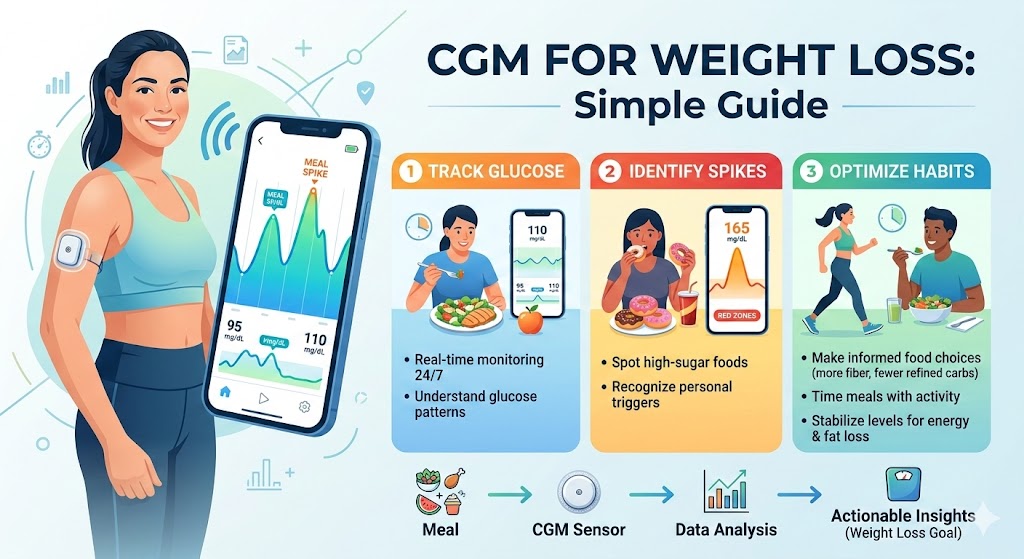
Weight loss is no longer just about calories in vs calories out. Today, technology is changing the way we understand metabolism — and one of the most powerful tools leading this shift is the Continuous Glucose Monitor.
Originally designed for diabetes management, a Continuous Glucose Monitor is now being used by biohackers, athletes, and everyday fitness enthusiasts to optimize fat loss, control cravings, and improve metabolic health.
In this complete guide, you’ll learn how a Continuous Glucose Monitor works, why it can support weight loss, how to use it correctly, and whether it’s worth it for your goals.
1. What Is a Continuous Glucose Monitor?
A Continuous Glucose Monitor (CGM) is a small wearable device that tracks your blood sugar levels in real time throughout the day and night.
It includes:
- A small sensor placed under the skin
- A transmitter
- A smartphone app that shows live glucose readings
Unlike finger-prick testing, a Continuous Glucose Monitor provides continuous data every few minutes.
Popular CGM brands include:
- Dexcom
- Abbott Laboratories (maker of FreeStyle Libre)
2. How a Continuous Glucose Monitor Helps With Weight Loss
2.1 Identifying Blood Sugar Spikes
When you eat refined carbs or sugary foods, your blood glucose spikes. A Continuous Glucose Monitor shows:
- How high your glucose rises
- How quickly it drops
- Whether you experience crashes
Frequent spikes and crashes can increase:
- Hunger
- Fat storage
- Cravings
By using a Continuous Glucose Monitor, you can adjust your meals to create smoother glucose curves.
2.2 Personalizing Your Diet
Not everyone reacts to food the same way.
For example:
- One person may spike from white rice
- Another may tolerate it well
- Some spike from bananas, others don’t
A Continuous Glucose Monitor removes guesswork and helps you build a personalized nutrition plan.
2.3 Reducing Cravings
Glucose crashes often trigger:
- Sugar cravings
- Late-night snacking
- Energy dips
Monitoring patterns with a Continuous Glucose Monitor helps you:
- Pair carbs with protein
- Add healthy fats
- Improve meal timing
Stable glucose = stable hunger.
3. What Healthy Glucose Patterns Look Like
Using a Continuous Glucose Monitor, ideal patterns include:
- Fasting glucose: 70–100 mg/dL
- Post-meal rise: Under 140 mg/dL
- Return to baseline within 2–3 hours
Large spikes above 160 mg/dL may indicate high glycemic load meals.
Consistency is more important than perfection.
4. Best Ways to Use a Continuous Glucose Monitor for Fat Loss
4.1 Track Your First 14 Days Carefully
During your first two weeks with a Continuous Glucose Monitor:
- Log all meals
- Record sleep
- Track workouts
- Note stress levels
Patterns will quickly emerge.
4.2 Experiment With Meal Structure
Test different combinations:
- Carbs alone
- Carbs + protein
- Carbs + protein + fats
Most people notice lower spikes when adding protein and fiber.
4.3 Test Fasted vs Fed Workouts
Some individuals burn fat more efficiently when training in a fasted state. A Continuous Glucose Monitor shows how your glucose behaves during workouts.
4.4 Improve Sleep & Stress
Poor sleep raises glucose levels.
With a Continuous Glucose Monitor, you may notice:
- Elevated morning readings after bad sleep
- Higher glucose during stressful days
This reinforces lifestyle optimization.
5. Who Should Use a Continuous Glucose Monitor?
A Continuous Glucose Monitor can benefit:
- People struggling with stubborn fat
- Those with insulin resistance
- Pre-diabetic individuals
- Fitness enthusiasts optimizing performance
- Biohackers tracking metabolic health
However, it may not be necessary for everyone.
6. Continuous Glucose Monitor vs Traditional Dieting
Traditional dieting:
- Focuses only on calories
- Ignores metabolic response
Using a Continuous Glucose Monitor:
- Tracks your body’s real-time response
- Identifies hidden glucose triggers
- Improves metabolic awareness
It adds data intelligence to fat loss.
7. Common Mistakes When Using a Continuous Glucose Monitor
- Obsessing over small fluctuations
- Eliminating all carbs unnecessarily
- Ignoring calorie balance
- Misinterpreting temporary spikes
- Using it without professional guidance (if diabetic)
A Continuous Glucose Monitor is a tool — not a magic solution.
8. Does Stable Glucose Mean Automatic Fat Loss?
No.
A Continuous Glucose Monitor helps optimize metabolic stability, but fat loss still depends on:
- Calorie deficit
- Protein intake
- Strength training
- Sleep quality
- Consistency
It enhances awareness — it doesn’t replace fundamentals.
9. Benefits Beyond Weight Loss
Using a Continuous Glucose Monitor may also improve:
- Energy stability
- Focus
- Reduced brain fog
- Improved insulin sensitivity
- Better long-term metabolic health
Many users report better relationship with food due to real-time feedback.
10. Is a Continuous Glucose Monitor Worth It in 2026?
Pros:
- Personalized nutrition
- Real-time feedback
- Data-driven decisions
- Improved awareness
Cons:
- Can be expensive
- Requires interpretation
- Not always necessary for beginners
For advanced fat loss optimization, a Continuous Glucose Monitor can be a powerful addition.
Frequently Asked Questions (FAQ)
Q1: Can a Continuous Glucose Monitor help lose belly fat?
Indirectly yes. By improving insulin control and reducing spikes, it supports fat loss.
Q2: Do I need diabetes to use it?
No. Many non-diabetics use a Continuous Glucose Monitor for metabolic tracking.
Q3: Is it painful?
The sensor insertion is mild and typically well tolerated.
Q4: How long should I wear one?
Most people benefit from 14–30 days of tracking.
Q5: Does it replace calorie tracking?
No. It complements calorie awareness but doesn’t replace it.
Final Thoughts
A Continuous Glucose Monitor represents the future of personalized nutrition. Instead of guessing how your body responds to food, you can see the data in real time.
For people serious about optimizing fat loss, controlling cravings, and improving metabolic health, a Continuous Glucose Monitor can provide insights that traditional dieting never reveals.
Technology doesn’t replace discipline — but it can make discipline smarter.
If you combine smart nutrition, strength training, sleep, and glucose awareness, sustainable fat loss becomes much more predictable.
More Related Topics:
High Protein Meal Prep for Fat Loss: A Complete Weekly Blueprint for Lean Results
Rapamycin for Anti Aging: What You Should Know Before Considering It
NAD Plus Therapy Benefits Explained (Longevity, Energy & Cellular Health)