
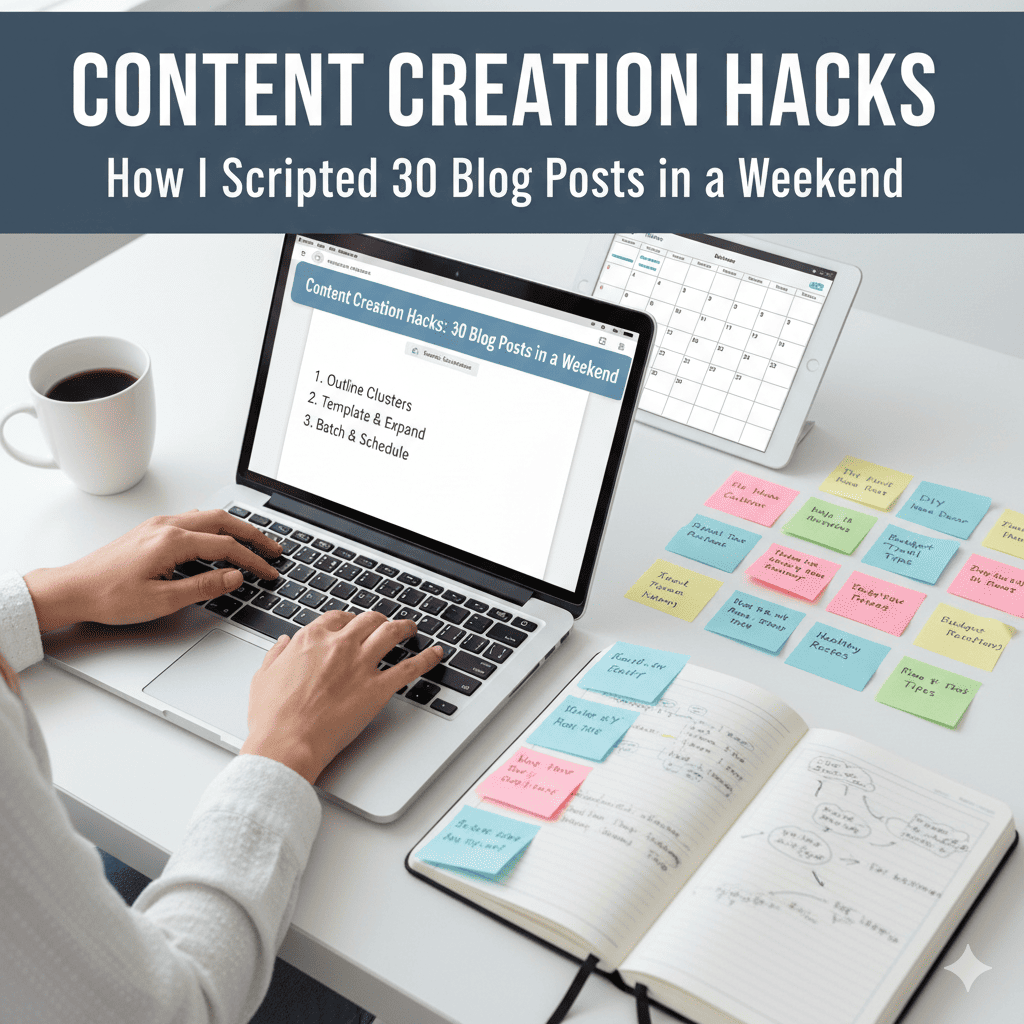
Content Creation I stared at my laptop screen, paralyzed. Another Monday morning, another empty content calendar mocking me. The cursor blinked accusingly in the blank document. My coffee grew cold as I typed and deleted the same sentence seventeen times.
Sound familiar?
For months, I struggled with Content Creation—churning out maybe 4-5 mediocre blog posts per month while my competitors published daily. I’d spend hours agonizing over every word, only to hit publish on content that barely moved the needle.
Then something clicked.
One weekend—just 48 hours—I scripted 30 blog posts. Not garbage content. Not thin, SEO-spam nonsense. Actual valuable, engaging posts that drove traffic, conversions, and engagement.
The secret? I stopped trying to create perfect content and started engineering a Content Creation system that removed friction, leveraged patterns, and turned creativity into a repeatable process.
Here’s exactly how I did it—and how you can replicate this Content Creation breakthrough yourself.
Why Traditional Content Creation Fails (And Why You’re Not Lazy)
The brutal truth: You’re not suffering from writer’s block. You’re suffering from decision fatigue.
Every blank page forces hundreds of micro-decisions: What topic? What angle? What structure? What tone? What examples? What call-to-action? Your creative brain exhausts itself before writing a single word.
The perfectionism trap: We convince ourselves every post must be our magnum opus. So we wait for inspiration, agonize over word choice, and revise endlessly—producing little while our competitors lap us.
The research rabbit hole: You open “just one” article for research. Three hours later, you’ve read forty pieces, saved fifty bookmarks, and written nothing. Information gathering becomes procrastination disguised as productivity.
The myth of “finding your voice”: Waiting to “find your voice” before publishing is like waiting to “feel confident” before acting confident. Your voice emerges through volume, not before it.
My weekend Content Creation system obliterates these obstacles. Here’s the blueprint.
🎯 Friday Night: The Foundation (2 Hours)
Step 1: Brain Dump Your Expertise (30 Minutes)
Forget elegant prose. Open a document and vomit every topic you could possibly write about. No filtering. No judging. Just rapid-fire listing.
Prompt yourself with questions:
- What do people constantly ask me?
- What mistakes do beginners make in my niche?
- What do I wish someone had told me when I started?
- What controversial opinions do I have?
- What processes have I mastered?
- What trends am I seeing?
- What tools do I swear by?
My result: 87 messy topics in 30 minutes. Most were fragments like “email subject lines,” “content calendar mistakes,” or “burnout recovery.” Perfect.
The magic: This brain dump bypasses the “what should I write about?” paralysis that kills Content Creation momentum. You’ve now got months of material.
Step 2: Categorize with Content Buckets (20 Minutes)
Raw topics are chaos. Organization creates clarity.
Create 5-7 content buckets aligned with your audience’s journey:
- Awareness: Problems they don’t know they have
- Education: Foundational knowledge and concepts
- Tactical: Step-by-step how-to guides
- Tools: Reviews, comparisons, recommendations
- Inspiration: Success stories, case studies, motivation
- Trends: Industry news, predictions, hot takes
- Personal: Behind-the-scenes, lessons learned, failures
Sort your 87 topics into buckets. Some fit multiple categories—that’s fine. This creates a balanced Content Creation diet rather than repetitive content.
The strategic advantage: Buckets ensure you’re serving readers at every stage—attracting newcomers, educating learners, and providing advanced tactics for veterans.
Step 3: Apply the Proven Title Formula (70 Minutes)
Here’s where Content Creation becomes engineering. Great titles follow patterns. Stop reinventing the wheel.
10 Proven Title Templates:
- Number + Adjective + Keyword + Promise: “7 Powerful Content Creation Hacks That Doubled My Traffic”
- How to + Desired Outcome + Without + Common Objection: “How to Master Content Creation Without Burning Out”
- The Ultimate Guide to + Topic: “The Ultimate Guide to Content Creation for Beginners”
- Little-Known + Topic + That + Big Benefit: “Little-Known Content Creation Tricks That Save 10 Hours Weekly”
- Why + Surprising Statement: “Why Your Content Creation Process Is Actually Sabotaging Your Growth”
- What + Authority Figure + Knows About + Topic: “What Top Creators Know About Content Creation (That You Don’t)”
- X vs Y: The Complete Comparison: “Batch Content Creation vs. Daily Publishing: Which Wins?”
- I Tried + Action + for + Timeframe + Here’s What Happened: “I Tried Scripting 30 Posts in One Weekend—Here’s What Happened”
- The Only + Topic + You’ll Ever Need: “The Only Content Creation Framework You’ll Ever Need”
- Stop + Common Mistake + Start + Better Alternative: “Stop Perfectionist Content Creation, Start Publishing Consistently”
Transform your raw topics into magnetic titles using these formulas. I turned “email subject lines” into “47 Email Subject Lines That Tripled My Open Rates” and “content calendar mistakes” into “7 Content Calendar Mistakes Killing Your Consistency.”
The psychological hack: You’re not staring at blank pages anymore. You’re filling in formulas. Content Creation becomes Mad Libs, not artistic suffering.
My Friday night result: 30 irresistible titles organized by content bucket, each promising specific value. Half the battle won.
⚡ Saturday: The Scripting Marathon (8 Hours)
The 15-Minute Post Framework
Most people think scripting 30 posts requires 30+ hours. They’re wrong. With frameworks eliminating structure decisions, you’re writing 15-20 minutes per post.
The Universal Blog Post Structure (steal this):
1. Hook (2-3 sentences): Problem, surprising statement, or relatable scenario grabbing attention immediately
2. Amplify the pain (1 short paragraph): Make readers feel understood. “Sound familiar?” moments create connection
3. Promise the solution (1-2 sentences): Tell them exactly what they’ll learn and why it matters
4. Deliver the value (3-5 main points): The meat of your post using one of the frameworks below
5. Recap and inspire (2-3 sentences): Summarize key takeaways and motivate action
6. Clear CTA (1-2 sentences): Tell them exactly what to do next
Time saved: You’re never wondering “how should I organize this?” Every post follows the same skeleton. Just add meat.
The 5 Content Frameworks for Effortless Scripting
Don’t write posts—fill frameworks. Here are my five go-to patterns powering 90% of successful Content Creation.
Framework 1: The List Post (Perfect for Tactical Content)
Structure:
- Introduction establishing why this list matters
- 5-10 numbered items, each with:
- Bold subheading stating the point
- 2-4 sentences explaining it
- Example or application
- Quick tip or warning
- Conclusion summarizing value
Scripting time: 12-15 minutes
Example topics: “10 Content Creation Tools I Can’t Live Without,” “7 Headlines That Always Get Clicks,” “5 Mistakes Killing Your Blog Traffic”
Why it works: Scannable, actionable, and satisfying. Readers love checking off numbered items.
Framework 2: The How-To Guide (Perfect for Educational Content)
Structure:
- Problem statement and why solving it matters
- Prerequisites or context needed
- Step 1: Clear action + why + example
- Step 2: Clear action + why + example
- Step 3: Clear action + why + example
- (Continue for 4-8 steps)
- Troubleshooting common issues
- What success looks like
Scripting time: 18-22 minutes
Example topics: “How to Build a Content Creation System,” “How to Write Headlines That Convert,” “How to Repurpose One Post Into Ten”
Why it works: Provides complete roadmap. Readers bookmark and return repeatedly.
Framework 3: The Comparison Post (Perfect for Tool/Strategy Content)
Structure:
- Introduce the debate/comparison
- Option A: Overview, pros, cons, best for whom
- Option B: Overview, pros, cons, best for whom
- Option C (if applicable): Overview, pros, cons, best for whom
- Side-by-side comparison table
- My recommendation with reasoning
- How to choose for your situation
Scripting time: 15-18 minutes
Example topics: “Batch vs. Daily Content Creation,” “Free vs. Paid Content Tools,” “Long-Form vs. Short-Form Content”
Why it works: Helps readers make decisions. Comparison posts rank well and drive conversions.
Framework 4: The Personal Story + Lesson (Perfect for Inspiration/Connection)
Structure:
- The situation: Set the scene
- The problem: What went wrong or the challenge faced
- The struggle: How you attempted to solve it
- The breakthrough: What finally worked
- The lesson: What you learned
- The application: How readers can use this lesson
- The invitation: Encourage readers to share their stories
Scripting time: 20-25 minutes
Example topics: “How I Overcame Content Creation Burnout,” “The Content Strategy That Finally Worked,” “My Biggest Content Mistake (And What It Taught Me)”
Why it works: Vulnerability builds trust. Lessons embedded in stories stick better than abstract advice.
Framework 5: The Myth-Busting Post (Perfect for Awareness/Authority)
Structure:
- The common belief everyone accepts
- Why this belief is so prevalent
- The reality: What’s actually true
- The evidence: Data, examples, logic
- Why the myth persists despite evidence
- What to do instead
- The transformation possible when you shift thinking
Scripting time: 16-20 minutes
Example topics: “Why Content Creation Doesn’t Require Daily Posting,” “The Quality vs. Quantity Debate Is Wrong,” “Why Your Content Isn’t Failing—Your Distribution Is”
Why it works: Contrarian posts spark conversation, shares, and position you as a thought leader challenging conventional wisdom.
Saturday Strategy: Batching Like a Beast
Don’t write posts in order. Group by framework for flow state.
My Saturday schedule:
- 8:00-10:00 AM: 8 list posts (15 min each)
- 10:15-12:15 PM: 6 how-to guides (20 min each)
- 12:15-1:00 PM: Lunch + walk + complete mental break
- 1:00-2:30 PM: 5 comparison posts (18 min each)
- 2:45-4:30 PM: 4 personal story posts (25 min each)
- 4:30-5:30 PM: 4 myth-busting posts (15 min each)
The psychology: Switching frameworks constantly drains energy. Batching similar content maintains momentum. By the third list post, you’re flying.
The reality check: Some posts took 10 minutes. Some took 30. But averaging 16 minutes per post, I scripted 27 posts by 5:30 PM Saturday.
The AI Assistance Secret (Use Responsibly)
I’ll be transparent: AI tools accelerated my Content Creation significantly. But not as ghostwriters—as research assistants and outline generators.
How I used AI ethically:
For research: “What are common mistakes beginners make with content calendars?” gave me a comprehensive list in seconds rather than hours of Googling
For outlining: “Create an outline for a blog post titled ‘7 Content Calendar Mistakes Killing Your Consistency'” provided structure I then customized
For examples: “Give me 5 examples of strong call-to-action statements” sparked ideas I refined with my voice
For editing: Pasting drafts to check clarity, catch typos, suggest improvements
What I never did: Copy-paste AI output as my content. Every sentence is mine. AI eliminated research friction, not writing itself.
The ethical line: AI should enhance your Content Creation process, not replace your thinking, perspective, or voice. Use it like an intern—helpful for grunt work, but you’re still the creator.
🎨 Sunday: The Polish (4 Hours)
Morning: The First Pass Edit (2 Hours)
Fresh eyes are powerful. Sunday morning, I reviewed Saturday’s 27 scripts with coffee and critical thinking.
What I looked for:
- Flow: Does each section connect logically?
- Clarity: Would my target reader understand this?
- Value density: Did I pack enough actionable insight?
- Voice: Does this sound like me, or generic internet content?
- Examples: Are my points concrete or vague?
The speed editing trick: Read aloud. Your mouth catches what your eyes miss. Awkward phrasing, repetition, unclear sentences—all obvious when spoken.
Time per post: 3-5 minutes of editing. Not perfection, just solid.
Afternoon: The Enhancement Layer (2 Hours)
Good posts became great with strategic additions.
The enhancement checklist:
Add subheadings: Breaking up walls of text improves scannability and SEO
Bold key phrases: Highlighting important points helps skimmers extract value
Insert examples: Replaced vague advice with specific scenarios wherever possible
Create bullet points: Listed items become scannable, actionable points
Write meta descriptions: 150-character summaries for each post optimizing search appeal
Plan visual notes: Marked where images, screenshots, or graphics would enhance understanding
The plugin play: If using WordPress, Yoast SEO guided optimization. If writing in Google Docs, I used heading styles (H2, H3) for proper hierarchy.
Sunday afternoon result: 27 polished, SEO-optimized scripts ready for scheduling. Plus 3 bonus posts from Friday’s list, hitting my 30-post goal.
🚀 The Content Creation System Benefits (Beyond the Weekend)
Benefit 1: Consistency Becomes Effortless
With 30 posts scripted, I scheduled 3-4 weekly for two months. No more Sunday night panic. No more skipped weeks. Just consistent Content Creation building audience trust.
Benefit 2: Quality Actually Improves
Counterintuitive but true: batch Content Creation produced better content than my old method. Why?
Decision fatigue elimination: Structure decisions made once, applied thirty times Flow state preservation: Deep work on similar tasks maintains creative momentum Pattern recognition: By post 15, I spotted what worked and doubled down
Benefit 3: Content Strategy Emerges Naturally
Those content buckets? They revealed gaps in my coverage. I realized I was heavy on tactical content, light on inspiration. The system showed me where to focus future Content Creation.
Benefit 4: Repurposing Becomes Obvious
Each blog post became:
- 5-10 social media posts
- 1 email newsletter
- 1 video script
- 1 podcast episode outline
- Multiple quote graphics
Suddenly I had 6+ months of omnichannel content from one weekend’s Content Creation effort.
Benefit 5: The Mental Freedom
The biggest benefit? Liberation from constant “what should I write?” anxiety. My creator brain could focus on strategy, promotion, community building—not just feeding the content beast.
🎯 Your Content Creation Weekend Blueprint
Ready to replicate this? Here’s your step-by-step action plan:
Friday Night Prep (2 Hours)
6:00-6:30 PM: Brain dump every possible topic 6:30-6:50 PM: Organize into content buckets 6:50-8:00 PM: Apply title formulas to 30+ topics
Saturday Scripting Session (8 Hours)
8:00-10:00 AM: 8 list posts 10:00-10:15 AM: Break, stretch, refuel 10:15-12:15 PM: 6 how-to guides 12:15-1:00 PM: Lunch break (actually rest!) 1:00-2:30 PM: 5 comparison posts 2:30-2:45 PM: Break, walk, reset 2:45-4:30 PM: 4 personal story posts 4:30-5:30 PM: 4 myth-busting posts
Target: 27-30 rough scripts
Sunday Polish Day (4 Hours)
9:00-11:00 AM: First-pass editing, reading aloud 11:00-11:15 AM: Break 11:15-1:15 PM: Enhancement—subheadings, formatting, meta descriptions, visual notes
Result: 30 publication-ready posts
⚡ Advanced Content Creation Hacks
Hack 1: The Template Library
Save your best introductions, transitions, conclusions. Building a swipe file of your own strong writing speeds up future Content Creation dramatically.
Hack 2: The Research Batch
Before starting, spend 30 minutes gathering all resources: stats, studies, quotes, examples. Having everything open in tabs eliminates mid-writing research interruptions.
Hack 3: The Voice-to-Text Sprint
Some posts flowed faster when I spoke them. Using voice-to-text for rough drafts, then editing for written clarity, combined conversational tone with efficiency.
Hack 4: The Accountability Partner
My weekend partner committed to the same goal. We checked in every 2 hours via text, celebrating progress and pushing through resistance. Content Creation is more fun with company.
Hack 5: The Reward System
After every 5 posts: 15-minute reward. After 15 posts: 1-hour reward doing something I loved. Gamifying Content Creation maintained energy and motivation.
Hack 6: The Music Playlist
Created a 2-hour instrumental playlist on repeat. Music without lyrics maintains focus, and the familiar playlist signaled “work mode” to my brain immediately.
Hack 7: The Distraction Elimination
Phone in another room. Browser extensions blocking social media. Email closed. Calendar cleared. Protecting deep work time is non-negotiable for productive Content Creation.
🔥 Common Content Creation Obstacles (And Solutions)
“I don’t have a full weekend available”
Solution: Split across multiple days. Friday night prep, then 2 hours daily for two weeks hits 30 posts. The system scales to your schedule.
“My posts need more research than this allows”
Solution: Batch research separately. Spend one day researching 10 topics thoroughly, then script them all the next day with research fresh.
“I can’t write that fast”
Solution: You probably can—you’re overthinking. Set timers. Force yourself to finish posts in 20 minutes. Rough drafts don’t need polish. Speed comes with practice.
“My niche is too technical for this approach”
Solution: Technical content needs frameworks even more. Create standard sections: Problem, Current Solutions, Better Approach, Implementation, Troubleshooting, Conclusion. Fill in technical details.
“What if the quality suffers?”
Solution: Batch Content Creation often improves quality. Test it. Script 5 posts in one session versus 5 posts over 5 days. Compare results. You might be surprised.
📈 Scaling Your Content Creation System
Once you’ve conquered the 30-post weekend, here’s how to level up:
Monthly batching: One weekend monthly produces 30+ posts, covering your entire month with buffer
Quarterly planning: Map 90 days of content in advance, identifying seasonal topics, product launches, trends to address
Team delegation: With frameworks documented, you can train writers to script in your voice, scaling Content Creation exponentially
Multimedia expansion: Those scripts become video scripts, podcast outlines, social content—true omnichannel efficiency
Content upgrades: Revisit top performers quarterly, updating with fresh data, examples, and perspectives
The Content Creation Truth Nobody Tells You
Here’s what I wish someone had told me years ago: Content creation isn’t about finding time—it’s about designing systems.
You’ll never “find” time to write 30 posts. Life expands to fill available space. But you can engineer a process that makes Content Creation so frictionless, so systematic, that output becomes inevitable rather than aspirational.
The weekend I scripted 30 posts wasn’t magic. It wasn’t superhuman discipline. It wasn’t some rare burst of inspiration.
It was simply removing every obstacle between me and the work. Eliminating decisions. Applying frameworks. Batching similar tasks. Protecting deep work time.
Content Creation transformed from creative torture into productive flow.
Your Content Creation Challenge
Here’s my challenge to you: Don’t just read this and nod. Don’t bookmark it for “someday.”
Block one weekend. Actually clear your calendar. Tell friends and family you’re unavailable. Stock up on coffee and snacks.
Then execute this system exactly as outlined.
I promise you: the feeling of Monday morning with 30 posts ready to publish—the security, the confidence, the creative freedom—is worth one weekend of focused effort.
Your audience is waiting. Your ideas deserve to be shared. Your business needs consistent Content Creation.
Stop agonizing over blank pages. Stop waiting for inspiration. Stop letting perfectionism hold you hostage.
Start scripting. Start batching. Start building your Content Creation system.
One weekend. 30 posts. Total transformation.
Your content calendar is about to become your secret weapon. ✍️🚀
Also read this:
The Future of Work: Jobs That Will Survive (and Thrive) in an AI-Driven World
Work From Anywhere: Best Remote Jobs, Tools & Lifestyle Tips for 2025
Why Mental Wellness Is the New Luxury: Self-Care Trends That Are Making Waves