
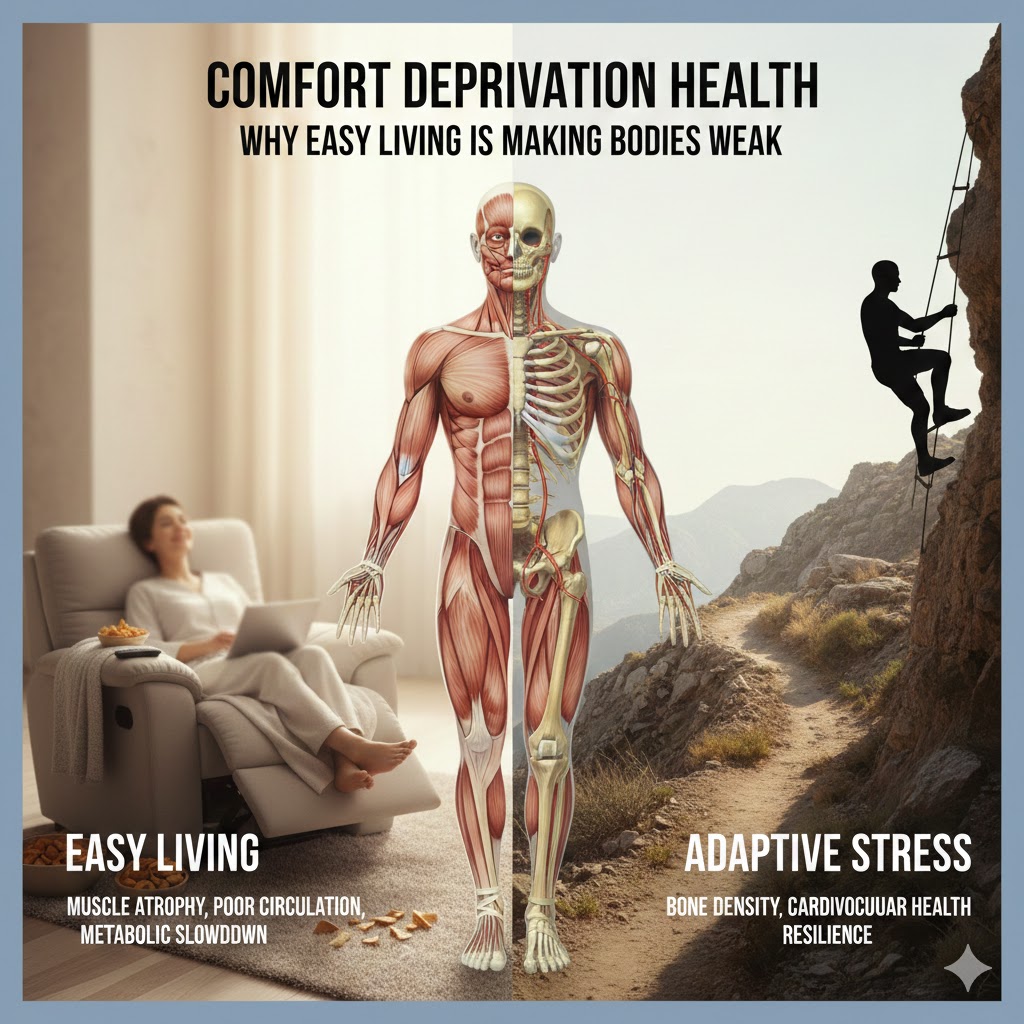
Comfort Deprivation Health Modern life is optimized for comfort. Temperature-controlled homes. Food delivered instantly. Chairs designed to eliminate effort. Screens that remove the need to move, explore, or struggle. Convenience has become the default—and discomfort the enemy.
Yet as life gets easier, bodies seem to be getting weaker.
This paradox is at the center of a growing wellness conversation known as Comfort Deprivation Health. It doesn’t promote suffering or extremes. Instead, it asks a simple question: What happens to the human body when it no longer needs to adapt?
This article explores why easy living may be quietly undermining physical resilience, how comfort deprivation health reframes wellness, and why controlled discomfort is being reintroduced into modern lifestyles.
1. What Comfort Deprivation Health Actually Means
Despite the name, this isn’t about hardship.
1.1 The Core Idea
- The human body evolved through challenge
- Mild stressors trigger adaptation and strength
- Removing all stress removes the stimulus to improve
1.2 What It Is Not
- Not punishment
- Not extreme biohacking
- Not ignoring safety or health conditions
Comfort Deprivation Health focuses on intentional, short-term discomfort to restore long-term resilience.
2. Why the Body Needs Stress to Stay Strong
Biology is adaptive by design.
2.1 Stress as a Signal
- Muscles grow from resistance
- Bones strengthen from impact
- Metabolism adapts to scarcity and effort
Without signals, systems downregulate.
2.2 What Happens When Signals Disappear
- Muscle loss despite inactivity
- Reduced cardiovascular efficiency
- Lower heat and cold tolerance
- Decreased metabolic flexibility
Comfort removes the need for adaptation—and the body responds by conserving capacity.
3. Easy Living and the Decline of Everyday Strength
Modern environments eliminate micro-challenges.

3.1 Disappearing Daily Stressors
- Elevators replace stairs
- Cars replace walking
- Climate control replaces temperature exposure
3.2 The Result
- Bodies rarely leave baseline
- Strength becomes “optional”
- Fatigue increases despite low effort
This mismatch helps explain why Comfort Deprivation Health is gaining traction among wellness experts.
4. Comfort Weakens the Nervous System Too
It’s not just physical.
4.1 Nervous System Under-Stimulation
- Constant ease reduces stress tolerance
- Minor discomfort feels overwhelming
- Resilience to unpredictability declines
4.2 Psychological Spillover
- Reduced confidence in physical ability
- Increased anxiety around discomfort
- Avoidance of challenge
Gentle stress trains calm responses. Total comfort removes that training.
5. Temperature Comfort and Loss of Adaptability
Thermal neutrality has consequences.
5.1 What Constant Comfort Does
- Weakens temperature regulation
- Reduces metabolic activation
- Limits circulation adaptability
5.2 Why Short Exposure Helps
- Cold and heat trigger adaptive responses
- Improves circulation and alertness
- Reinforces resilience without harm
This is a cornerstone of Comfort Deprivation Health thinking—short, safe exposure over constant neutrality.
6. Food Abundance Without Effort
Convenience has changed metabolism.
6.1 Eating Without Movement
- Calories divorced from effort
- Constant availability removes metabolic flexibility
- Hunger signals blur
6.2 The Body’s Response
- Energy efficiency declines
- Fatigue increases despite intake
- Sensitivity to dietary changes drops
The body thrives when effort and nourishment are connected—even loosely.
7. Reintroducing Discomfort—Safely and Intentionally
This is where the concept becomes practical.

7.1 Examples of Gentle Discomfort
- Walking instead of driving short distances
- Taking stairs regularly
- Brief cold or heat exposure
- Carrying groceries by hand
- Standing or floor sitting
7.2 Why These Work
- Low risk
- Repeatable
- Integrated into daily life
Comfort Deprivation Health emphasizes consistency over intensity.
8. Why Exercise Alone Isn’t Enough Anymore
Gyms can’t replace daily adaptation.
8.1 The Problem With “One-Hour Fixes”
- One workout can’t offset 23 hours of ease
- Bodies adapt to environments, not sessions
- Strength needs frequent signals
8.2 Environmental Fitness Matters
- Movement woven into life
- Variety of stresses
- Constant low-level adaptation
This is why lifestyle-based discomfort is outperforming exercise-only approaches.
9. Comfort Deprivation Health and Aging
Aging reveals adaptation gaps.
9.1 Why Weakness Appears Faster
- Loss of muscle from inactivity
- Reduced balance from flat environments
- Slower recovery
9.2 Why Adaptation Slows With Comfort
- Less stimulus to maintain capacity
- Fear of challenge increases
- Systems atrophy quietly
Reintroducing controlled challenge helps preserve independence and strength.
10. Why This Concept Is Gaining Momentum Now
This isn’t a trend—it’s a correction.
10.1 Cultural Awareness Is Shifting
- Burnout from comfort without vitality
- Desire for resilience, not ease
- Return to functional strength
10.2 The Message Resonates
- People feel weaker despite convenience
- Health feels fragile, not empowered
- Comfort Deprivation Health offers a reframing
The goal isn’t discomfort—it’s capability.
FAQs: Comfort Deprivation Health
Is comfort deprivation health about suffering?
No. It focuses on small, controlled challenges that build resilience.
Is this safe for everyone?
People should adapt practices to their abilities and consult professionals when needed.
Does this replace exercise?
No. It complements exercise by restoring daily adaptation.
Why does comfort reduce strength?
Because the body adapts to what it experiences most—ease reduces the need for strength.
Is this scientifically supported?
Yes. Adaptation and hormesis are well-established biological principles.
Final Thoughts
Comfort isn’t the enemy—but constant comfort is. The human body evolved through variation, effort, and challenge. When those signals disappear, strength quietly fades.
Comfort Deprivation Health doesn’t ask you to suffer. It asks you to participate again—to move, feel, adapt, and respond.
In a world designed to make life easier, resilience has to be chosen.
And the strongest bodies aren’t the most protected ones—they’re the most adaptable.
More Related Topics:
Silent Fatigue Disorder: When Blood Tests Look Normal but Energy Is Gone
Breathwork Therapy for Anxiety: Why It Works Faster Than Mindfulness