
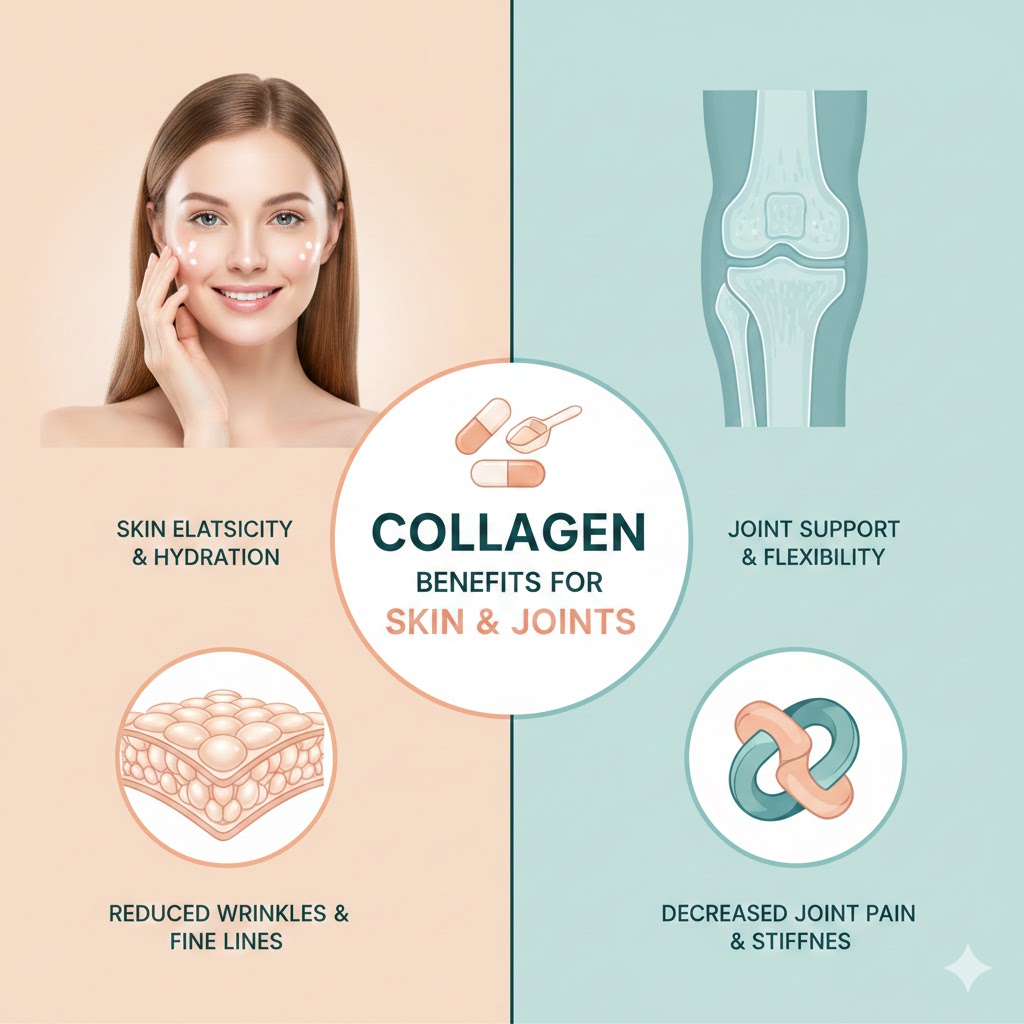
Collagen Benefits has become one of the most talked-about supplements in the health and beauty industry. From glowing skin claims to joint support promises, it’s everywhere — powders, capsules, drinks, even coffee creamers.
But what are the real Collagen Benefits, and who actually needs it?
In this detailed guide, we’ll break down how collagen works, its impact on skin and joints, what science supports, and how to use it effectively.

1. What Is Collagen?
Collagen is the most abundant protein in the human body.
It forms:
- Skin structure
- Tendons
- Ligaments
- Cartilage
- Bones
Think of collagen as the body’s structural framework. As we age, natural collagen production declines — which is where supplementation enters the conversation.
2. Why Collagen Declines With Age
Collagen production begins to slow in your mid-20s.
Factors that accelerate decline:
- Aging
- Sun exposure
- Smoking
- Poor diet
- High sugar intake
- Chronic stress
This decline explains many visible and physical changes associated with aging.
3. Collagen Benefits for Skin Elasticity
One of the most popular Collagen Benefits is improved skin firmness.
How it helps:
- Supports skin elasticity
- Reduces appearance of fine lines
- Improves hydration
- Strengthens skin barrier
Some studies suggest collagen peptides may increase skin elasticity after consistent use.
4. Collagen Benefits for Skin Hydration
Dryness often increases with age.
Potential effects:
- Improved moisture retention
- Smoother texture
- Reduced roughness
Hydrated skin often appears brighter and healthier.
5. Collagen Benefits for Joint Health
Collagen plays a crucial role in cartilage — the cushioning between joints.
Joint-related benefits:
- Reduced joint discomfort
- Improved mobility
- Support for cartilage structure
- Faster post-exercise recovery
Athletes and active adults often report noticeable improvements.
6. Collagen Benefits for Tendons and Ligaments
Beyond joints, collagen supports connective tissue.
Why this matters:
- Better structural integrity
- Reduced strain injury risk
- Improved recovery
This makes collagen interesting for physically active individuals.
7. Collagen Benefits for Bone Strength
Bones contain collagen as a foundational protein.
Potential advantages:
- Supports bone density
- Works alongside calcium
- Maintains structural strength
Bone health becomes especially important after age 40.
8. Collagen and Muscle Mass Support
Collagen is not a complete protein like whey, but it still contributes to muscle structure.
Benefits include:
- Supports lean muscle when combined with training
- Assists connective tissue repair
It’s best used alongside a balanced protein intake.
9. Types of Collagen (What to Choose)
There are multiple types of collagen.
Most common:
- Type I (skin, bones)
- Type II (cartilage)
- Type III (skin & organs)
Most supplements contain hydrolyzed collagen peptides for better absorption.
10. How Long Does It Take to See Results?
Consistency is key.
Typical timeline:
- 4 weeks: Subtle skin hydration changes
- 8 weeks: Improved elasticity
- 8–12 weeks: Joint comfort improvements
Results vary by individual.
11. Natural Ways to Support Collagen Production
Supplementation isn’t the only option.
Lifestyle support:
- Vitamin C intake
- Protein-rich diet
- Bone broth
- Omega-3 fatty acids
- Sun protection
Internal and external factors both matter.
12. Is Collagen Safe?
Collagen supplements are generally considered safe for healthy adults.
However:
- Choose high-quality brands
- Check for allergens (fish, bovine sources)
- Avoid excessive dosing
Moderation is important.
13. Who Benefits Most From Collagen?
Collagen may be helpful for:
- Adults over 30
- Athletes
- Individuals with joint discomfort
- Those noticing skin aging
- Post-menopausal women
Not everyone needs it — but many may benefit.
14. Collagen Benefits vs Marketing Hype
It’s important to stay realistic.
Collagen can:
- Support skin hydration
- Improve elasticity
- Aid joint comfort
It cannot:
- Stop aging completely
- Replace sunscreen
- Substitute proper nutrition
Balanced expectations matter.
15. Best Time to Take Collagen
There’s no strict rule.
Common approaches:
- Morning in coffee
- Post-workout
- Before bed
Consistency matters more than timing.
16. Final Verdict: Are Collagen Benefits Worth It?
The research suggests that Collagen Benefits for skin hydration, elasticity, and joint support are promising — especially with consistent use.
While it’s not a miracle anti-aging solution, collagen can complement a healthy lifestyle. Combined with proper nutrition, exercise, and sun protection, it may support both appearance and mobility as you age.
The key is realistic expectations and long-term consistency.
Frequently Asked Questions (FAQ)
Q1. Do collagen supplements really work?
Studies suggest they may improve skin elasticity and joint comfort when taken consistently.
Q2. How much collagen should I take daily?
Common doses range between 5–10 grams per day.
Q3. Can young people take collagen?
Yes, but benefits may be more noticeable as natural production declines.
Q4. Is collagen better than protein powder?
They serve different purposes. Collagen supports connective tissue; whey supports muscle growth.
Q5. Are there side effects?
Side effects are rare but can include mild digestive discomfort.
Conclusion
Aging is natural — but supporting your body’s structure is smart. Collagen Benefits extend beyond beauty trends into connective tissue and joint health support.
If you’re focused on long-term skin vitality and mobility, collagen may be a practical addition to your routine — especially when paired with a balanced diet and healthy habits.
More Related Topics:
Intermittent Fasting 16:8 Benefits Explained (Complete Beginner’s Guide)
Adaptogenic Herbs for Stress and Energy Balance (Natural Resilience Support)
Cold Plunge Benefits for Mental and Physical Health (Science, Recovery & Resilience)