
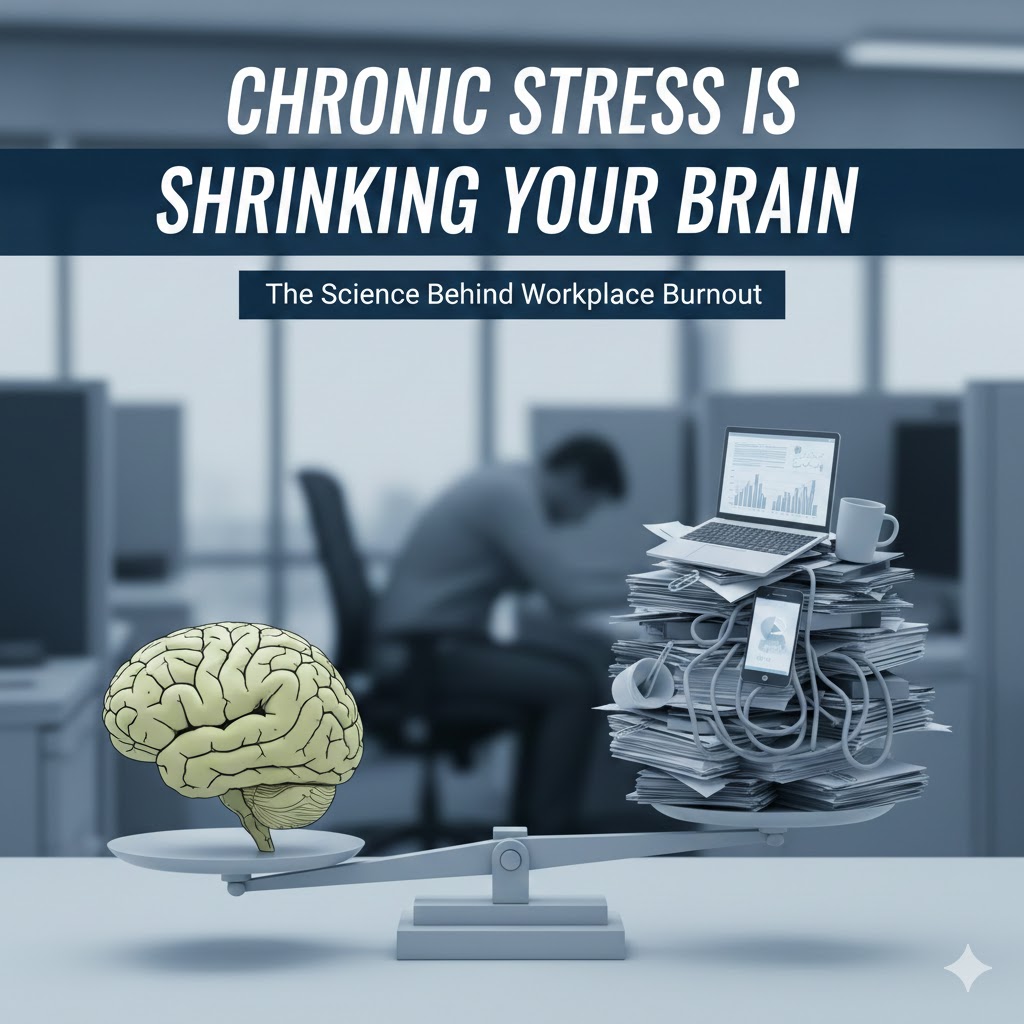
Chronic Stress Is Shrinking Your Brain Burnout is often talked about as an emotional problem—feeling exhausted, unmotivated, or detached from work. But modern neuroscience tells a far more serious story. Chronic Stress Is Shrinking Your Brain, and workplace burnout is one of the most common triggers behind this process.
This isn’t a metaphor. Long-term, unmanaged stress causes measurable structural and functional changes in the brain—affecting memory, focus, emotional regulation, and decision-making. Understanding this science explains why burnout feels so overwhelming and why “just taking a vacation” rarely fixes it.
Let’s break down what’s really happening inside your brain, why modern work environments accelerate the damage, and how recovery actually works.
1. What Chronic Stress Really Means (and Why It’s Different From Normal Stress)
Not all stress is harmful. Short-term stress can sharpen focus and improve performance. The problem begins when stress becomes chronic—persistent, unpredictable, and without recovery.
Chronic stress typically involves:
- Long working hours with little control
- Constant performance pressure
- Job insecurity
- Lack of rest and psychological safety
- Always being “on” due to emails and notifications
This is the kind of stress that convinces your brain it’s under threat all the time. And this is where the statement Chronic Stress Is Shrinking Your Brain becomes biologically accurate.
2. Cortisol: The Hormone That Changes Brain Structure
Under stress, your body releases cortisol. In short bursts, cortisol is useful. Chronically elevated cortisol, however, is neurotoxic.
Long-term cortisol exposure:
- Damages neurons
- Suppresses new brain cell growth
- Disrupts neurotransmitter balance
This hormonal environment is the foundation of workplace burnout—and the reason stress becomes more than just “mental.”
3. The Hippocampus: Where Shrinkage Actually Happens
The hippocampus is the brain region responsible for:
- Memory formation
- Learning
- Emotional regulation
- Context and perspective
It is also extremely sensitive to cortisol.
Research shows that people under prolonged stress have reduced hippocampal volume. This is one of the strongest pieces of evidence behind the claim that Chronic Stress Is Shrinking Your Brain.
What this feels like in daily life:
- Forgetfulness
- Brain fog
- Difficulty learning new tasks
- Feeling mentally slower than before
This isn’t laziness or aging—it’s a stress-injured brain.
4. The Prefrontal Cortex: Why Decision-Making Collapses
The prefrontal cortex controls:
- Focus
- Planning
- Emotional regulation
- Impulse control
Chronic stress suppresses activity in this region, while over-activating survival centers like the amygdala.
This leads to:
- Poor concentration
- Emotional overreactions
- Difficulty prioritizing
- Feeling overwhelmed by simple tasks
When people say burnout makes them feel “not like themselves,” this brain imbalance is why.
5. Why Workplace Burnout Is a Perfect Storm
Modern workplaces create the exact conditions that accelerate brain stress damage:
- Constant cognitive load without recovery
- Low autonomy with high expectations
- Emotional labor without acknowledgment
- Digital overload preventing mental rest
The brain never exits threat mode. Over time, the system adapts by conserving energy—reducing cognitive flexibility and motivation.
This is not weakness. It’s biology responding to prolonged pressure.
6. Burnout vs Depression: Why They Overlap
Burnout and depression share neurological pathways.
Both involve:
- Reduced hippocampal activity
- Altered dopamine signaling
- Elevated inflammatory markers
This overlap explains why untreated burnout can progress into clinical depression—and why Chronic Stress Is Shrinking Your Brain is a mental health issue, not just a productivity one.
7. Why Time Off Alone Often Doesn’t Work
Many people take time off expecting instant recovery—then feel frustrated when symptoms persist.
That’s because:
- Structural brain changes take time to reverse
- Nervous systems need repeated safety signals
- Rest without regulation doesn’t lower cortisol enough
True recovery requires consistency, not just escape.
8. Can the Brain Recover From Chronic Stress?
Yes—this is the hopeful part.
The brain is plastic. With the right conditions:
- Hippocampal volume can increase
- Neural connections can strengthen
- Cognitive function can improve
But recovery requires reducing stress and rebuilding capacity.
9. What Actually Helps Reverse Burnout at the Brain Level
Research-supported strategies include:
- Regular sleep with consistent timing
- Reducing cognitive multitasking
- Physical movement (especially walking)
- Psychological safety and boundaries
- Mindfulness and nervous system regulation
- Adequate nutrition and energy intake
These aren’t lifestyle clichés—they’re interventions that counteract the biological effects behind Chronic Stress Is Shrinking Your Brain.
10. Why Burnout Is a Systemic Problem, Not a Personal Failure
The most dangerous myth about burnout is that it’s an individual resilience issue.
In reality:
- Burnout reflects mismatched demands and recovery
- Brains aren’t designed for constant pressure
- No mindset can override biology forever
Recognizing that Chronic Stress Is Shrinking Your Brain reframes burnout from a character flaw into a health signal.
Frequently Asked Questions (FAQ)
Is it true that chronic stress shrinks the brain?
Yes. Research shows prolonged stress reduces hippocampal volume and impairs prefrontal cortex function.
Does workplace burnout cause permanent damage?
Not usually. With proper recovery, many stress-related brain changes are reversible.
How long does it take to recover from burnout?
Recovery varies, but meaningful improvement often takes weeks to months, not days.
Can exercise fix stress-related brain damage?
Exercise helps, especially low-intensity movement, but it must be combined with rest and stress reduction.
Why do I feel less intelligent during burnout?
Cognitive slowdown is a biological response to chronic stress, not a loss of intelligence.
Is burnout the same as depression?
They are different but overlapping conditions. Burnout can increase the risk of depression if unaddressed.
Final Thoughts
The phrase Chronic Stress Is Shrinking Your Brain isn’t meant to scare—it’s meant to clarify. Burnout isn’t a motivation problem or a mindset issue. It’s a neurological response to sustained pressure without recovery.
When we understand the science, burnout stops being something to push through and starts being something to treat. And with the right support, the brain doesn’t just survive—it can heal, adapt, and come back stronger.
More Related Topics:
Perimenopause at 35? Why It’s Happening Earlier Than You Think
Recovery Nutrition 2.0: Why Protein Timing Isn’t What We Thought
Keto for Endurance Is Dead—Here’s the New Fat-Adaptation Protocol