
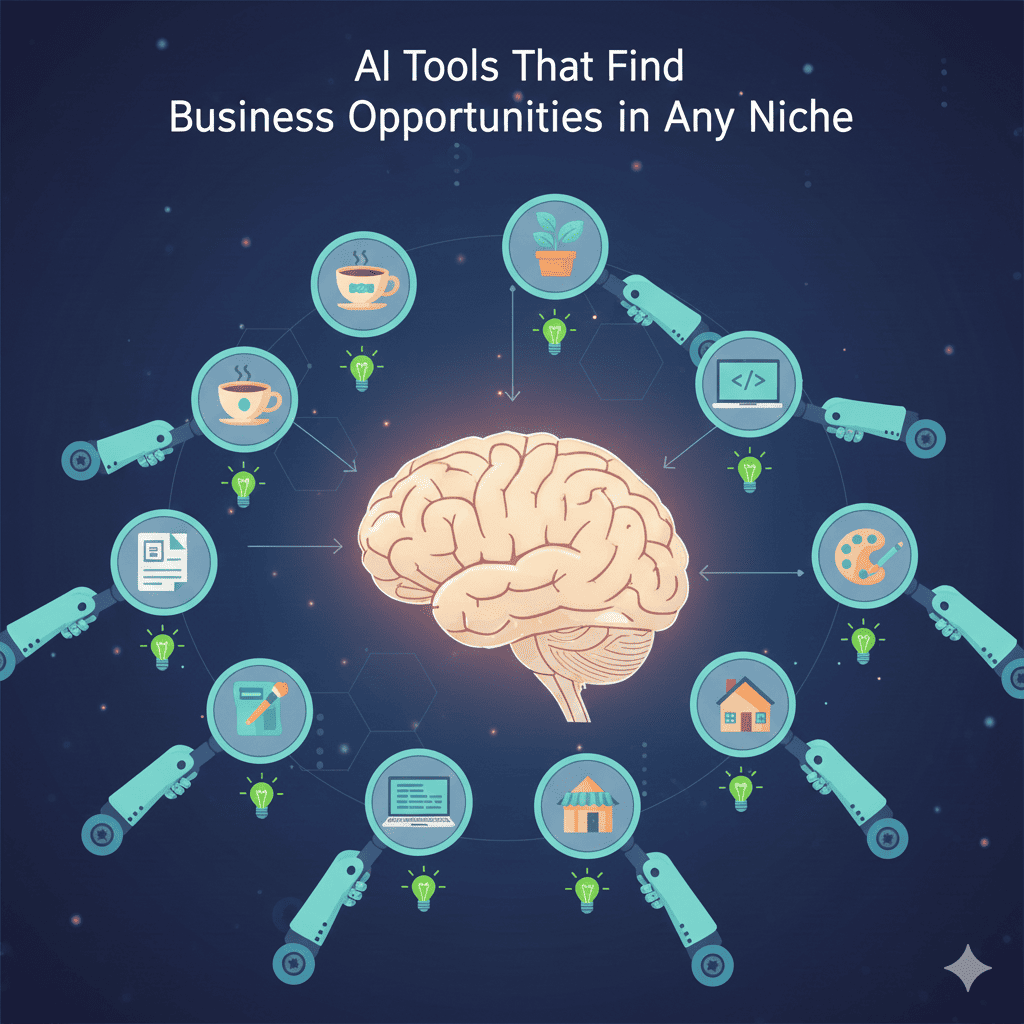
Business Opportunities in Any Niche The most successful entrepreneurs share a common trait: they see opportunities where others see only markets. While most people look at an industry and see what already exists, the opportunity finder sees gaps, inefficiencies, and unmet needs waiting to be addressed. This ability to spot potential has traditionally been part instinct, part experience, and largely inaccessible to those without years of industry immersion. But artificial intelligence is changing this fundamental equation.
AI tools are now capable of identifying Business Opportunities in Any Niche with a speed and comprehensiveness that surpasses even experienced market analysts. These systems can analyze millions of data points across consumer behavior, competitor strategies, market trends, and emerging technologies to surface opportunities that humans might take months to discover—or miss entirely. The question is no longer whether opportunities exist in your chosen niche, but whether you have the tools to find them before someone else does.
This shift represents a fundamental democratization of opportunity discovery. You no longer need decades of industry experience or expensive consulting firms to identify promising business angles. With the right AI tools and approaches, anyone can systematically analyze any niche and uncover actionable opportunities. The competitive advantage increasingly belongs to those who know how to leverage these tools effectively, not just those with the deepest industry connections or longest track records.
1. Understanding How AI Identifies Market Gaps
Before diving into specific tools and techniques, it’s essential to understand how AI approaches opportunity discovery differently than human analysts.
Pattern Recognition at Scale
Human market analysts can review dozens or perhaps hundreds of data sources when researching opportunities. AI systems can analyze millions of data points simultaneously—customer reviews, social media conversations, search trends, patent filings, funding announcements, and competitive offerings. This scale allows AI to identify patterns and correlations that would be invisible in smaller datasets.
The system might notice that customers in a specific demographic consistently complain about the same product feature across multiple platforms, or that search volume for certain solution-oriented queries is rising while no major competitors address those needs directly. These signals, buried in massive data volumes, become clear opportunities when AI aggregates and analyzes them systematically.
Sentiment Analysis and Customer Pain Points
Business Opportunities in Any Niche AI excels at analyzing unstructured text—reviews, forum posts, social media comments, support tickets—to identify common frustrations and unmet needs. Natural language processing allows systems to understand not just what people are saying, but how they feel about it. A product with five-star ratings might still have reviews revealing specific pain points that represent opportunities for improved or alternative solutions.
This sentiment analysis works across languages and platforms, giving you a comprehensive view of customer satisfaction and frustration within any niche. The AI can identify which problems customers care about most, which are mentioned most frequently, and which generate the strongest emotional responses.
Competitive Gap Analysis
AI tools can map the entire competitive landscape of a niche, identifying not just who the major players are, but exactly what they offer, how they position themselves, what features they emphasize, and where they fall short. By comparing competitor offerings against customer needs and desires, AI can identify gaps—combinations of features, price points, or target audiences that remain underserved.
This analysis extends beyond obvious competitors to include adjacent markets and substitute products. The AI might recognize that customers are using makeshift solutions or combining multiple products to meet needs that a single focused offering could address more effectively.
Trend Forecasting and Early Signal Detection
By analyzing search trends, social media momentum, patent filings, academic research, and early-stage company activity, AI can identify Business Opportunities in Any Niche before they become obvious to the broader market. The system might notice that interest in a specific technology or approach is accelerating, that thought leaders are beginning to discuss a particular problem more frequently, or that adjacent industries are experiencing changes that will soon affect your target niche.
This early signal detection gives you a crucial time advantage—the opportunity to enter a market before it becomes crowded, establish yourself as a pioneer, and build momentum while others are still recognizing the opportunity exists.
2. Essential AI Tools for Opportunity Discovery
Different AI tools serve different aspects of opportunity identification, and understanding which tools excel at which tasks helps you build an effective discovery process.
Market Intelligence Platforms
Advanced market intelligence platforms use AI to monitor and analyze markets continuously. These systems track competitor activity, pricing changes, product launches, customer sentiment, and market dynamics in real time. Tools like Crayon, Klue, and Kompyte help you understand not just the current state of your niche but how it’s evolving.
These platforms shine at helping you understand competitive positioning and identifying when competitors are vulnerable—perhaps they’ve raised prices, changed their product focus, or are facing customer backlash that creates an opening for alternatives.
Consumer Insight Tools
Business Opportunities in Any Niche AI-powered consumer research platforms can analyze millions of conversations, reviews, and social media posts to understand what customers want, need, and struggle with. Tools like Brandwatch, Sprinklr, and NetBase Quid surface the topics, emotions, and trends that matter most to your target audience.
The value here isn’t just knowing that customers are discussing your niche, but understanding the nuanced problems they face, the language they use to describe these problems, and the solutions they wish existed. This insight becomes the foundation for product development and positioning strategies.
Trend Analysis and Prediction Tools
Platforms like Google Trends, Exploding Topics, and specialized AI trend forecasting tools identify emerging interests before they hit mainstream awareness. These systems analyze search behavior, social media activity, news coverage, and other signals to predict which topics, products, and solutions are gaining momentum.
Finding Business Opportunities in Any Niche often means being early to recognize shifts in customer interest or market dynamics. These tools help you spot the wave before it crests, giving you time to position yourself advantageously.
Natural Language Processing Platforms
Advanced NLP tools can process vast amounts of unstructured text to extract meaningful insights. Whether you’re analyzing customer support tickets, product reviews, forum discussions, or social media conversations, these tools identify themes, sentiment, pain points, and emerging needs with remarkable accuracy.
Platforms like MonkeyLearn, Lexalytics, and various specialized sentiment analysis tools turn mountains of text into structured, actionable intelligence about what customers need and where current solutions fall short.
Competitive Intelligence AI
Specialized tools focus specifically on competitive analysis, tracking everything competitors do across their websites, pricing, marketing, product features, and customer engagement. Some tools even analyze competitor job postings to understand what capabilities they’re building or marketing campaigns to understand how they’re positioning themselves.
This comprehensive competitive view helps you identify not just what competitors do well, but where they’re weak, where they’re investing resources, and where they’re leaving gaps that you could exploit.
3. Systematic Approaches to Niche Analysis
Having the right tools matters, but using them effectively requires systematic approaches that ensure comprehensive opportunity identification.
The Customer Pain Point Method
Start by using AI tools to compile every complaint, frustration, and problem statement customers express about existing solutions in your niche. Sentiment analysis tools can process thousands of reviews, forum posts, and social media comments to identify recurring themes. Look for problems that appear frequently but remain unsolved, especially those that generate strong emotional responses.
Once you have this compilation, use AI to categorize pain points by severity, frequency, and how well current solutions address them. The sweet spot opportunities are problems that matter deeply to customers but remain inadequately solved by existing offerings.
The Feature Gap Analysis
Map every feature offered by every significant competitor in your niche using AI scraping and analysis tools. Then map these features against customer requests, desires, and discussions. The AI can identify combinations of features that customers want but no single competitor provides, or features that customers consistently request but no one offers.
This analysis often reveals that the opportunity isn’t necessarily a completely new product, but rather a specific combination of features, pricing, and positioning that uniquely serves a particular customer segment.
The Demographic Opportunity Scan
Most niches serve multiple demographic segments, but competitors often focus on the largest or most obvious segments. Use AI tools to analyze which demographic groups express interest in your niche, then map which groups are well-served and which are underserved or ignored entirely.
You might discover that while the niche overall is competitive, specific age groups, geographic regions, income levels, or use cases remain poorly addressed. These underserved segments often represent excellent opportunities for focused offerings.
The Adjacent Market Exploration
AI tools can help you identify markets adjacent to your niche—related industries, complementary products, or alternative solutions that address similar needs. By analyzing how customers in these adjacent markets behave and what they need, you can identify opportunities to either serve these markets more directly or pull customers from these adjacent spaces into your niche.
Discovering Business Opportunities in Any Niche often means recognizing that the boundaries between markets are fluid, and that customers solving similar problems in different categories might be ready for a better, more focused solution.
The Trend Convergence Analysis
Use AI trend analysis tools to identify multiple trends that are converging in your niche. Perhaps environmental consciousness is rising while technology costs are falling, creating opportunities for sustainable tech products. Or remote work is growing while collaboration tool fatigue is setting in, suggesting opportunities for simplified solutions.
These trend convergences often create entirely new opportunity spaces that didn’t exist before. The AI helps you identify not just individual trends but the powerful intersections where multiple trends create new needs.
4. Turning AI Insights Into Actionable Opportunities
Raw data and insights only become valuable when transformed into concrete business opportunities you can pursue.
Opportunity Validation Framework
Once AI tools surface potential opportunities, validate them systematically. Use AI to estimate market size by analyzing search volumes, social media audience sizes, and competitor revenue indicators. Assess competition intensity by mapping how many players target this opportunity and how well-resourced they are. Evaluate barrier to entry by understanding what capabilities, capital, or connections would be required.
The AI can help you score opportunities across multiple dimensions, allowing you to prioritize those with the best combination of market size, addressable need, manageable competition, and reasonable barriers to entry.
Customer Persona Development
Use AI analysis of customer discussions, reviews, and behavior to develop detailed personas representing your target customers. These personas should capture not just demographics but psychographics—what customers value, what frustrates them, what language they use, what objections they raise, and what benefits they seek.
These AI-generated personas become the foundation for product development, marketing messaging, and business strategy. They ensure your opportunity pursuit remains grounded in actual customer needs rather than assumptions.
Competitive Positioning Strategy
With comprehensive competitive intelligence from AI tools, develop positioning that differentiates your opportunity pursuit from existing players. Identify the specific angle, message, or value proposition that will resonate with your target customers while distinguishing you from competitors.
The AI analysis should reveal white space in positioning—angles competitors aren’t claiming, benefits they aren’t emphasizing, or messages they aren’t using—that you can own.
Resource Requirement Assessment
Use AI insights to estimate what resources pursuing an opportunity will require. Analyze what capabilities successful players in the space possess, what marketing channels drive customer acquisition, what price points the market will bear, and what development or operational capabilities you’ll need.
This resource assessment helps you determine which opportunities you’re equipped to pursue now versus which would require significant preparation or capital.
5. Industry-Specific Opportunity Discovery
AI tools can find Business Opportunities in Any Niche, but the specific approaches vary by industry type and maturity.
Technology and Software Niches
For technology niches, AI tools excel at analyzing feature requests, integration needs, and workflow pain points. Tool review sites, developer forums, and feature request boards contain rich data about what users need. AI can identify patterns across these sources—perhaps users consistently struggle with the same integration, or a specific use case remains poorly served by major platforms.
GitHub discussions, Stack Overflow questions, and technical documentation reveal where developers hit obstacles. These technical pain points often represent opportunities for tools, services, or platforms that solve specific problems more elegantly.
E-commerce and Physical Products
Business Opportunities in Any Niche In product-focused niches, AI analysis of reviews reveals detailed insights about product shortcomings. Customers often describe exactly what they wish a product did differently—these descriptions are essentially product specifications for improved offerings.
AI can also identify trending product categories, seasonal opportunity windows, and demographic segments with unmet needs. Search trend analysis reveals what products people are looking for before those products gain mainstream attention, giving early movers significant advantages.
Service-Based Businesses
For service niches, AI analysis of customer complaints about existing providers reveals opportunity. Perhaps customers consistently mention that providers are unresponsive, that pricing is opaque, that service quality is inconsistent, or that specific customer segments are poorly served.
Local service businesses benefit from AI analysis of geographic gaps—areas where demand exists but supply is limited. The same analysis can reveal times when existing providers are overbooked, suggesting capacity-based opportunities.
Content and Media Niches
Content-focused niches benefit from AI analysis of what topics generate engagement, what questions remain poorly answered, and what content gaps exist. Tools can identify high-volume search queries that lack quality content, suggesting opportunities for authoritative resources.
Sentiment analysis reveals which existing content sources frustrate users—perhaps they’re too technical, too shallow, outdated, or biased—suggesting opportunities for alternative approaches.
B2B and Enterprise Markets
In B2B niches, AI analysis of job postings, company announcements, and industry discussions reveals what challenges companies face and what capabilities they’re seeking. Patterns in what companies are hiring for or what solutions they’re discussing indicate where pain points and opportunities exist.
LinkedIn discussions, industry forums, and conference proceedings contain rich data about enterprise needs. AI can identify recurring themes that represent potential service offerings or software solutions.
6. Avoiding Common Pitfalls in AI-Driven Opportunity Discovery
While AI is powerful for finding Business Opportunities in Any Niche, certain pitfalls can lead you astray if you’re not careful.
The Echo Chamber Problem
AI tools analyze existing data, which means they can reinforce existing biases or assumptions. If everyone in a niche believes something, AI will reflect that consensus even if it’s wrong. Truly innovative opportunities sometimes require challenging conventional wisdom that AI-driven analysis might support.
Mitigate this by specifically asking AI to identify contrarian viewpoints, looking for small but growing segments that disagree with the mainstream, and maintaining healthy skepticism about consensus opinions.
The Noise Versus Signal Challenge
Not every pain point represents a real business opportunity. Customers complain about many things, but only some complaints represent problems they’d actually pay to solve. AI can identify patterns in what people say, but human judgment is required to distinguish meaningful opportunity signals from background noise.
Cross-reference AI findings with actual behavior—what are people doing, not just saying? Look for pain points backed by evidence that customers are actively seeking solutions, paying for imperfect alternatives, or making significant efforts to work around problems.
The Timing Miscalculation
AI can identify emerging trends, but predicting exactly when those trends will reach critical mass remains challenging. Entering too early means educating a market that isn’t ready. Entering too late means facing established competition.
Use multiple indicators to assess timing—search trend acceleration, competitor funding activity, regulatory changes, and technology maturity. Look for convergence of signals suggesting momentum is building rather than relying on a single trend indicator.
The Overfitting Trap
It’s easy to find patterns in data that seem meaningful but represent statistical noise rather than real opportunity. AI might identify a niche that appears perfect—growing interest, limited competition, clear pain points—but further investigation reveals the market is too small, the problem isn’t severe enough, or the opportunity window is closing.
Validate AI-identified opportunities with real-world checks: talk to potential customers, examine whether people are currently spending money on alternatives, and assess whether the opportunity can support a sustainable business.
7. Building Your AI-Powered Opportunity Discovery System
Rather than using AI tools ad-hoc, build a systematic approach to continuous opportunity monitoring and discovery.
Create a Monitoring Dashboard
Set up automated monitoring for your niche using AI tools that track competitors, customer sentiment, search trends, and market developments. This dashboard should surface noteworthy changes without requiring daily manual checking—the AI identifies what matters and alerts you.
Your monitoring should cover competitor websites and social media, industry news sources, relevant forums and communities, search trends for key terms, and sentiment across review platforms. The system should flag significant changes: new competitors entering the market, shifts in customer sentiment, emerging trends gaining momentum, or gaps appearing in competitive coverage.
Establish Regular Analysis Rhythms
Schedule regular deep-dive analyses using AI tools even when your monitoring dashboard doesn’t flag urgent changes. Quarterly comprehensive competitive analyses, monthly trend reviews, and weekly sentiment checks ensure you’re not missing gradual shifts that don’t trigger alerts but compound into significant changes.
These regular analyses also help you identify longer-term patterns and opportunities that emerge slowly rather than appearing suddenly.
Build an Opportunity Pipeline
Don’t just identify opportunities and then forget them. Maintain a pipeline tracking every opportunity AI tools surface, along with assessment notes, validation status, and timing considerations. Some opportunities won’t be right immediately but might become attractive as market conditions evolve.
This pipeline becomes a strategic asset—a curated list of validated opportunities you can pursue when timing aligns or resources become available.
Develop Validation Protocols
Create standardized processes for validating AI-identified opportunities before investing significant resources. Your protocol might include customer interviews, minimum viable product tests, landing page experiments, or small-scale pilot programs.
These validation steps ensure you’re not pursuing opportunities based purely on data analysis without confirming that real customers exist and will actually pay for your proposed solution.
8. Future Trends in AI Opportunity Discovery
The capabilities of AI for finding Business Opportunities in Any Niche continue evolving rapidly, and understanding where the technology is heading helps you prepare for enhanced capabilities.
Predictive Opportunity Modeling
Emerging AI systems don’t just analyze current conditions but predict future opportunities by modeling how markets evolve. These systems can forecast which niches will become more attractive, which will decline, and which new niches will emerge from technology changes, demographic shifts, or regulatory developments.
This predictive capability means moving from reactive opportunity discovery—finding what exists now—to proactive opportunity anticipation, positioning yourself ahead of market shifts.
Real-Time Opportunity Alerts
Rather than periodic analysis, next-generation systems provide real-time alerts when opportunities emerge. The moment a competitor stumbles, a new pain point surfaces in customer discussions, or a trend accelerates past a threshold, you’ll know immediately.
This real-time capability dramatically shortens the window between opportunity emergence and pursuit, giving early movers even greater advantages.
Cross-Niche Opportunity Synthesis
Advanced AI will increasingly identify opportunities that exist at the intersection of multiple niches. These synthesis opportunities—serving needs that span categories or combining solutions from different markets—often represent less competitive spaces because they require understanding multiple domains simultaneously.
The AI can identify these intersections more easily than humans because it analyzes multiple markets simultaneously without the mental compartmentalization that leads humans to think in discrete industry categories.
Personalized Opportunity Matching
Future systems will understand your specific capabilities, resources, goals, and constraints, then identify opportunities specifically suited to you rather than generating generic opportunity lists. The AI will know what you’re good at, what resources you have access to, what markets you understand, and what your risk tolerance is, then surface opportunities that match your unique profile.
This personalization makes opportunity discovery more actionable because every identified opportunity comes pre-filtered for relevance to your specific situation.
Conclusion
The ability to systematically identify Business Opportunities in Any Niche using AI tools represents a fundamental shift in how entrepreneurship and business development work. What once required extensive industry experience, expensive market research, or lucky timing can now be approached systematically using tools accessible to anyone with curiosity and persistence.
This democratization doesn’t eliminate the need for judgment, creativity, or execution capability. AI tools show you where opportunities exist, but you must still evaluate which opportunities align with your strengths, validate that real customers exist, and execute effectively to capture those opportunities. The tools make opportunity discovery more systematic and comprehensive, but success still requires the distinctly human capabilities of strategic thinking, risk assessment, and determined execution.
Business Opportunities in Any Niche The entrepreneurs and businesses that thrive in this environment will be those who master the combination of AI-powered analysis and human judgment. They’ll use AI to ensure they’re not missing opportunities, to validate their intuitions with data, and to understand markets more comprehensively than competitors relying solely on traditional research methods. But they’ll combine this analytical power with creativity, industry insight, and the ability to see opportunities that exist between the data points rather than just in them.
Finding Business Opportunities in Any Niche with AI isn’t about replacing human entrepreneurship with automated discovery. It’s about augmenting human capability, allowing you to see further, understand deeper, and move faster than would be possible without these tools. The opportunity landscape has never been more transparent, the barriers to discovery have never been lower, and the potential for finding and capturing valuable opportunities has never been greater.
The question isn’t whether AI can help you find opportunities in your chosen niche—it demonstrably can. The question is whether you’ll develop the skills to use these tools effectively, the judgment to distinguish real opportunities from mirages, and the execution capability to turn identified opportunities into successful businesses. Those who master this combination will find that opportunities exist everywhere, waiting to be discovered by those with the tools and tenacity to uncover them.
Also read this:
How AI Turns Five-Minute Ideas Into Full Projects
How AI Creates Cinematic Scenes Without a Film Crew: The Future of Visual Storytelling