
build a reliable AI service business The AI revolution has created an unprecedented opportunity for entrepreneurs and consultants to build profitable service businesses. While established agencies compete for enterprise contracts, a massive market of small and medium businesses desperately needs AI guidance but doesn’t know where to find it. This gap represents your opportunity.
Building a successful AI service business doesn’t require a computer science degree, venture capital funding, or years of corporate AI experience. What it requires is strategic thinking, commitment to learning, and systematic execution of proven business fundamentals adapted for the AI era.
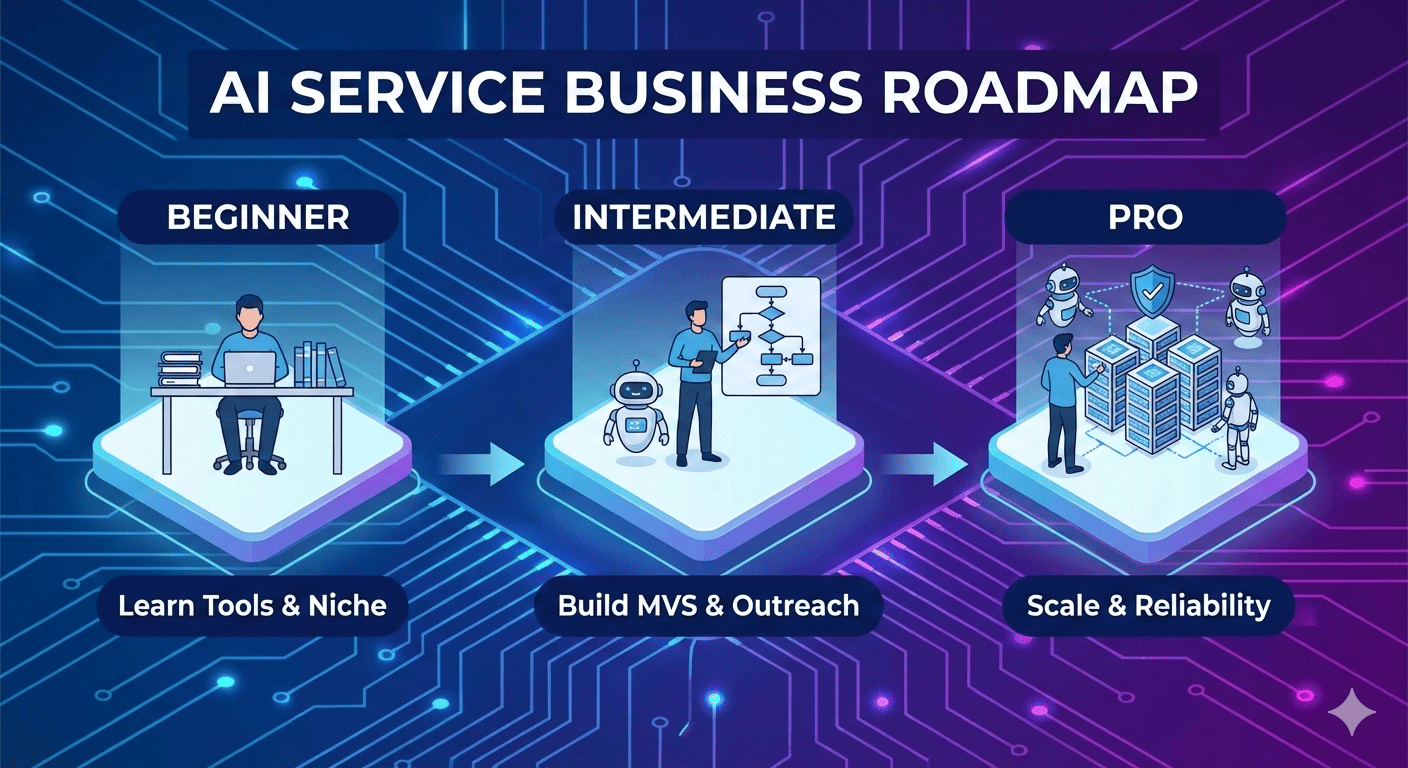
This comprehensive guide takes you from complete beginner to professional AI service provider. You’ll learn exactly how to build a reliable AI service business that generates consistent income, serves clients effectively, and positions you as a trusted expert in this rapidly expanding field.
1. Laying Your Foundation: Skills and Knowledge
Before you can serve clients effectively, you need foundational understanding of AI capabilities, limitations, and applications. The good news is you don’t need to become a data scientist or machine learning engineer.
Understanding what you actually need to know
To build a reliable AI service business, you need business understanding of AI—how different AI technologies work conceptually, what problems they solve effectively, their limitations and failure modes, and how to evaluate AI solutions and vendors. You don’t need to code neural networks from scratch or understand complex mathematical theory.
Think of it like being an architect versus a construction worker. Architects design buildings and specify materials without personally installing plumbing or pouring concrete. Similarly, you’ll design AI solutions and guide implementation without necessarily coding every component.
Essential AI knowledge areas to master
Focus your learning on natural language processing applications like chatbots and content generation, computer vision for image and video analysis, predictive analytics and forecasting, recommendation systems and personalization, process automation and workflow optimization, and the major AI platforms and tools available in the market.
Spend 2-3 months gaining solid conceptual understanding through online courses, reading industry publications, experimenting with AI tools, and following AI thought leaders.
Developing complementary business skills
Technical AI knowledge alone doesn’t create successful businesses. Develop consultative selling skills to understand client needs, project management capabilities to deliver reliably, communication skills to explain complex concepts simply, business analysis to identify high-value opportunities, and pricing strategies that capture appropriate value.
These business fundamentals separate successful AI consultants from struggling technical experts.
Creating your learning roadmap
Structure your learning systematically. Month one, focus on AI fundamentals and major application areas. Month two, dive deep into one specific AI domain aligned with your target market. Month three, start experimenting with actual AI tools and creating sample projects. This focused approach builds practical capability faster than scattered learning.
2. Choosing Your Profitable Niche
The fastest way to build a reliable AI service business is specialization. Generalists struggle to differentiate and attract clients, while specialists become obvious choices for specific problems.
Why niching accelerates your success
When you specialize, marketing becomes easier because you can speak directly to specific pain points. Sales cycles shorten because you demonstrate relevant expertise immediately. Pricing power increases because you’re not competing with every other AI consultant. Delivery improves because you solve similar problems repeatedly, developing efficient processes.
Identifying your ideal niche
Choose your niche based on the intersection of your existing knowledge or experience, clear market demand with budget for solutions, your genuine interest in the domain, and reasonable competition levels allowing market entry.
If you have healthcare background, healthcare AI services make sense. Experience in e-commerce positions you for retail AI consulting. Marketing background enables AI-powered marketing services. Leverage whatever domain expertise you already possess.
Validating market demand
Before fully committing, validate that businesses in your niche actually need AI solutions and have budget to pay for them. Check whether companies are hiring for AI-related roles, vendors are targeting this market, LinkedIn and forums show active discussions about AI challenges, and search volume exists for relevant keywords.
Speak with potential clients to understand their challenges, current approaches, and willingness to invest in solutions.
Starting broad then narrowing
You might begin with broader positioning like “AI for small businesses” then narrow to “AI customer service for local service businesses” as you understand which specific services resonate best. This progressive specialization is perfectly acceptable and often more practical than premature narrow positioning.
3. Defining Your Core Service Offerings
Clear service offerings make selling dramatically easier. Clients don’t want custom everything—they want packages that solve specific problems with predictable pricing and outcomes.
Choosing your initial services
When you first build a reliable AI service business, start with 1-3 core services you can deliver confidently and profitably. Common beginner-friendly services include AI chatbot implementation for customer service, AI-powered content creation systems, process automation using AI tools, AI tool selection and vendor evaluation, or AI strategy consulting and roadmapping.
These services have clear deliverables, don’t require extensive custom development, and solve problems businesses already recognize they have.
Packaging services effectively
Transform vague “AI consulting” into specific packages with clear scope. For example, “AI Customer Service Accelerator: 30-day implementation of AI chatbot handling common customer inquiries, reducing support volume by 40-60%, including setup, training, and 90 days of optimization support—$12,000.”
Specific packages eliminate confusion, speed sales cycles, and set clear expectations preventing scope creep.
Creating tiered offerings
Develop good-better-best tiers serving different client budgets and needs. A basic tier might offer essential functionality at accessible pricing, a professional tier adds advanced features and support, and a premium tier provides comprehensive services with white-glove delivery.
Tiered offerings give clients choice while anchoring perceptions—many clients choose middle tiers when presented with three options.
Planning service evolution
Your initial services bootstrap your business but shouldn’t limit your growth. Plan how services might evolve over 12-24 months. Simple implementations might expand to ongoing optimization services, one-time projects might become recurring retainers, and basic offerings might develop into sophisticated platforms.
4. Building Your Business Infrastructure
Professional infrastructure signals credibility and enables efficient operations as you build a reliable AI service business.
Essential legal and business setup
Register your business entity appropriately for your jurisdiction. Obtain necessary business licenses and insurance, particularly professional liability coverage. Set up business banking and accounting systems from day one. Create standard contracts and service agreements, ideally reviewed by a lawyer.
These foundational elements protect you legally and enable professional client relationships.
Developing your brand and positioning
Create a professional brand including a memorable business name clearly communicating your focus, a simple logo and visual identity, a clear positioning statement explaining who you serve and how, and consistent messaging across all platforms.
Your brand doesn’t need expensive design—it needs clarity and professionalism. Many successful agencies use clean, simple branding that emphasizes expertise over flashiness.
Building your digital presence
Establish essential online assets including a professional website explaining your services and showcasing expertise, active LinkedIn profile optimized for your niche, and initial content demonstrating your knowledge. These assets work 24/7 attracting and educating potential clients.
Your website doesn’t need complex functionality initially—clear service explanations, credibility indicators, and easy contact methods are sufficient.
Setting up operational systems
Implement basic systems for client management and CRM, project management and delivery, invoicing and payment processing, document storage and templates, and time tracking and profitability analysis.
Simple tools like Notion, Trello, and Stripe can handle these needs initially. Don’t over-invest in complex systems before you have clients to manage.
5. Acquiring Your First Clients
The transition from preparation to paid work is where most aspiring consultants stumble. Getting initial clients requires strategic effort and persistence.
Leveraging your existing network
Your fastest path to first clients is through existing connections. Systematically reach out to former colleagues, industry contacts, friends and family who own businesses, and members of professional associations you belong to.
Don’t ask for clients directly—ask for advice, introductions, and feedback on your new service. These conversations naturally lead to opportunities and referrals.
Offering founder’s pricing
Reduce initial client acquisition friction with special pricing for early clients. Offer 30-50% discounts in exchange for detailed testimonials, case study participation, referrals to similar businesses, and patience as you refine your delivery process.
Frame this as a limited “founder’s pricing” opportunity creating urgency while setting expectation that prices will increase.
Creating case studies from early projects
Treat first projects as case study opportunities even if they’re discounted. Document everything meticulously including client’s initial challenge and impact, your approach and methodology, implementation process and timeline, specific results with metrics, and client testimonial about the experience.
These case studies become your most powerful sales tools for subsequent clients.
Strategic pro bono work
If you’re truly struggling to land paid clients, consider one or two pro bono projects for organizations with strong networks or reputations. The experience, testimonial, and case study can be worth more than the foregone revenue if chosen strategically.
Select pro bono clients carefully—they should be able to demonstrate results, provide strong testimonials, refer paying clients, or enhance your portfolio significantly.
6. Delivering Exceptional Client Results
Your reputation and referrals depend entirely on client outcomes. Reliable delivery is how you build a reliable AI service business that grows sustainably.
Setting realistic expectations upfront
Under-promise and over-deliver by setting conservative timelines with buffer, being honest about potential challenges and limitations, clearly defining what’s included and excluded in scope, and establishing measurable success criteria before starting.
Disappointed clients rarely result from poor work—they result from mismatched expectations. Clear upfront alignment prevents most client relationship problems.
Managing projects systematically
Use consistent project management approaches including detailed kickoff meetings establishing understanding, regular status updates maintaining visibility, clear milestone definitions tracking progress, proactive issue identification and communication, and thorough documentation of decisions and changes.
Even simple projects benefit from professional project management creating confidence in your competence.
Communicating proactively
Excellent communication differentiates great consultants from mediocre ones. Update clients regularly even when there’s nothing urgent to report. Explain technical concepts in business terms they understand. Respond to questions promptly. Flag potential issues before they become problems.
Clients often value communication as much as technical quality. Responsive, clear communication builds trust and satisfaction.
Measuring and documenting results
Track concrete metrics demonstrating your impact. For customer service AI, measure response time reductions and volume handled. For content AI, track content output and engagement metrics. For automation, quantify time saved and error reduction.
Document results formally in wrap-up reports that clients can share with stakeholders and that you can use as case studies.
7. Developing Scalable Delivery Systems
As you grow beyond initial clients, systematization becomes essential to build a reliable AI service business that doesn’t collapse under its own success.
Creating standardized processes
Document your approach for each service including discovery and requirements gathering steps, typical implementation sequence, quality assurance procedures, common challenges and solutions, and client onboarding and training processes.
These documented processes enable consistent delivery, faster onboarding of team members, and confidence in taking on multiple projects simultaneously.
Building reusable assets and templates
Develop assets you can customize for each client rather than starting from scratch including proposal templates, project plans, implementation checklists, training materials, and reporting formats.
Reusable assets dramatically reduce delivery time while maintaining quality, improving your profitability per project.
Leveraging AI tools for efficiency
Use AI tools to deliver your services more efficiently. AI writing assistants can draft reports and documentation. Project management AI can optimize scheduling. AI tools can automate routine aspects of implementation. This ironic twist—using AI to deliver AI services—increases your capacity significantly.
Planning for team growth
As demand exceeds your personal capacity, plan how you’ll scale through hiring contractors for specialized skills, training junior team members for routine tasks, partnering with complementary service providers, or developing semi-automated delivery approaches.
Scalability planning prevents saying no to opportunities when demand increases.
8. Implementing Smart Marketing Strategies
Consistent client flow requires systematic marketing, not just occasional outreach when your pipeline thins.
Content marketing for authority building
Establish expertise through consistent content creation including weekly LinkedIn posts sharing insights, monthly blog articles solving client problems, case studies showcasing successful projects, and educational videos or webinars on AI topics.
Content marketing works slowly but compounds powerfully. Six months of consistent content creates substantial visibility and inbound interest.
Strategic networking and partnerships
Build relationships deliberately by joining industry associations in your target niche, attending relevant conferences and events, participating in online communities where clients gather, and forming referral partnerships with complementary service providers.
Quality relationships generate more valuable opportunities than broad shallow networking.
Speaking and teaching opportunities
Position yourself as expert through public speaking at industry events, guest presentations for business groups, teaching workshops on AI topics, and podcast interviews discussing your specialty.
Speaking opportunities build authority faster than almost any other tactic while reaching concentrated groups of potential clients.
Asking for referrals systematically
Don’t leave referrals to chance. After successful project completion, explicitly ask satisfied clients for introductions to similar businesses. Make referrals easy by suggesting specific types of introductions and providing talking points.
Most clients will gladly refer you if asked directly—they just don’t think to do so spontaneously.
9. Pricing Your Services for Profitability
Pricing determines your profitability, client quality, and perceived value. Most new consultants dramatically underprice their services, limiting both income and business viability.
Moving beyond hourly billing
Hourly billing penalizes efficiency and caps your income. Instead, use value-based pricing tied to client outcomes, project-based fixed fees for defined deliverables, or monthly retainers for ongoing services.
These models align your incentives with client results and allow your income to scale without linearly increasing your hours.
Calculating your minimum viable pricing
Determine your minimum pricing by calculating your required annual income, realistic billable hours (typically 50-60% of work time), desired profit margin, and business expenses including tools, insurance, and marketing.
If you need $100,000 annually, have $20,000 in expenses, and can bill 1,000 hours yearly, you need minimum $120 per hour—but should charge significantly more for sustainability and growth.
Positioning premium pricing
Charge premium rates by specializing deeply in valuable problems, demonstrating clear ROI from your services, providing exceptional client experience, and confidently communicating your value.
Clients willing to pay premium rates are often easier to work with, more committed to success, and more likely to see strong results than bargain hunters.
Increasing prices progressively
As you gain experience and case studies, systematically raise prices. Increase rates 10-20% every 6-12 months for new clients. This progressive increase reflects growing expertise while rewarding early clients with locked-in rates.
10. Scaling Your Business Strategically
Once you’ve established consistent client flow and reliable delivery, strategic scaling transforms your practice into a substantial business.
Deciding between lifestyle practice and scaled agency
Determine whether you want a lifestyle practice generating strong personal income with limited team, or a scaled agency building significant enterprise value through team growth.
Both are legitimate choices with different implications for how you operate, invest, and spend your time. Clarify your goal before scaling decisions.
Building your team strategically
If scaling with a team, hire strategically starting with contractors for project overflow before full-time employees, junior team members for routine delivery work, senior specialists for capabilities you lack, and administrative support freeing you for revenue-generating activities.
Each hire should solve specific capacity or capability constraints enabling growth.
Developing recurring revenue streams
Transform project-based business into predictable income through ongoing optimization and monitoring services, monthly advisory retainers, subscription-based tools or content, and white-label solutions for partners.
Recurring revenue provides stability enabling confident scaling investments.
Systematizing business operations
As you grow, systematize everything including client acquisition and sales processes, project delivery and quality assurance, team management and training, financial management and reporting, and strategic planning and review.
Systems allow the business to operate smoothly without your constant involvement in every detail.
Avoiding Common Mistakes
Learning from others’ mistakes accelerates your success as you build a reliable AI service business.
Mistake one: Trying to serve everyone
Resist the temptation to pursue every opportunity regardless of fit. Specialization builds expertise, reputation, and profitability faster than generalization. Say no to work outside your focus area even when it seems appealing.
Mistake two: Underpricing services
Charging too little attracts wrong clients, prevents business sustainability, and signals low value. Price confidently based on value delivered, not your costs or insecurity. You can always discount strategically but starting low makes increases difficult.
Mistake three: Neglecting ongoing learning
AI evolves rapidly. Dedicate time weekly to learning about new developments, tools, and applications. Stagnant knowledge becomes obsolete quickly in this field. Continuous learning keeps your services relevant and valuable.
Mistake four: Poor client communication
Most client relationship problems stem from communication gaps, not technical issues. Over-communicate rather than under-communicate. Set clear expectations, provide regular updates, and address concerns promptly.
Mistake five: Scaling too quickly
Premature scaling—hiring team members, renting offices, investing in expensive tools—before establishing consistent revenue destroys many businesses. Scale incrementally based on proven demand, not optimistic projections.
Your 90-Day Launch Plan
To build a reliable AI service business, follow this practical 90-day roadmap transforming you from beginner to operational consultant.
Days 1-30: Foundation and learning
Complete fundamental AI education through courses and reading. Choose your initial niche based on experience and research. Define your first service offering with clear deliverables. Set up basic business entity and systems. Create professional LinkedIn profile and simple website. Reach out to 50 people in your network about your new venture.
Days 31-60: Positioning and outreach
Publish 3-4 substantial pieces of content demonstrating knowledge. Engage actively in online communities in your niche. Attend 2-3 networking events or industry gatherings. Conduct 10 informational interviews with potential clients. Develop detailed service packages with pricing. Create proposal templates and service agreements.
Days 61-90: Client acquisition and delivery
Pursue 5-10 serious sales conversations. Offer founder’s pricing to first 3 clients who commit. Begin delivering your first projects with meticulous documentation. Create initial case studies from completed work. Request testimonials and referrals from satisfied clients. Refine your service delivery based on early experience.
By day 90, you should have paying clients, documented results, refined services, and clear next steps for growth. This foundation positions you for sustained success.
The Long-Term Vision
Building a successful AI service business isn’t a sprint—it’s a marathon requiring patience, persistence, and continuous improvement. The consultants who thrive long-term commit to ongoing learning, genuinely care about client success, systematically improve their services, build strong professional reputations, and balance growth ambition with sustainable practices.
The AI market will continue expanding for years. Businesses of all sizes need guidance implementing AI effectively. The opportunity to build a reliable AI service business has never been stronger.
Your success depends not on having perfect knowledge before starting, but on beginning with solid fundamentals and improving continuously. Every successful AI consultant started exactly where you are now—uncertain but committed to learning and serving clients well.
The difference between those who succeed and those who remain perpetual beginners is simple: successful consultants start before they feel ready, learn through doing, persist through initial challenges, and systematically improve based on experience.
You now have a complete roadmap from beginner to professional AI service provider. The knowledge, strategies, and tactics are proven and practical. The only remaining requirement is your commitment to execution.
Start today. Choose your niche this week. Define your first service offering. Reach out to your network. Take the first uncertain steps toward building something valuable and sustainable. Six months from now, you’ll be amazed at how far you’ve progressed. A year from now, you could have a thriving business serving clients, generating strong income, and positioning you as an expert in your field.
The opportunity is here. The path is clear. Your success in building a reliable AI service business depends entirely on the actions you take starting now.
Also read this:
High-Value AI Agency Services That Depend on Thinking, Not Programming
Recurring Revenue for AI Agencies: How to Create Predictable Monthly Income
How to Build Authority as a Niche AI Agency (Step-by-Step Strategy)