
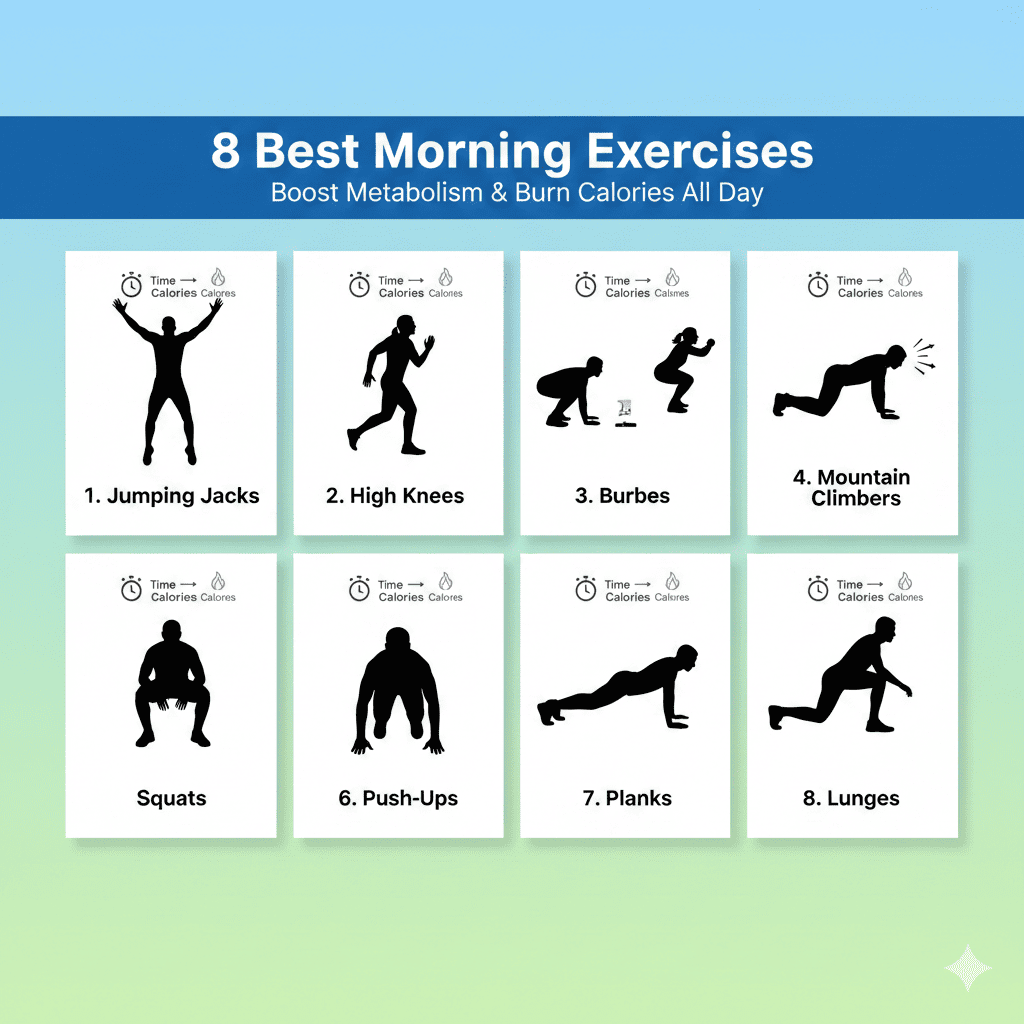
Your morning routine sets the tone for your entire day, and few habits are as transformative as starting with exercise. While any physical activity benefits your health, specific morning exercises create a metabolic advantage that extends far beyond the workout itself. When you strategically exercise in the morning, you ignite your metabolism, creating an elevated calorie-burning state that persists for hours afterward. This phenomenon, known as excess post-exercise oxygen consumption or EPOC, means you continue burning additional calories while sitting at your desk, driving to work, or going about your normal activities.
This comprehensive guide reveals the eight most effective morning exercises scientifically proven to boost metabolism and burn calories throughout your entire day. These aren’t random movements or trendy fitness fads—they’re evidence-based exercises that create optimal hormonal responses, maximize calorie expenditure, and build lean muscle tissue that elevates your resting metabolic rate. Whether you have five minutes or fifty, whether you’re a complete beginner or an experienced athlete, these exercises can be adapted to your fitness level and schedule while delivering impressive metabolic benefits.
Understanding how to strategically boost metabolism and burn calories through morning exercise provides you with a powerful tool for weight management, energy enhancement, and overall health improvement. You’ll discover not only which exercises are most effective but also why they work, how to perform them correctly, and how to structure your morning routine for maximum metabolic impact. The metabolic advantages you create before most people have finished their morning coffee will compound throughout the day, making your weight loss and fitness goals significantly easier to achieve.
The Science of Morning Metabolism
Understanding Your Metabolic Rate
Your metabolism encompasses all the chemical processes that keep you alive, with the largest component being your basal metabolic rate—the calories your body burns at rest to maintain basic functions like breathing, circulation, and cellular repair. This baseline accounts for 60-75% of your daily calorie expenditure. The remaining calories are burned through activity (both exercise and daily movement) and the thermic effect of food—the energy required to digest and process what you eat.
While genetics influence your baseline metabolic rate, multiple factors within your control significantly impact how many calories you burn daily. Muscle tissue is metabolically active, burning more calories at rest than fat tissue. This means increasing your muscle mass through resistance training elevates your resting metabolic rate permanently. Age typically brings metabolic decline, but this largely reflects decreased muscle mass and activity rather than inevitable aging—staying active and maintaining muscle counters this decline.
Your body’s metabolic rate fluctuates throughout the day based on hormone levels, activity, food intake, and circadian rhythms. Morning exercise strategically leverages these natural rhythms to boost metabolism and burn calories more effectively than exercising at other times. Your body is primed for physical activity in the morning, with higher testosterone and growth hormone levels that support muscle building and fat burning.
The EPOC Effect Explained
Excess post-exercise oxygen consumption is the scientific term for the “afterburn effect”—the increased calorie burning that continues after you finish exercising. When you exercise intensely, your body’s oxygen consumption increases dramatically to fuel muscular work. After you stop, your body doesn’t immediately return to its resting state. Instead, it continues consuming elevated oxygen levels as it repairs muscle tissue, replenishes energy stores, regulates temperature, and returns all systems to baseline.
This recovery process burns additional calories for hours after exercise completion. The magnitude and duration of EPOC depend primarily on exercise intensity and duration. High-intensity interval training and resistance training create the largest EPOC effects, potentially elevating metabolic rate by 5-15% for several hours post-exercise. While this might sound modest, it represents 50-150 additional calories burned throughout the day without any additional effort—a significant advantage that compounds over weeks and months.
Morning exercise maximizes EPOC’s practical benefits because you create this elevated metabolic state before your day truly begins. Those extra calories burn while you’re working, doing household tasks, or simply living your life. Exercise later in the day provides similar EPOC, but you’re likely to sleep through much of it, wasting the metabolic advantage.
Hormonal Optimization Through Morning Exercise
Morning exercise creates favorable hormonal conditions that support fat loss and muscle building. Cortisol, often vilified as a stress hormone, actually serves beneficial functions when properly regulated. Cortisol naturally peaks in the early morning, mobilizing energy stores to prepare you for the day. Morning exercise leverages this natural cortisol surge to mobilize fat for energy, supporting fat loss while avoiding the negative effects of chronically elevated cortisol that occur with evening exercise or chronic stress.
Exercise also increases human growth hormone and testosterone—both crucial for building and maintaining muscle mass. These anabolic hormones are naturally higher in the morning and receive an additional boost from exercise. This hormonal environment supports muscle protein synthesis throughout the day, helping you build or maintain lean tissue that permanently elevates metabolic rate.
Additionally, morning exercise improves insulin sensitivity—your cells’ responsiveness to insulin and ability to efficiently use glucose for energy. Improved insulin sensitivity means better blood sugar control, reduced fat storage, and enhanced fat burning. These metabolic improvements persist throughout the day, meaning your morning workout influences how your body processes every meal you eat.
1. High-Intensity Interval Training (HIIT)
Why HIIT Is Metabolically Superior
High-intensity interval training alternates short bursts of maximum effort with brief recovery periods, creating a workout that’s both time-efficient and metabolically powerful. HIIT produces greater EPOC than steady-state cardio of equal or even longer duration. A 20-minute HIIT session can create metabolic effects surpassing an hour of moderate-intensity jogging.
The intense exertion during work intervals depletes muscle glycogen stores and creates metabolic disturbance that requires substantial recovery. Your body must replenish these stores, clear metabolic byproducts, repair muscle tissue, and restore all systems to baseline—processes that burn significant calories. Research shows HIIT can elevate metabolic rate for up to 24 hours post-exercise, making it one of the most effective ways to boost metabolism and burn calories throughout your entire day.
HIIT also stimulates beneficial adaptations including increased mitochondrial density (more cellular powerhouses to generate energy), improved cardiovascular capacity, and enhanced fat oxidation. These adaptations mean your body becomes more efficient at burning fat for fuel even during rest and low-intensity activities.
Sample HIIT Morning Routine
Warm-up (3 minutes): Light jogging in place, arm circles, leg swings, and gentle twisting movements to increase blood flow and prepare your body.
Work intervals (20 seconds maximum effort, 40 seconds active recovery, repeated 8 times):
- Burpees: From standing, place hands on floor, jump feet back to plank position, perform a push-up, jump feet back to hands, and explosively jump upward. During recovery, march in place.
- Mountain climbers: From plank position, rapidly drive knees toward chest alternately. Recovery involves slow, controlled mountain climbers or a plank hold.
- Jump squats: Perform a squat then explode upward into a jump, landing softly back into squat position. Recovery is bodyweight squats without the jump.
- High knees: Run in place, driving knees as high as possible. Recovery is gentle jogging in place.
Cool-down (3 minutes): Slow walking, gentle stretching of major muscle groups, and deep breathing to gradually lower heart rate.
This 20-minute routine creates a powerful metabolic stimulus that will boost metabolism and burn calories for hours afterward. The beauty of HIIT is its scalability—beginners can modify exercises (step back instead of jumping into burpees, reduce speed, take longer recovery periods) while advanced individuals can increase intensity and reduce rest.
HIIT Safety and Progression
HIIT’s intensity makes it highly effective but also demanding. If you’re new to exercise or have been sedentary, build a fitness foundation with moderate-intensity exercise for several weeks before attempting true HIIT. Start with work-to-rest ratios favoring recovery (20 seconds work, 60 seconds rest) and gradually progress to more challenging ratios.
Listen to your body. Maximum effort means maximum for you today, not compared to anyone else or even to your past performance. Some days you’ll feel strong; other days less so. Adjust intensity accordingly while maintaining consistency. HIIT shouldn’t be performed daily—2-3 times weekly provides optimal benefits while allowing adequate recovery.
2. Resistance Training Circuits
Building Metabolic Muscle
Resistance training builds lean muscle tissue, which permanently elevates your resting metabolic rate. Each pound of muscle burns approximately 6 calories daily at rest compared to 2 calories per pound of fat. This might seem small, but building 10 pounds of muscle increases your daily calorie burn by 40 calories even when doing nothing—equivalent to running a mile every three days without moving. Over a year, this represents burning over 14,000 additional calories, or approximately 4 pounds of fat, simply by having more muscle.
Circuit-style resistance training—moving between exercises with minimal rest—combines strength building with cardiovascular challenge, creating substantial EPOC and optimal conditions to boost metabolism and burn calories. The combination of mechanical muscle damage from resistance work and metabolic disturbance from sustained elevated heart rate creates powerful calorie-burning effects that last well beyond the workout.
Full-Body Morning Circuit
Warm-up (5 minutes): Dynamic movements including arm swings, leg swings, bodyweight squats, and light cardio to prepare muscles and joints.
Circuit (perform each exercise for 45 seconds, 15 seconds transition between exercises, complete 3-4 rounds):
Push-ups: Target chest, shoulders, and triceps. Modify on knees or against an elevated surface if needed. Focus on controlled lowering and explosive pushing.
Bodyweight squats: Stand with feet shoulder-width apart, lower hips back and down while keeping chest up, drive through heels to stand. This fundamental movement engages all major leg muscles plus core.
Plank rows: From plank position, lift one hand toward hip, squeezing shoulder blade back, then alternate sides. Without weights, simply tap hand to hip while maintaining plank stability. Targets back, shoulders, and core with anti-rotation challenge.
Alternating lunges: Step forward, lower back knee toward floor, push back to standing, alternate legs. Builds leg strength, balance, and coordination while challenging cardiovascular system.
Pike push-ups: Start in downward dog position, bend elbows to lower head toward floor, push back up. Emphasizes shoulders while building upper body strength.
Glute bridges: Lie on back with knees bent, lift hips toward ceiling while squeezing glutes, lower with control. Strengthens glutes and hamstrings while improving hip mobility.
Cool-down (3 minutes): Gentle stretching focusing on all worked muscle groups plus deep breathing.
This 25-30 minute circuit provides comprehensive strength stimulus to all major muscle groups while maintaining elevated heart rate throughout. The minimal rest between exercises keeps your metabolism elevated during the workout and creates substantial EPOC afterward.
Progressive Overload Principles
To continuously boost metabolism and burn calories through resistance training, you must progressively challenge your muscles. As exercises become easier, increase difficulty by: adding repetitions, increasing exercise duration, reducing rest periods, using slower tempos (particularly on the lowering phase), or incorporating resistance bands or dumbbells when bodyweight becomes insufficient.
Track your workouts to ensure progressive challenge. If you completed 12 push-ups in the first round this week, aim for 13 next week. These small, consistent increases compound over weeks and months into significant strength gains and metabolic improvements.
3. Compound Movement Sequences
The Power of Multi-Joint Exercises
Compound exercises engage multiple muscle groups simultaneously, burning more calories during exercise and creating greater metabolic disturbance than isolation exercises targeting single muscles. A squat engages quadriceps, hamstrings, glutes, core, and even upper back stabilizers—potentially hundreds of muscles working together. This massive recruitment burns substantial calories and creates optimal conditions for muscle building and metabolic enhancement.
Sequencing compound movements into flowing combinations maximizes efficiency while maintaining elevated heart rate. You transition seamlessly from one position to the next, keeping muscles under tension and metabolism elevated throughout the sequence.
Dynamic Compound Sequence
Perform each sequence 10-12 times, rest 60 seconds, complete 4-5 rounds. This 20-minute routine powerfully stimulates metabolism.
Squat to overhead reach: Begin in standing position. Perform a deep squat, then as you rise, reach arms overhead in a powerful extension. This combination engages legs, core, and shoulders while creating full-body extension that activates many muscle groups.
Push-up to downward dog: From standing, hinge forward and place hands on floor, walk hands out to plank position, perform a push-up, then push hips up and back into downward dog position. Hold briefly, walk hands back to feet, and return to standing. This sequence flows through multiple positions, engaging virtually every muscle while challenging cardiovascular system.
Reverse lunge to knee drive: Step one leg back into a reverse lunge, then drive that same knee up toward chest as you rise, creating a knee lift. This challenges balance while building leg strength and elevating heart rate through the dynamic movement.
Plank to squat thrust: From standing, place hands on floor, jump or step feet back to plank, hold briefly, jump or step feet back to hands, return to standing. This burpee variation emphasizes core stability with the plank hold while maintaining metabolic intensity.
The flowing nature of these sequences creates sustained metabolic demand that continues to boost metabolism and burn calories throughout your day. The constant muscle engagement without complete rest between movements keeps your heart rate elevated and creates substantial EPOC.
Form Focus
Compound movements’ effectiveness depends on proper form. Rushing through repetitions with poor technique diminishes benefits and increases injury risk. Move deliberately, maintaining awareness of body position throughout each sequence. Quality repetitions with full range of motion provide better metabolic stimulus than sloppy high-rep sets.
Video yourself occasionally to check form, or have a knowledgeable friend observe. Small adjustments to alignment and movement patterns dramatically improve exercise effectiveness while protecting joints from stress.
4. Plyometric Power Exercises
Explosive Movement Benefits
Plyometric exercises involve explosive, powerful movements that require maximum muscle fiber recruitment. Your body contains different muscle fiber types—slow-twitch fibers for endurance activities and fast-twitch fibers for powerful, explosive movements. Fast-twitch fibers are larger, burn more calories, and contribute more to metabolic rate than slow-twitch fibers.
Plyometric training preferentially recruits and develops these fast-twitch fibers, building calorie-hungry muscle that permanently elevates metabolism. The explosive nature also creates significant metabolic disturbance requiring extended recovery, producing substantial EPOC. Plyometrics are among the most effective exercises to boost metabolism and burn calories both during and after workouts.
Morning Plyometric Routine
Warm-up (5 minutes): Critical before plyometrics due to their explosive nature. Include dynamic stretching, light cardio, and movement-specific preparation like practice jumps at reduced intensity.
Plyometric circuit (perform each exercise for 30 seconds, 30 seconds rest, complete 3 rounds):
Jump squats: Squat down, then explode upward into a jump, reaching arms overhead. Land softly with bent knees, immediately descending into the next squat. Focus on maximum height and power rather than speed.
Skater hops: Leap laterally from one leg to the other, landing on the outside leg while swinging the trailing leg behind in a skating motion. This lateral power movement challenges different planes of motion while building leg strength and power.
Box jumps or step-ups: If you have a sturdy box or step, jump onto it with both feet, landing softly. Step down and repeat. Without equipment, perform explosive step-ups, driving off the ground leg powerfully to lift yourself onto an imaginary box. Focus on explosive upward drive.
Plyo push-ups: From push-up position, lower yourself, then push up explosively enough that your hands leave the ground briefly. Land softly and immediately descend into the next repetition. Beginners can modify by performing explosive push-ups without the airborne phase or doing plyo push-ups from knees.
Tuck jumps: From standing, jump as high as possible while tucking knees toward chest mid-air. Land softly and repeat. This maximum effort jump engages entire body and creates substantial metabolic demand.
Cool-down (5 minutes): Gentle walking and static stretching, allowing heart rate to gradually decrease.
This 20-minute plyometric session creates massive metabolic stimulus despite its relatively short duration. The explosive power requirements deplete energy stores and create muscle damage that requires extended recovery, meaning you’ll boost metabolism and burn calories for many hours afterward.
Plyometric Safety Considerations
Plyometric training is high-impact and demands strong joints, tendons, and muscles. Build a strength foundation before adding significant plyometric volume. If you’re new to exercise, overweight, or have joint issues, start with lower-impact variations: step-ups instead of box jumps, split squats instead of skater hops, or regular push-ups before progressing to plyometric versions.
Always emphasize landing mechanics. Land softly with bent knees, absorbing impact through your entire leg rather than jarring your joints. Quality matters more than quantity—ten perfect explosive jumps provide better stimulus with less injury risk than twenty sloppy ones.
5. Core-Intensive Circuits
Core Strength and Metabolic Impact
Your core—the muscles of your abdomen, lower back, hips, and pelvis—stabilizes your entire body during virtually all movements. A strong core improves performance in all other exercises, allowing you to lift heavier, move more efficiently, and maintain better form. These improvements translate to greater calorie burn during workouts and enhanced muscle building that elevates resting metabolism.
Core exercises themselves burn fewer calories than large compound movements, but incorporating them into circuits that maintain elevated heart rate creates effective metabolic stimulus. The key is choosing dynamic, challenging core movements rather than endless crunches, and structuring them into sequences that keep your metabolism elevated.
Metabolic Core Circuit
Warm-up (3 minutes): Cat-cow stretches, torso rotations, gentle side bends, and light movement.
Core circuit (perform each exercise for 40 seconds, 20 seconds transition, complete 4 rounds):
Plank with shoulder taps: From plank position, maintain stable hips while tapping opposite shoulder with alternating hands. This anti-rotation exercise challenges core stability while engaging shoulders and chest.
Mountain climbers: From plank position, rapidly drive knees toward chest in a running motion. This dynamic core exercise also provides cardiovascular challenge and engages hip flexors intensely.
Russian twists: Sit with knees bent, lean back slightly while maintaining straight spine, rotate torso side to side, tapping floor beside hips. For added challenge, lift feet off floor. This rotational movement targets obliques while requiring significant core stability.
Bicycle crunches: Lie on back, bring opposite elbow to opposite knee while extending the other leg, alternate sides in a pedaling motion. Focus on rotation from torso rather than yanking on neck. This effectively engages all abdominal muscles.
Plank to downward dog: From plank position, push hips up and back into downward dog, then return to plank. This flowing movement challenges core while stretching hamstrings and shoulders, providing active recovery within the circuit.
Hollow body hold: Lie on back, lift shoulders and legs slightly off floor, creating a curved “hollow” shape. Hold steady, pressing lower back into floor. This static hold builds tremendous core strength and endurance.
Cool-down (3 minutes): Child’s pose, gentle stretching, and deep breathing.
This 20-minute core-focused circuit maintains elevated heart rate throughout while building core strength that supports all other training. The varied movements target core from multiple angles while creating metabolic demand that helps boost metabolism and burn calories throughout your day.
Core Training Frequency
Core muscles recover relatively quickly compared to larger muscle groups, allowing more frequent training. Including core work 3-5 times weekly as part of your morning routine provides optimal development without overtraining. Vary exercises and intensity to prevent adaptation and maintain progress.
6. Bodyweight Flow Sequences
The Art of Continuous Movement
Flow sequences link multiple bodyweight exercises into seamless transitions, creating extended periods of continuous movement without rest. This sustained activity maintains elevated heart rate while moving through diverse positions that engage different muscle groups. The varied movement patterns prevent localized muscle fatigue while keeping metabolism elevated.
Flow training develops movement quality, body awareness, and coordination alongside metabolic benefits. The mindful, intentional movement creates a moving meditation that many people find mentally restorative alongside the physical benefits.
Morning Flow Routine
Perform the following sequence slowly and deliberately 5-8 times, focusing on smooth transitions between positions. As you become comfortable with the sequence, gradually increase speed while maintaining control. A complete session takes 20-25 minutes.
Stand to forward fold: Begin standing tall. Hinge at hips, folding forward with straight or slightly bent legs, allowing arms to hang.
Forward fold to plank walk-out: From forward fold, place hands on floor and walk them forward until reaching plank position. Maintain core tension throughout the walk-out.
Plank to cobra stretch: From plank, lower body to floor, then press upper body up into cobra pose, extending spine and opening chest. Hold briefly.
Cobra to downward dog: From cobra, push back and up into downward dog position, creating an inverted V-shape with your body. Hold and breathe.
Downward dog to warrior flow: Step right foot forward between hands into a lunge position. Lift torso, extending arms overhead for warrior one pose. Hold, then rotate torso to open into warrior two, extending arms parallel to floor. Hold briefly.
Warrior to side angle: From warrior two, lower right elbow to right thigh, extending left arm overhead to create a side angle stretch. Hold and breathe.
Return to downward dog: Release side angle, place hands on floor, step back to downward dog. Repeat the warrior sequence on the left side.
Downward dog to child’s pose: From downward dog, lower knees to floor and sit back into child’s pose, resting forehead on floor with arms extended.
Child’s pose to standing: From child’s pose, press up to kneeling, then stand, reaching arms overhead in a full-body stretch before returning to starting position.
This flowing sequence engages virtually every muscle while maintaining constant movement that keeps your heart rate elevated. The varied positions and smooth transitions create sustained metabolic demand that helps boost metabolism and burn calories while building strength, flexibility, and body awareness.
Modifying and Progressing Flow Training
Flow sequences easily adapt to any fitness level. Beginners can hold positions longer between transitions, reducing cardiovascular demand while building strength and familiarity. More advanced practitioners can move quickly through sequences, add repetitions within each position (push-ups in plank, pulses in warrior poses), or create more complex sequences with additional movements.
The beauty of flow training is its adaptability—you can create infinite sequences based on your current fitness level, available time, and specific goals, all while maintaining the metabolic benefits that make morning exercise so effective.
7. Metabolic Finisher Combinations
The Finisher Concept
Metabolic finishers are brief, intense exercise bursts performed at the end of a workout to maximize EPOC and calorie burning. While they can follow any training session, performing them as a standalone morning workout provides substantial metabolic benefits in minimal time. A 10-minute finisher creates remarkable metabolic disturbance, making it perfect for busy mornings when time is limited.
The key to effective finishers is maximum effort during work periods. You’re not pacing for a long workout—you’re giving complete effort for brief intervals, pushing your body to create the metabolic disturbance necessary for extended calorie burning.
Quick Morning Metabolic Finishers
Finisher Option 1: Descending Ladder (10 minutes)
Perform the following sequence: 10 burpees, 10 jump squats, 10 mountain climbers (per leg), rest 30 seconds. Then 9 of each, rest 30 seconds. Continue descending until reaching 1 repetition of each. This creates a volume challenge that builds as you fatigue.
Finisher Option 2: EMOM (Every Minute On the Minute, 10 minutes)
At the start of each minute, perform 5 burpees as quickly as possible, then rest for the remainder of the minute. As you fatigue, burpees take longer, reducing rest time and increasing difficulty. This format allows you to push hard while built-in rest prevents complete exhaustion.
Finisher Option 3: Tabata Intervals (8 minutes)
Perform maximum effort exercise for 20 seconds, rest for 10 seconds, repeat for 8 rounds (4 minutes), rest 2 minutes, complete a second 4-minute Tabata with a different exercise. Exercise options: sprint in place, jump squats, mountain climbers, or burpees. The extreme work-to-rest ratio creates massive metabolic disturbance.
Finisher Option 4: Complex Circuit (8 minutes)
Perform the following complex continuously for 8 minutes, resting only when absolutely necessary: 5 burpees, 10 jump squats, 15 mountain climbers per leg, 20 high knees per leg. Count how many complete rounds you achieve. Try to beat this number in future sessions, creating progressive challenge.
These brief, intense finishers create disproportionate metabolic effects relative to their duration. Ten minutes of maximum effort can boost metabolism and burn calories for hours, making them ideal for busy mornings when a full workout isn’t feasible.
Finisher Integration
Finishers can stand alone as complete morning workouts or serve as metabolic capstones to longer sessions. If performing a 20-minute strength circuit, add a 5-minute finisher to maximize EPOC. If you only have 10 minutes, a single finisher provides substantial metabolic benefits.
The versatility makes finishers valuable tools for maintaining consistency despite schedule constraints. Even your busiest morning allows 8-10 minutes for a metabolic finisher that creates calorie-burning effects lasting throughout the day.
8. Active Recovery and Mobility Work
The Often-Overlooked Metabolic Benefits
While not creating the dramatic EPOC effects of high-intensity exercise, active recovery and mobility work provide valuable metabolic benefits while supporting your ability to train consistently at high intensity. Recovery work increases blood flow, delivering nutrients to muscles and clearing metabolic waste products, accelerating adaptation and preparing you for your next intense session.
Mobility work—improving range of motion and movement quality—allows you to perform other exercises with better form and greater intensity. Improved squat depth means greater muscle engagement and calorie burning. Better shoulder mobility enables more effective pressing movements. Enhanced hip mobility supports better deadlift and lunge mechanics. These improvements compound over time, allowing more intense training that creates greater metabolic benefits.
Morning Recovery and Mobility Routine
Perform this 20-25 minute routine on days between intense workouts to maintain consistency, promote recovery, and sustain elevated daily activity.
Gentle cardiovascular warm-up (5 minutes): Easy walking, light jogging, or cycling at conversational pace to increase blood flow without creating fatigue.
Dynamic mobility sequence (15 minutes):
Cat-cow flows: Move through 10 slow, controlled repetitions, synchronizing movement with breath. This mobilizes the spine while engaging core.
Hip circles: Stand on one leg, make large circles with the free leg in both directions, 10 circles each way per leg. This improves hip mobility and balance.
Arm circles and shoulder rotations: Large, controlled arm circles in both directions, followed by internal and external shoulder rotations. Promotes shoulder health and upper body mobility.
Walking lunges with rotation: Step forward into a lunge, rotate torso toward the front leg, return to center, step forward with opposite leg. Combines hip mobility, rotation, and light strength work.
Downward dog to cobra flows: Move through 10 smooth transitions, stretching calves, hamstrings, and hip flexors while mobilizing the spine.
90/90 hip stretches: Sit with one leg bent in front at 90 degrees, the other bent behind at 90 degrees, hold the position while breathing deeply, then switch sides. Excellent for hip internal and external rotation mobility.
Deep breathing and meditation (5 minutes): Sit comfortably or lie on your back, focusing on slow, deep breathing to activate your parasympathetic nervous system and promote recovery.
While less intense than other options, this routine maintains your morning exercise habit, supports recovery from intense sessions, and continues providing the general metabolic benefits of morning activity. The movement helps boost metabolism and burn calories while preventing the complete rest that many people use as justification to skip morning exercise entirely.
Strategic Recovery Implementation
Schedule this recovery routine for the day after your most intense workouts. If you perform HIIT Monday, resistance circuits Wednesday, and plyometrics Friday, do recovery work Tuesday, Thursday, and Saturday. This pattern maintains daily morning exercise consistency while allowing proper recovery for intense sessions.
Recovery days aren’t optional—they’re when your body adapts to training stimulus, building strength and metabolic improvements. Strategic recovery allows you to train intensely during workout days because you know restoration is built into your schedule.
Creating Your Personalized Morning Exercise Plan
Structuring Your Weekly Schedule
The most effective approach combines different exercise types throughout the week rather than performing the same workout daily. This variety prevents adaptation, reduces injury risk from repetitive stress, and addresses different aspects of fitness simultaneously. A balanced weekly schedule might look like:
Monday: HIIT workout Tuesday: Resistance training circuit Wednesday: Active recovery and mobility Thursday: Plyometric power training Friday: Core-intensive circuit Saturday: Bodyweight flow sequence Sunday: Complete rest or gentle activity
This structure provides intense metabolic stimulus three times weekly, moderate training twice, recovery work once, and complete rest one day. Adjust based on your fitness level, schedule, and recovery capacity.
Progressive Implementation
If you’re new to morning exercise, attempting all these intense workouts immediately invites injury and burnout. Start with 2-3 morning workouts weekly, choosing lower-intensity options like bodyweight flows or modified resistance circuits. As morning exercise becomes habitual and your fitness improves, gradually increase frequency and intensity.
Begin with shorter durations—even 10-minute sessions provide benefits. As your capacity improves and morning exercise becomes ingrained in your routine, extend workout duration. It’s better to consistently perform shorter workouts than to start with ambitious plans you can’t maintain.
Overcoming Common Obstacles
Lack of time: Even 10 minutes provides substantial benefits. Wake 15 minutes earlier—you’ll likely compensate with improved sleep quality from regular exercise. Use metabolic finishers on your busiest mornings.
Morning fatigue: This improves significantly after a few weeks of consistent morning exercise. Your body adapts to the schedule, making early waking easier. The energy boost from morning exercise typically exceeds the effort required to start.
Not a morning person: This is often a habit rather than an immutable trait. Gradually shift your sleep schedule earlier by 15-minute increments. Prepare everything the night before—clothes laid out, workout plan decided—to reduce morning decision-making.
Limited space or equipment: All the workouts in this guide require minimal space and zero equipment, making them accessible regardless of living situation. Your body provides all the resistance necessary for effective training.
Maximizing Your Metabolic Benefits
Nutrition Timing Considerations
Exercising in a fasted state—before eating breakfast—potentially enhances fat burning by forcing your body to rely more heavily on stored fat for fuel. However, some people perform better with light pre-workout nutrition. Experiment to determine what works for you.
Post-workout nutrition is more critical. Consuming protein and carbohydrates within two hours after training supports muscle recovery and replenishes energy stores. This doesn’t require special supplements—a balanced breakfast with eggs, oatmeal, and fruit provides everything necessary.
Stay hydrated before, during, and after morning workouts. Drink 8-16 ounces of water upon waking and sip water during exercise if your session exceeds 20 minutes. Proper hydration supports performance and enhances the metabolic benefits of your training.
Sleep and Recovery Priorities
Morning exercise works best when supporting it with adequate sleep. Aim for seven to nine hours nightly to allow your body to recover from training and maintain the hormone balance necessary for optimal fat burning and muscle building. Poor sleep undermines the metabolic benefits of morning exercise by disrupting hunger hormones, reducing workout performance, and impairing recovery.
Create a consistent sleep schedule, going to bed and waking at the same times daily. This regulates your circadian rhythm, improving sleep quality and making early waking for morning exercise more manageable. Your body adapts to the schedule, naturally preparing for both sleep and morning activity.
Consistency Over Perfection
The most important factor in successfully using morning exercise to boost metabolism and burn calories is consistency. Performing these workouts sporadically provides minimal benefits. Regular morning exercise—even if imperfect—creates cumulative metabolic improvements that transform your body composition and health.
Some mornings you’ll feel energized and complete an amazing workout. Other mornings you’ll feel sluggish and struggle through a mediocre session. Both count equally toward building the habit and creating metabolic benefits. Show up consistently, do what you can, and trust that the cumulative effect produces results.
Your Morning Transformation Begins Now
You now possess a comprehensive understanding of the eight most effective morning exercises to boost metabolism and burn calories throughout your entire day. You understand the science behind why morning exercise provides unique metabolic advantages, you have specific workouts for different goals and fitness levels, and you know how to structure a weekly plan that maximizes benefits while allowing adequate recovery.
The only remaining step is implementation. Knowledge without action creates no results. The metabolic advantages described throughout this guide—the elevated calorie burning, the hormonal optimization, the muscle building, the EPOC effects—all require actually performing the exercises, not just reading about them.
Start tomorrow morning. Set your alarm 20 minutes earlier. Choose one workout from this guide. Complete it, even imperfectly. Then do it again the next morning. And the next. Consistency creates transformation—each workout builds on the previous one, gradually elevating your metabolic rate, improving your fitness, and moving you closer to your goals.
Three months from now, you could be someone who exercises every morning, who has dramatically improved fitness, who has noticeably enhanced body composition, and who experiences the energy and mental clarity that morning exercise provides. Or you could still be reading articles about the benefits of morning exercise while continuing to skip it.
The choice is yours. The workouts are ready. The science supports them. Your body is capable. The only question is whether you’ll take action. Make tomorrow morning the beginning of your transformation. Your future self will thank you for the consistency you demonstrate today.
Also read this:
12 Simple Weight Loss Techniques That Actually Work Long-Term (Backed by Science)
Beginner Running Guide: How to Start Running with Zero Experience in Just 14 Days
The Best 10-Minute Stretching Routine for People Who Sit All Day (Instant Pain Relief)