
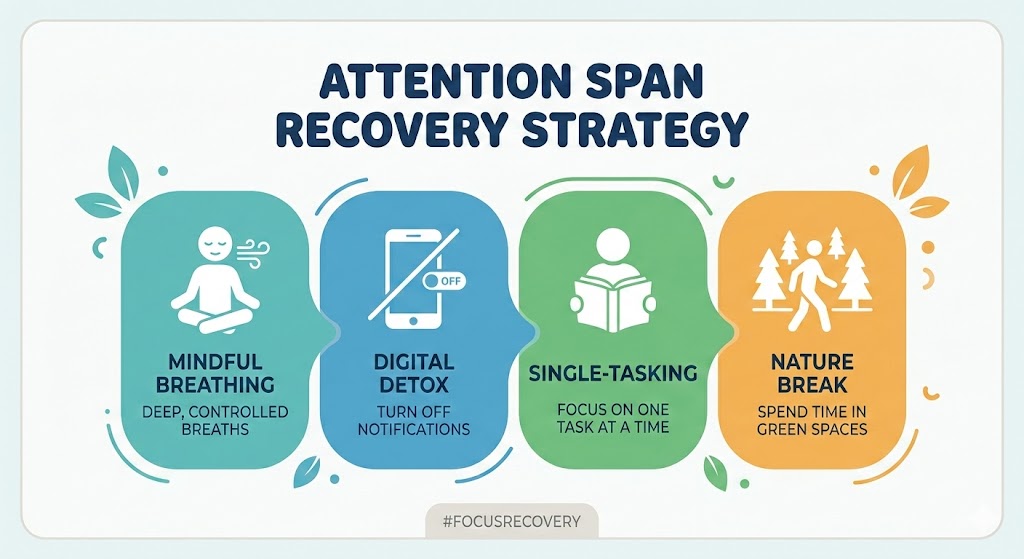
In the modern digital world, maintaining focus has become increasingly difficult. Constant notifications, short-form videos, multitasking, and endless scrolling have significantly reduced many people’s ability to concentrate for extended periods. That’s why developing an effective Attention Span Recovery Strategy has become essential for productivity, learning, and mental clarity.
This guide explains what causes attention span decline, why it matters, and practical steps you can use to rebuild your focus using a proven Attention Span Recovery Strategy.
1. What Is an Attention Span Recovery Strategy?
An Attention Span Recovery Strategy is a structured approach designed to retrain the brain to focus for longer periods by reducing distractions and rebuilding cognitive endurance.
The goal is to:
- Improve sustained concentration
- Reduce digital distractions
- Increase deep work capacity
- Strengthen mental discipline
In essence, an Attention Span Recovery Strategy helps your brain return to a healthier focus baseline.
2. Why Attention Spans Are Declining
Several modern habits contribute to shorter attention spans.
2.1 Constant Digital Stimulation
Apps like TikTok and Instagram deliver rapid bursts of entertainment, training the brain to expect constant novelty.
This makes slower activities like reading or studying feel difficult.
2.2 Multitasking Culture
Many people constantly switch between:
- Emails
- Messages
- Social media
- Work tasks
Frequent task switching reduces cognitive efficiency and disrupts focus.
2.3 Dopamine Overload
Continuous digital rewards (likes, notifications, new content) overstimulate the brain’s reward system, making normal tasks feel less engaging.
An effective Attention Span Recovery Strategy helps rebalance this.
3. Signs Your Attention Span Needs Recovery
You may benefit from an Attention Span Recovery Strategy if you experience:
- Difficulty reading long articles or books
- Frequent phone checking
- Inability to focus for more than 10–15 minutes
- Constant urge to multitask
- Mental fatigue from simple tasks
These signs indicate your brain has adapted to high-stimulation environments.
4. Step 1: Reduce Digital Noise
The first step in any Attention Span Recovery Strategy is minimizing unnecessary distractions.
Practical steps include:
- Turning off non-essential notifications
- Limiting social media usage
- Using website blockers during work sessions
Reducing digital noise helps the brain relearn sustained focus.
5. Step 2: Practice Deep Work Sessions
Deep work refers to uninterrupted focus on a single task.
Try this structure:
- 25–45 minutes focused work
- 5–10 minute break
- Repeat 3–4 cycles
Gradually increase session length as your focus improves.
This technique strengthens your Attention Span Recovery Strategy over time.
6. Step 3: Rebuild Reading Endurance
Reading long-form content trains sustained attention.
Start with:
- 10–15 minutes of reading daily
- Gradually increase to 30–45 minutes
Books, research articles, or thoughtful essays are excellent tools in an Attention Span Recovery Strategy.
7. Step 4: Practice Single-Tasking
Instead of multitasking, focus on one activity at a time.
Examples:
- Eat without scrolling
- Study without music or social media
- Complete one task before starting another
Single-tasking is a core principle of an effective Attention Span Recovery Strategy.
8. Step 5: Improve Sleep Quality
Sleep plays a crucial role in cognitive performance.
Poor sleep reduces:
- attention
- memory
- decision-making
A healthy sleep routine strengthens the results of your Attention Span Recovery Strategy.
Aim for:
- 7–9 hours per night
- Consistent sleep schedule
- Reduced screen exposure before bedtime.
9. Step 6: Use Focus Training Techniques
Certain exercises can strengthen concentration.
Examples include:
- Meditation
- Breathing exercises
- Mindfulness practices
Meditation trains the brain to return attention to a chosen object, which directly supports an Attention Span Recovery Strategy.
10. Step 7: Limit Short-Form Content Consumption
Short-form content platforms encourage rapid attention switching.
Limiting time spent on these platforms helps prevent attention fragmentation.
This step is often one of the most important elements of an Attention Span Recovery Strategy.
11. Step 8: Build Mental Endurance Gradually
Focus works like a muscle. It improves with consistent training.
Start small:
- 20 minutes of focused work
- Increase to 45 minutes
- Eventually reach 90-minute deep work sessions
A sustainable Attention Span Recovery Strategy focuses on gradual improvement rather than drastic changes.
12. Benefits of an Attention Span Recovery Strategy
Improving your attention span can lead to:
- Higher productivity
- Better learning ability
- Improved creativity
- Reduced stress
- Stronger decision-making
Long-term focus is one of the most valuable cognitive skills in the modern economy.
13. Who Needs an Attention Span Recovery Strategy?
This strategy is particularly useful for:
- Students
- Remote workers
- Entrepreneurs
- Content creators
- Professionals working in digital environments
Anyone exposed to constant digital stimuli can benefit from an Attention Span Recovery Strategy.
Frequently Asked Questions (FAQ)
Q1: How long does attention span recovery take?
Many people notice improvements within a few weeks of consistent practice.
Q2: Can meditation improve focus?
Yes. Meditation is widely used as part of many Attention Span Recovery Strategy programs.
Q3: Is multitasking harmful?
Frequent multitasking can reduce productivity and attention quality.
Q4: Are attention spans really getting shorter?
Research suggests digital environments can influence how people allocate attention.
Q5: Can attention span fully recover?
With consistent habits and reduced distractions, significant improvement is possible.
Final Thoughts
In an era of constant digital stimulation, maintaining deep focus has become increasingly difficult. Implementing a structured Attention Span Recovery Strategy can help rebuild concentration, improve productivity, and strengthen cognitive resilience.
By reducing distractions, practicing deep work, improving sleep, and gradually training your brain to sustain attention, you can regain control of your focus and perform better in both work and learning environments.
Attention is one of the most valuable resources in the modern world — protecting and strengthening it is an investment in your long-term success.
More Related Topics:
Protein Water Trend Explained 2026: Why This Fitness Drink Is Taking Over the Market
Mushroom Complex Supplements Ranked: The Best Functional Mushroom Blends in 2026
Brown Fat Activation Methods Guide: How to Naturally Boost Fat Burning in 2026