
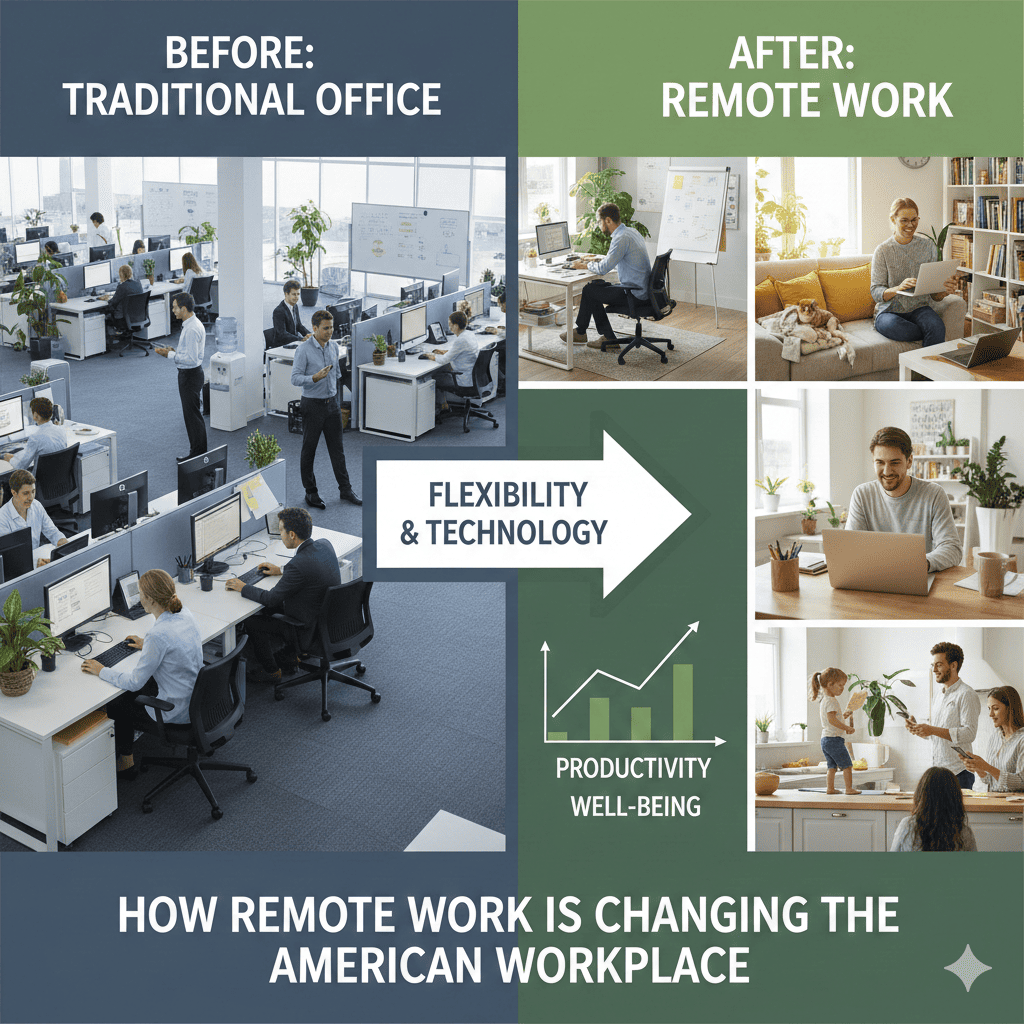
The American workplace has undergone a seismic shift in recent years, fundamentally altering how millions of people approach their careers, collaborate with colleagues, and balance their professional and personal lives. What began as a necessary adaptation during the COVID-19 pandemic has evolved into a permanent restructuring of work culture across the United States. This comprehensive exploration examines how remote work is reshaping every aspect of the American workplace, from corporate real estate and productivity metrics to employee expectations and organizational culture.
The transformation we’re witnessing isn’t merely about working from home—it represents a complete reimagining of what work means in the 21st century. Traditional office-centric models that dominated for decades are giving way to flexible, hybrid arrangements that prioritize results over presence. This shift carries profound implications for businesses, workers, cities, and the broader economy, creating both unprecedented opportunities and complex challenges that organizations must navigate carefully.
1. The Decline of Traditional Office Culture
The most visible change in the American workplace is the dramatic reduction in traditional office attendance. Major metropolitan areas that once saw downtown streets packed with commuters now witness a fraction of their pre-pandemic foot traffic, even years after restrictions lifted. This shift reflects a fundamental reassessment of whether physical offices remain necessary for knowledge work.
Changing Occupancy Rates
Commercial real estate data reveals that office occupancy rates across major American cities hover between 50-70% of pre-pandemic levels. Companies ranging from tech giants to financial institutions have reduced their physical footprints, subleasing excess space or declining to renew leases as they expire. This trend extends beyond coastal tech hubs into traditional business centers across the Midwest and South.
The implications cascade through local economies dependent on office workers. Restaurants, dry cleaners, transit systems, and coffee shops that catered to the morning rush have seen business models disrupted. Some have adapted by shifting focus to residential neighborhoods where remote workers now spend their days, while others continue struggling with this new reality.
Redesigning Physical Spaces
Organizations maintaining office presence are fundamentally rethinking their purpose. Rather than rows of individual desks, modern offices emphasize collaborative spaces, meeting rooms equipped for hybrid participation, and flexible environments that workers choose based on task requirements. The office is becoming a destination for specific activities—team building, strategic planning, client meetings—rather than a default location for all work.
This evolution reflects recognition that different work requires different environments. Deep focus work might happen best in quiet home offices, while creative brainstorming benefits from in-person energy. The smartest companies in the American workplace are designing spaces that complement rather than duplicate remote work capabilities.
Cultural Shifts and Water Cooler Moments
Perhaps the most debated aspect of office decline involves culture and spontaneous collaboration. Critics of remote work argue that casual hallway conversations and unplanned interactions drive innovation in ways that scheduled video calls cannot replicate. These “water cooler moments” supposedly generate creative insights and build social bonds that strengthen organizational culture.
However, emerging research suggests these benefits may be overstated or that organizations can intentionally recreate them through structured approaches. Many companies report that deliberate collaboration—through scheduled brainstorming sessions, virtual social events, and periodic in-person gatherings—produces comparable or superior results to hoping for accidental interactions.
The reality appears nuanced: some roles and organizations truly benefit from high levels of in-person collaboration, while others function effectively with minimal face-to-face contact. The key insight transforming the American workplace is recognizing this variability rather than applying one-size-fits-all policies.
2. Geographic Flexibility and Talent Access
Remote work has shattered geographic constraints that limited both employers and employees for generations. Companies once restricted to hiring within commuting distance of physical offices can now access talent nationwide or globally. Simultaneously, workers are no longer tethered to expensive coastal cities where major employers concentrate, enabling migration to more affordable or desirable locations.
The Great Reshuffling
Population data shows significant migration patterns emerging as remote work normalizes. Mid-sized cities across the Sun Belt, Mountain West, and Southeast have experienced population booms as workers flee high-cost metros like San Francisco, New York, and Los Angeles. Cities like Austin, Nashville, Boise, and Raleigh have become magnets for remote workers seeking lower costs, better weather, or proximity to outdoor recreation.
This geographic redistribution carries enormous implications for regional economies and real estate markets. Secondary cities gain educated, high-earning residents who boost local businesses and tax bases. Meanwhile, traditional power centers grapple with declining populations, falling property values, and shrinking tax revenues that strain municipal budgets.
The American workplace transformation thus extends far beyond individual companies to reshape the nation’s economic geography. Regions that once struggled to retain college graduates now compete effectively for talent against historically dominant metros.
Expanding the Talent Pool
From an employer perspective, geographic flexibility revolutionizes recruitment and retention. A technology company in the Midwest can now hire the specialized engineer in Portland or the experienced designer in Atlanta without requiring relocation. This expanded talent pool improves hiring outcomes and reduces compensation pressure in some markets.
Small and medium-sized businesses benefit particularly from this democratization. Companies in tertiary markets once struggled to compete against big-city employers for top talent. Remote work levels this playing field, allowing organizations everywhere to access the skills they need without geographic limitations.
However, this opportunity creates new challenges around compensation philosophy. Should companies pay based on employee location or role regardless of geography? Some organizations maintain San Francisco salary levels for all employees, while others adjust compensation for local cost of living. Each approach carries different implications for talent attraction, retention, and internal equity.
International Remote Work
The most progressive companies are pushing geographic flexibility to its logical conclusion by hiring internationally. Fully distributed organizations build teams spanning multiple continents, accessing global talent pools and enabling round-the-clock productivity as work passes between time zones.
This internationalization of the American workplace brings complexity around taxes, employment law, benefits, and cultural integration. Specialized services have emerged to handle these administrative challenges, making international hiring increasingly accessible even for smaller companies.
3. Productivity Debates and Measurement Challenges
Few aspects of remote work generate more heated debate than productivity. Traditional management thinking equates presence with productivity, assuming that employees at desks are working while those at home might be doing laundry. The shift to remote work forces organizations to confront whether this assumption ever had merit.
Measuring Knowledge Work Output
The challenge lies in defining and measuring productivity for knowledge work. Manufacturing productivity is straightforward—count widgets produced per hour. But how do you quantify a software engineer’s productivity, a marketer’s creativity, or a strategist’s thinking? The American workplace has long struggled with this question, often defaulting to crude proxies like hours worked or meetings attended.
Remote work necessitates better approaches. Forward-thinking organizations are implementing outcome-based performance metrics, focusing on deliverables, project completion, and business impact rather than activity levels. This shift represents healthy evolution toward evaluating what matters rather than what’s easily observed.
Early research on remote work productivity shows mixed results, partly because productivity measurement varies so widely across studies. Some research indicates productivity gains as workers eliminate commutes, enjoy quieter environments, and experience fewer interruptions. Other studies suggest productivity challenges, particularly for collaborative work requiring coordination across distributed teams.
The Trust Equation
Underlying productivity debates is a fundamental question about trust. Organizations accustomed to management-by-observation struggle to trust that unsupervised employees will work diligently. This lack of trust manifests in surveillance technologies—keystroke monitors, mouse trackers, random screenshot capture—that attempt to replicate office oversight remotely.
These surveillance approaches typically backfire, damaging morale and driving away top talent who resent being monitored like children. The most successful remote organizations recognize that hiring responsible adults and establishing clear expectations produces better results than technological surveillance.
The transformation of the American workplace toward remote work thus requires a parallel transformation in management philosophy from monitoring inputs to evaluating outputs, from micromanaging activities to trusting professionals to manage their own time.
Async Versus Synchronous Work
Remote work enables greater asynchronous collaboration, where team members contribute on their own schedules rather than requiring simultaneous presence. This approach can dramatically improve productivity by allowing deep work during peak performance hours and eliminating unnecessary meetings.
However, some organizations overcorrect toward asynchronous work, creating isolation and slowing decision-making that benefits from real-time discussion. Finding the right balance between async and synchronous collaboration represents an ongoing challenge as companies navigate the new American workplace landscape.
4. Technology Infrastructure and Digital Transformation
The remote work revolution would be impossible without parallel advances in communication technology, collaboration software, and cybersecurity. These digital tools don’t merely enable remote work—they’re fundamentally changing how work gets done regardless of location.
Collaboration Platform Explosion
Video conferencing platforms like Zoom, Microsoft Teams, and Google Meet became household names virtually overnight, facilitating billions of meetings that previously would have occurred in conference rooms. But these synchronous tools represent just one category in an expanding ecosystem of remote work software.
Project management platforms like Asana, Monday, and Trello help distributed teams coordinate work without physical proximity. Document collaboration tools enable simultaneous editing and commenting, replacing email attachments with living documents. Slack and similar chat platforms create persistent communication channels that substitute for hallway conversations.
The American workplace now runs on a technology stack that would have seemed impossibly sophisticated just years ago. Organizations that previously resisted digital transformation were forced to modernize rapidly, compressing decades of evolution into months of urgent implementation.
Cybersecurity Concerns
Distributed workforces create expanded attack surfaces for cyber threats. Employees working from home offices, coffee shops, and co-working spaces access corporate systems across networks that IT departments don’t control. This distributed access increases vulnerability to phishing attacks, data breaches, and ransomware.
Forward-thinking organizations have responded by implementing zero-trust security architectures, multi-factor authentication, VPN requirements, and comprehensive employee training on security best practices. The remote work transition has accelerated cybersecurity investments that might otherwise have occurred more gradually.
Digital Skill Requirements
As work becomes more technology-mediated, digital literacy evolves from a nice-to-have skill to a fundamental requirement across the American workplace. Workers must become proficient with collaboration platforms, comfortable with virtual communication, and able to troubleshoot basic technical issues without immediate IT support.
This requirement creates challenges for workers who previously succeeded based on in-person communication skills and relationship building. Organizations must invest in training and support to ensure all employees can thrive in increasingly digital work environments.
5. Work-Life Balance and Burnout Challenges
Remote work promises better work-life balance by eliminating commutes, enabling flexible schedules, and allowing employees to integrate work with personal responsibilities. Many workers report significant quality-of-life improvements from remote arrangements. However, the reality proves more complex, with blurred boundaries between work and personal life creating new challenges.
The Commute Time Dividend
The average American commute takes 27 minutes each way, meaning remote workers reclaim nearly an hour daily. Over a year, this amounts to hundreds of hours returned for sleep, exercise, family time, or hobbies. This time dividend represents one of remote work’s most tangible benefits and a primary reason many employees resist returning to offices full-time.
Beyond time savings, eliminating commutes reduces stress, vehicle expenses, and environmental impact. Workers in particularly congested metros like Los Angeles or Washington DC see even larger benefits, avoiding two-hour daily commutes that previously dominated their lives.
Boundary Erosion Challenges
Paradoxically, remote work can also blur healthy boundaries between professional and personal life. Without physical separation between office and home, many workers struggle to “leave work” at the end of the day. Laptops in bedrooms enable checking email at midnight. The lack of defined start and end times can extend working hours indefinitely.
This boundary erosion has contributed to rising burnout rates across the American workplace, particularly during the pandemic when remote work coincided with extraordinary stress and isolation. Organizations are recognizing the need to actively support boundaries by discouraging after-hours communication, modeling healthy practices, and respecting personal time.
Flexibility Versus Expectations
Remote work theoretically enables flexible scheduling, allowing employees to work during their peak productive hours or accommodate family responsibilities. A parent might work early morning and evening, taking midday for childcare. A night owl might shift their schedule later.
However, expectations for synchronous availability can undermine this flexibility. If employees must be present for meetings during traditional business hours regardless of when they complete individual work, flexibility remains largely theoretical. The most progressive organizations are actively designing for asynchronous work and flexible schedules rather than simply moving office hours online.
Mental Health Implications
The mental health impacts of remote work vary enormously based on individual circumstances. Introverts often thrive in low-stimulation home environments, while extroverts may struggle with isolation. Parents might appreciate proximity to children or feel overwhelmed by constant juggling of responsibilities.
Organizations are investing in mental health resources, encouraging regular time off, and creating virtual social connections to combat isolation. The transformation of the American workplace must account for psychological wellbeing alongside productivity and efficiency.
6. Equity and Access Disparities
While remote work offers tremendous opportunities, access to these benefits is distributed unevenly across the workforce. The remote work revolution primarily benefits knowledge workers in professional roles, while service workers, manufacturing employees, and frontline staff cannot work remotely by nature of their jobs.
The Remote Work Privilege
Ability to work remotely correlates strongly with education, income, and professional status. College-educated professionals in fields like technology, finance, consulting, and media can often work from anywhere. Meanwhile, retail workers, healthcare providers, restaurant staff, and logistics workers must be physically present.
This divide creates a two-tier American workplace where some workers enjoy unprecedented flexibility while others face the same constraints as always. Organizations employing both remote and on-site workers must carefully manage equity to avoid resentment and engagement gaps.
Home Office Requirements
Even among remote-eligible workers, success depends on having adequate home infrastructure. Reliable high-speed internet, dedicated workspace, ergonomic furniture, and quiet environments separate those who thrive remotely from those who struggle.
Lower-income workers are less likely to have these resources, creating performance disparities not based on ability but on home circumstances. Progressive employers provide stipends for home office setup, coworking space access, or maintained office facilities to ensure all employees have the resources needed to succeed.
Geographic Digital Divide
Remote work’s promise of geographic freedom assumes ubiquitous high-speed internet access. The reality is that rural areas, tribal lands, and lower-income urban neighborhoods often lack reliable broadband infrastructure. Workers in these areas cannot fully participate in remote work opportunities regardless of their skills or employers’ policies.
Addressing this digital divide requires public investment in broadband infrastructure as essential utility rather than luxury amenity. The transformation of the American workplace toward remote work makes internet access an economic justice issue with implications for regional development and opportunity distribution.
7. Company Culture in Distributed Organizations
Maintaining strong organizational culture represents one of the most significant challenges as the American workplace disperses geographically. Culture traditionally formed through shared physical spaces, informal interactions, and ambient organizational norms that employees absorbed through presence. Distributed organizations must deliberately design culture rather than hoping it emerges organically.
Intentional Culture Building
Leading remote organizations recognize that culture requires intentional cultivation. They articulate values explicitly, model desired behaviors consistently, and create structured opportunities for connection. Regular all-hands meetings, virtual social events, and communication rituals replace the ambient culture that offices provided.
Documentation becomes crucial in distributed settings. Written communication of decisions, strategies, and norms ensures everyone accesses the same information regardless of when they join meetings or check messages. This creates an archive of organizational knowledge that benefits remote workers but often proves valuable even for co-located teams.
Onboarding and Integration
Bringing new employees into organizational culture proves particularly challenging remotely. Traditional onboarding relies heavily on shadowing colleagues, observing workplace norms, and informal conversations that help newcomers understand both explicit policies and unwritten rules.
Successful distributed organizations have developed structured onboarding programs with buddy systems, comprehensive documentation, regular check-ins, and explicit teaching of cultural norms. Some bring new hires to headquarters for initial weeks, creating in-person connections before they disperse to remote locations.
Building Trust Remotely
Trust forms the foundation of effective teams, yet building trust proves harder without in-person interaction. Video calls lack the richness of face-to-face conversation, and remote communication biases toward task-focused discussion rather than relationship-building small talk.
Organizations are experimenting with virtual coffee chats, online games, and periodic in-person gatherings to foster connection. The most successful approaches create psychological safety where employees feel comfortable being authentic, vulnerable, and creative regardless of physical distance.
Regional Subcultures
As companies hire across geographies, regional subcultures can emerge that fragment organizational identity. The New York team develops different norms than the Denver team, creating coordination challenges and inconsistent employee experiences.
Preventing fragmentation requires active management of the American workplace culture through rotation programs, cross-regional projects, and consistent policies that unite distributed teams around shared purpose rather than shared location.
8. Legal and Regulatory Complexity
Remote work across state lines creates legal complexity that organizations previously avoided by maintaining centralized workforces. Employment laws, tax obligations, and regulatory requirements vary by state, and remote employers must navigate this patchwork of jurisdictions.
Multi-State Tax Obligations
When employees work remotely from different states, both employers and employees may have tax obligations in multiple jurisdictions. Employers must withhold state income taxes, unemployment insurance, and potentially local taxes based on where employees physically work. Some states assert tax claims even for temporary remote work, creating administrative nightmares.
Professional tax guidance becomes essential for organizations embracing geographic flexibility. The administrative burden of multi-state compliance represents a hidden cost of remote work that partially offsets benefits from reduced real estate and relocation expenses.
Employment Law Variations
Labor laws regarding minimum wage, overtime, paid leave, disability accommodations, and termination procedures vary substantially across states. A remote workforce spanning multiple states means complying with the most restrictive requirements for each location or limiting hiring to states with compatible regulations.
Some organizations restrict remote work to specific states where they maintain legal entities and HR infrastructure. This approach limits geographic flexibility but reduces compliance complexity—a trade-off that reflects different organizational priorities in navigating the transformed American workplace.
Workers’ Compensation and Liability
When employees are injured working from home, workers’ compensation liability becomes murky. Is an employee who trips over a dog while walking to their home office entitled to workers’ compensation? What about repetitive stress injuries from inadequate home ergonomics?
These questions lack clear answers, with courts and regulators still developing precedents. Progressive employers address these concerns through home office safety guidelines, ergonomic equipment stipends, and clear policies defining work hours and locations.
Remote Work Across International Borders
Some workers push geographic flexibility to its ultimate conclusion by working remotely from foreign countries. This “digital nomad” arrangement creates extraordinary legal complexity around immigration status, tax treaties, benefits eligibility, and employment law compliance.
Organizations must carefully structure international remote work arrangements or prohibit them entirely. The regulatory framework hasn’t caught up to the reality of the borderless American workplace that technology enables.
9. Environmental and Urban Planning Implications
The remote work transformation carries implications far beyond individual companies and workers, affecting environmental sustainability, urban development, and public infrastructure planning. These macro-level changes will shape American communities for decades.
Reduced Carbon Emissions
Eliminating commutes translates directly into reduced vehicle emissions and gasoline consumption. If remote work permanently reduces commuting by even 30%, the environmental impact rivals many green energy initiatives. This benefit extends beyond climate impact to include reduced air pollution, particularly in metro areas where vehicle emissions significantly degrade air quality.
However, the environmental calculus is complex. Increased residential energy usage for heating and cooling home offices partially offsets transportation savings. Additionally, migration to sprawling suburban or exurban areas may increase overall vehicle miles traveled even if commuting decreases.
Urban Core Challenges
The exodus from downtown offices threatens cities’ economic models. Reduced foot traffic harms businesses that serve office workers. Declining property values shrink tax revenues at the exact moment when cities need resources to adapt infrastructure and services for changing patterns.
Some urban planners envision converting obsolete office buildings into residential space, creating more livable downtown neighborhoods less dependent on commuter traffic. This transformation would represent a fundamental reimagining of the American workplace relationship with urban geography.
Suburban and Rural Renaissance
Conversely, remote work breathes new life into communities that previously struggled with population decline or stagnation. Small towns with attractive quality of life now compete effectively for residents no longer tethered to big-city employment. This redistribution could revitalize communities, diversify regional economies, and reduce the coastal-interior divide that defines American geography and politics.
However, rapid influx of remote workers into smaller communities creates tensions around housing affordability, infrastructure capacity, and cultural change. Long-term residents sometimes resent newcomers driving up costs and changing community character.
10. The Future Evolution of Work
The remote work transformation of the American workplace is far from complete. As organizations and workers gain experience with distributed arrangements, new models continue emerging that push beyond simple remote-versus-office dichotomies toward more sophisticated approaches.
Hybrid Models and Policy Evolution
Most organizations have settled on hybrid approaches that combine remote work flexibility with periodic in-person collaboration. However, implementations vary enormously in their specifics. Some require specific days in office, while others leave timing to team discretion. Some mandate monthly in-person weeks, while others gather quarterly.
The optimal approach likely varies by organization, industry, and role. Over time, best practices will emerge from natural experimentation as companies test different models and measure outcomes. The American workplace is experiencing an extended period of discovery and adaptation.
Fully Distributed Future
A growing cohort of companies embrace fully remote models with no headquarters or required in-person presence. These organizations represent the vanguard of workplace transformation, operating entirely through digital infrastructure and intentional culture building.
Whether this model becomes mainstream or remains niche depends partly on its success at enabling the collaboration, innovation, and culture that skeptics argue require physical presence. The next decade will reveal whether distributed work succeeds across industries and organization types or proves most viable for specific contexts.
Generational Shifts
Attitudes toward remote work vary significantly by generation. Younger workers who entered the workforce during the pandemic have different expectations and skills than those who spent decades in traditional offices. As digital natives rise into leadership positions, the American workplace will continue evolving in ways that feel natural to them but transformative to older generations.
The long-term trajectory points toward increasing flexibility, digital fluency, and outcome-oriented management—trends that predate but were dramatically accelerated by recent events.
Conclusion: Embracing Permanent Transformation
The remote work revolution represents not a temporary disruption but a permanent transformation of the American workplace. While some aspects may ebb—perhaps office attendance increases modestly from current levels—the fundamental shift toward geographic flexibility, digital infrastructure, and outcome-based work is irreversible.
Organizations that embrace this transformation thoughtfully will access broader talent pools, reduce real estate costs, improve employee satisfaction, and attract top performers seeking flexibility. Those that resist or attempt to force returns to 2019 norms risk losing talent to more progressive competitors.
For workers, the transformed American workplace offers unprecedented freedom to design lives around personal priorities rather than employer location. This flexibility carries challenges around boundaries, isolation, and home infrastructure, but most workers consider the trade-offs worthwhile.
The broader societal implications—from urban planning to environmental impact to regional economic development—will unfold over decades. The full consequences of dispersing work geographically are only beginning to emerge.
Also read this:
Top 10 Mixpanel Features Every Startup Must Use for Faster Growth