
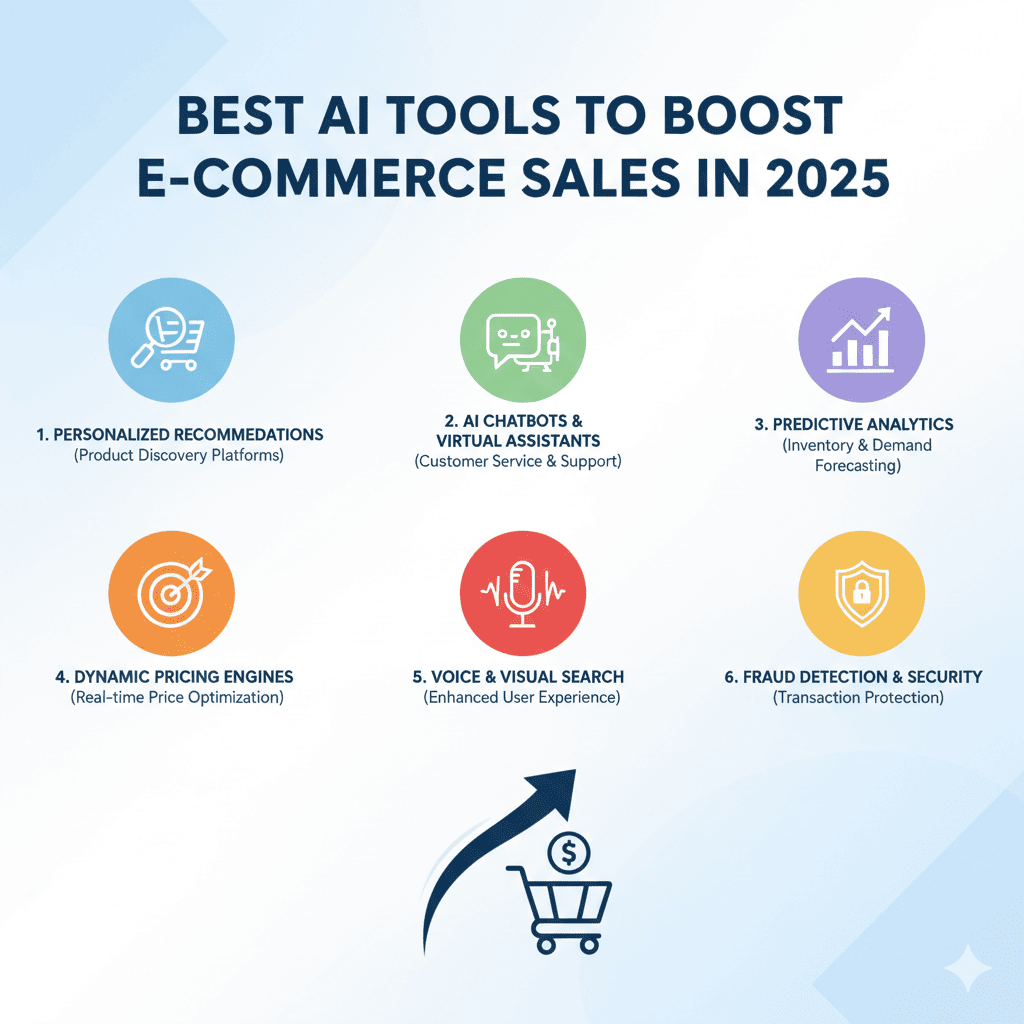
The e-commerce landscape has transformed dramatically, and artificial intelligence is no longer a luxury—it’s a necessity. In 2025, businesses that leverage AI tools to boost e-commerce sales are seeing unprecedented growth, while those that don’t risk falling behind. From personalized shopping experiences to automated customer service, AI is revolutionizing how online stores operate and convert visitors into loyal customers.
This comprehensive guide explores the most effective AI tools to boost e-commerce sales that are making waves in 2025. Whether you’re a small startup or an established online retailer, these tools can help you increase conversions, reduce costs, and deliver exceptional customer experiences.
1. AI-Powered Personalization Engines
Personalization is the cornerstone of modern e-commerce success. Today’s consumers expect tailored experiences, and AI delivers this at scale.
Dynamic Yield has emerged as a leader in personalization, using machine learning to create individualized shopping experiences for each visitor. The platform analyzes browsing behavior, purchase history, and demographic data to serve relevant product recommendations, personalized homepage layouts, and targeted promotions. E-commerce stores using Dynamic Yield report up to 30% increases in conversion rates.
Nosto specializes in real-time personalization across the entire customer journey. It automatically segments your audience and delivers personalized product recommendations, content, and pop-ups. What sets Nosto apart is its ability to learn from every interaction, continuously improving its recommendations without manual intervention.
Bloomreach combines AI-driven personalization with powerful commerce search. Its loomi AI technology understands customer intent and delivers hyper-relevant product suggestions. The platform excels at predicting what customers want before they even search for it, reducing the time to purchase and increasing average order values by 15-40%.
These AI tools to boost e-commerce sales work by analyzing millions of data points to understand customer preferences, creating shopping experiences that feel intuitive and personal. When customers see products that match their tastes, they’re more likely to make purchases and return for more.
2. Intelligent Chatbots and Virtual Shopping Assistants
Customer service can make or break an e-commerce business. AI-powered chatbots provide instant support, answer questions, and guide customers through their buying journey 24/7.
Tidio offers an intuitive chatbot platform that combines live chat with AI automation. Its Lyro AI chatbot handles up to 70% of customer inquiries without human intervention, answering questions about products, shipping, returns, and more. The platform seamlessly transfers complex queries to human agents, ensuring customers always get the help they need.
Zendesk AI has evolved into a sophisticated customer service solution that uses machine learning to understand customer intent and provide accurate responses. It can handle multiple languages, learn from past conversations, and even detect customer sentiment to prioritize urgent issues. E-commerce businesses using Zendesk AI report 25% faster response times and higher customer satisfaction scores.
Ada is revolutionizing automated customer service with its no-code platform that allows businesses to build sophisticated chatbots without technical expertise. Ada’s AI understands complex questions, provides personalized product recommendations, and can even process orders directly through chat. The platform integrates with major e-commerce platforms, making implementation seamless.
Intercom combines live chat, chatbots, and product tours to create engaging customer experiences. Its Resolution Bot uses AI to provide instant answers to common questions, while its Product Tours feature guides customers through your store, highlighting new products and special offers. This proactive approach to customer engagement significantly boosts sales conversions.
These virtual assistants are among the most effective AI tools to boost e-commerce sales because they eliminate friction in the buying process, providing instant answers when customers need them most.
3. Predictive Analytics and Demand Forecasting
Understanding what customers will want tomorrow is invaluable for e-commerce businesses. AI-powered predictive analytics help you stock the right products, optimize pricing, and plan marketing campaigns with precision.
Crayon uses AI to track competitor pricing, product launches, and marketing strategies in real-time. This competitive intelligence allows you to adjust your strategies dynamically, ensuring you stay ahead of market trends. Businesses using Crayon report better inventory decisions and more effective pricing strategies.
Hevo Data provides AI-driven analytics that help e-commerce businesses understand customer behavior patterns and predict future trends. The platform consolidates data from multiple sources, using machine learning to identify which products are likely to surge in demand and which marketing channels deliver the best ROI.
Sisense offers advanced analytics with embedded AI that can forecast sales trends, identify at-risk customers, and recommend optimal inventory levels. Its natural language processing allows non-technical team members to ask complex questions and get actionable insights instantly.
Tableau with Einstein AI combines powerful data visualization with Salesforce’s Einstein AI to provide predictive insights. The platform can forecast revenue, predict customer churn, and identify opportunities for upselling and cross-selling. Its AI-powered explanations help teams understand why certain trends are occurring, not just what is happening.
By leveraging these AI tools to boost e-commerce sales, businesses can reduce overstock situations by 30-50%, minimize stockouts, and optimize their marketing spend based on accurate demand predictions.
4. AI-Enhanced Product Search and Discovery
When customers can’t find what they’re looking for, they leave. AI-powered search solutions ensure products are discoverable, even when customers use vague or unconventional search terms.
Algolia has become the gold standard for AI-powered site search. Its neural search understands context, synonyms, and even typos to deliver relevant results instantly. Algolia’s merchandising tools allow you to boost certain products strategically while maintaining search relevance. E-commerce sites using Algolia see up to 50% increases in search-to-purchase conversion rates.
Coveo uses machine learning to understand search intent and deliver personalized results for each customer. Its AI continuously learns from user behavior, improving search relevance over time. Coveo excels at handling complex catalogs with thousands of products, making it ideal for large e-commerce operations.
Constructor.io specializes in AI-powered product discovery, combining search, browse, and recommendations into a unified experience. Its machine learning models understand which products convert best for different customer segments, automatically optimizing search results to maximize revenue.
Klevu offers intelligent site search with natural language processing that understands conversational queries. If a customer searches for “red dress for summer wedding,” Klevu understands the context and filters results accordingly. The platform also provides visual search capabilities, allowing customers to upload images and find similar products.
These search solutions are critical AI tools to boost e-commerce sales because they reduce the friction between customer intent and product discovery, directly impacting conversion rates.
5. Automated Email Marketing and Customer Retention
Email remains one of the highest-ROI marketing channels, and AI makes it exponentially more effective through intelligent automation and personalization.
Klaviyo has revolutionized e-commerce email marketing with its predictive analytics and AI-driven segmentation. The platform predicts customer lifetime value, identifies customers at risk of churning, and automatically sends personalized campaigns based on behavior triggers. Klaviyo’s AI determines the optimal send time for each recipient, increasing open rates by 20-35%.
Mailchimp with AI offers sophisticated automation that learns from your campaign performance. Its AI-powered content optimizer suggests subject lines, send times, and content variations most likely to engage your audience. The platform’s customer journey builder uses predictive intelligence to guide customers through personalized nurture sequences.
Omnisend specializes in omnichannel marketing automation for e-commerce, using AI to coordinate email, SMS, and push notifications. Its predictive algorithms identify the best channel and time to reach each customer, while its product recommendation engine suggests items based on browsing and purchase history.
Braze provides real-time customer engagement powered by AI that understands when customers are most likely to convert. Its Intelligent Selection feature automatically tests different message variations and sends the winning version to your audience, continuously optimizing campaign performance without manual A/B testing.
Email marketing powered by these AI tools to boost e-commerce sales can increase repeat purchase rates by 30-50%, turning one-time buyers into loyal customers who generate consistent revenue.
6. Visual AI and Image Recognition
In e-commerce, visuals matter immensely. AI-powered visual tools help customers find products through images and help businesses optimize their product photography.
Syte offers visual AI that enables visual search, product recommendations, and automated product tagging. Customers can upload photos of products they like and instantly find similar items in your catalog. This technology is particularly powerful for fashion and home decor retailers, where visual appeal drives purchasing decisions.
ViSenze provides visual search and image recognition that understands product attributes from images. Its AI can identify colors, patterns, styles, and even mood, helping customers discover products that match their aesthetic preferences. Retailers using ViSenze report 40% higher engagement rates from visual search users.
Pixelcut uses AI to automatically remove backgrounds, enhance product images, and create professional-looking photos without expensive photography equipment. This democratizes high-quality product imagery for small businesses that may not have large creative budgets.
Remove.bg and Canva AI work together to help e-commerce businesses create stunning product visuals quickly. Remove.bg’s AI perfectly removes backgrounds from product photos, while Canva’s Magic Design AI creates complete product listings with coordinated graphics, saving hours of design time.
Visual AI tools to boost e-commerce sales are particularly effective for mobile shoppers, who increasingly use image-based searches to find products quickly.
7. AI-Driven Pricing Optimization
Dynamic pricing powered by AI helps e-commerce businesses maximize revenue while remaining competitive. These tools analyze market conditions, competitor pricing, and demand patterns to suggest optimal price points.
Prisync monitors competitor prices in real-time and uses AI to recommend pricing adjustments. Its algorithms consider factors like stock levels, seasonality, and competitor activity to help you stay competitive without sacrificing margins. Businesses using Prisync report 10-25% profit margin improvements.
Competera offers advanced dynamic pricing that considers over 20 different factors, including competitor prices, demand elasticity, and customer behavior patterns. Its AI continuously tests different price points to find the sweet spot that maximizes both conversion rate and profit margin.
Intelligence Node provides retail analytics and dynamic pricing powered by machine learning. The platform excels at identifying pricing opportunities across different customer segments, allowing you to offer targeted discounts to price-sensitive shoppers while maintaining premium pricing for others.
Vendavo specializes in B2B e-commerce pricing optimization, using AI to analyze customer relationships, purchase histories, and market conditions. Its predictive analytics help identify opportunities for price increases that customers will accept, as well as strategic discounts that drive volume growth.
Pricing optimization is one of the most impactful AI tools to boost e-commerce sales because even small pricing improvements can significantly affect profitability without requiring additional marketing spend.
8. Fraud Detection and Security
As e-commerce grows, so does fraud. AI-powered security tools protect businesses and customers while minimizing false positives that can frustrate legitimate shoppers.
Signifyd uses machine learning to guarantee against fraud in real-time, analyzing hundreds of signals to distinguish legitimate transactions from fraudulent ones. The company’s Commerce Protection Platform assumes liability for approved orders, giving businesses confidence to accept more transactions without fear of chargebacks.
Riskified employs advanced machine learning models trained on billions of transactions to identify fraud patterns. Its AI considers device fingerprinting, behavioral analysis, and global fraud networks to make instant approval decisions. E-commerce businesses using Riskified approve 5-8% more orders that would otherwise be declined due to fraud concerns.
Kount provides comprehensive fraud prevention powered by AI that analyzes customer behavior throughout the entire shopping journey. Its Identity Trust Global Network shares intelligence across thousands of merchants, identifying fraudsters even when they’re using stolen credentials for the first time on your site.
Sift offers digital trust and safety solutions that go beyond transaction fraud, detecting account takeovers, payment abuse, and content abuse. Its machine learning models adapt to new fraud tactics in real-time, ensuring your e-commerce store stays protected against emerging threats.
These security-focused AI tools to boost e-commerce sales work invisibly in the background, protecting revenue while ensuring legitimate customers enjoy frictionless checkout experiences.
9. Content Generation and Product Descriptions
Creating compelling product descriptions for hundreds or thousands of SKUs is time-consuming. AI writing tools generate high-quality, SEO-optimized content at scale.
Jasper AI (formerly Jarvis) specializes in marketing copy and product descriptions. Its e-commerce templates understand how to write persuasive product descriptions that highlight benefits, address objections, and incorporate keywords naturally. Businesses using Jasper report 50-70% time savings on content creation.
Copy.ai offers AI-powered copywriting specifically designed for e-commerce, with templates for product descriptions, ad copy, email campaigns, and social media posts. Its brand voice feature ensures all generated content maintains consistent messaging across your entire catalog.
Writesonic provides AI content generation with built-in SEO optimization. Its product description generator analyzes top-performing listings in your category and creates descriptions designed to rank well in search engines while converting browsers into buyers.
Anyword uses predictive performance scoring to evaluate copy before you publish it. Its AI analyzes which words and phrases resonate with your target audience, helping you create product descriptions that drive conversions. The platform also optimizes headlines, calls-to-action, and marketing messages.
Content creation AI tools to boost e-commerce sales enable businesses to maintain fresh, engaging product pages without hiring large content teams, improving SEO performance and conversion rates simultaneously.
10. Inventory Management and Supply Chain Optimization
Efficient inventory management directly impacts profitability. AI-powered solutions predict demand, optimize stock levels, and streamline supply chain operations.
NetSuite AI provides intelligent inventory management that learns from historical data to predict future demand. Its machine learning algorithms consider seasonality, trends, and external factors like weather or economic indicators to recommend optimal reorder points and quantities.
Blue Yonder (formerly JDA) offers AI-driven supply chain solutions that optimize everything from demand forecasting to warehouse operations. Its machine learning models can predict supply chain disruptions and recommend alternative sourcing strategies, helping e-commerce businesses maintain inventory availability even during challenging times.
o9 Solutions provides an AI-powered platform that integrates demand planning, supply planning, and inventory optimization. Its digital brain technology simulates millions of scenarios to recommend the most profitable inventory strategies, considering factors like carrying costs, stockout risks, and supplier lead times.
Lokad specializes in probabilistic forecasting for e-commerce, moving beyond traditional demand forecasting to predict entire demand distributions. This approach helps businesses optimize for profit rather than just forecast accuracy, balancing inventory costs against service levels to maximize profitability.
Supply chain AI tools to boost e-commerce sales reduce inventory carrying costs by 20-40% while simultaneously improving product availability, creating a powerful competitive advantage.
11. Social Media Marketing and Influencer Discovery
Social commerce is exploding in 2025, and AI tools help e-commerce businesses identify the right influencers, optimize social content, and convert social followers into customers.
Grin offers influencer marketing automation powered by AI that identifies authentic influencers whose audiences match your target demographics. Its predictive analytics estimate campaign ROI before you commit resources, helping you invest in partnerships most likely to drive sales.
Lately.ai uses AI to analyze your best-performing content and automatically generate social media posts that resonate with your audience. It can transform long-form content like blog posts into dozens of social snippets, maintaining a consistent social presence without constant manual effort.
Hootsuite Insights powered by Talkwalker provides AI-driven social listening that identifies trending topics, sentiment shifts, and emerging opportunities in real-time. E-commerce businesses use these insights to create timely content, adjust product offerings, and respond to customer concerns before they escalate.
Sprout Social with ViralPost AI optimizes social media posting times based on when your specific audience is most engaged. Its AI analyzes engagement patterns to ensure your content reaches the maximum number of potential customers, increasing click-through rates to your e-commerce store.
Social media AI tools to boost e-commerce sales are essential for brands building community-driven growth, turning social engagement into measurable revenue.
12. Voice Commerce and Conversational AI
Voice shopping is gaining momentum, with millions of consumers using smart speakers and voice assistants to make purchases. Forward-thinking e-commerce businesses are optimizing for this channel.
Voiceflow enables businesses to create voice shopping experiences for Alexa, Google Assistant, and other voice platforms. Its AI handles natural language processing, allowing customers to browse products, ask questions, and complete purchases entirely through voice commands.
SoundHound provides voice AI technology that powers conversational commerce experiences. Its Houndify platform understands complex, multi-part queries and maintains context across conversations, creating natural shopping experiences through voice interfaces.
Voca.ai specializes in voice-enabled product search and recommendations for e-commerce. Its AI understands accents, dialects, and colloquial language, making voice shopping accessible to diverse customer populations.
Nuance (now part of Microsoft) offers conversational AI that powers sophisticated voice commerce experiences. Its technology understands intent even when customers phrase requests in unexpected ways, reducing frustration and improving conversion rates in voice shopping scenarios.
Voice-enabled AI tools to boost e-commerce sales position businesses for the future of shopping, capturing sales from customers who prefer hands-free commerce experiences.
Conclusion: The Future is AI-Powered
The e-commerce landscape in 2025 is defined by artificial intelligence. Businesses that strategically implement AI tools to boost e-commerce sales are experiencing unprecedented growth, while those that resist digital transformation struggle to compete.
The most successful e-commerce operations in 2025 don’t just use one or two AI tools—they build comprehensive AI ecosystems where personalization engines, predictive analytics, intelligent automation, and customer engagement platforms work together seamlessly. This integrated approach creates shopping experiences that feel magical to customers while driving remarkable business results.
Also read this:
Top AI Lead Generation Tools for Businesses