
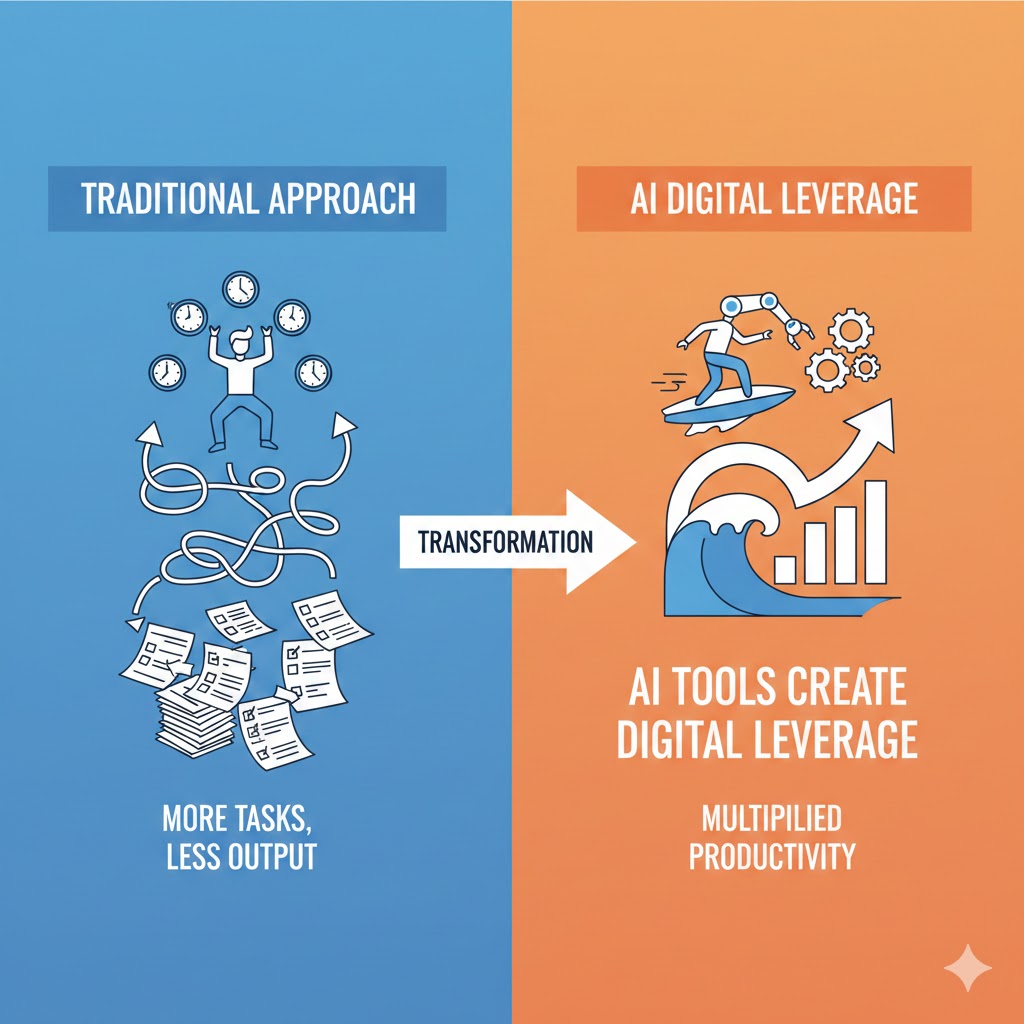
Most people approach AI the wrong way.
They ask:
“How can AI help me do more work?”
High performers ask a different question:
“How can AI reduce my involvement altogether?”
This shift in mindset explains why AI Tools Create Digital Leverage rather than adding more tasks. When used correctly, AI doesn’t pile work onto your plate—it removes you from the plate entirely.
This blog explains what digital leverage really means, how AI tools create it, and why people who use AI strategically are scaling faster while doing less.
1. What Does “Digital Leverage” Actually Mean?
Digital leverage is the ability to produce outsized results without proportional effort.
1.1 Effort vs Leverage
- More effort = more hours, more fatigue
- More leverage = systems that work without you
When AI Tools Create Digital Leverage, your output grows while your personal workload shrinks.
2. Why AI Often Feels Like “More Work” at First
Many people say AI made them busier. That’s not an AI problem—it’s a usage problem.
2.1 The Wrong Way to Use AI
- Asking AI for help on every small task
- Copying, pasting, tweaking endlessly
- Treating AI like a faster intern
This creates task acceleration, not leverage.
2.2 The Right Goal
AI should:
- Replace processes
- Automate decisions
- Eliminate repetition
That’s when AI Tools Create Digital Leverage.
3. AI Tools Create Digital Leverage by Replacing Systems, Not Tasks
The biggest shift is moving from task-level thinking to system-level thinking.
3.1 Task Thinking (Low Leverage)
- Write this email
- Make this post
- Analyze this report
3.2 System Thinking (High Leverage)
- Auto-respond to inquiries
- Auto-generate content pipelines
- Auto-analyze performance weekly
AI tools shine when they run entire workflows, not single actions.
4. The Difference Between Productivity and Leverage
Productivity and leverage are not the same.
4.1 Productivity
- Do tasks faster
- Stay busy
- Optimize time
4.2 Leverage
- Remove tasks entirely
- Reduce decision-making
- Create self-running outputs
People chasing productivity burn out. People using leverage scale calmly—because AI Tools Create Digital Leverage, not busyness.
5. Where AI Tools Create the Most Digital Leverage
Some areas benefit far more than others.
5.1 High-Leverage Use Cases
- Content systems (one idea → many outputs)
- Sales qualification and follow-ups
- Customer support triage
- Research and analysis pipelines
In these areas, AI doesn’t just help—it multiplies.
6. Digital Leverage for Solo Founders and Freelancers
This is where AI changes lives.
6.1 Before AI
- Income tied to hours
- Every client needs manual attention
- Growth = exhaustion
6.2 After Digital Leverage
- Automated onboarding
- AI-assisted delivery
- Scalable services
For solo operators, AI Tools Create Digital Leverage that used to require teams.
7. AI Tools Create Digital Leverage by Reducing Decisions
Decision fatigue kills momentum.
7.1 What AI Removes
- What to prioritize
- What to respond
- What to create next
AI systems surface options, not chaos.
7.2 Why This Matters
Fewer decisions =
- More focus
- Better judgment
- Faster execution
Leverage isn’t just time—it’s mental clarity.
8. From Operator to Architect: The Real AI Upgrade
The biggest transformation AI enables is identity-level.
8.1 Operators
- Execute tasks
- React to problems
- Stay busy
8.2 Architects
- Design systems
- Let AI execute
- Focus on strategy
When AI Tools Create Digital Leverage, humans move up the value chain.
9. Common Mistakes That Kill Digital Leverage
9.1 Using Too Many Tools
More tools ≠ more leverage. Simpler systems win.
9.2 Automating Chaos
If the process is broken, AI just breaks it faster.
9.3 Staying “Hands-On” Out of Habit
Leverage requires letting go—not micromanaging AI output.
10. A Simple Framework to Create Digital Leverage with AI
10.1 Step-by-Step
- Identify repetitive outcomes (not tasks)
- Map the full workflow
- Insert AI where decisions or repetition exist
- Remove yourself from execution
- Review results weekly
This is how AI Tools Create Digital Leverage instead of digital overload.
11. Why Digital Leverage Is the New Career Advantage
The future doesn’t reward effort—it rewards system builders.
11.1 Who Wins Going Forward
- People who design workflows
- People who delegate to AI
- People who think in outcomes
AI isn’t replacing humans—it’s replacing inefficient effort.
Frequently Asked Questions (FAQ)
What does it mean that AI tools create digital leverage?
It means AI allows you to generate more results with less personal effort by automating systems, not just speeding up tasks.
Why do some people feel busier after using AI?
Because they use AI at the task level instead of the system level, creating more outputs without removing responsibility.
Who benefits most from digital leverage?
Solo founders, freelancers, creators, and small teams benefit the most because leverage replaces hiring.
Do I need technical skills to create digital leverage with AI?
No. Most leverage comes from workflow design and decision logic, not coding.
Is digital leverage only about saving time?
No. It also reduces mental load, improves consistency, and increases scalability.
Will AI tools replace jobs or create leverage?
They replace repetitive tasks—but create leverage for people who learn to direct them.
Final Thoughts
The real promise of AI isn’t speed.
It’s detachment from unnecessary effort.
When used correctly, AI Tools Create Digital Leverage—allowing you to step back from execution and step into strategy.
Also read this:
AI Is the Fastest Skill-to-Income Path: Why 2026 Belongs to AI-Driven Earners
AI Software That Optimizes Ad Spend Automatically: What Actually Works in 2026