
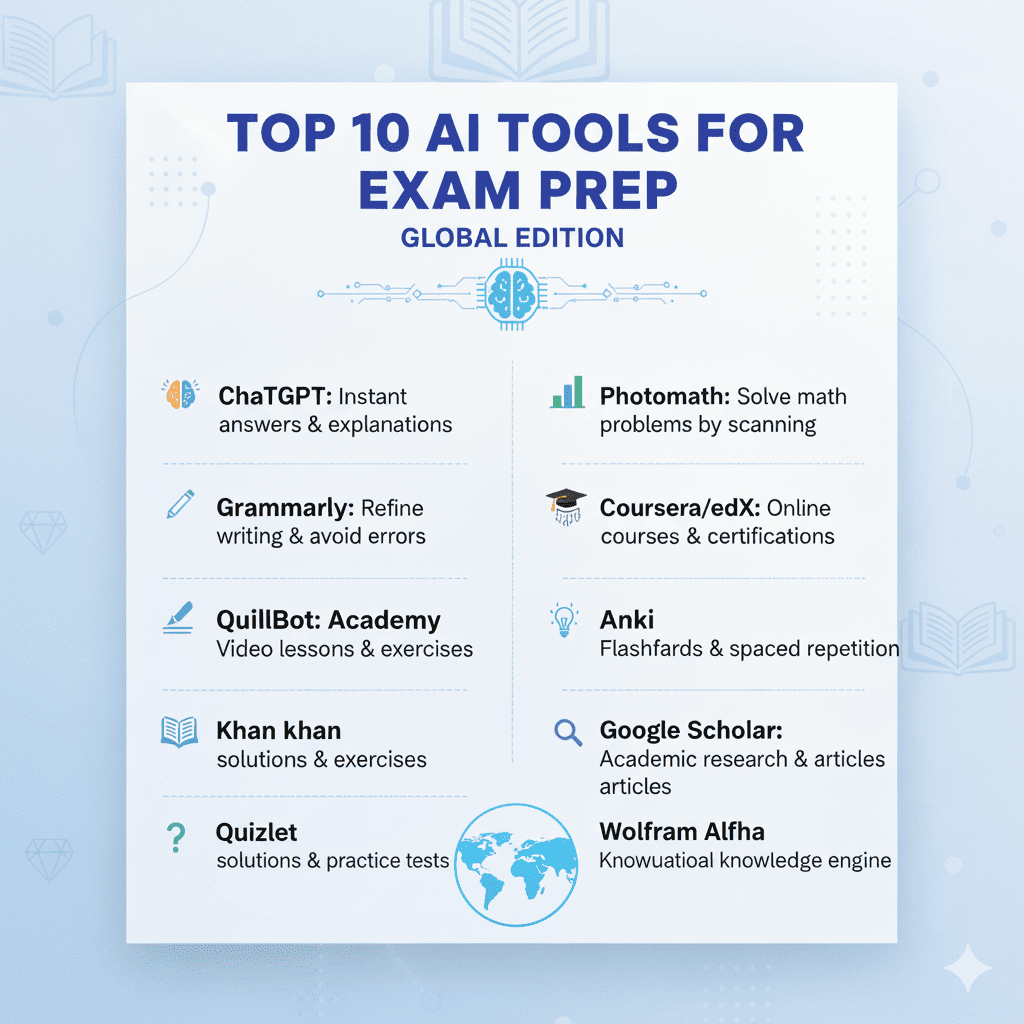
The alarm rings at 5 AM. Rajesh, a JEE aspirant from Kota, reaches for his phone—not to scroll through social media, but to open his AI-powered study assistant. Thousands of kilometers away in Chennai, Priya uses an AI tool to solve a tricky organic chemistry problem at midnight. Welcome to the new era of exam preparation in India, where artificial intelligence tools are transforming how millions of students learn, practice, and excel.
The AI Revolution in Indian Education: Why It Matters Now
India’s education system is witnessing an unprecedented transformation. With over 250 million students competing for limited seats in prestigious institutions, the pressure to perform has never been higher. Traditional coaching classes, while still relevant, are no longer the only path to success. AI tools have democratized access to world-class education, making personalized learning available to students in tier-3 cities just as easily as those in metropolitan areas.
The numbers tell a compelling story. According to recent surveys, over 60% of Indian students preparing for competitive exams now use at least one AI tool regularly. This isn’t just a trend—it’s a fundamental shift in how education is consumed and delivered. These technologies understand your strengths, identify your weaknesses, and adapt in real-time to make your study sessions more effective than ever before.
But what makes AI tools so revolutionary? Unlike traditional resources, they don’t just present information—they interact, adapt, and evolve with you. They’re available 24/7, cost a fraction of expensive coaching fees, and provide instant feedback that would take human tutors hours to deliver. For students in remote areas where quality coaching is scarce, AI tools are literally changing lives.
Understanding AI in Education: What Makes These Tools Different?
Before we dive into specific platforms, let’s understand what makes AI tools unique. Traditional study materials are static—a textbook presents the same information to every student regardless of their understanding level. AI tools, however, use machine learning algorithms to analyze your performance patterns, identify knowledge gaps, and customize content delivery.
Think of it as having a personal tutor who knows exactly when you’re struggling with calculus but excelling in physics, who remembers that you make calculation errors under time pressure, and who can instantly generate practice problems tailored to your exact needs. This level of personalization was impossible before AI tools entered the education space.
Moreover, these AI tools leverage natural language processing to understand your questions in conversational language, not rigid keywords. They can explain concepts using analogies, provide visual representations, and even adjust their explanation style based on what works best for you.
The 10 Game-Changing AI Tools Every Indian Student Should Know
1. ChatGPT & Claude: Your 24/7 Virtual Study Companion
These conversational AI tools have become the Swiss Army knives of exam preparation. Developed by OpenAI and Anthropic respectively, they represent the cutting edge of artificial intelligence in education.
Why Indian Students Love Them:
- Explain complex concepts from NCERT textbooks in simple, relatable language
- Solve numerical problems with detailed step-by-step solutions
- Help with essay writing for UPSC, descriptive exams, and competitive tests
- Generate practice questions based on specific topics
- Assist with English language learning and vocabulary building
- Create study schedules and revision plans
- Summarize lengthy chapters and research papers
Real-World Application: Amit, preparing for UPSC from his hometown in Madhya Pradesh, uses ChatGPT to practice answer writing every evening. He asks the AI tool to evaluate his answers, suggest improvements, and provide model answers for comparison. What would have required expensive coaching in Delhi is now available on his laptop.
Pro Tips for Maximum Benefit:
- Ask for explanations in Hindi or regional languages for better understanding
- Request multiple examples when learning new concepts
- Use it to create flashcards and mnemonics for memorization
- Practice verbal reasoning and logical questions
- Get help organizing study notes and creating mind maps
Limitations to Remember: While these AI tools are incredibly powerful, always verify critical information from standard textbooks, especially for factual subjects like History and Geography. Use them as study partners, not as replacement for core study materials.
2. Photomath: The Mathematics Revolution in Your Pocket
Mathematics anxiety is real, and Photomath addresses it brilliantly. This AI tool uses computer vision to scan handwritten or printed math problems and provides instant solutions with detailed explanations.
Perfect For:
- JEE Main and Advanced mathematics preparation
- Board exam problem-solving practice
- Understanding complex calculus, algebra, and trigonometry
- Quick verification of answers during practice sessions
- Learning multiple solution methods for the same problem
How It’s Helping Indian Students: The app recognizes mathematical notation in English and can handle everything from basic arithmetic to differential equations. For students in schools with limited resources or those studying independently, it’s like having a mathematics teacher on call.
Advanced Features:
- Step-by-step solutions that break down complex problems
- Multiple solving methods for the same problem
- Graphing calculator functionality
- Animated tutorials for difficult concepts
- Offline capability for areas with poor connectivity
Success Story: Sneha from a government school in rural Karnataka used Photomath to prepare for JEE. Without access to expensive coaching, she practiced 50+ problems daily, using the AI tool to understand concepts her school teacher couldn’t explain. She secured admission to a top NIT, crediting the app for her mathematics success.
3. Quillbot: The Writing Enhancement AI Tool
In an era where communication skills matter as much as technical knowledge, Quillbot has emerged as an essential AI tool for students. It’s not just about grammar—it’s about expressing ideas clearly and effectively.
Key Features:
- Paraphrasing tool that helps reword content while maintaining meaning
- Grammar and spell checker with contextual corrections
- Summarizer that condenses long articles into key points
- Citation generator for research papers and projects
- Tone adjustment (formal, creative, simple, etc.)
Why It Matters: Whether you’re writing an SOP for college applications, preparing essays for descriptive exams, or improving your English for placements, this AI tool elevates your writing quality instantly.
Usage Scenarios for Indian Students:
- Improving assignment quality for internal marks
- Writing compelling statements of purpose for abroad applications
- Practicing essay writing for UPSC mains
- Enhancing project reports and dissertations
- Preparing for group discussions and written tests
4. Grammarly: Beyond Spell Check
While many consider Grammarly just a grammar checker, it’s evolved into a comprehensive AI tool for clear communication. For Indian students navigating English as a second or third language, it’s transformative.
What Makes It Special:
- Real-time grammar, punctuation, and spelling corrections
- Tone detection to ensure appropriate communication style
- Plagiarism checker (premium feature)
- Vocabulary enhancement suggestions
- Style improvements for academic writing
- Browser extension for seamless integration
Academic Applications:
- Email communication with professors and placement coordinators
- Polishing research papers and thesis work
- Preparing for IELTS, TOEFL writing sections
- Creating professional resumes and cover letters
- Improving readability of technical documentation
The Confidence Factor: Many students report that using Grammarly consistently improves their English proficiency over time. By seeing corrections and understanding why changes are suggested, they internalize grammar rules and develop better writing instincts.
5. Duolingo: Gamified Language Learning AI Tool
Language proficiency is increasingly important for career opportunities, and Duolingo makes learning engaging through gamification and AI-powered personalization.
Why Indian Students Choose Duolingo:
- Free access to multiple language courses
- Bite-sized lessons that fit into busy schedules
- AI that adapts difficulty based on performance
- Competitive leaderboards for motivation
- Pronunciation practice using speech recognition
- Preparation for English proficiency tests
Strategic Use Cases:
- Building English vocabulary for competitive exams
- Learning German or French for higher education abroad
- Improving speaking and listening skills
- Daily practice maintaining consistency through streaks
- Supplementing school language curriculum
The Streak Effect: The app’s streak system—encouraging daily practice—has proven remarkably effective. Students report that the gamification aspect transforms language learning from a chore into an engaging daily habit.
6. Khan Academy: Personalized Learning Powered by AI
Khan Academy has long been a free education pioneer, and its AI-powered features make it even more valuable for Indian students preparing for various exams.
Comprehensive Coverage:
- Mathematics from basic to advanced levels
- Science subjects (Physics, Chemistry, Biology)
- SAT, GMAT preparation materials
- Computer programming and data science
- Economics and finance fundamentals
AI Integration:
- Personalized learning dashboard tracking progress
- Mastery-based learning system
- Recommended practice based on performance gaps
- Video lectures with transcripts
- Interactive practice exercises
Ideal For: Students preparing for SAT, building foundational concepts for JEE/NEET, or filling knowledge gaps in school subjects. The platform’s emphasis on mastery learning ensures solid understanding before moving to advanced topics.
Community Impact: In rural India, where coaching infrastructure is limited, Khan Academy has become a primary learning resource. Many students credit the platform for building their fundamental understanding in mathematics and science.
7. Notion AI: The Ultimate Organization AI Tool
Exam preparation isn’t just about studying—it’s about organizing information effectively. Notion AI transforms how students manage their study materials and notes.
Revolutionary Features:
- AI writing assistant for creating and improving notes
- Document summarization for lengthy study materials
- Database creation for organizing topics and subtopics
- Template library for study planners and trackers
- Collaboration features for group study
- Cross-device synchronization
Study Organization Applications:
- Creating comprehensive subject notes with AI assistance
- Building question banks with difficulty ratings
- Tracking syllabus completion across subjects
- Maintaining revision schedules and progress logs
- Storing important formulas, definitions, and concepts
- Creating subject-wise resource libraries
The Notion Advantage: Unlike traditional note-taking apps, Notion’s AI tool can help expand on concepts, generate practice questions from your notes, and even create study guides automatically. It’s like having a study secretary and content creator combined.
Popular Among: Engineering and medical students managing vast syllabi, UPSC aspirants organizing current affairs and static portions, and MBA aspirants coordinating multiple preparation resources.
8. Wolfram Alpha: The Computational Knowledge AI Tool
For STEM students, Wolfram Alpha is nothing short of magical. This computational AI tool doesn’t just calculate—it understands and explains.
Unmatched Capabilities:
- Solves complex mathematical equations step-by-step
- Provides detailed explanations for physics problems
- Handles chemistry calculations and molecular structures
- Generates graphs and visualizations
- Offers statistical analysis and probability calculations
- Includes unit conversions and dimensional analysis
Subject-Wise Applications:
Mathematics: From basic algebra to differential equations, complex analysis, and linear algebra—essential for JEE preparation.
Physics: Solves mechanics, electromagnetism, thermodynamics problems with detailed working and relevant formulas.
Chemistry: Molecular structure visualization, stoichiometry calculations, periodic table information, and chemical equation balancing.
Why It Stands Out: Unlike simple calculators, Wolfram Alpha shows complete working, explains concepts, and provides additional related information. It’s like having a reference book, calculator, and tutor combined.
Advanced Use: Engineering students use it for verification of lengthy calculations, medical students for biochemistry computations, and data science aspirants for statistical analysis practice.
9. Quizlet: AI-Powered Flashcards and Active Recall
Memorization remains crucial for many Indian exams, and Quizlet makes it scientifically effective using AI tools and spaced repetition.
Smart Features:
- AI-generated flashcards from study materials
- Multiple study modes (learn, test, match, spell)
- Spaced repetition algorithm for optimal retention
- Pronunciation guides for language learning
- Collaborative study sets shared by global community
- Mobile app for learning on-the-go
Exam-Specific Applications:
- Biology terminology for NEET aspirants
- Historical dates and events for UPSC preparation
- Vocabulary building for English competitive exams
- Chemical formulas and reactions
- Economics terms and definitions
- Legal terms for law entrance exams
The Science Behind It: Quizlet’s AI tool tracks which concepts you struggle with and presents them more frequently. This spaced repetition approach, backed by cognitive science, improves long-term retention significantly.
Community Advantage: Millions of study sets created by students worldwide mean you can find ready-made flashcard decks for almost any exam or subject. Many Indian students share NEET, JEE, and UPSC-specific sets.
10. Socratic by Google: The Homework Helper AI Tool
Google’s Socratic app represents AI accessibility at its finest. Simply photograph any question, and the AI tool provides comprehensive explanations.
Powerful Functionality:
- Visual problem recognition across subjects
- Step-by-step solutions with explanations
- Video tutorials from trusted educational sources
- Subject coverage from mathematics to literature
- Related concept explanations
- Completely free with no hidden costs
How It Works: The app uses Google’s visual AI to understand questions, then curates the best explanations from across the internet, including Khan Academy videos, educational websites, and verified sources.
Student Benefits:
- Instant doubt clearing during self-study
- Understanding homework problems independently
- Learning multiple approaches to solve problems
- Accessing quality explanations without internet searching
- Building confidence in problem-solving
Particularly Useful For: Board exam students working through NCERT exercises, students in schools with limited teacher support, and anyone studying independently who needs quick clarification.
Strategic Implementation: Maximizing Your AI Tool Arsenal
Having access to AI tools is one thing; using them strategically is another. Here’s how toppers integrate these technologies into their preparation:
Morning Study Session (6:00 AM – 9:00 AM):
- Use Khan Academy or educational apps for fresh concept learning
- Practice problems using Photomath for mathematics
- Take notes in Notion AI for organization
Mid-Day Review (12:00 PM – 2:00 PM):
- Use Quizlet flashcards for quick revision during breaks
- Clarify doubts using ChatGPT or Claude
- Practice language skills on Duolingo (15-minute session)
Evening Deep Study (5:00 PM – 9:00 PM):
- Solve complex problems using Wolfram Alpha for verification
- Write practice answers and improve with Grammarly
- Use Socratic for homework doubt clearing
Night Revision (10:00 PM – 11:00 PM):
- Review flashcards on Quizlet
- Organize tomorrow’s study plan in Notion AI
- Quick concept recap using AI chatbots
Subject-Specific AI Tool Recommendations
For JEE Aspirants: Primary: Photomath, Wolfram Alpha, Khan Academy Secondary: ChatGPT for concept clarity, Notion AI for formula organization
For NEET Students: Primary: Quizlet for biology, ChatGPT for explanations, Socratic for quick doubts Secondary: Notion AI for organizing vast medical terminology
For UPSC Preparation: Primary: ChatGPT/Claude for answer writing, Notion AI for current affairs organization Secondary: Quillbot for essay improvement, Grammarly for language perfection
For CAT and Management Exams: Primary: Khan Academy for quantitative aptitude, Grammarly for written ability Secondary: ChatGPT for case study analysis practice
For Board Exams: Primary: Socratic for NCERT solutions, Quizlet for memorization Secondary: Photomath for mathematics, Duolingo for language subjects
The Cost Factor: Free vs. Paid AI Tools
Budget is a real concern for Indian students. Here’s the honest breakdown:
Completely Free:
- ChatGPT (basic version)
- Photomath (core features)
- Duolingo (ad-supported)
- Khan Academy (entirely free)
- Socratic (100% free)
- Quizlet (basic features)
Freemium (Good Free Version, Better Paid):
- Grammarly (free version sufficient for students)
- Notion (generous free plan for individuals)
- Quillbot (limited free paraphrasing)
- Claude (some free access)
Paid But Worth It:
- Wolfram Alpha Pro (for serious STEM students)
- Premium versions of above apps
Budget Strategy: Start with free versions of all tools. Invest in paid versions only for tools you use daily and where premium features genuinely enhance your preparation.
Real Success Stories: Indian Students Who Leveraged AI Tools
Arjun’s JEE Journey: From a small town in Uttar Pradesh with no coaching infrastructure, Arjun used AI tools to secure AIR 873 in JEE Advanced. His strategy involved daily practice with Photomath and Wolfram Alpha, concept building with Khan Academy, and doubt clearing through ChatGPT. Total coaching cost: Zero rupees.
Meera’s Medical Dream: Preparing for NEET while managing her family responsibilities, Meera utilized Quizlet for biology memorization during commute time, Socratic for quick doubt resolution, and organized her vast syllabus using Notion AI. She secured admission to a government medical college, crediting AI tools for making her limited study time maximally productive.
Prateek’s Civil Services Success: A working professional preparing for UPSC, Prateek used ChatGPT for daily answer writing practice, Notion AI for organizing current affairs and static content, and Grammarly to refine his essay writing. He cleared the exam in his second attempt, attributing his mains success to consistent writing practice enabled by AI tools.
Addressing Common Concerns and Misconceptions
“Will AI tools make me dependent and lazy?” Not if used correctly. Think of AI tools as calculators for mathematics—they enhance efficiency but don’t replace understanding. Use them to clarify concepts, not to avoid thinking.
“Are AI-generated answers always correct?” No. AI tools can make mistakes, especially with very recent information or complex calculations. Always cross-verify critical information from authoritative sources like textbooks and official study materials.
“Will using AI tools in exams be considered cheating?” These AI tools are for preparation, not for use during actual exams. They help you learn and understand, preparing you to perform independently when it matters.
“Can AI replace coaching classes entirely?” For self-motivated students with good internet access, AI tools can significantly reduce dependence on expensive coaching. However, structured guidance and peer learning in coaching have their own benefits. The best approach combines both.
“Is my data safe with these AI tools?” Reputable AI tools have privacy policies and data protection measures. Avoid sharing personal information unnecessarily, and read privacy policies for apps you use extensively.
The Future: What’s Coming Next in AI Education
The AI tools revolution is just beginning. Here’s what Indian students can expect soon:
Regional Language AI: More AI tools offering complete support in Hindi, Tamil, Telugu, Marathi, and other Indian languages, breaking the English barrier.
Exam-Specific AI Assistants: Specialized AI tools designed specifically for JEE, NEET, UPSC with syllabus-aligned content and previous year paper analysis.
Voice-Based Learning: AI tutors that students can talk to naturally, making learning more conversational and accessible.
AR/VR Integration: Imagine studying human anatomy through augmented reality or visualizing physics concepts in 3D—all powered by AI.
Personalized Learning Paths: AI tools that create completely customized study plans based on your current level, target exam, and available time.
Expert Tips for Maximizing AI Tool Benefits
1. Active Engagement: Don’t just passively consume AI-generated answers. Ask follow-up questions, request alternative explanations, and truly understand concepts.
2. Consistency Over Intensity: Daily 30-minute sessions with AI tools beat sporadic 3-hour marathons. These tools reward consistent interaction.
3. Cross-Verification: Use multiple sources. If ChatGPT explains a concept, verify it with your textbook or Khan Academy for comprehensive understanding.
4. Focus on Weak Areas: Use AI analytics to identify your weak topics and spend more time there. Don’t just practice what you’re already good at.
5. Teach to Learn: Use AI tools as your student. Explaining concepts to the AI helps reinforce your own understanding—a proven learning technique.
6. Set Boundaries: Don’t let AI tools become distractions. Use website blockers to ensure focused study sessions.
7. Track Progress: Use Notion AI or simple spreadsheets to track which topics you’ve covered, practiced, and mastered using these tools.
Making the Smart Choice: Your AI Tool Action Plan
Ready to transform your preparation? Here’s your week-one action plan:
Day 1-2: Download and set up five essential AI tools based on your exam needs.
Day 3-4: Spend 30 minutes with each tool understanding its features and interface.
Day 5-6: Integrate one tool at a time into your existing study routine.
Day 7: Evaluate which AI tools work best for your learning style and double down on those.
Conclusion: Your AI-Powered Success Journey Starts Now
The students topping competitive exams today aren’t necessarily more intelligent—they’re simply studying smarter using AI tools. These technologies have democratized access to quality education in a way India has never seen before. A student in Patna has access to the same AI tools as one in Mumbai. The playing field is leveling.
But remember: AI tools are amplifiers, not magic wands. They amplify your efforts, dedication, and consistency. They can’t replace hard work, but they make hard work significantly more effective. They can’t give you discipline, but they make disciplined studying more productive.
Also read this:
Work From Anywhere: Best Remote Jobs, Tools & Lifestyle Tips for 2025
The Future of Work: Jobs That Will Survive (and Thrive) in an AI-Driven World
Content Creation Hacks: How I Scripted 30 Blog Posts in a Weekend