
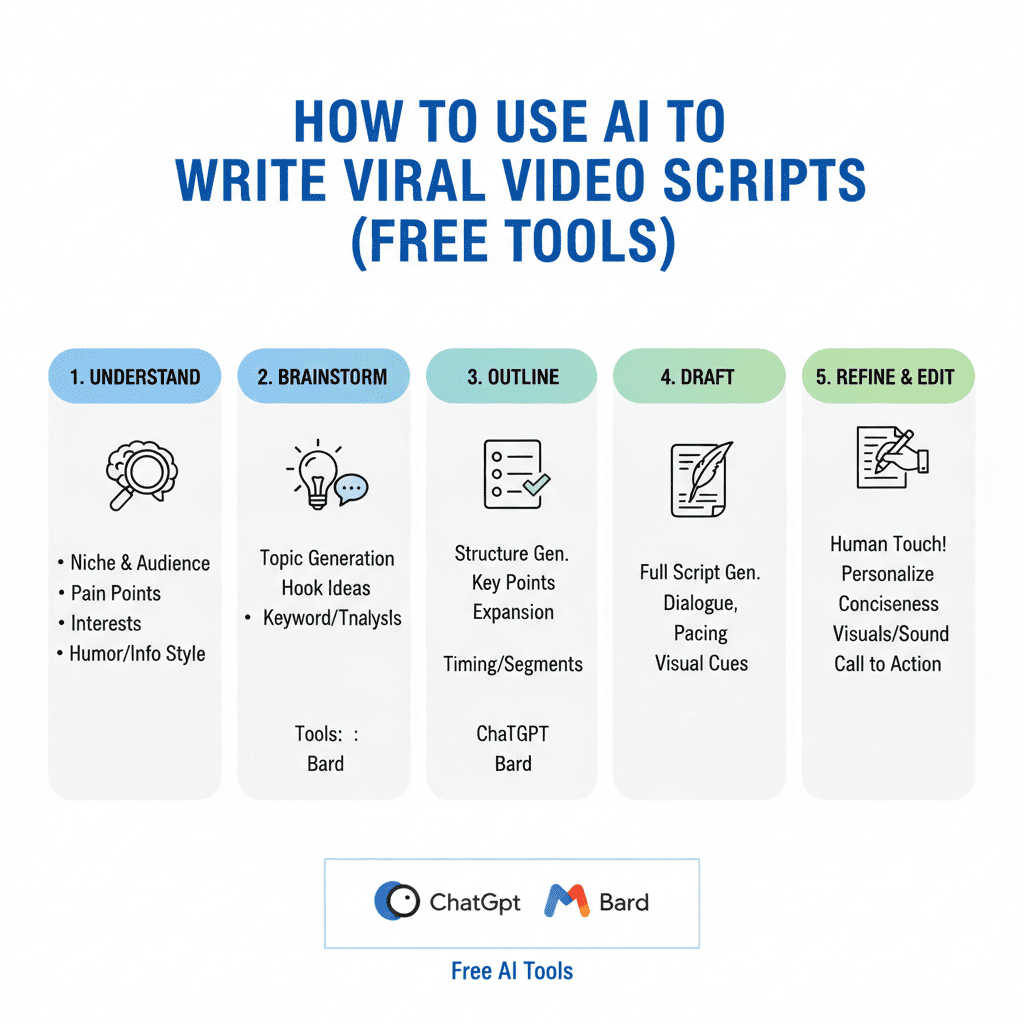
In the ever-evolving landscape of digital content creation, mastering how to use AI to write viral video scripts has become an essential skill for creators, marketers, and businesses alike. Whether you’re creating content for YouTube, TikTok, Instagram Reels, or any other platform, artificial intelligence can transform your scriptwriting process from hours of brainstorming to minutes of refined, engaging content.
This comprehensive guide will walk you through everything you need to know about leveraging free AI tools to craft compelling video scripts that capture attention, engage audiences, and have the potential to go viral.
Why Learn How to Use AI to Write Viral Video Scripts?
Before diving into the tools and techniques, let’s understand why AI to write viral video scripts has revolutionized content creation:
Time Efficiency
Traditional scriptwriting can take hours or even days. AI tools can generate complete first drafts in minutes, allowing you to focus on refinement and personalization rather than staring at a blank page.
Consistency and Quality
AI maintains consistent quality across multiple scripts, ensuring your content stays engaging regardless of creative burnout or time constraints.
Data-Driven Insights
Modern AI tools analyze millions of viral videos to understand patterns, hooks, and structures that resonate with audiences across different platforms.
Cost-Effectiveness
Many powerful AI scriptwriting tools are available for free or offer generous free tiers, making professional-level scriptwriting accessible to creators at any budget level.
Understanding What Makes Video Scripts Go Viral
Before you learn how to use AI to write viral video scripts, you need to understand the fundamental elements that make content shareable:
The Hook (First 3 Seconds)
Viral videos capture attention immediately. Your opening line must create curiosity, shock, or promise immediate value. AI excels at generating multiple hook variations based on proven patterns.
Emotional Resonance
Whether it’s humor, inspiration, surprise, or relatability, viral content triggers strong emotional responses. AI can help identify and incorporate emotional triggers relevant to your niche.
Clear Value Proposition
Viewers need to understand within seconds why they should keep watching. AI helps structure scripts that deliver value progressively, maintaining engagement throughout.
Platform-Specific Formatting
A YouTube script differs significantly from a TikTok script. AI tools can adapt content to match platform-specific requirements and audience expectations.
Top Free AI Tools to Write Viral Video Scripts
Let’s explore the best free tools available for creators who want to master AI to write viral video scripts:
1. ChatGPT (Free Version)
Best For: Comprehensive script generation, brainstorming, and refinement
ChatGPT remains one of the most versatile tools for scriptwriting. The free version (GPT-3.5 or GPT-4o mini) offers substantial capabilities for video script creation.
How to Use ChatGPT for Video Scripts:
Start with a detailed prompt that includes:
- Your video topic and main message
- Target platform (YouTube, TikTok, Instagram, etc.)
- Desired video length
- Target audience demographics
- Tone and style preferences
- Call-to-action goals
Example Prompt: “Write a 60-second TikTok script about morning productivity hacks for busy professionals. Use a conversational, energetic tone with a hook that creates curiosity. Include 3 specific tips and end with a question to encourage comments.”
Pro Tips:
- Request multiple hook variations
- Ask for B-roll suggestions alongside dialogue
- Request timing breakdowns for each section
- Iterate by asking for specific improvements
2. Claude AI (Free Tier)
Best For: Long-form scripts, nuanced storytelling, and detailed content
Claude offers excellent contextual understanding and can maintain consistency across longer video scripts, making it ideal for YouTube videos and documentary-style content.
Strengths:
- Excellent at maintaining narrative flow
- Superior at incorporating storytelling elements
- Great for educational content scripts
- Handles complex topics with clarity
3. Google Bard (Free)
Best For: Research-backed scripts and current trends
Bard’s integration with Google Search makes it particularly valuable for creating scripts that reference current events, trending topics, or require factual accuracy.
Use Cases:
- News commentary scripts
- Trend analysis videos
- Product review scripts
- Tutorial videos requiring recent information
4. Copy.ai (Free Plan)
Best For: Short-form content and social media scripts
Copy.ai offers specific templates for video scripts, making it user-friendly for beginners learning how to use AI to write viral video scripts.
Features:
- Pre-built video script templates
- Hook generators
- CTA (Call-to-Action) creators
- Multiple tone options
5. Jasper AI (Free Trial)
Best For: Marketing-focused video scripts
While primarily a paid tool, Jasper offers a free trial that’s valuable for testing its video script capabilities, particularly for promotional content.
Step-by-Step Guide: How to Use AI to Write Viral Video Scripts
Now let’s walk through the complete process of using AI to write viral video scripts from concept to final draft:
Step 1: Research and Planning
Before engaging with AI tools, gather essential information:
Audience Research:
- Who are you creating for?
- What problems do they face?
- What content do they already engage with?
- What language and tone resonate with them?
Platform Analysis:
- Study top-performing videos in your niche
- Note common script structures
- Identify successful hooks and CTAs
- Understand optimal video lengths
Trend Identification:
- Use tools like Google Trends
- Check platform-specific trending pages
- Monitor competitor content
- Identify seasonal or timely topics
Step 2: Craft Your AI Prompt
The quality of your AI to write viral video scripts output depends heavily on prompt quality. Include these elements:
Essential Prompt Components:
- Context: “I’m creating a [platform] video about [topic]”
- Audience: “My audience is [demographic] who [characteristics]”
- Goal: “The video should [educate/entertain/inspire/sell]”
- Format: “I need a [duration] script with [structure]”
- Tone: “Use a [adjectives] tone”
- Specifics: “Include [specific elements, stats, examples]”
- Constraints: “Avoid [unwanted elements]”
Advanced Prompt Template:
Create a [duration] video script for [platform] targeting [audience].

Topic: [Your specific topic]
Video Goal: [What should viewers do/feel/learn?]
Tone: [Conversational/Professional/Humorous/Inspirational]
Key Points to Cover: [List 3-5 main points]
Hook Style: [Question/Shocking stat/Bold statement/Story]
CTA: [Your desired call-to-action]

Please structure the script with:
- Attention-grabbing hook (first 3 seconds)
- Clear value proposition
- Main content sections with timestamps
- Visual suggestions for B-roll
- Engagement prompts throughout
- Strong closing with CTA

Additional requirements: [Any specific needs]
Step 3: Generate Multiple Versions
Never settle for the first output. When you use AI to write viral video scripts, generate multiple versions:
Variation Strategy:
- Request 3-5 different hooks
- Generate alternative main content structures
- Create multiple CTA options
- Experiment with different tones
Ask the AI: “Give me 5 alternative hooks for this script, each using a different psychological trigger (curiosity, fear of missing out, social proof, problem-agitation, bold statement).”
Step 4: Refine and Personalize
AI provides the foundation, but your unique voice makes content viral:
Personalization Checklist:
- Add personal anecdotes or experiences
- Include your unique phrases or catchphrases
- Adjust humor to match your style
- Incorporate brand-specific elements
- Ensure authenticity in tone
Refinement Questions to Ask AI:
- “Make the hook more intriguing”
- “Simplify the language for broader appeal”
- “Add more emotional appeal to the conclusion”
- “Include a pattern interrupt at the 15-second mark”
- “Make the CTA more compelling”
Step 5: Optimize for Platform
Different platforms require different approaches when you use AI to write viral video scripts:
YouTube Scripts (Long-Form):
- Detailed introduction (first 30 seconds)
- Chapter markers for longer videos
- Mid-roll engagement prompts
- End screen CTA
- Description and comment prompts
TikTok/Reels Scripts (Short-Form):
- Immediate hook (first second)
- Fast-paced delivery cues
- Visual transitions noted
- Trending sound suggestions
- Engagement bait ending
Instagram Feed Videos:
- Caption-friendly structure
- Silent-viewing optimization
- Story-style narrative
- Carousel coordination notes
Step 6: Add Production Notes
Transform your AI-generated script into a production-ready document:
Include:
- Timing for each section
- Camera angle suggestions
- B-roll requirements
- Text overlay cues
- Music/sound effect notes
- Transition suggestions
- Props or visual elements needed
Example format:
[0:00-0:03] HOOK
Camera: Close-up
Dialogue: "Stop scrolling - this morning routine changed my life"
Visual: Jump scare transition
Text Overlay: "Life-changing routine 👇"
Advanced Techniques: Mastering AI to Write Viral Video Scripts
Once you understand the basics of how to use AI to write viral video scripts, implement these advanced strategies:
Pattern Interrupt Integration
Ask AI to include pattern interrupts every 10-15 seconds to maintain attention:
- Surprising facts
- Rhetorical questions
- Tone shifts
- Visual cue suggestions
- Record scratch moments
Psychological Triggers
Request specific psychological principles:
- Curiosity gaps (open loops)
- Social proof elements
- Scarcity and urgency
- Reciprocity (free value)
- Authority establishment
Story Arc Implementation
For longer videos, use classic storytelling structures:
The Hero’s Journey: “Structure this video script using the hero’s journey: ordinary world, call to adventure, facing challenges, transformation, and return with knowledge.”
Problem-Solution-Transformation: “Create a script that clearly establishes a problem my audience faces, presents my solution, and paints a picture of their transformed life after implementing it.”
Data-Driven Optimization
Leverage AI to incorporate proven elements:
“Based on viral video patterns, include:
- A controversial or contrarian statement in the first 5 seconds
- Three specific, actionable tips with numbers
- A vulnerability moment to build connection
- A call-back to the opening hook in the conclusion
- An engagement question that encourages comments”
Common Mistakes When Using AI to Write Viral Video Scripts
Avoid these pitfalls to maximize your success with AI to write viral video scripts:
1. Using Generic Prompts
Generic inputs produce generic outputs. Always provide detailed, specific prompts with context about your unique angle and audience.
2. Accepting First Drafts
AI-generated scripts are starting points, not finished products. Iterate, refine, and personalize before recording.
3. Ignoring Platform Nuances
A script optimized for YouTube won’t work on TikTok. Always specify your target platform and study its unique requirements.
4. Forgetting Authenticity
Over-reliance on AI can make content feel robotic. Inject your personality, experiences, and unique perspective.
5. Neglecting SEO for Video Descriptions
While AI helps with scripts, don’t forget to optimize your video titles, descriptions, and tags. Ask AI to generate these elements too.
6. Skipping the Research Phase
AI works best with context. Research your topic, audience, and competition before generating scripts.
7. Missing the Human Touch
Viral content connects emotionally. AI provides structure, but you provide the humanity that makes people care.
Optimizing AI-Generated Scripts for Maximum Virality
Understanding how to use AI to write viral video scripts effectively means knowing how to optimize the output:
Hook Optimization Framework
Test your AI-generated hooks against these criteria:
- Curiosity: Does it create an information gap?
- Relevance: Is it immediately relevant to your target audience?
- Specificity: Does it promise concrete value?
- Emotion: Does it trigger an emotional response?
- Brevity: Can it be delivered in 3 seconds or less?
Engagement Maximization
Strategically place engagement prompts throughout your script:
Early Engagement (0:10-0:15): “If you’ve ever felt [relatable problem], keep watching”
Mid-Point Engagement (0:30-0:40): “Drop a comment if you’re going to try this”
End Engagement: “Which tip will you implement first? Tell me below”
CTA Optimization
Request multiple CTA variations from AI and A/B test:
- Direct CTAs: “Subscribe now for more tips”
- Indirect CTAs: “Don’t miss next week’s video where I…”
- Value-first CTAs: “Grab my free checklist in the description”
- Community CTAs: “Join 50,000 others who…”
Measuring Success and Iterating
After you use AI to write viral video scripts, track performance to improve:
Key Metrics to Monitor
Engagement Metrics:
- Average view duration
- Drop-off points
- Like-to-view ratio
- Comment quality and quantity
- Share rate
Algorithm Metrics:
- Click-through rate (CTR)
- Watch time
- Audience retention graph
- Traffic sources
Iterative Improvement Process
- Analyze Performance: Review metrics for patterns
- Identify Elements: What worked? What didn’t?
- Update Prompts: Incorporate learnings into future AI prompts
- Test Variations: Create similar content with adjustments
- Build Template Library: Save successful prompt formulas
Building Your AI Script Template Library
As you master how to use AI to write viral video scripts, create a library of proven prompts:
Template Categories
Educational Video Template: Save prompts that effectively explain complex topics simply, with clear learning objectives and step-by-step breakdowns.
Entertainment Template: Document prompts that generate funny, engaging, or entertaining content in your style.
Inspirational Template: Preserve prompts that create motivational content with strong emotional resonance.
Product Review Template: Keep prompts that structure honest, valuable reviews with proper disclaimers and balanced perspectives.
Customization Variables
Within each template, identify variables you can swap:
- Topic/product name
- Target audience descriptor
- Specific pain points
- Desired outcome
- Platform specifications
- Video length
The Future of AI in Video Script Writing
Understanding the trajectory of AI to write viral video scripts helps future-proof your skills:
Emerging Capabilities
Multi-Modal AI: Future tools will analyze successful videos (not just text) to generate scripts that match visual patterns and pacing of viral content.
Real-Time Trend Integration: AI will soon automatically incorporate trending topics, sounds, and formats into script suggestions.
Personalization at Scale: Advanced AI will analyze your previous content to learn your unique style and automatically personalize outputs.
Predictive Virality Scoring: Tools will score script drafts based on viral potential before you invest time in production.
Staying Ahead
- Continuously experiment with new AI tools
- Study AI-assisted viral content across platforms
- Join communities sharing AI scriptwriting techniques
- Invest time in learning prompt engineering
- Balance AI efficiency with human creativity
Ethical Considerations When Using AI to Write Viral Video Scripts
As you leverage AI to write viral video scripts, maintain ethical standards:
Transparency
Consider disclosing AI use when appropriate, especially for educational or informative content where trust is crucial.
Originality
Use AI as a tool for creation, not copying. Don’t reproduce existing content—generate original angles and perspectives.
Fact-Checking
Always verify facts, statistics, and claims in AI-generated scripts, particularly for educational or news-related content.
Audience Value
Prioritize providing genuine value over manipulation. Use viral techniques ethically to spread quality content, not misinformation.
Attribution
When AI incorporates specific frameworks or references, ensure proper credit is given to original sources.
Conclusion: Your Path to Mastering AI-Powered Video Scripts
Learning how to use AI to write viral video scripts is no longer optional for serious content creators—it’s essential for staying competitive in the fast-paced digital landscape. By combining the efficiency and pattern recognition of AI with your unique voice, experiences, and creative vision, you can consistently produce compelling video content that resonates with audiences and has genuine viral potential.
Remember these key takeaways:
Start with Strategy: Always begin with clear goals, audience understanding, and platform research before engaging AI tools.
Prompt Quality Matters: Invest time in crafting detailed, specific prompts that give AI the context needed to generate excellent scripts.
Iterate and Personalize: Never use AI output verbatim. Refine, personalize, and inject your authentic voice into every script.
Test and Learn: Track performance metrics, identify patterns, and continuously improve your AI prompting and script refinement process.
Stay Ethical: Use AI to amplify quality content creation, not to manipulate or mislead audiences.
The creators who succeed with AI to write viral video scripts aren’t those who blindly accept AI output—they’re those who strategically combine artificial intelligence with human creativity, emotional intelligence, and authentic connection. Start experimenting with these tools today, build your template library, and watch your content creation efficiency and quality transform.
The future of viral video content belongs to creators who master this balance. Will you be one of them?
Frequently Asked Questions About Using AI to Write Viral Video Scripts
Q: Can AI really help my videos go viral? A: AI analyzes patterns from millions of successful videos to help you structure content effectively. While no tool guarantees virality, AI significantly improves your odds by incorporating proven elements of viral content while you focus on authenticity and value.
Q: Do I need expensive AI tools to create viral scripts? A: No. Free tools like ChatGPT, Claude, and Google Bard offer robust capabilities for scriptwriting. Start with free options and upgrade only when you’ve maximized their potential and have specific needs they can’t meet.
Q: How much should I edit AI-generated scripts? A: Treat AI scripts as detailed first drafts requiring 20-40% revision. Add personal stories, adjust tone to match your voice, incorporate current references, and ensure every element serves your audience and goals.
Q: Will using AI make my content feel inauthentic? A: Only if you use it incorrectly. AI provides structure and efficiency; you provide personality, experiences, and genuine connection. The best content combines AI efficiency with human authenticity.
Q: How long does it take to learn how to use AI to write viral video scripts effectively? A: Basic competency: 1-2 weeks of daily practice. Proficiency: 1-2 months of consistent use and iteration. Mastery: 3-6 months of experimenting, tracking results, and refining your process. The learning curve is accessible, but ongoing optimization never stops.
Also read this:
The Coming Wave of Digital Clones & Virtual Humans: Automate Your Business Using AI Tools
Top 5 Passive Income Apps That Actually Pay in 2025: Earn Money While You Sleep