
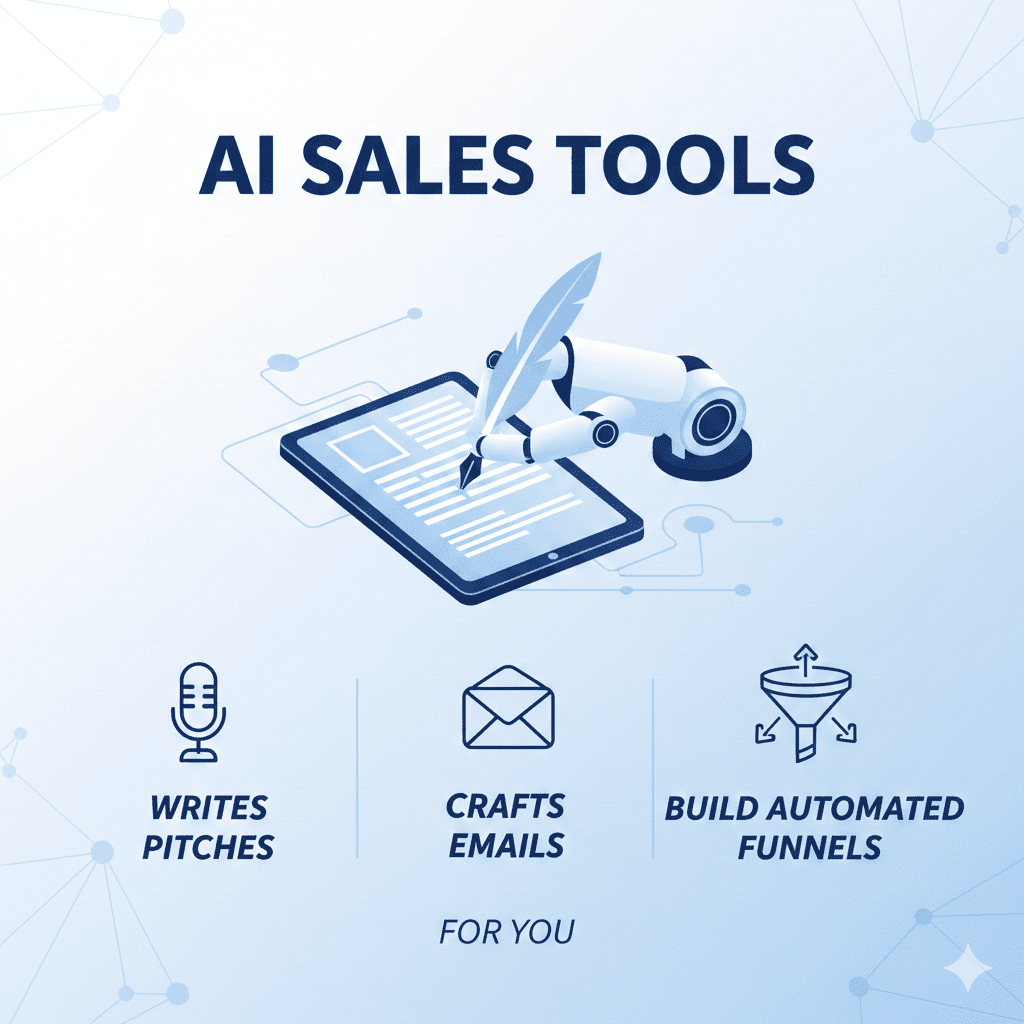
AI Sales Tools The sales landscape has undergone a seismic shift in recent years. What once required teams of copywriters, marketers, and sales professionals can now be accomplished by a single entrepreneur armed with the right technology. AI sales tools have emerged as game-changing solutions that democratize access to world-class sales copy, enabling businesses of all sizes to compete with enterprise-level marketing departments.
The numbers tell a compelling story. Companies implementing AI sales tools for their content creation report up to 60% reduction in time spent on copywriting, 40% increase in email open rates, and conversion improvements ranging from 25% to 100% depending on the industry and implementation quality. These aren’t marginal gains—they represent fundamental transformations in how businesses approach customer acquisition and revenue generation.
This comprehensive guide explores the revolutionary AI sales tools that are reshaping how modern businesses create pitches, craft email campaigns, and build conversion funnels. Whether you’re a solopreneur launching your first product or a growing sales team looking to scale your outreach, understanding these tools and their strategic application can dramatically accelerate your revenue growth while reducing the time and cost associated with traditional copywriting.
1. AI-Powered Sales Pitch Generation
Intelligent Pitch Crafting Platforms
Creating compelling sales pitches that resonate with specific audiences requires deep understanding of persuasion psychology, target customer pain points, and competitive positioning. Modern AI sales tools now analyze your product or service features, identify key differentiators from competitors, generate multiple pitch variations for different audience segments, adapt tone and style to match your brand voice, and incorporate proven persuasion frameworks automatically.
These platforms have been trained on millions of successful sales pitches across industries, enabling them to apply best practices that would typically require years of sales experience to develop naturally.
Core capabilities include:
- Value proposition articulation that highlights unique benefits
- Pain point identification and solution positioning
- Competitive differentiation messaging
- Call-to-action optimization for maximum conversion
- A/B testing variations to identify top performers
Presentation Deck Creation
Visual sales presentations require both compelling copy and effective design. AI presentation tools now generate complete pitch deck outlines based on your business model, create slide content that tells a coherent story, suggest visual elements that enhance key messages, adapt presentations for different audience types and time constraints, and maintain consistent branding across all slides.
For entrepreneurs and sales teams without dedicated design resources, these tools eliminate the hours typically spent creating professional presentations from scratch.
Proposal and Quote Automation
Custom proposals and quotes often follow similar structures while requiring personalization for each prospect. AI sales tools specializing in proposal generation now pull relevant information from your CRM and product catalog, customize template content based on prospect-specific needs and conversations, calculate pricing and discounts according to your rules, generate professional formatting automatically, and create tracking links to monitor prospect engagement with proposals.
This automation allows sales teams to respond to opportunities within minutes rather than hours or days, dramatically improving close rates simply through faster response times.
2. Email Marketing and Outreach Automation
Cold Email Campaign Creation
Cold outreach remains one of the most effective customer acquisition channels, but writing emails that get opened, read, and replied to requires significant skill and testing. Modern AI email tools now craft subject lines optimized for high open rates, write email body content that follows proven frameworks, personalize messages using prospect data and research, generate follow-up sequences with appropriate timing, and create multiple variations for split testing.
The way AI sales tools approach email creation represents a fundamental shift from generic templates to truly personalized communication at scale.
Email optimization features:
- Spam filter avoidance through language and structure analysis
- Optimal length recommendations based on audience type
- Personalization token insertion that feels natural, not robotic
- Follow-up sequencing that adapts based on recipient behavior
- Multi-channel coordination integrating email with LinkedIn and other platforms
Newsletter and Nurture Campaign Development
Maintaining consistent communication with prospects and customers through educational content builds relationships and drives conversions over time. AI newsletter platforms now generate content topics based on audience interests and trending industry issues, write articles and updates in your established voice, create engaging subject lines that improve open rates, segment content for different audience groups, and optimize send timing for maximum engagement.
These systems ensure you maintain top-of-mind awareness with prospects without the weekly content creation burden that causes many nurture campaigns to fail.
Email Response and Follow-Up Assistance
Responding to inbound inquiries quickly and effectively is crucial for conversion, but crafting quality responses takes time. AI email assistants now draft responses to common inquiry types instantly, adapt tone and detail level to match the incoming message, suggest relevant resources or next steps, schedule follow-ups automatically, and learn from your editing to improve future suggestions.
This capability allows sales teams to handle significantly higher inquiry volumes without sacrificing response quality or personalization.
Re-engagement Campaign Generation
Prospects who go cold represent significant lost opportunity, but manual re-engagement efforts rarely receive adequate attention. AI sales tools focused on re-engagement now identify dormant prospects based on engagement patterns, create personalized re-engagement messages referencing past interactions, test different angles and offers to reignite interest, automate multi-touch re-engagement sequences, and prioritize which cold prospects are most likely to re-engage.
These automated re-engagement campaigns often recover 10-20% of cold prospects at minimal additional cost, representing significant revenue uplift from efforts that otherwise wouldn’t happen.
3. Sales Funnel Architecture and Copywriting
Landing Page Copy Generation
Landing pages serve as critical conversion points, but creating copy that converts requires expertise in direct response copywriting. AI landing page tools now generate headlines that capture attention and communicate value, write body copy following proven conversion frameworks like AIDA and PAS, create benefit-focused bullet points that address customer needs, craft compelling calls-to-action that drive clicks, and produce multiple variations for testing different approaches.
The ability of AI sales tools to apply sophisticated copywriting techniques consistently across all landing pages ensures every visitor receives optimized messaging regardless of which campaign brought them to your site.
Landing page elements optimized:
- Above-the-fold hero sections that immediately communicate value
- Social proof and testimonial sections that build credibility
- Feature and benefit descriptions that educate while persuading
- FAQ sections that preemptively address objections
- Urgency and scarcity messaging that encourages immediate action
Sales Funnel Sequence Development
Effective sales funnels guide prospects through awareness, consideration, and decision stages with appropriate content at each step. AI funnel builders now map complete customer journeys from initial awareness to purchase, create content appropriate for each funnel stage, design email sequences that nurture prospects through the journey, identify where prospects typically drop off and suggest improvements, and adapt funnels based on performance data.
This strategic approach to funnel development ensures you’re not just creating isolated pieces of content but cohesive systems that systematically move prospects toward purchase decisions.
Video Sales Letter Scripts
Video sales letters have become increasingly important in modern funnels, but scriptwriting that maintains viewer attention while building desire requires specialized skills. AI script generators now create video scripts following proven structures, write in conversational tone that sounds natural when spoken, include strategic pattern interrupts to maintain attention, incorporate storytelling elements that create emotional connection, and suggest visual elements and scenes to accompany each section.
These tools make professional video sales content accessible to businesses without scriptwriting expertise or large video production budgets.
Checkout and Cart Page Optimization
The final conversion moment when prospects become customers requires carefully crafted messaging that reinforces the purchase decision. AI sales tools for checkout optimization now create reassuring copy that reduces purchase anxiety, generate urgency messages that encourage immediate completion, write guarantee language that removes risk perception, craft upsell and cross-sell offers that increase average order value, and develop abandoned cart recovery sequences.
Optimizing this critical final step often provides the highest ROI of any funnel improvement, as even small conversion rate increases directly impact revenue.
4. Social Media Sales Content Creation
LinkedIn Outreach and Connection Messages
LinkedIn has become essential for B2B sales, but writing connection requests and initial messages that get accepted and replied to requires finesse. AI LinkedIn tools now craft personalized connection request messages that reference shared interests, write initial outreach that provides value before asking for anything, create follow-up sequences that build relationships gradually, generate content for posts that position you as a thought leader, and suggest optimal timing for messages and posts.
The ability to maintain consistent, valuable LinkedIn presence while running other aspects of your business makes these tools invaluable for modern B2B sales professionals.
Instagram and Facebook Ad Copy
Social media advertising requires thumb-stopping creativity combined with persuasive copy in very limited character counts. AI ad copywriting tools now generate multiple headline variations testing different angles, write primary text that tells compelling micro-stories, create call-to-action text optimized for each platform’s best practices, adapt messaging for different audience segments, and produce countless variations enabling extensive testing.
AI sales tools specializing in social ad copy often produce 20-30 variations in the time it would take to manually write five, dramatically expanding your testing capabilities.
Social Proof and Testimonial Optimization
Customer testimonials and reviews provide powerful social proof but often need editing for maximum impact. AI testimonial tools now identify the most compelling elements in customer feedback, rewrite testimonials for clarity while maintaining authenticity, create graphics and visual testimonial formats, generate case study outlines from customer success stories, and organize social proof for different audience segments and use cases.
This systematic approach to social proof ensures you’re maximizing the persuasive power of customer validation across all marketing channels.
5. Content Marketing for Sales Enablement
Blog Post and Article Generation
Educational content attracts prospects and establishes expertise, but consistent content creation challenges most sales-focused teams. AI content platforms now generate article outlines on topics relevant to your prospects, write complete blog posts in your brand voice, optimize content for search engines and reader engagement, create internal linking strategies that guide readers toward conversion pages, and develop content calendars ensuring consistent publishing.
The way AI sales tools integrate educational content with sales objectives creates content that both provides genuine value and strategically guides prospects toward purchase decisions.
Content types automated:
- How-to guides that showcase your product as the solution
- Comparison articles that position your offering favorably
- Industry trend analysis that demonstrates your expertise
- Problem-focused content that identifies customer pain points
- Success story narratives that illustrate transformation potential
Lead Magnet and Free Resource Creation
Valuable free resources like ebooks, checklists, and templates generate leads by providing immediate value in exchange for contact information. AI lead magnet tools now identify topics your audience would value enough to exchange contact information, create content outlines and structures, write comprehensive guides and resources, design professional formatting and layouts, and develop promotional copy for the lead magnet itself.
These automated lead magnets enable you to offer multiple valuable resources to different audience segments without the weeks typically required to create each resource manually.
Webinar and Workshop Script Development
Educational webinars and workshops serve as high-converting sales tools but require substantial preparation. AI webinar script generators now create presentation outlines that balance education with selling, write speaker notes and talking points, develop engagement elements like polls and Q&A prompts, craft transition language between sections, and generate follow-up email sequences for attendees.
This preparation assistance allows you to deliver professional webinars consistently without spending days on preparation for each event.
6. CRM Integration and Personalization at Scale
Dynamic Content Personalization
Generic one-size-fits-all messaging underperforms compared to personalized content, but creating custom versions for every prospect doesn’t scale. AI personalization engines now pull prospect data from your CRM automatically, customize email and page content based on prospect attributes, adapt messaging based on prospect behavior and engagement, test which personalization elements drive best results, and maintain consistency across all customer touchpoints.
AI sales tools with deep CRM integration enable true one-to-one marketing at scale, treating each prospect as an individual while serving thousands simultaneously.
Lead Scoring and Prioritization Content
Not all prospects deserve equal attention, and messaging should reflect where prospects are in their buying journey. AI lead scoring systems now analyze prospect engagement patterns to predict conversion likelihood, recommend which content to send to specific prospects, identify optimal timing for sales team outreach, flag at-risk deals requiring intervention, and suggest messaging angles most likely to resonate with specific prospects.
This intelligence ensures sales teams focus their limited time on the highest-value activities with prospects most likely to convert.
Account-Based Marketing Content
Enterprise sales often require coordinated campaigns targeting multiple stakeholders within a single organization. AI ABM platforms now research target accounts and identify key decision-makers, create customized content for different roles within the organization, coordinate multi-channel campaigns across email, social media, and advertising, track engagement across all contacts at target accounts, and recommend next-best actions for sales teams.
This level of coordination would require significant manual effort without AI sales tools designed specifically for account-based approaches.
7. Conversation and Chat Sales Copy
Website Chat and Chatbot Scripts
Live chat and chatbots provide immediate engagement with website visitors, but conversation quality determines whether they help or hurt conversion rates. AI chatbot builders now create conversation flows that qualify leads naturally, write responses that sound human rather than robotic, handle objections with appropriate empathy and information, escalate to human sales reps at optimal moments, and learn from conversations to improve over time.
These intelligent chat systems can handle unlimited simultaneous conversations, ensuring no visitor waits for assistance while maintaining conversation quality that rivals skilled sales representatives.
SMS and Text Message Campaigns
Text messaging provides unmatched open rates but requires careful crafting to avoid being intrusive or salesy. AI SMS tools now write text messages that feel personal and conversational, create campaigns that respect recipient preferences and timing, develop sequences that provide value before asking for commitment, coordinate with other channels for cohesive multi-channel campaigns, and comply with regulations around consent and opt-out.
The direct nature of SMS combined with AI’s ability to personalize at scale makes text messaging increasingly important in modern sales strategies.
Voice Call Scripts and Talk Tracks
Phone conversations remain critical for high-value sales, but creating effective talk tracks requires experience and testing. AI call script tools now generate opening scripts that establish rapport quickly, create question frameworks that uncover prospect needs, develop objection handling responses for common concerns, write closing techniques appropriate to the situation, and provide real-time suggestions during calls based on conversation flow.
These tools help newer sales representatives perform like veterans while giving experienced reps additional tools to handle challenging conversations.
8. Sales Training and Coaching Content
Onboarding and Training Material Generation
New sales team members need comprehensive training to become productive quickly. AI training content generators now create onboarding documentation covering your products and sales process, develop quiz and assessment materials to verify knowledge retention, write role-play scenarios for practice situations, generate frequently asked questions and answers, and maintain updated training materials as products and processes evolve.
This automated training content creation ensures consistent onboarding quality regardless of how frequently you hire or how busy your existing team might be.
Sales Playbook Development
Systematic sales playbooks codify best practices and ensure consistent execution across teams. AI sales tools for playbook creation now document proven processes and methodologies, create templates and frameworks for common situations, develop checklists ensuring critical steps aren’t missed, write guidance for handling specific scenarios, and update content based on performance data and changing market conditions.
These living playbooks ensure your team continuously improves rather than repeatedly making the same mistakes or reinventing approaches others have already perfected.
9. Analytics and Performance Optimization
Copy Performance Analysis
Understanding which messages resonate and which fall flat is essential for continuous improvement. AI analytics platforms now track performance across all content types and channels, identify patterns in high-performing versus low-performing copy, suggest specific improvements based on performance data, test variations automatically to optimize results, and provide clear recommendations for content strategy.
The way AI sales tools connect content performance to business outcomes ensures you’re optimizing for revenue rather than vanity metrics.
Key metrics tracked:
- Open rates, click rates, and conversion rates across all campaigns
- Engagement time and content consumption patterns
- A/B test results with statistical significance calculations
- Customer journey analysis showing content impact at each stage
- ROI calculations connecting content investment to revenue generated
Competitive Intelligence and Positioning
Understanding how competitors position themselves helps inform your own messaging strategy. AI competitive analysis tools now monitor competitor messaging and content strategies, identify gaps in competitor offerings your messaging can exploit, suggest positioning angles that differentiate your solution, track changes in competitor tactics over time, and recommend messaging adjustments based on competitive landscape shifts.
This ongoing competitive intelligence ensures your messaging remains differentiated and compelling as markets evolve.
10. Implementation Strategy and Best Practices
Selecting the Right AI Sales Tools for Your Needs
The proliferation of AI sales tools can overwhelm businesses trying to determine where to invest. Successful implementation requires evaluating which sales activities consume the most time currently, identifying where copy quality most impacts conversion rates, assessing which content types you struggle to create consistently, considering which tools integrate with your existing technology stack, and starting with one or two high-impact areas before expanding.
Beginning with focused implementation allows you to learn the tools thoroughly and demonstrate clear value before expanding to additional capabilities.
Maintaining Brand Voice and Authenticity
AI-generated content requires guidance to match your unique brand personality. Effective brand voice maintenance involves creating detailed brand voice guidelines for AI tools to follow, providing examples of on-brand and off-brand content, reviewing and editing AI output initially until consistency improves, having the AI learn from your edits over time, and conducting periodic audits to ensure voice consistency across channels.
Remember that AI should amplify your brand voice, not replace it with generic corporate-speak that sounds like everyone else in your industry.
Quality Control and Human Oversight
While AI sales tools produce impressive results, human oversight remains essential for quality. Implement review processes where experienced team members approve content before publication, establish feedback loops where performance data informs future AI guidance, test AI-generated content against human-written benchmarks periodically, maintain human involvement for high-stakes or sensitive communications, and use AI as a starting point that humans refine rather than final output.
The goal is human-AI collaboration that combines AI’s speed and data processing with human creativity and judgment.
Compliance and Ethical Considerations
AI-generated sales content must comply with regulations and ethical standards. Ensure AI tools don’t make claims your product can’t support, respect privacy regulations in how they use prospect data, maintain transparency about AI involvement where legally required, avoid manipulative or deceptive tactics even if technically effective, and regularly review content to ensure it aligns with your values.
Short-term conversion gains from questionable tactics inevitably lead to long-term brand damage and potential legal issues that far outweigh any immediate benefits.
Measuring ROI and Continuous Improvement
Justifying ongoing investment in AI sales tools requires clear performance measurement. Track time savings compared to manual content creation, monitor conversion rate improvements across the funnel, calculate revenue impact from increased output and better performance, assess team satisfaction and burnout reduction, and compare costs against hiring additional copywriters or agencies.
Most businesses implementing AI sales tools strategically see ROI within the first few months, with benefits compounding as teams become more proficient with the tools and processes improve.
Conclusion: The Future of AI-Powered Sales
The transformation in how businesses create sales content through AI sales tools represents one of the most significant developments in modern marketing and sales. These powerful platforms have democratized access to world-class copywriting, enabling businesses of all sizes to create compelling pitches, engaging email campaigns, and high-converting sales funnels that previously required large teams or expensive agencies.
The businesses that will dominate their markets in coming years are those that embrace these tools strategically while maintaining the human elements that create genuine connection and trust. AI should amplify your team’s capabilities and free them to focus on high-value activities like relationship building, strategic thinking, and creative problem-solving that technology cannot replicate.
Starting your AI sales content journey doesn’t require massive investment or technical expertise. Begin by identifying the single most time-consuming or challenging aspect of your content creation process. Research AI tools designed specifically to address that challenge. Implement one solution, learn from the experience, measure the results, and expand from there.
The competitive landscape is shifting rapidly. Your competitors are already exploring how AI sales tools can accelerate their growth. Customers increasingly expect the personalized, timely communication that AI enables. The opportunity to fundamentally transform your sales content creation while improving results and reducing costs exists today. The only question is how quickly you’ll embrace it and gain the competitive advantages it provides.
The future of sales belongs to those who combine AI’s scalability and data processing capabilities with human creativity, empathy, and strategic thinking. That future is not distant—it’s available right now for those ready to seize it.
Also read this
AI Automation Tools Redefining How Small Businesses Operate
Smart Fitness: AI Tools That Track Performance Better Than Wearables
AI Tools That Build Personalized Home Workout Plans in Seconds: Transform Your Home Fitness Journey