
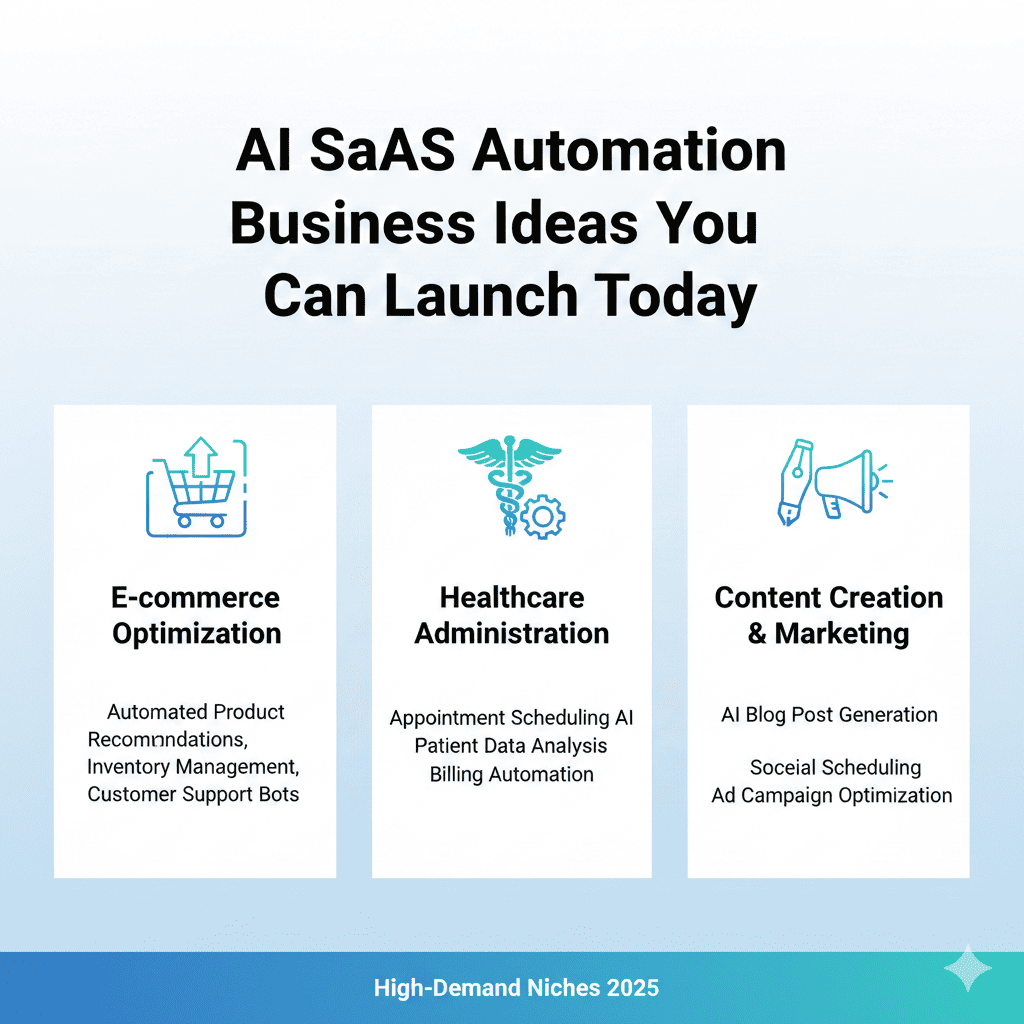
AI SaaS Automation Business Ideas The artificial intelligence revolution has created an unprecedented opportunity for entrepreneurs. While tech giants battle over foundational AI models, a massive market exists for specialized, practical applications that solve specific business problems. AI SaaS Automation Business Ideas are proliferating across industries as companies desperately seek tools that deliver immediate value without requiring extensive technical expertise or massive implementation projects.
The numbers tell a compelling story. The global AI software market is projected to exceed four hundred billion dollars by 2027, growing at over thirty-seven percent annually. More importantly, small and medium-sized businesses represent the fastest-growing segment as AI capabilities become accessible beyond enterprise-level organizations. These companies need targeted solutions for specific pain points rather than comprehensive platforms that require armies of consultants to implement.
What makes AI SaaS Automation Business Ideas particularly attractive for entrepreneurs is the combination of high demand, subscription-based revenue models, and relatively low barriers to entry. Modern development tools, pre-trained AI models, and cloud infrastructure mean you can build and launch sophisticated automation solutions faster and cheaper than ever before. You don’t need to be a machine learning expert or invest millions in infrastructure to create valuable products.
This comprehensive guide explores twelve high-demand niches where you can launch profitable AI SaaS automation businesses today. Each opportunity addresses real pain points that businesses are actively spending money to solve, with clear paths to customer acquisition and revenue generation. Whether you’re a developer looking to build your own product, an entrepreneur seeking your next venture, or a business professional ready to solve problems you’ve personally experienced, these ideas provide concrete starting points.
1. Industry-Specific Document Intelligence Solutions
Every industry drowns in paperwork, but the specific documents and extraction needs vary dramatically. Generic document processing tools miss opportunities for deep specialization that commands premium pricing and creates defensible competitive advantages.
The Specialized Opportunity
Rather than building another general-purpose document processor, focus on becoming the definitive solution for a specific industry’s most painful document challenges. Healthcare providers need to extract information from medical records, insurance claims, and lab reports. Law firms process contracts, discovery documents, and case files. Real estate agencies handle purchase agreements, title documents, and inspection reports. Construction companies manage blueprints, change orders, and compliance documentation.
Each industry has unique document types, specific data fields that matter, specialized terminology and formats, and regulatory requirements that generic tools don’t address adequately. This specificity creates opportunities for focused solutions that deliver dramatically better results than horizontal products.
Building Your Specialized Solution
Start by identifying an industry where you have domain expertise or strong connections. Interview potential customers to understand their specific document processing pain points, what fields they need extracted, what accuracy levels they require, and how processed information integrates into their workflows.
Develop a solution that handles their specific document types with high accuracy, extracts the exact fields they care about, validates data against industry-specific rules, and integrates with their existing systems. The specialization allows you to charge premium prices because you’re solving their exact problem rather than offering a generic tool they must adapt.
Go-to-Market Strategy
Industry-specific solutions enable focused marketing that’s more effective and cost-efficient than competing in broad markets. You can target industry associations, attend specialized trade shows, advertise in industry publications, and build partnerships with industry software vendors. Your marketing speaks directly to prospects’ specific challenges rather than generic productivity promises.
These AI SaaS Automation Business Ideas often achieve profitability quickly because focused positioning attracts higher-quality leads who understand their pain and are willing to pay for solutions.
2. AI-Powered Proposal and RFP Response Automation
Companies competing for contracts, especially in B2B and government sectors, spend countless hours crafting proposals and responding to requests for proposals. This repetitive yet customized work is ideal for AI automation that learns from past submissions to accelerate future responses.
Understanding the Pain Point
Sales teams, business development professionals, and account managers waste enormous time responding to RFPs and creating proposals. Each response requires gathering information from multiple sources, customizing boilerplate content, ensuring consistency with brand messaging, and tailoring to specific client requirements. A single comprehensive proposal can consume fifty to one hundred hours of skilled professional time.
The challenge isn’t just time consumption but also inconsistency. Different team members include different information, messaging varies across proposals, and valuable content from winning proposals doesn’t get reused effectively. Organizations need systematic ways to capture institutional knowledge and deploy it consistently.
Your Automation Solution
Build a platform that maintains a intelligent content library of proposal sections, case studies, team biographies, technical specifications, and standard responses. When users need to create a new proposal or respond to an RFP, your AI analyzes the requirements, suggests relevant content from the library, customizes text based on the specific opportunity, and ensures consistency across sections.
The system learns from each submission, especially winning proposals, continuously improving its recommendations. It can generate first drafts in minutes rather than hours, allowing professionals to focus on strategic customization and relationship building rather than content assembly.
Target Market and Pricing
This solution appeals to professional services firms, government contractors, technology companies, and any organization that regularly submits complex proposals. Because it directly impacts revenue generation and saves expensive professional time, customers readily pay substantial subscription fees.
Consider tiered pricing based on number of users, proposal volume, or advanced features like competitor intelligence and win probability scoring.
3. Intelligent Social Media Content Generation and Scheduling
Social media management remains labor-intensive despite numerous existing tools. Businesses struggle to maintain consistent presence across multiple platforms while creating engaging, brand-appropriate content that drives results. An AI solution that truly understands brand voice and generates platform-optimized content addresses a persistent pain point.
The Content Creation Challenge
Marketing teams know they need active social media presence but struggle with the operational burden. Creating fresh, engaging content daily across multiple platforms requires creativity, time, and platform-specific expertise. Content that works on LinkedIn fails on Instagram. What resonates with one audience falls flat with another.
Most businesses either post inconsistently, recycle the same content repeatedly, or invest significant resources in social media management that could generate better returns elsewhere. They need automation that maintains their unique voice while producing volume.
Building a Superior Solution
Develop an AI system that learns a company’s brand voice from their existing content, website, and marketing materials. The platform generates original posts optimized for each social platform, suggests relevant images and hashtags, and schedules content strategically based on audience engagement patterns.
Advanced features might include competitive content analysis to identify trending topics and gaps, automated response suggestions for comments and messages, performance prediction to prioritize high-potential content, and cross-platform content adaptation that transforms one piece into multiple platform-specific variations.
Differentiation in a Crowded Market
Yes, social media tools exist, but most offer scheduling without intelligent generation or generation without deep brand understanding. Your differentiation comes from truly learning each client’s voice and producing content that sounds human-written and brand-consistent. Focus on specific industries or business types to develop specialized content templates and best practices.
These AI SaaS Automation Business Ideas work well with freemium models where basic generation is free or inexpensive, but advanced features, higher volume, and team collaboration require paid subscriptions.
4. Automated Financial Forecasting and Scenario Planning for SMBs
Small and medium businesses need sophisticated financial planning but rarely have dedicated financial analysts or expensive enterprise software. An accessible AI-powered forecasting tool that provides CFO-level insights at SMB prices fills a substantial market gap.
The Financial Planning Gap
Business owners make critical decisions about hiring, inventory, marketing spend, and expansion based on financial projections. However, most SMBs rely on simple spreadsheets or gut instinct rather than sophisticated modeling. They need to understand cash flow runway, break-even points for new initiatives, and financial impact of strategic decisions, but lack the tools and expertise to model scenarios effectively.
Existing enterprise financial planning systems are too expensive and complex for companies without dedicated finance teams. SMBs need powerful capabilities in user-friendly packages at accessible price points.
Your AI-Powered Solution
Create a platform that integrates with common accounting systems, pulls historical financial data, generates accurate forecasts using machine learning, and enables scenario planning through simple interfaces. Business owners can model questions like what happens if we hire three new salespeople, how would a ten percent price increase affect profitability, or when will we need additional financing given projected growth.
The AI identifies patterns in their financial data, adjusts forecasts based on seasonality and trends, alerts users to potential cash flow issues, and provides natural language explanations of financial projections rather than just numbers.
Market Positioning
Target growing companies with annual revenues between five hundred thousand and fifty million dollars. These businesses have complex-enough financials to need sophisticated planning but lack enterprise resources. Position your solution as affordable CFO-level intelligence that helps owners make informed strategic decisions.
Monthly subscription pricing tied to company size or revenue makes the solution accessible while creating predictable recurring revenue.
5. AI-Driven Employee Onboarding and Training Personalization
Employee onboarding and training typically follows one-size-fits-all approaches that waste time on information employees already know while missing critical gaps. AI-powered personalization creates more effective onboarding that accelerates time-to-productivity.
The Onboarding Challenge
Companies invest heavily in employee onboarding, yet most programs are inefficient. New hires sit through training on tools they’ve used for years while struggling with concepts unique to the organization. Managers lack visibility into how well onboarding is working and where new employees need additional support.
Poor onboarding leads to longer ramp times, lower productivity, and higher turnover. Companies desperately need better solutions but most HR tech focuses on recruiting or performance management rather than that critical first ninety days.
Your Intelligent Platform
Build a system that assesses each new hire’s existing knowledge and skills, creates personalized onboarding paths that focus on genuine gaps, delivers training through varied formats based on learning preferences, and adapts dynamically based on progress and comprehension.
The platform might include AI-powered coaching that answers questions conversationally, scenario-based learning that simulates real situations, progress tracking that alerts managers when employees struggle, and integration with existing tools so training happens in context.
Target Customers and Value Proposition
This solution appeals to growing companies hiring regularly, especially in industries with complex products or processes like technology, healthcare, and financial services. The value proposition centers on faster time-to-productivity, reduced onboarding costs, and improved retention.
Price based on number of employees onboarded or total employee count, ensuring the model scales with customer growth.
6. Intelligent Contract Analysis and Management for Small Legal Teams
Contracts govern business relationships but reviewing and managing them consumes enormous time for legal teams. Small legal departments and businesses without full-time counsel need AI assistance to identify risks, ensure compliance, and manage obligations effectively.
Understanding Legal Operations Pain
Every business signs numerous contracts with vendors, customers, partners, and employees. These agreements contain critical obligations, termination clauses, liability limitations, and renewal terms that must be tracked and honored. Yet most small businesses manage contracts haphazardly through email folders and shared drives, leading to missed deadlines, unfavorable auto-renewals, and compliance risks.
Legal teams spend countless hours reviewing contracts manually, yet consistency suffers and important details get overlooked. They need systematic contract intelligence without enterprise-level complexity or pricing.
Building Your Contract Intelligence Platform
Develop an AI system that extracts key terms from contracts automatically including parties, dates, payment terms, obligations, and termination clauses. The platform identifies unusual or risky provisions, ensures standard clauses are present, flags contracts approaching renewal or termination dates, and maintains a searchable repository of all agreements.
Advanced features might include clause libraries for common agreement types, templates that incorporate learned best practices, redlining that suggests improvements to incoming contracts, and obligation tracking that ensures compliance with contractual commitments.
Market Opportunity
Target small law firms, in-house legal teams at mid-sized companies, and businesses in regulated industries where contract compliance is critical. These AI SaaS Automation Business Ideas command premium pricing because they directly mitigate legal risk while saving expensive attorney time.
Consider pricing based on number of contracts managed or users, with enterprise features available at higher tiers.
7. Automated Competitive Intelligence and Market Monitoring
Businesses need to track competitors, market trends, and industry developments but lack resources for dedicated competitive intelligence teams. An AI platform that monitors the competitive landscape automatically provides strategic advantages at a fraction of traditional costs.
The Intelligence Gap
Understanding what competitors are doing, how markets are evolving, and where opportunities or threats are emerging is critical for strategic planning. However, comprehensive competitive intelligence traditionally requires dedicated analysts who manually track websites, social media, press releases, job postings, and regulatory filings.
Most businesses either ignore competitive intelligence entirely or assign it as an additional duty to already-busy executives who lack time for thorough analysis. They make strategic decisions with incomplete information about competitive dynamics.
Your Monitoring Solution
Create an AI platform that continuously monitors competitor websites, social media, news mentions, job postings, product launches, pricing changes, and customer reviews. The system identifies significant developments, analyzes implications, and delivers actionable intelligence through regular briefings.
The AI might detect patterns like a competitor hiring aggressively in specific roles suggesting new product development, pricing changes indicating market positioning shifts, or customer sentiment trends revealing opportunities or threats. Natural language summaries make intelligence accessible to busy executives who need insights without data analysis.
Target Market and Differentiation
This solution appeals to businesses in competitive markets including technology, professional services, retail, and manufacturing. Differentiate by focusing on specific industries where you can train AI to recognize meaningful competitive signals rather than just tracking generic metrics.
Subscription pricing based on number of competitors tracked and depth of monitoring creates recurring revenue that scales with customer value.
8. AI-Powered Customer Support Ticket Routing and Response Suggestions
Customer support teams struggle with ticket volume, response consistency, and knowledge management. An intelligent system that routes tickets optimally and suggests proven responses improves efficiency and customer satisfaction simultaneously.
Support Operations Challenges
Support teams face mounting ticket volumes, diverse inquiry types requiring different expertise, knowledge scattered across systems and individual team members, and pressure to respond quickly while maintaining quality. Manual ticket routing leads to delays and inefficient resource allocation. New support agents struggle to find answers while experienced agents waste time on routine questions.
Companies know better support operations improve customer retention and reduce costs, but most support platforms offer basic ticketing without true intelligence about routing, responses, or continuous improvement.
Your Intelligent Support Platform
Build an AI system that analyzes incoming tickets to understand intent and urgency, routes tickets to agents best equipped to handle them based on expertise and availability, suggests response templates based on similar past tickets, and learns from each resolution to improve future recommendations.
The platform might identify trending issues that require systematic fixes, spot knowledge gaps that need documentation, predict ticket volume to optimize staffing, and measure agent performance on resolution time and customer satisfaction.
Business Model and Positioning
This solution works for any business with customer support operations, especially growing companies where support is becoming unwieldy but enterprise platforms are overkill. Position as the intelligent layer that makes existing support tools dramatically more effective.
Price based on ticket volume, number of agents, or advanced features, creating natural expansion revenue as customers grow.
9. Specialized AI Content Optimization for E-commerce Product Listings
E-commerce businesses with hundreds or thousands of product listings struggle to optimize content for search visibility and conversion. An AI platform that analyzes and enhances product listings at scale drives measurable revenue increases.
The E-commerce Content Challenge
Product listings are sales pages that must balance search optimization, compelling copy, and conversion-focused elements. Most e-commerce businesses have inconsistent product content with some listings well-optimized and others bare-bones. Writing compelling content for thousands of products manually is impractical, yet generic content performs poorly.
Businesses know better product content drives more organic traffic and higher conversion rates, directly impacting revenue. They need systematic optimization without hiring armies of copywriters.
Your Optimization Platform
Create an AI system that analyzes existing product listings, identifies optimization opportunities, generates improved titles, descriptions, and bullet points, suggests relevant keywords based on search data, and A/B tests variations to determine what converts best.
The platform learns from your customer’s best-performing listings and applies those patterns across their entire catalog. It might also monitor competitor listings to identify content gaps or opportunities, suggest cross-sell and upsell content, and adapt content for different marketplaces like Amazon, eBay, and proprietary e-commerce sites.
Market Opportunity
Target e-commerce businesses with large catalogs including online retailers, manufacturers selling direct, and brands managing multiple sales channels. These AI SaaS Automation Business Ideas deliver measurable ROI through increased organic traffic and conversion rates, making pricing discussions straightforward.
Consider pricing based on number of products managed or percentage of incremental revenue generated, aligning your success with customer outcomes.
10. AI-Powered Meeting Intelligence and Action Item Tracking
Meetings consume enormous time yet often produce unclear outcomes and forgotten action items. An intelligent meeting platform that captures discussions, extracts decisions and commitments, and ensures follow-through addresses widespread frustration.
Meeting Productivity Crisis
Organizations hold countless meetings that often feel unproductive. Attendees leave with different understandings of decisions made and commitments given. Action items get lost in email threads or handwritten notes. Follow-up on meeting outcomes is inconsistent at best.
The problem isn’t lack of awareness—everyone knows meetings could be better—but lack of tools that capture and operationalize meeting content without adding administrative overhead. Recording and transcription exist, but intelligent extraction and follow-through is missing.
Your Meeting Intelligence Solution
Build a platform that records and transcribes meetings automatically, identifies key decisions, action items, and commitments using AI, assigns owners and deadlines for follow-up items, and integrates with project management and communication tools to ensure accountability.
The system might generate meeting summaries automatically, track completion of action items across meetings, identify recurring topics that need resolution, and analyze meeting patterns to identify productivity improvements like recurring meetings with low value or meetings that consistently run over time.
Target Market and Positioning
This solution appeals to organizations of all sizes, especially remote and hybrid teams where meeting documentation is critical. Position as the system that ensures meetings drive actual results rather than just consuming time.
Price per user or meeting hours processed, with team and enterprise tiers offering advanced features like integration with specific business tools or custom AI training for industry-specific terminology.
11. Automated Compliance Monitoring and Reporting for Regulated Industries
Companies in regulated industries spend enormous resources ensuring compliance with industry rules and standards. An AI platform that monitors operations for compliance issues and generates required reports reduces costs while minimizing regulatory risk.
The Compliance Burden
Healthcare, finance, food services, manufacturing, and numerous other industries face complex regulatory requirements. Compliance demands systematic monitoring of processes, comprehensive documentation, and regular reporting to regulatory bodies. Manual compliance management is expensive, error-prone, and doesn’t scale.
Companies need assurance they’re meeting regulatory obligations without dedicating entire teams to compliance monitoring. They’re motivated by both cost reduction and risk mitigation—regulatory violations carry severe penalties.
Your Compliance Automation Platform
Develop an AI system that monitors business operations for compliance issues by integrating with operational systems, identifies potential violations before they occur, maintains documentation required by regulators, generates compliance reports automatically, and tracks corrective actions to ensure timely resolution.
The specificity required for compliance creates natural specialization opportunities. Focus on a particular industry and regulatory framework to develop deep expertise that generic tools cannot match. For example, HIPAA compliance for healthcare, SOX compliance for public companies, or FDA compliance for food manufacturers.
Business Model
Compliance tools command premium pricing because they directly mitigate expensive regulatory risks. Companies readily invest in solutions that reduce violation probability and streamline compliance overhead.
Price based on company size, transaction volume, or number of compliance frameworks managed. The critical nature of compliance creates sticky customer relationships with low churn.
12. Intelligent Inventory Optimization and Demand Forecasting
Businesses with physical inventory constantly balance having enough stock to meet demand without tying up excessive capital in inventory. AI-powered demand forecasting and inventory optimization improves this balance significantly.
Inventory Management Challenges
Too much inventory means capital tied up, storage costs, and potential obsolescence. Too little means lost sales, disappointed customers, and rush orders at premium prices. Finding the right balance requires accurate demand forecasting considering seasonality, trends, promotions, and external factors.
Most small and medium businesses use basic methods like safety stock rules or gut instinct rather than sophisticated forecasting. They know better inventory management would improve cash flow and customer satisfaction but lack accessible tools.
Your AI Forecasting Platform
Create a system that analyzes historical sales data, identifies patterns and seasonality, forecasts demand for each product, recommends optimal inventory levels, and alerts when reordering is needed. The AI considers factors like lead times, order minimums, storage costs, and stockout costs to optimize total inventory costs.
Advanced features might include promotion planning that forecasts demand lift from marketing activities, supplier performance tracking that adjusts lead times based on actual delivery history, and multi-location optimization that suggests inventory distribution across warehouses or stores.
Target Customers
This solution works for retailers, distributors, manufacturers, and any business managing significant inventory. These AI SaaS Automation Business Ideas deliver measurable ROI through reduced carrying costs and improved sales, making value proposition discussions straightforward.
Price based on number of SKUs managed, transaction volume, or percentage of cost savings delivered.
Launching Your AI SaaS Automation Business Successfully
Having a strong business idea is just the beginning. Successfully launching and growing an AI SaaS automation business requires strategic execution across multiple dimensions.
Start with Deep Customer Understanding
Before building anything, talk to dozens of potential customers in your target market. Understand their current workflows, specific pain points, how they currently solve the problem, what they’re willing to pay for better solutions, and how they evaluate and purchase similar tools.
This research informs everything from feature prioritization to pricing strategy and marketing messages. Founders who skip deep customer discovery often build products people admire but don’t buy.
Build a Minimum Viable Product Quickly
Resist the temptation to build comprehensive platforms before getting customer feedback. Start with core functionality that solves the most painful problem for your target market. Launch quickly to real users, gather feedback intensively, and iterate rapidly based on usage patterns and customer input.
Many successful SaaS businesses started with manual processes behind seemingly automated interfaces. You can personally perform some automation tasks while building true AI capabilities, allowing you to serve early customers and validate demand before massive development investment.
Price for Value, Not Costs
One of the biggest mistakes new SaaS founders make is pricing based on development costs or competitor pricing rather than customer value. If your solution saves a customer twenty thousand dollars annually or generates fifty thousand in incremental revenue, pricing at three thousand annually is a bargain regardless of your costs.
Start with value-based pricing understanding what outcomes you deliver and what those outcomes are worth to customers. You can always reduce prices if needed, but raising prices on existing customers is difficult.
Invest in Content Marketing Early
Content marketing is particularly effective for SaaS businesses because it builds credibility, educates potential customers, and generates ongoing leads. Start blogging, creating videos, and sharing insights immediately even before your product launches.
Focus on addressing specific questions and challenges your target customers face. Ranking for long-tail search terms related to problems you solve drives highly qualified traffic consistently over time.
Plan for Customer Success from Day One
In subscription businesses, acquiring customers is just the beginning. Long-term success requires keeping customers and expanding their usage. Build customer success processes from your first customer including structured onboarding that ensures customers achieve early value, regular check-ins to identify issues early, proactive education on advanced features, and expansion conversations when customers are ready for more.
Churn is the silent killer of SaaS businesses. Companies that maintain ninety-five percent monthly retention grow dramatically faster than those with ninety percent retention despite similar acquisition rates.
Conclusion: Your Path to Building Profitable AI SaaS Automation
The AI SaaS Automation Business Ideas presented in this guide represent real opportunities where businesses are actively seeking solutions and willing to pay for them. Each niche addresses genuine pain points with clear value propositions and practical paths to market.
Success doesn’t require revolutionary AI breakthroughs or massive funding. Many profitable SaaS businesses are built by founders who deeply understand a specific problem, build focused solutions, and execute effectively on customer acquisition and retention. The AI capabilities you need are increasingly accessible through APIs, pre-trained models, and development frameworks.
The key is choosing an opportunity aligned with your expertise, interests, and resources, then committing to deep customer understanding and iterative product development. Talk to potential customers before writing code. Build minimum viable solutions quickly to test assumptions. Price based on value delivered rather than costs incurred. Invest in marketing and customer success alongside product development.
The AI automation market is massive and growing rapidly, but opportunities won’t remain open indefinitely. As markets mature, established players gain advantages and customer acquisition becomes more expensive. The time to enter is now while many niches remain underserved and customers are actively seeking solutions.
Choose one of these AI SaaS Automation Business Ideas, commit to deep execution, and build something valuable that solves real problems for real businesses. The combination of genuine market need, accessible technology, and favorable business models creates tremendous opportunity for entrepreneurs willing to do the work. Your successful AI SaaS business could launch today.
Also read this:
11 AI SaaS Automation Tools Every Business Needs in 2026
AI CRM Consulting for Beginners: Step-by-Step Guide to Attract High-Ticket Clients
Top AI CRM Tools for Lead Generation & Sales Automation in 2025