
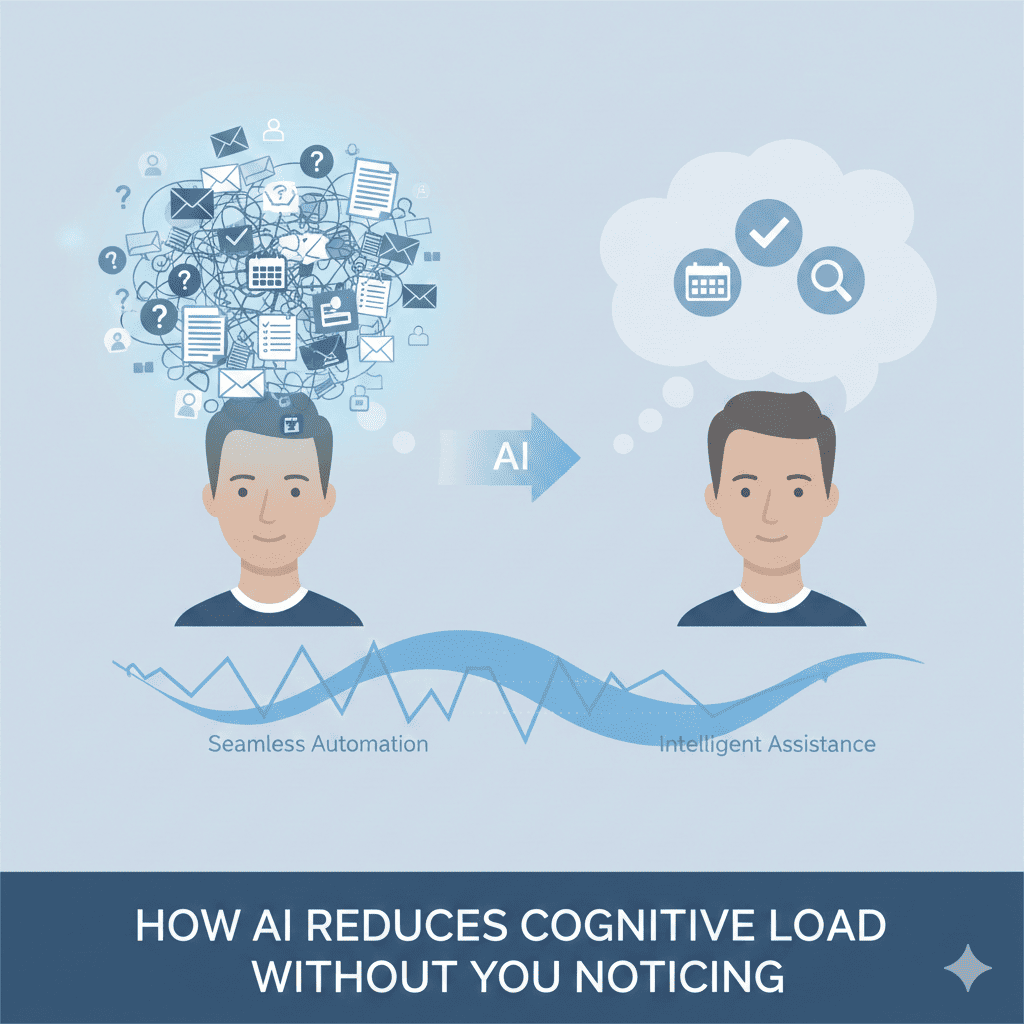
AI reduces cognitive load Your brain is exhausted, and you might not even realize it. Every day, you make thousands of decisions, process countless pieces of information, and juggle multiple cognitive tasks simultaneously. From choosing what to eat for breakfast to deciding which email to answer first, from remembering passwords to calculating the fastest route to work—your mind operates under constant pressure.
This mental strain is called cognitive load, and it’s one of the most significant yet invisible challenges of modern life. We live in an era of information abundance where our cognitive capacity hasn’t expanded, but the demands on it have multiplied exponentially. The result is decision fatigue, reduced productivity, increased stress, and diminished quality of life.
Enter artificial intelligence. Quietly, invisibly, and often without your conscious awareness, AI reduces cognitive load in dozens of ways throughout your day. It’s filtering your emails, predicting your next word, recommending your next show, optimizing your route, and making countless micro-decisions that would otherwise consume your mental energy. This isn’t a distant future scenario—it’s happening right now, and understanding how AI reduces cognitive load reveals both the profound benefits and subtle implications of our increasingly AI-mediated existence.
1. Understanding Cognitive Load and Its Impact
What Is Cognitive Load?
Cognitive load refers to the total amount of mental effort being used in your working memory. Think of your brain as having limited processing capacity, like RAM in a computer. Every task, decision, and piece of information you process consumes some of this capacity. When demands exceed capacity, performance deteriorates, stress increases, and cognitive function suffers.
Cognitive scientists categorize load into three types: intrinsic load (inherent difficulty of the task), extraneous load (how information is presented), and germane load (effort of processing and understanding). Modern life maximizes all three simultaneously—complex tasks presented poorly while we’re trying to learn and adapt constantly.
The consequences of chronic cognitive overload are severe. Research links excessive cognitive load to poor decision-making, reduced creativity, decreased learning ability, increased errors, and mental exhaustion. In extreme cases, it contributes to burnout, anxiety, and other mental health challenges.
The Modern Cognitive Load Crisis
Previous generations faced cognitive demands too, but today’s information environment is unprecedented. The average person encounters more information in a day than someone in the 15th century encountered in their lifetime. We’re expected to maintain expertise in our jobs while staying informed about news, managing complex personal finances, navigating health decisions, and maintaining digital presences across multiple platforms.
This cognitive overload crisis manifests in familiar symptoms: decision fatigue by afternoon, inability to focus on deep work, constant feeling of being overwhelmed, and the paradoxical situation where having more choices makes us less satisfied with our decisions. We experience “attention residue”—where thinking about previous tasks impairs performance on current ones.
The smartphone revolution exacerbated this crisis. Now we carry devices that demand our attention constantly, fragmenting focus and multiplying the number of micro-decisions we face hourly. Without intervention, this trajectory is unsustainable.
Why Cognitive Load Reduction Matters
Reducing cognitive load isn’t about laziness—it’s about cognitive sustainability and optimization. When AI reduces cognitive load for routine, low-value decisions, it preserves mental capacity for high-value thinking: creative problem-solving, strategic planning, deep relationships, and meaningful work.
Studies show that cognitive load reduction improves decision quality, increases productivity, enhances learning, reduces stress, and even improves physical health through reduced cortisol levels. People with lower cognitive loads report higher life satisfaction, better relationships, and greater sense of control over their lives.
2. Invisible AI Filters and Curators
Email Prioritization and Filtering
Every morning, you open your email to find dozens or hundreds of messages. Without AI intervention, you’d need to read each subject line, assess its importance, and decide whether to address it immediately, later, or ignore it. AI reduces cognitive load by pre-sorting this chaos.
Modern email systems use machine learning to identify priority messages, filter spam, categorize emails into tabs, and even suggest responses. Gmail’s Smart Reply analyzes message context and generates appropriate responses that you can send with one tap. These systems learn your patterns—which emails you typically respond to quickly, which senders are important to you, and which messages can wait.
The cognitive savings are substantial. Instead of processing 100 individual emails, you’re presented with 15 priority items and can safely ignore or batch-process the rest. The mental energy saved accumulates across hundreds of emails weekly, preserving cognitive capacity for actual work.
Content Recommendation Systems
Netflix, Spotify, YouTube, and countless other platforms employ sophisticated AI to curate content for you. Without these systems, you’d face the paradox of choice: thousands of options but no efficient way to find what you’ll enjoy. The cognitive load of searching, evaluating, and selecting would be overwhelming.
AI reduces cognitive load by analyzing your viewing history, preferences, and behavior patterns to surface content you’re likely to enjoy. You’re presented with a manageable selection rather than an infinite catalog. The system handles the cognitive work of filtering, categorizing, and matching content to your tastes.
Interestingly, these systems work best when they’re invisible. Users don’t want to think about the AI—they just want recommendations that feel intuitive and accurate. The cognitive load reduction happens unconsciously; you simply experience less decision fatigue when choosing entertainment.
Social Media Feed Curation
Social media platforms face an impossible challenge: showing you everything your friends post would create cognitive overload, but showing nothing would make the platforms useless. AI solves this by curating feeds based on what you’re most likely to engage with.
While this raises legitimate concerns about filter bubbles and manipulation, from a cognitive load perspective, the AI performs essential filtering. It handles the impossible task of prioritizing among thousands of potential posts, reducing what you see to a manageable stream. Without this curation, social platforms would be unusable due to information overload.
The system learns which types of content you engage with, when you’re most active, and how long you typically spend viewing different post types. This data informs real-time decisions about what to show you, silently reducing the cognitive burden of navigating social information.
3. Predictive Text and Communication Assistance
Autocomplete and Suggestion Systems
Every time you type on a smartphone, AI is predicting your next word, completing your sentences, and correcting your mistakes. These predictive systems analyze billions of text samples to understand language patterns, then apply this knowledge to anticipate what you intend to write.
AI reduces cognitive load by eliminating much of the mechanical effort of typing. You don’t need to type every letter of every word—the AI anticipates and completes words and phrases. For common phrases you use regularly, you might type only a few characters before the complete phrase appears for selection.
This seems minor, but the cognitive savings compound. Writing a 200-word email might involve the AI completing 50-100 words, correcting 10-15 typos, and suggesting appropriate punctuation. Each of these would have required conscious attention without AI assistance. The mental energy saved is redirected toward message content and meaning rather than mechanical execution.
Smart Reply and Response Generation
Modern messaging apps and email clients generate contextually appropriate responses that you can send with a single tap. The AI analyzes the incoming message and suggests 2-3 likely responses based on your communication patterns and the message context.
For simple messages—confirmations, acknowledgments, brief answers—this eliminates the cognitive load entirely. You don’t need to formulate a response, type it, or even think about it consciously. The AI has anticipated the appropriate response, and you simply approve or reject it.
This capability is particularly valuable during high-cognitive-load situations. When you’re in a meeting, driving, or focused on complex work, being able to handle routine communication with minimal cognitive effort maintains productivity without creating dangerous distractions.
Language Translation in Real-Time
For multilingual communication, AI translation services eliminate the massive cognitive burden of translating between languages. Services like Google Translate and DeepL provide near-instant translation that’s increasingly accurate and natural-sounding.
AI reduces cognitive load for language by handling translation automatically. You can read content in languages you don’t speak, communicate with people who don’t share your language, and access global information without the cognitive overhead of manual translation or the years of effort required to learn multiple languages fluently.
This cognitive load reduction enables global collaboration and information access that would otherwise be impossible for most people. The mental energy that would go toward translation is redirected toward understanding concepts and building relationships.
4. Navigation and Route Optimization
Real-Time Traffic Processing
Navigation apps like Google Maps and Waze process vast amounts of real-time data—traffic speeds, accidents, road closures, historical patterns—to calculate optimal routes. Without AI, you’d need to check traffic reports, mentally calculate alternative routes, estimate travel times, and make navigation decisions constantly.
AI reduces cognitive load by handling all this processing invisibly. You simply input your destination and receive turn-by-turn guidance optimized for current conditions. The system continuously recalculates as conditions change, adapting to traffic in real-time without requiring your attention or decision-making.
The cognitive savings extend beyond the route itself. Knowing the AI is handling navigation allows you to focus on driving safely, conducting conversations with passengers, or thinking about your upcoming meeting. The mental energy not spent on navigation decisions is available for other cognitive tasks.
Predictive Destination Suggestions
Your phone learns your routines and frequently visited locations. It predicts where you’re likely going based on time of day, day of week, and historical patterns. Often, the app suggests your destination before you even open it.
This prediction eliminates the cognitive steps of opening the app, entering the destination, and confirming the route. The AI has anticipated your need and prepared the solution. This micro-optimization happens multiple times daily, each instance saving small amounts of cognitive effort that accumulate significantly over time.
Multi-Modal Transportation Integration
In urban environments, getting from point A to point B might involve walking, public transit, bike-sharing, and ridesharing. Evaluating all these options and combinations creates substantial cognitive load—comparing schedules, costs, walking distances, and total travel times.
AI-powered transit apps integrate all these modes, presenting optimized multi-modal routes. AI reduces cognitive load by performing complex optimization across multiple transportation systems, considering dozens of variables you’d struggle to mentally process. The result is a simple, actionable plan rather than overwhelming complexity.
5. Smart Home Automation and Environment Control
Adaptive Learning Thermostats
Smart thermostats like Nest learn your temperature preferences and daily patterns. They adjust heating and cooling automatically, eliminating the need to manually adjust settings multiple times daily. This seems trivial until you consider how many times you’d otherwise think about and adjust temperature.
AI reduces cognitive load by removing temperature management from your conscious decision-making. The thermostat learns when you’re home, when you’re asleep, and what temperatures you prefer in different situations. It makes these adjustments invisibly, one less thing demanding your attention and decisions.
The system also optimizes for energy efficiency within your comfort constraints, handling trade-offs that would require complex calculation if done manually. You benefit from optimization without expending cognitive effort to achieve it.
Lighting and Scene Automation
Smart lighting systems learn when you want lights on or off in different rooms. They can adjust brightness based on time of day, natural light levels, and your activities. The cognitive load of remembering to turn lights on and off, adjusting brightness, and managing multiple light sources is eliminated.
Motion sensors and AI-driven automation mean lights adjust without conscious thought. You walk into a room and lighting is appropriate for the time of day and available natural light. The system handles micro-decisions that would otherwise occupy small portions of your attention repeatedly throughout the day.
Integrated Device Orchestration
Modern smart home systems coordinate multiple devices—lights, thermostat, locks, cameras, appliances—based on learned patterns and contexts. The AI understands scenarios: “morning routine,” “leaving home,” “movie time”—and orchestrates appropriate device behaviors automatically.
AI reduces cognitive load by managing complex device interactions you’d otherwise need to consciously control. Instead of thinking “I’m leaving, so I need to adjust the thermostat, turn off lights, lock the door, and arm the security system,” you simply leave. The AI handles everything based on recognizing this departure pattern.
6. Financial Management and Decision Support
Fraud Detection and Security
Your credit card company’s AI analyzes every transaction in real-time, comparing it to your spending patterns to detect potential fraud. Without this, you’d need to review every transaction consciously to identify suspicious activity—an impossible cognitive burden given dozens of transactions monthly.
AI reduces cognitive load by performing continuous monitoring that would be impractical for humans. When the system detects anomalies, it either blocks the transaction or alerts you for verification. You’re only involved when human judgment is needed, preserving cognitive resources for important decisions.
This invisible protection provides both security and peace of mind. You don’t need to maintain constant vigilance about your accounts because the AI is monitoring them continuously with superhuman consistency.
Automated Categorization and Budgeting
Personal finance apps use AI to categorize transactions automatically. A purchase at a grocery store is categorized as “groceries,” a restaurant as “dining,” a gas station as “transportation.” This eliminates the tedious cognitive work of manually categorizing dozens of transactions monthly.
The AI also tracks spending against budgets, alerts you to unusual spending patterns, and provides insights about your financial behavior. AI reduces cognitive load by transforming raw transaction data into actionable financial intelligence without requiring your active analysis.
Investment and Portfolio Management
Robo-advisors use AI to manage investment portfolios based on your risk tolerance, goals, and time horizon. They automatically rebalance, optimize for tax efficiency, and adjust allocations as needed. Without this automation, managing investments requires substantial financial knowledge and ongoing cognitive effort.
The AI handles complex decisions about asset allocation, tax-loss harvesting, and rebalancing that would overwhelm most investors. You receive professional-level portfolio management without the cognitive burden of making these decisions yourself or the mental load of worrying whether your investments are properly managed.
7. Information Synthesis and Knowledge Work
Research and Information Gathering
AI-powered research assistants can scan thousands of documents, extract relevant information, identify key points, and synthesize findings. Tasks that once required hours of reading and note-taking now take minutes. AI reduces cognitive load by handling information gathering and initial synthesis.
These systems don’t just find information—they understand context and relevance. When researching a topic, the AI identifies the most important sources, extracts key insights, and presents synthesized information tailored to your needs. The cognitive work of reading comprehensively and connecting ideas across sources is partially automated.
Meeting Notes and Action Items
AI meeting assistants transcribe conversations, identify action items, extract key decisions, and generate summaries. Participants can focus on the discussion rather than taking notes, secure in the knowledge that everything important is being captured and organized.
This eliminates the dual cognitive load of simultaneously participating in discussion and documenting it. AI reduces cognitive load by allowing full cognitive engagement with the meeting itself while ensuring nothing important is lost. Post-meeting, you have organized notes and clear action items without having created them manually.
Writing Assistance and Enhancement
AI writing tools suggest improvements to clarity, grammar, tone, and style. They can restructure sentences, suggest stronger word choices, and identify unclear passages. Tools like Grammarly and similar services provide real-time feedback that would require conscious editorial review otherwise.
The cognitive load of writing includes both content generation and editorial refinement. AI handles much of the refinement automatically, allowing writers to focus cognitive resources on ideas and arguments rather than mechanical correctness and stylistic polish.
8. Health and Wellness Optimization
Activity Tracking and Recommendations
Fitness trackers and health apps use AI to analyze your activity patterns, sleep quality, and health metrics. They provide personalized recommendations for exercise, sleep, and wellness based on data analysis that would be impossible to perform manually.
AI reduces cognitive load by transforming raw health data into actionable insights. Instead of tracking steps, heart rate, sleep stages, and activity levels manually and then analyzing patterns to derive recommendations, the AI does this continuously and presents simple guidance.
Medication Reminders and Health Management
Health management apps remind you to take medications, track symptoms, monitor chronic conditions, and coordinate care across multiple providers. They eliminate the cognitive burden of remembering complex medication schedules and tracking health information over time.
For people managing chronic conditions, this cognitive load reduction is particularly valuable. The mental effort of maintaining medication schedules, tracking symptoms, remembering doctor appointments, and coordinating among specialists is substantial. AI automates much of this, allowing cognitive focus on living well rather than managing illness.
Sleep Optimization
Smart sleep tracking systems analyze sleep patterns and environmental factors to optimize sleep quality. They can adjust room temperature, lighting, and sound based on sleep stage, learning what conditions produce your best sleep.
AI reduces cognitive load by managing the complex interaction between environment and sleep quality. You don’t need to consciously optimize conditions—the AI learns what works and implements it automatically, one less thing to think about and manage consciously.
9. The Future of Cognitive Load Reduction
Anticipatory Computing
The next evolution in AI-driven cognitive load reduction is anticipatory computing—systems that predict your needs before you’re consciously aware of them. Your phone might prepare information for an upcoming meeting, your car might precondition itself before you leave home, and your devices might orchestrate themselves based on predicted activities.
AI reduces cognitive load in anticipatory systems by eliminating even the initial step of requesting assistance. The AI recognizes patterns, predicts needs, and prepares solutions proactively. This moves from reactive assistance to predictive support, further minimizing cognitive demands.
Ambient Intelligence
Future environments will incorporate pervasive AI that manages complexity invisibly. Your home, car, workplace, and public spaces will continuously adapt to optimize for your cognitive comfort and productivity. The AI becomes environmental rather than tool-based.
This ambient intelligence handles countless micro-decisions and optimizations without conscious interaction. Temperature, lighting, information display, device behavior, and environmental conditions adapt continuously based on context, occupants, and activities. The cognitive load of managing these factors disappears entirely.
Personal AI Assistants
Emerging AI assistants function as cognitive partners that understand your goals, preferences, and context. They handle routine cognitive tasks, provide decision support for complex choices, and act as memory extensions. AI reduces cognitive load by serving as an external cognitive system that complements human thinking.
These assistants will eventually handle scheduling, communication, information management, task coordination, and decision support across all life domains. The cognitive load of managing modern life’s complexity will shift from individual humans to human-AI partnerships.
Conclusion: The Invisible Revolution
The ways AI reduces cognitive load represent perhaps the most impactful yet least visible technology revolution of our time. Unlike smartphones or social media, which announced themselves with fanfare, AI-driven cognitive load reduction happens quietly in the background of daily life. You notice its absence more than its presence—when a system fails to predict your next word, when navigation doesn’t adapt to traffic, when recommendations miss the mark.
This invisibility is both the technology’s greatest strength and its most significant challenge. The cognitive benefits are real and substantial—reduced decision fatigue, preserved mental energy for important thinking, decreased stress, and improved quality of life. Studies suggest AI assistance can reduce daily cognitive load by 20-40% for knowledge workers, freeing significant mental capacity for creative and strategic work.
However, this invisible assistance raises important questions. As we delegate more cognitive tasks to AI, do we risk atrophying cognitive capabilities we’re no longer exercising? When AI makes decisions for us, do we lose agency and autonomy? As systems become better at predicting and satisfying our preferences, do we lose the capacity for serendipity and growth that comes from unexpected choices?
The answer isn’t to reject AI assistance but to use it mindfully. AI reduces cognitive load most beneficially when it handles routine, low-value cognitive tasks—filtering information, remembering details, optimizing logistics, managing complexity—thereby preserving human cognitive capacity for high-value thinking: creativity, strategy, relationship building, and learning.
The ideal future isn’t one where AI does all our thinking, but one where AI and human intelligence form complementary partnerships. AI handles the cognitive burden of managing complexity, allowing humans to focus on what we do best: making meaning, forming connections, exercising judgment, and engaging in the deep thinking that defines human flourishing.
As these systems become more sophisticated and pervasive, understanding how AI reduces cognitive load becomes essential for navigating modern life effectively. The invisible revolution is already here, quietly reshaping how we think, decide, and live. By understanding these dynamics, we can harness AI’s benefits while remaining conscious agents in our own lives, using technology to amplify rather than replace human cognitive capabilities.
The future belongs to those who can effectively partner with AI in managing cognitive load—leveraging machine assistance for routine tasks while preserving and strengthening uniquely human cognitive abilities. This balance will define successful living in our increasingly complex, AI-augmented world.
Also read this:
How AI Combines Unrelated Ideas to Generate New Concepts
Why AI Will Become the Default Interface for the Internet in the Next 5 Years
AI Feature Improves Typing Speed: The Revolutionary Technology That’s Changing How We Type