
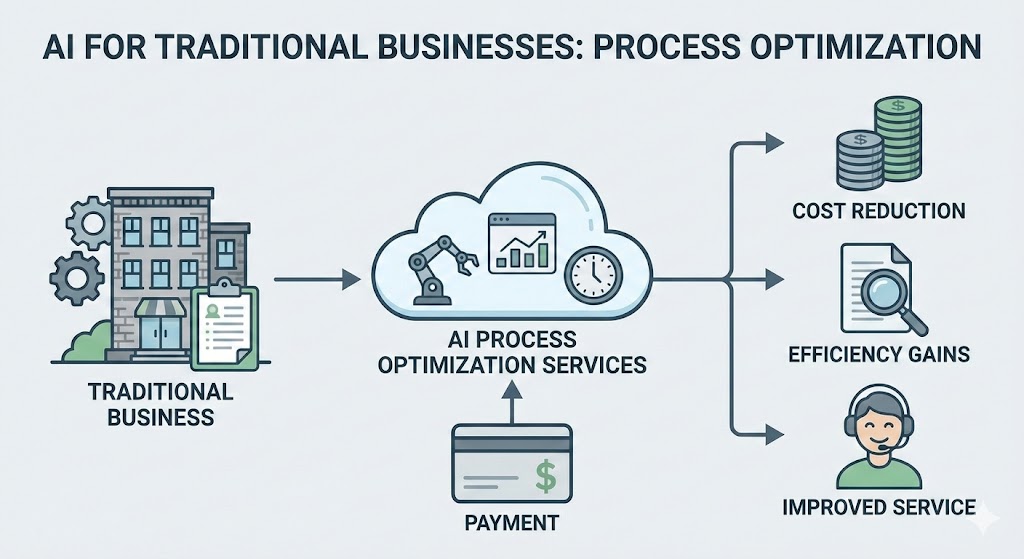
The artificial intelligence revolution isn’t just transforming tech companies and Silicon Valley startups. Traditional businesses across manufacturing, retail, healthcare, logistics, and professional services are discovering that AI can fundamentally transform their operations. However, these established companies face a critical challenge: they understand their industries deeply but lack the expertise to implement AI solutions that optimize their processes.
This gap creates an extraordinary opportunity for service providers who can bridge traditional business operations with modern AI capabilities. Companies are actively seeking partners who understand both their industry challenges and AI solutions, and they’re willing to pay substantial monthly fees for AI process optimization services that deliver measurable improvements in efficiency, cost reduction, and revenue growth.
Understanding how to identify optimization opportunities, implement AI solutions, and deliver consistent value positions you to build a thriving recurring revenue business serving traditional industries. This comprehensive guide explores everything you need to know about creating profitable AI process optimization services that traditional businesses depend on and pay for month after month.
Why Traditional Businesses Need AI Process Optimization Services
Traditional businesses built their operations over decades using established processes, legacy systems, and institutional knowledge. While these foundations created success, they also introduced inefficiencies that compound over time. Manual data entry consumes hours daily. Decision-making relies on intuition rather than data analysis. Quality control depends on human inspection with inconsistent results. Scheduling and resource allocation use spreadsheets and guesswork.
These inefficiencies represent hidden costs that erode profitability. A manufacturing plant losing 3% of production to preventable defects might not notice the gradual impact, but over years it represents millions in lost revenue. A retail chain making suboptimal inventory decisions across hundreds of locations leaves cash tied up in slow-moving stock while missing sales opportunities. A healthcare practice scheduling patients inefficiently wastes provider time worth thousands of dollars weekly.
AI process optimization services address these challenges by applying modern technology to traditional operations. Predictive analytics forecast demand more accurately than human judgment. Computer vision inspects products with superhuman consistency. Natural language processing extracts insights from unstructured documents. Machine learning optimizes complex scheduling and routing problems.
Traditional businesses recognize the potential but lack several critical capabilities. They don’t have data scientists on staff to build models. Their IT teams understand infrastructure but not machine learning. They can’t afford to hire AI specialists full-time for each department. This creates the perfect market for AI process optimization services delivered on a recurring basis by specialized providers.
1. Identifying High-Value Process Optimization Opportunities
Success in AI process optimization services begins with identifying where AI delivers maximum impact. Not every process benefits from AI, and traditional businesses need guidance separating genuine opportunities from hype.
Manufacturing Process Optimization
Manufacturing operations contain numerous processes ripe for AI optimization. Predictive maintenance systems analyze equipment sensor data to predict failures before they occur, reducing unplanned downtime by 30-50%. Quality control automation using computer vision inspects products with greater consistency than human inspectors while generating detailed defect analytics. Production scheduling optimization balances multiple constraints including equipment availability, worker skills, material inventory, and delivery deadlines to maximize throughput. Energy consumption optimization reduces utility costs by predicting optimal equipment operating parameters.
Supply Chain and Logistics Enhancement
Supply chains involve complex decisions that AI handles exceptionally well. Demand forecasting that considers historical sales, seasonal patterns, economic indicators, and emerging trends reduces inventory costs while improving product availability. Route optimization for delivery fleets minimizes fuel consumption and maximizes deliveries per vehicle. Warehouse operations optimization determines optimal product placement, pick paths, and staffing levels. Supplier risk assessment predicts potential disruptions based on financial health, geopolitical factors, and historical performance.
Retail Operations Improvement
Retail businesses face daily operational decisions where AI provides significant advantages. Inventory optimization balances stock levels across locations to minimize carrying costs while preventing stockouts. Dynamic pricing adjusts prices based on demand, competition, and inventory levels to maximize revenue. Staff scheduling optimization ensures appropriate coverage during peak times while controlling labor costs. Customer behavior analysis predicts purchase patterns enabling targeted marketing and personalized experiences.
Healthcare Practice Optimization
Medical practices and healthcare facilities have numerous inefficient processes amenable to AI optimization. Patient scheduling systems optimize appointment times considering provider specialties, procedure durations, and patient needs to maximize utilization while minimizing wait times. Insurance verification automation speeds up patient intake while reducing claim denials. Medical coding assistance suggests appropriate billing codes based on clinical documentation, improving revenue cycle efficiency. Readmission risk prediction identifies patients needing additional support to prevent costly hospital returns.
2. Building Your AI Process Optimization Service Offering
Creating comprehensive AI process optimization services requires combining technical capabilities with industry expertise and operational excellence.
Industry Specialization Strategy
Rather than being a generalist, focus on specific industries where you can develop deep expertise. Understanding manufacturing operations, retail customer behavior, healthcare regulations, or logistics constraints allows you to deliver superior results. Industry specialization enables you to build reusable solutions, speak the language of potential clients, and command premium pricing based on demonstrated expertise.
Assessment and Discovery Methodology
Develop systematic approaches for identifying optimization opportunities within client organizations. Conduct operational audits documenting current processes, bottlenecks, and inefficiencies. Analyze data availability and quality for potential AI applications. Calculate baseline performance metrics for comparison after optimization. Interview stakeholders to understand pain points and priorities. This discovery phase ensures implementations focus on high-impact opportunities rather than technically interesting but low-value projects.
Solution Development Approach
Balance custom development with reusable components to maintain profitability while meeting client needs. Build industry-specific frameworks that accelerate implementation across similar clients. Develop integration libraries for common enterprise systems like ERP, CRM, and industry-specific software. Create template models that require tuning rather than building from scratch. This approach enables faster implementations at lower cost while maintaining quality.
Implementation and Change Management
Technical excellence alone doesn’t ensure success. Traditional businesses require careful change management to adopt new AI-powered processes. Train staff on new workflows and systems. Address concerns about job security or role changes transparently. Implement gradually to minimize disruption. Demonstrate quick wins that build momentum for larger changes. Successful implementations consider human and organizational factors alongside technical requirements.
3. Technology Stack for AI Process Optimization Services
Delivering professional AI process optimization services requires assembling appropriate technologies that balance capability, cost, and ease of deployment.
Data Collection and Integration Infrastructure
AI optimization requires access to operational data often trapped in siloed systems. Build capabilities for extracting data from legacy databases, ERP systems, and specialized industry software. Implement real-time data streaming for time-sensitive applications. Create data warehouses consolidating information from multiple sources. Develop data quality monitoring ensuring AI receives clean, accurate inputs. Robust data infrastructure is foundational to effective optimization.
Machine Learning Development Platforms
Choose platforms enabling efficient model development and deployment. Cloud-based services like AWS SageMaker, Google Vertex AI, or Azure Machine Learning provide comprehensive capabilities without infrastructure management overhead. Open-source frameworks including TensorFlow, PyTorch, and Scikit-learn offer flexibility and cost control. AutoML platforms like H2O.ai or DataRobot accelerate development for clients with simpler requirements. Select technologies matching project complexity and budget constraints.
Business Intelligence and Visualization Tools
Traditional business stakeholders need to understand AI recommendations to act on them. Integrate AI outputs with familiar business intelligence tools like Tableau, Power BI, or Looker. Create intuitive dashboards showing predictions, recommendations, and expected impacts. Provide drill-down capabilities enabling users to understand reasoning behind AI suggestions. Effective visualization bridges the gap between AI sophistication and business usability.
Monitoring and Maintenance Systems
AI process optimization services require ongoing monitoring to maintain performance. Implement systems tracking model accuracy and prediction quality over time. Monitor data drift that could degrade performance. Track business impact metrics demonstrating continued value. Alert on anomalies or performance degradation requiring attention. Proactive monitoring prevents issues before they affect client operations.
4. Pricing Models and Packaging for Maximum Revenue
How you structure and price AI process optimization services significantly impacts both customer acquisition and long-term profitability.
Value-Based Pricing Frameworks
Price based on value delivered rather than development costs. If your inventory optimization reduces carrying costs by $200,000 annually, charging $60,000 yearly represents tremendous value while generating excellent margins. Calculate expected financial impact through cost savings, revenue increases, or risk reduction. Price to capture 20-40% of annual value created. This approach aligns your success with client outcomes.
Service Package Structures
Create tiered offerings serving different client segments. A starter package might include single-process optimization with monthly reporting and email support for $3,000 monthly. A professional package could optimize multiple related processes with weekly reporting and priority support for $7,500 monthly. An enterprise package offering comprehensive optimization across departments with real-time monitoring and dedicated account management might command $15,000 or more.
Implementation Plus Subscription Models
Separate one-time implementation fees from ongoing subscription charges. Implementation fees of $20,000 to $100,000 cover discovery, custom development, integration, and training. Monthly subscriptions of $2,000 to $10,000 cover monitoring, maintenance, optimization, and support. This structure ensures you’re compensated for initial heavy lifting while creating recurring revenue.
Performance-Based Pricing Options
Consider hybrid models combining fixed fees with performance bonuses. Charge a base monthly fee covering operational costs plus bonuses tied to achieved outcomes like cost reductions, revenue increases, or quality improvements. Performance-based components align incentives while demonstrating confidence in your solutions. However, ensure baseline fees cover costs even if bonuses aren’t achieved.
5. Implementing AI Process Optimization for Client Success
Excellence in implementation determines whether clients achieve results justifying continued investment in your AI process optimization services.
Phase One: Deep Process Analysis
Begin implementations with thorough process analysis. Map current workflows step by step identifying manual tasks, decision points, and bottlenecks. Quantify time spent on each activity and error rates. Document data sources feeding into process decisions. Identify constraints and business rules that must be respected. Interview frontline staff who understand practical challenges. This analysis reveals optimization opportunities and implementation requirements.
Phase Two: Pilot Development and Testing
Rather than full-scale implementations, start with focused pilots proving value quickly. Select a single location, product line, or department for initial deployment. Develop and train AI models using historical data. Test thoroughly in staging environments before production deployment. Compare pilot results against control groups or historical baselines. Successful pilots build confidence for broader rollout while identifying necessary adjustments.
Phase Three: Gradual Scaling and Expansion
After pilot success, scale systematically rather than deploying everywhere simultaneously. Expand to additional locations or processes incrementally. Refine implementations based on lessons learned. Train additional staff as rollout progresses. Monitor performance at each expansion stage. Gradual scaling reduces risk while demonstrating value continuously.
Phase Four: Integration with Operations
Ensure AI optimization becomes integral to daily operations rather than a separate system. Integrate recommendations into existing workflows and software. Provide interfaces matching staff preferences and capabilities. Automate data flows eliminating manual entry. Create feedback loops enabling staff to report issues or suggest improvements. Deep operational integration creates dependency that improves retention.
6. Delivering Ongoing Value Through Continuous Optimization
After implementation, continuous value delivery justifies monthly fees and builds long-term relationships critical for AI process optimization services.
Regular Performance Monitoring and Reporting
Track and communicate performance continuously. Monitor key metrics including cost savings achieved, efficiency improvements measured, quality enhancements documented, and revenue impacts quantified. Generate monthly reports showing cumulative value delivered. Compare actual results against initial projections. Conduct quarterly business reviews presenting strategic insights and recommendations. Consistent reporting demonstrates ongoing value beyond initial implementation.
Model Retraining and Improvement
AI models require periodic updating to maintain performance as business conditions change. Monitor prediction accuracy and retrain when performance degrades. Incorporate new data reflecting recent operational realities. Test and deploy improved model versions. Document accuracy improvements and business impacts. Continuous model improvement prevents degradation while increasing value over time.
Process Refinement Based on Results
Use AI insights to recommend operational improvements beyond the AI itself. Identify processes that could be streamlined based on optimization learnings. Suggest policy changes supported by data analysis. Recommend investments in areas where AI reveals high impact potential. This consultative approach positions you as a strategic partner rather than just a technology provider.
Proactive Issue Resolution
Address potential problems before they impact operations. Monitor for data quality issues affecting AI inputs. Identify drift in business patterns requiring model adjustments. Anticipate capacity constraints as operations scale. Alert clients to anomalies deserving investigation. Proactive management demonstrates expertise and prevents client frustration.
7. Industry-Specific AI Process Optimization Opportunities
Different industries present unique optimization opportunities requiring specialized knowledge and approaches.
Manufacturing Excellence
Manufacturing facilities offer numerous high-value optimization opportunities. Predictive maintenance prevents costly unplanned downtime by scheduling repairs before failures occur. Quality prediction models identify conditions likely to produce defects enabling preemptive adjustments. Production scheduling optimization balances competing constraints to maximize throughput. Energy optimization reduces utility costs by managing equipment operating parameters intelligently. Material optimization minimizes waste while ensuring production continuity.
Healthcare Operational Efficiency
Healthcare organizations face operational challenges well-suited to AI optimization. Patient flow optimization reduces wait times while maximizing provider utilization. Resource allocation ensures appropriate staffing levels matching patient acuity and volume patterns. Operating room scheduling balances surgeon preferences, equipment availability, and patient urgency. Revenue cycle optimization improves coding accuracy and reduces claim denials. Readmission prevention identifies high-risk patients for targeted interventions.
Retail Performance Optimization
Retail businesses benefit from AI optimization across multiple operational areas. Merchandise planning and allocation distributes inventory optimally across locations based on local demand patterns. Labor scheduling matches staffing to traffic patterns while respecting employee preferences and regulations. Markdown optimization maximizes revenue from seasonal or slow-moving inventory. Loss prevention identifies suspicious patterns indicating theft or fraud. Customer lifetime value optimization prioritizes high-value customer relationships.
Professional Services Productivity
Professional services firms including law, accounting, and consulting have processes amenable to AI optimization. Resource allocation matches project requirements with staff skills and availability. Document analysis extracts key information from contracts, financial statements, or legal filings. Time entry prediction reduces administrative burden by suggesting likely time allocations. Client risk assessment identifies accounts requiring additional attention or presenting payment risk. Proposal optimization analyzes win rates and suggests improvements.
8. Overcoming Common Implementation Challenges
Every AI process optimization services engagement faces challenges. Anticipating and addressing them prevents small issues from becoming project failures.
Data Quality and Availability Issues
Traditional businesses often have poor data quality and accessibility. Legacy systems may not capture needed information. Data exists in disconnected spreadsheets rather than databases. Historical records contain errors or inconsistencies. Address these challenges through data quality audits identifying and prioritizing cleanup efforts, integration development connecting disparate systems, and data enrichment filling gaps with external sources. Sometimes implementation timelines must accommodate data infrastructure improvements.
Resistance to Change and Adoption
Employees may resist AI optimization fearing job loss or discomfort with new technologies. Overcome resistance through transparent communication about AI augmenting rather than replacing workers. Involve frontline staff in implementation ensuring solutions address real needs. Provide comprehensive training building confidence. Demonstrate quick wins proving value. Celebrate successes highlighting employee contributions. Change management is as important as technical excellence.
Integration with Legacy Systems
Traditional businesses run on legacy systems resistant to modern integration approaches. Some systems lack APIs requiring custom integration development. Real-time data access may be impossible necessitating batch processing. Outdated databases have schemas that don’t map cleanly to modern structures. Budget time and resources for integration complexity. Sometimes phased approaches implementing optimization where integration is easier first builds credibility for harder integrations later.
Managing Expectations and Defining Success
Clients may have unrealistic expectations about AI capabilities or implementation timelines. Set realistic expectations through pilot projects demonstrating actual capabilities. Define success metrics collaboratively ensuring alignment on goals. Communicate regularly about progress, challenges, and timeline adjustments. Under-promise and over-deliver when possible. Clear expectation management prevents disappointment and builds trust.
9. Scaling Your AI Process Optimization Service Business
Growing from initial clients to a substantial business requires strategic scaling across multiple dimensions.
Building Reusable Solutions and Frameworks
Create industry-specific frameworks reducing custom development for each client. Develop template models for common optimization problems like demand forecasting, scheduling, or quality prediction. Build integration adapters for frequently encountered enterprise systems. Create assessment methodologies standardizing discovery processes. Reusability improves margins while enabling faster implementations.
Developing Your Team and Capabilities
As you scale, build a team with complementary skills. Data scientists develop and refine optimization models. Industry experts bring domain knowledge ensuring solutions address real business challenges. Implementation specialists handle technical deployment and integration. Customer success managers maintain client relationships and identify expansion opportunities. Build capabilities systematically as revenue supports investment.
Creating Strategic Partnerships
Partner with complementary organizations to expand reach and capabilities. System integrators and enterprise software vendors can refer clients needing optimization. Industry consultants appreciate technical partners enabling data-driven recommendations. Technology vendors building point solutions may need optimization expertise. Strategic partnerships create referral channels and enhance credibility.
Marketing and Thought Leadership
Establish yourself as an authority in AI process optimization services for your target industries. Publish case studies demonstrating measurable results. Speak at industry conferences and events. Write articles for industry publications. Create educational content explaining AI optimization opportunities. Thought leadership generates inbound leads and commands premium pricing.
10. Measuring and Maximizing Customer Lifetime Value
Recurring revenue businesses succeed based on customer retention and account expansion. Maximizing customer lifetime value requires focus on long-term success.
Comprehensive Value Tracking
Measure and communicate value delivered continuously. Track operational metrics showing process improvements. Calculate financial impacts from cost reductions and revenue increases. Monitor adoption rates and user satisfaction. Document prevented issues and near-misses. Quantify time savings for staff. Comprehensive value tracking provides ammunition for retention and expansion conversations.
Identifying Expansion Opportunities
Look for natural growth within existing accounts. Organizations starting with single-process optimization often have additional opportunities. Success in one department creates referrals to others. Pilot deployments lead to enterprise-wide implementations. Stay alert for expansion signals including client requests for additional capabilities, new initiatives requiring optimization, and budget availability for additional projects. Account expansion dramatically increases customer lifetime value.
Building Deep Client Relationships
Invest in relationships beyond service delivery. Understand client business strategies and priorities. Participate in strategic planning discussions. Provide industry insights and competitive intelligence. Celebrate successes together. Strong relationships create loyalty resistant to competitive threats. Clients view trusted partners differently than vendors.
Creating Switching Costs and Dependencies
The more integral your AI process optimization services become to daily operations, the harder switching becomes. Deep integration with operational systems, custom models trained on client-specific data, historical performance data showing long-term trends, and trained staff dependent on your solutions all create switching costs. Design implementations that naturally increase dependency over time.
The Future of AI Process Optimization Services
The opportunity for AI process optimization services will expand significantly in coming years. Several trends strengthen the market opportunity. Traditional industries continue digital transformation journeys requiring expert guidance. Labor shortages make automation increasingly critical. Economic pressures demand operational efficiency. Competitive dynamics force adoption to remain viable. Regulatory requirements around AI create demand for compliant implementation expertise.
These trends ensure sustained demand for service providers who can bridge traditional business operations with modern AI capabilities. Success requires combining technical AI expertise with deep industry knowledge and excellent client service. The companies that master this combination will build substantial businesses serving traditional industries for decades to come.
Conclusion
AI process optimization services represent an exceptional opportunity to build a thriving recurring revenue business. Traditional businesses across manufacturing, retail, healthcare, logistics, and professional services desperately need help applying AI to their operations. They have budget authority, understand the value of efficiency improvements, and will pay substantial monthly fees for services that deliver measurable results.
Success requires more than AI technical knowledge. You must understand traditional business operations, communicate value in business terms, manage change effectively, and build long-term partnerships. The service providers who excel at combining technical capability with business acumen will create valuable, sustainable businesses.
The market is massive and growing rapidly. Traditional industries represent trillions in economic activity with countless processes amenable to AI optimization. The question isn’t whether opportunity exists but whether you’re prepared to build the expertise, develop the delivery capabilities, and make the commitments necessary to capture it.
For those willing to invest in industry knowledge, develop systematic delivery approaches, and focus relentlessly on client success, AI process optimization services offer a clear path to building a substantial business in one of the most promising markets in technology. Traditional businesses need your expertise and will pay handsomely for solutions that deliver results. The opportunity is here now for those ready to seize it.
Also read this:
AI Monitoring and Optimization: How Businesses Pay Monthly for Performance
Running AI-Powered Customer Support as a Recurring Service: The Complete Guide
AI Automation Niches That Businesses Pay For Every Month (Recurring Revenue)