
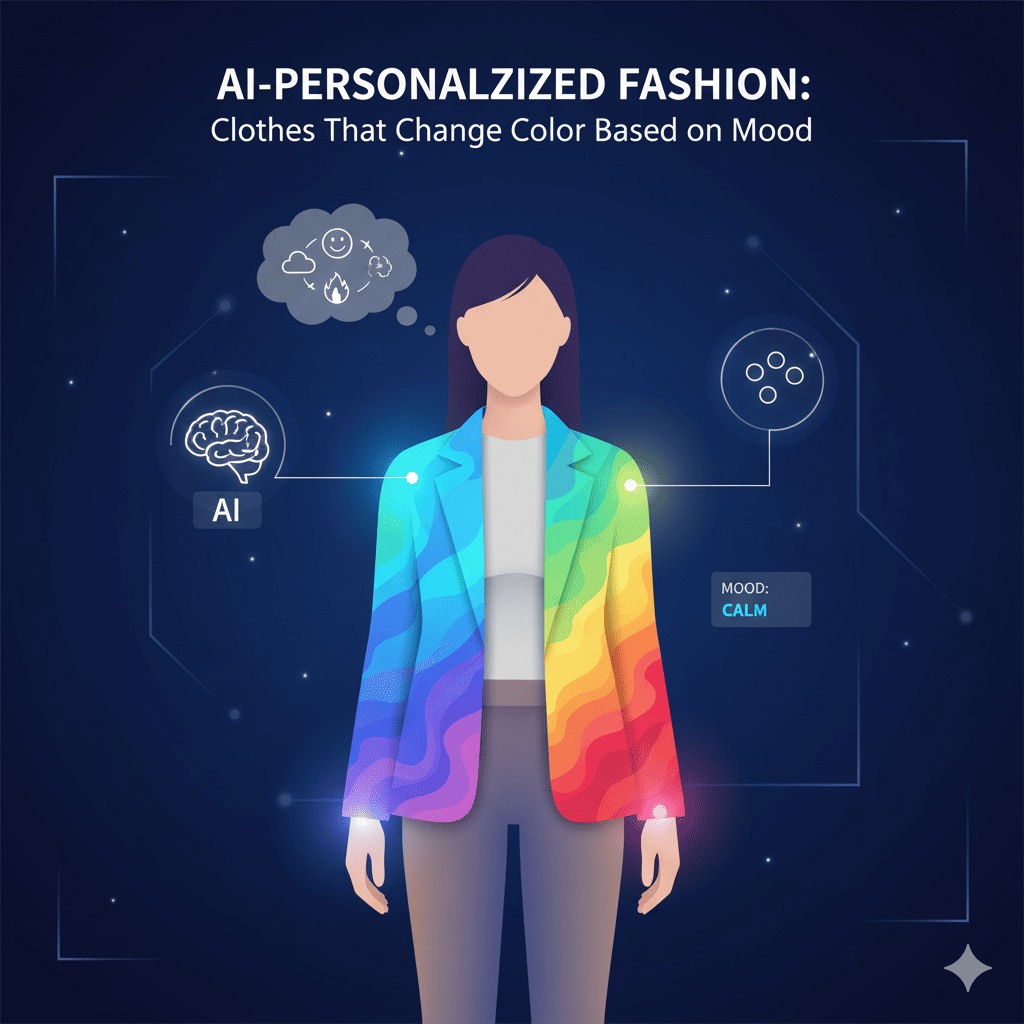
AI-Personalized Fashion is experiencing its most radical transformation since the invention of synthetic fabrics. In 2025, artificial intelligence has merged with wearable technology to create clothing that doesn’t just express your style—it literally changes color to reflect your emotional state. Welcome to the era of mood-responsive fashion, where your outfit adapts to your feelings in real-time, creating a truly personalized and dynamic wardrobe experience.
The Science Behind Mood-Responsive Clothing
Biometric Integration Technology Modern AI-personalized fashion utilizes advanced biometric sensors seamlessly woven into fabric fibers. These microscopic sensors monitor heart rate variability, skin conductance, body temperature, and even subtle changes in breathing patterns to determine emotional states with remarkable accuracy.
Chromogenic Fabric Revolution The breakthrough came with the development of electrically responsive chromogenic fibers that can shift through millions of color combinations based on electrical signals. These smart textiles contain microscopic capsules filled with thermochromic and electrochromic materials that react instantly to AI-generated commands.
Machine Learning Emotional Recognition Sophisticated AI algorithms analyze the combination of biometric data, environmental factors, time of day, and personal behavioral patterns to accurately identify emotional states. These systems learn individual emotional signatures over time, becoming increasingly precise at mood detection and color selection.
Real-Time Processing Power Miniaturized processors embedded in clothing can analyze biometric data and trigger color changes in milliseconds, creating seamless transitions that feel natural and responsive to emotional fluctuations.
How AI Determines Your Emotional State
Multi-Sensor Data Fusion AI systems combine data from various sources to create comprehensive emotional profiles. Heart rate patterns indicate stress or excitement, skin conductance reveals arousal levels, while micro-movements detected by accelerometers can signal anxiety or confidence.
Contextual Awareness Advanced systems consider environmental context—a elevated heart rate during exercise receives different interpretation than the same reading during a business meeting. GPS location, calendar events, and activity recognition help AI systems make accurate emotional assessments.
Personal Baseline Learning Each individual has unique physiological responses to emotions. AI systems spend initial weeks learning personal baselines, understanding how your body specifically responds to different emotional states for more accurate color triggering.
Privacy-First Processing Most systems process emotional data locally on embedded chips rather than transmitting sensitive biometric information to external servers, addressing privacy concerns while maintaining functionality.
The Color Psychology of Emotional Expression
Traditional Color-Mood Associations Blue typically represents calm and stability, red indicates passion or anger, green suggests balance and growth, while yellow conveys happiness and energy. AI systems incorporate these universal associations while learning personal color preferences.
Cultural Adaptation Advanced AI considers cultural backgrounds when selecting colors, as emotional color associations vary significantly across different cultures. What represents mourning in one culture might symbolize celebration in another.
Personal Color Preferences Over time, AI systems learn individual preferences—perhaps you feel most confident in deep purple or find comfort in soft pastels. The system adapts its emotional color mapping to align with personal associations and preferences.
Gradient Transitions Rather than abrupt color changes, advanced systems create smooth gradients and transitions that feel natural and aesthetically pleasing while accurately representing complex emotional states.
Leading Brands and Technology Pioneers
Google’s Project Spectrum Google’s wearable technology division has developed “smart fabric” that integrates seamlessly with Android devices, allowing clothing to change colors based on notification types, calendar events, and emotional analysis from various health apps.
Apple’s iWear Initiative Apple’s foray into mood-responsive fashion connects with Apple Watch biometric data, creating coordinated color schemes across multiple clothing items while maintaining the company’s focus on user privacy and data security.
Levi’s AI Denim Collection Levi Strauss partnered with AI companies to create denim that changes color intensity based on confidence levels—literally growing brighter as the wearer feels more self-assured throughout the day.
Startup Innovation Leaders Companies like MoodThread, EmotiWear, and ChromaCloth have emerged as specialized providers, focusing exclusively on AI-personalized fashion with more experimental approaches to emotional color mapping.
Real-World Applications and User Experiences
Professional Environment Benefits Business professionals report that mood-responsive clothing helps them maintain awareness of stress levels during important meetings, with subtle color changes serving as early warning systems for emotional overwhelm.
Therapeutic and Mental Health Applications Therapists and counselors use mood-responsive clothing as diagnostic tools, observing color patterns to better understand clients’ emotional states and track progress over time in treatment settings.
Social Connection Enhancement Couples and families wearing coordinated mood-responsive outfits report improved empathy and communication, as they can literally see each other’s emotional states reflected in their clothing colors.
Fitness and Wellness Integration Athletes and fitness enthusiasts use color-changing workout wear to monitor stress and recovery states, optimizing training intensity based on emotional and physical readiness indicators.
The Fashion Industry Transformation
Designer Collaboration Revolution Traditional fashion designers now collaborate with AI engineers and biometric specialists, creating entirely new job categories and skill requirements within the fashion industry.
Sustainable Fashion Benefits Mood-responsive clothing extends wardrobe versatility dramatically—a single garment can serve multiple aesthetic purposes, potentially reducing overall clothing consumption and supporting sustainability goals.
Customization at Scale Mass production techniques now accommodate individual emotional profiles, creating personalized fashion experiences without the traditional cost barriers of custom clothing.
Retail Experience Evolution Fashion retailers have transformed their spaces into technology showrooms, offering biometric testing stations where customers can experience how different garments respond to their emotional states before purchasing.
Technical Challenges and Solutions
Battery Life and Power Management Early mood-responsive clothing struggled with battery life, but advances in energy harvesting from body heat and movement have created self-sustaining systems that can operate for weeks without charging.
Washability and Durability Integrating electronics with textiles initially created maintenance challenges, but waterproof encapsulation techniques and flexible circuit designs now allow normal washing and wearing without functionality loss.
Color Accuracy and Consistency Achieving consistent color reproduction across different lighting conditions required advanced calibration systems that adapt chromogenic responses based on ambient light sensors.
Sensor Integration Comfort Making biometric sensors comfortable and unnoticeable required breakthroughs in flexible electronics and textile integration, resulting in sensors thinner than human hair woven directly into fabric.
Privacy and Ethical Considerations
Biometric Data Protection Mood-responsive clothing generates intimate personal data about emotional states, raising significant privacy concerns about who has access to this information and how it might be used or misused.
Consent and Control Users must have complete control over when emotional monitoring is active and who can see the resulting color displays, with easy opt-out mechanisms and privacy modes for sensitive situations.
Emotional Manipulation Concerns Critics worry that constant emotional monitoring could lead to manipulation or pressure to maintain certain emotional states, potentially affecting mental health and authentic self-expression.
Workplace Discrimination Risks Employers might unfairly judge employees based on emotional displays in clothing, creating new forms of discrimination that require careful legal and ethical consideration.
Market Analysis and Consumer Adoption
Pricing Trends and Accessibility Initial mood-responsive garments cost $200-500 per item, but mass production and competition have driven prices down to $50-150 for basic items, making the technology increasingly accessible.
Demographics and Early Adopters Young professionals and tech enthusiasts represent the largest early adopter segment, followed by fitness enthusiasts and individuals interested in mental health monitoring.
Geographic Adoption Patterns Urban areas with high technology adoption rates show fastest growth, while cultural attitudes toward emotional expression influence adoption rates in different regions worldwide.
Integration with Existing Wardrobes Most consumers start with single statement pieces—a color-changing scarf or jacket—before gradually expanding to full mood-responsive wardrobes as comfort and trust in the technology grows.
Health and Wellness Applications
Stress Management Tools Healthcare providers increasingly recommend mood-responsive clothing as stress monitoring tools, helping patients recognize emotional patterns and implement coping strategies before stress escalates.
Autism and Sensory Support For individuals with autism spectrum disorders, mood-responsive clothing provides valuable emotional communication tools, helping express feelings that might be difficult to verbalize.
Elderly Care Applications In senior care facilities, mood-responsive clothing helps caregivers quickly identify residents experiencing distress, depression, or discomfort, improving response times and care quality.
Mental Health Monitoring Therapists and psychiatrists use long-term mood pattern data from clothing to better understand patient emotional cycles and adjust treatment approaches accordingly.
Social and Cultural Impact
Emotional Transparency Movement Mood-responsive fashion contributes to growing cultural acceptance of emotional transparency, challenging traditional expectations about maintaining emotional facades in public spaces.
Non-Verbal Communication Evolution Color-changing clothing creates new forms of non-verbal communication, allowing people to express emotional availability, stress levels, or social preferences without speaking.
Empathy and Social Connection Visible emotional states in clothing can increase empathy between strangers and strengthen social connections by providing insight into others’ internal experiences.
Cultural Expression and Identity Different cultures are adapting mood-responsive fashion to reflect their specific emotional expression traditions and color symbolism, creating diverse regional variations in the technology’s application.
Future Technological Developments
Advanced Emotion Recognition Next-generation systems will recognize more nuanced emotional states, distinguishing between different types of stress, happiness variations, and complex mixed emotions with greater accuracy.
Environmental Responsiveness Future clothing may change colors based not just on mood but also environmental factors like air quality, UV exposure, or temperature changes, providing comprehensive personal environmental monitoring.
Social Network Integration Emerging systems allow mood-responsive clothing to share emotional states with friends and family through social networks, creating new forms of digital intimacy and connection.
Predictive Emotional Analysis AI systems are developing capabilities to predict emotional changes before they fully manifest, potentially offering early intervention opportunities for mental health management.
Manufacturing and Supply Chain Innovation
Smart Textile Production Manufacturing facilities now require clean room environments similar to electronics production, as integrating sensitive electronic components with textiles demands precision manufacturing processes.
Global Supply Chain Adaptation Fashion supply chains have evolved to include technology suppliers, battery manufacturers, and software developers, creating complex new partnership networks across traditional industry boundaries.
Quality Control Evolution Testing procedures now include electronic functionality verification alongside traditional textile quality measures, requiring new expertise and equipment throughout the production process.
Intellectual Property Landscapes The convergence of fashion and technology has created complex patent landscapes where clothing designs intersect with AI algorithms and sensor technologies.
User Education and Adoption Support
Digital Literacy Requirements Consumers need education about biometric technology, privacy settings, and emotional awareness to effectively use mood-responsive clothing, creating new customer support requirements.
Setup and Calibration Processes Initial garment setup involves personal biometric calibration sessions where AI systems learn individual emotional signatures, requiring user patience and commitment to the learning process.
Maintenance and Troubleshooting Users must understand basic troubleshooting for electronic components while maintaining textile care practices, requiring new skills that bridge fashion and technology knowledge.
Community Support Networks Online communities and user groups have emerged to share experiences, troubleshoot problems, and discover creative applications for mood-responsive fashion technology.
Environmental and Sustainability Impact
Electronic Waste Considerations The integration of electronics with textiles raises questions about disposal and recycling, requiring new approaches to handle electronic components within fabric waste streams.
Energy Consumption Analysis While individual garments consume minimal power, the collective energy impact of millions of mood-responsive clothing items requires consideration in sustainability planning.
Sustainable Material Innovation Research focuses on developing biodegradable sensors and electronic components that can safely decompose with organic textile materials at end-of-life.
Circular Economy Opportunities Mood-responsive clothing’s extended functionality could support circular economy models where garments retain value longer and can be updated with software rather than replaced.
Business Model Innovation
Subscription Service Emergence Some companies offer mood-responsive clothing through subscription models, providing regular updates to both hardware and software components while maintaining current fashion trends.
Data Monetization Strategies Companies explore ethical ways to monetize aggregated emotional data for market research and product development while maintaining strict privacy protections for individual users.
Partnership Ecosystem Development Fashion brands increasingly partner with technology companies, creating hybrid business models that combine traditional fashion expertise with cutting-edge AI development.
Customization Premium Services High-end providers offer personalized emotional color mapping services, creating custom algorithms tailored to individual psychological profiles and aesthetic preferences.
Conclusion: The Future of Emotionally Intelligent Fashion
AI-personalized fashion represents more than a technological novelty—it’s a fundamental shift toward clothing that truly adapts to human needs and experiences. As mood-responsive garments become more sophisticated and accessible, they’re creating new possibilities for self-expression, emotional awareness, and social connection.
The transformative potential includes:
- Enhanced emotional self-awareness and mental health monitoring
- New forms of non-verbal communication and social connection
- Personalized fashion experiences that adapt to individual needs
- Innovative approaches to sustainable and versatile wardrobes
- Integration of wellness technology into daily life
Key challenges requiring ongoing attention:
- Privacy protection and ethical data use
- Accessibility and affordability for diverse populations
- Cultural sensitivity in emotional expression interpretation
- Environmental impact and sustainable disposal methods
- User education and technology literacy development
Future outlook for AI-personalized fashion:
- More sophisticated emotion recognition capabilities
- Integration with broader health and wellness ecosystems
- Expansion into specialized applications like medical monitoring
- Evolution of social norms around emotional transparency
- Continued convergence of fashion, technology, and healthcare industries
As we move forward, the success of mood-responsive fashion will depend not just on technological advancement, but on thoughtful consideration of human needs, cultural values, and ethical implications. The clothes that change color based on mood represent just the beginning of a broader transformation toward truly intelligent, responsive, and personalized fashion experiences.
Practical considerations for consumers:
- Start with single pieces to test comfort and functionality
- Prioritize privacy settings and data control options
- Consider cultural context and workplace appropriateness
- Invest in quality systems with good customer support
- Stay informed about technological updates and new features
The future of fashion is not just about looking good—it’s about feeling understood, supported, and authentically expressed through clothing that responds to who you are and how you feel. As AI-personalized fashion continues evolving, it promises to transform not just our wardrobes, but our relationships with both technology and our own emotional experiences.
Also read this:
Esports Betting with AI Predictions: Risk or Reward?