
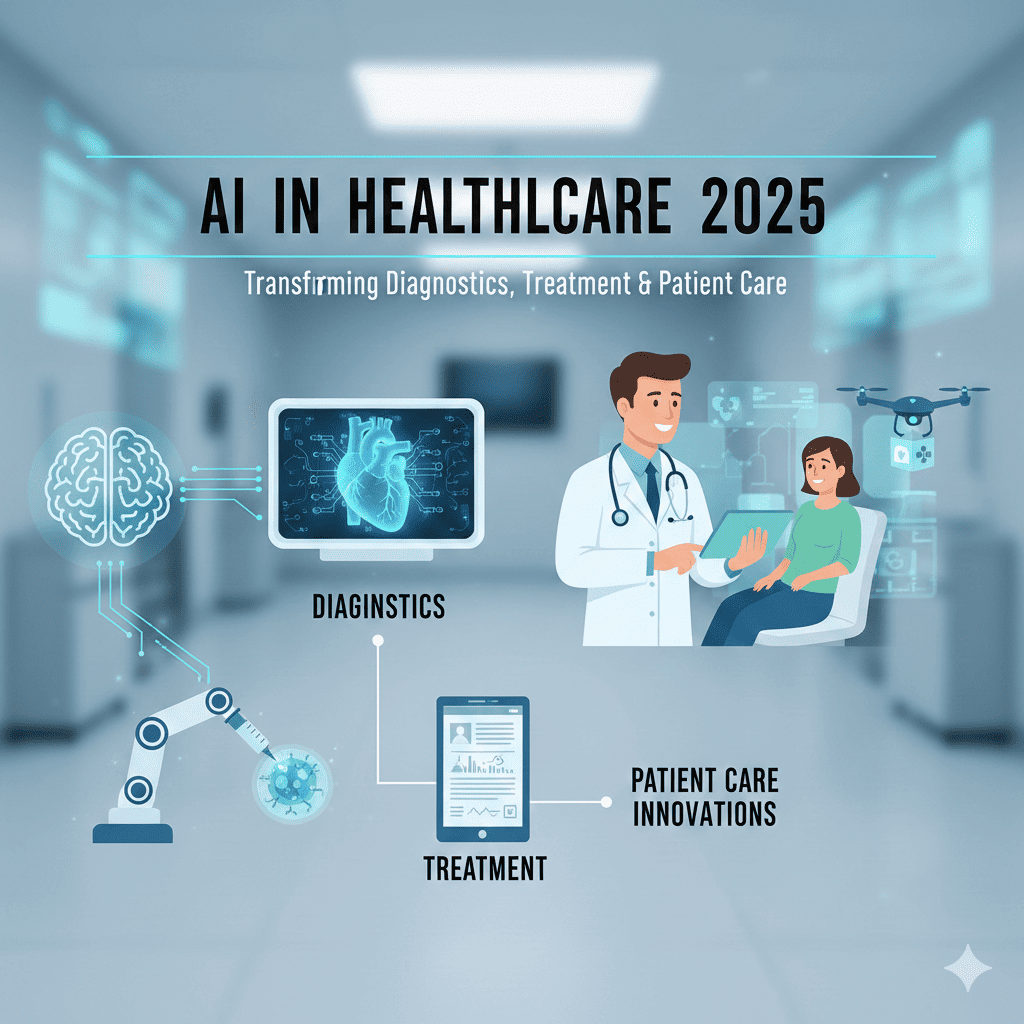
The healthcare industry stands at the precipice of its most significant revolution since the discovery of antibiotics. In 2025, AI is transforming healthcare in ways that seemed like science fiction just a decade ago. From detecting diseases years before symptoms appear to personalizing treatment plans down to individual genetic markers, artificial intelligence has moved from experimental labs into everyday clinical practice.
This comprehensive exploration reveals how AI is transforming healthcare across diagnostics, treatment protocols, patient care, and administrative operations. Whether you’re a healthcare professional, patient, or simply interested in medical innovation, understanding these changes will help you navigate the future of medicine.
1. Revolutionary AI-Powered Diagnostic Systems
Early and accurate diagnosis can mean the difference between life and death. This is where AI is transforming healthcare most dramatically, enabling physicians to identify diseases faster and more accurately than ever before.
Medical Imaging and Radiology
AI algorithms now analyze medical images with accuracy that matches or exceeds human radiologists in many specialties. These systems examine X-rays, CT scans, MRIs, and ultrasounds, identifying subtle patterns invisible to the human eye.
In oncology, AI-powered imaging systems detect tumors at incredibly early stages. Studies show these systems can identify breast cancer up to two years earlier than traditional mammography screening. The algorithms analyze thousands of data points in each image, comparing them against millions of previous cases to spot anomalies measuring just millimeters.
Neurological imaging has seen remarkable advances. AI systems now predict Alzheimer’s disease progression years before cognitive symptoms appear by analyzing brain scans for microscopic changes in neural pathways. This early detection window opens possibilities for preventive treatments that can slow or halt disease progression.
Cardiovascular imaging has transformed with AI analysis of echocardiograms and cardiac CT scans. These systems calculate ejection fraction, identify valve abnormalities, and predict heart failure risk with precision that reduces diagnosis time from hours to minutes while improving accuracy.
Pathology and Laboratory Diagnostics
Digital pathology powered by AI examines tissue samples, blood work, and cellular structures with unprecedented speed and accuracy. Machine learning models trained on millions of pathology slides can identify cancerous cells, determine tumor grades, and predict treatment responses.
AI systems in hematology analyze blood samples to detect rare blood disorders, identify infection markers, and monitor treatment effectiveness. These platforms process results in real-time, flagging critical findings that require immediate clinical attention.
Molecular diagnostics leverage AI to interpret complex genetic testing results. These systems identify disease-causing mutations, predict drug responses based on genetic profiles, and recommend personalized treatment approaches.
Predictive Diagnostics and Risk Assessment
Perhaps most revolutionary is AI’s ability to predict disease before it manifests. By analyzing electronic health records, genetic data, lifestyle factors, and environmental influences, AI models identify individuals at high risk for specific conditions.
Diabetes prediction models analyze factors including blood glucose patterns, family history, body mass index, and dietary habits to identify pre-diabetic patients years before diagnosis. This early warning enables lifestyle interventions that can prevent disease onset entirely.
Cardiovascular risk prediction has advanced beyond traditional calculators. AI systems incorporate hundreds of variables including imaging data, biomarkers, genetic factors, and social determinants of health to provide personalized risk assessments that guide preventive care strategies.
2. Personalized Treatment Planning and Precision Medicine
The era of one-size-fits-all medicine is ending as AI is transforming healthcare through personalized treatment strategies tailored to individual patient characteristics.
Genomic Medicine and Targeted Therapies
AI algorithms analyze entire genomes in hours rather than months, identifying genetic variations that influence disease susceptibility and treatment response. This capability has revolutionized cancer treatment, where AI matches tumor genetic profiles with the most effective targeted therapies.
Pharmacogenomics uses AI to predict how individuals will respond to specific medications based on their genetic makeup. This eliminates much of the trial-and-error approach to prescribing, reducing adverse drug reactions and improving treatment efficacy from the first prescription.
Rare disease diagnosis has accelerated dramatically. AI systems compare patient symptoms and genetic data against databases of known rare conditions, providing diagnoses in cases that previously remained medical mysteries for years.
Treatment Protocol Optimization
AI clinical decision support systems analyze patient data alongside current medical literature, clinical guidelines, and treatment outcomes from similar cases. These platforms recommend evidence-based treatment plans customized to individual patient factors.
In oncology, AI systems design personalized chemotherapy regimens by analyzing tumor characteristics, patient genetics, treatment history, and predicted side effects. This optimization maximizes therapeutic benefit while minimizing toxicity.
Chronic disease management benefits from AI platforms that continuously adjust treatment plans based on real-time patient data. Diabetes management systems, for example, analyze glucose patterns, medication adherence, activity levels, and dietary intake to recommend insulin dosing and lifestyle modifications.
Drug Discovery and Development
AI accelerates the traditionally slow and expensive drug development process. Machine learning models predict which molecular compounds will successfully treat specific diseases, reducing the number of candidates requiring laboratory testing.
Clinical trial matching uses AI to identify patients who meet specific trial criteria and would benefit most from experimental treatments. This accelerates enrollment while ensuring trials include diverse, representative populations.
Repurposing existing drugs for new indications happens faster with AI analysis of molecular mechanisms and disease pathways. Several COVID-19 treatments emerged through AI-identified drug repurposing opportunities.
3. Enhanced Patient Care and Monitoring
Beyond diagnosis and treatment, AI is transforming healthcare delivery by improving how patients receive care and enabling continuous health monitoring.
Virtual Health Assistants and Telemedicine
AI-powered virtual health assistants provide 24/7 patient support, answering medical questions, assessing symptoms, and determining whether professional care is needed. These systems triage patients effectively, directing emergencies to immediate care while managing routine concerns through self-care guidance.
Telemedicine platforms incorporate AI to enhance remote consultations. Real-time symptom analysis, automated vital sign monitoring through smartphone cameras, and AI-generated visit summaries improve the quality and efficiency of virtual appointments.
Mental health care has expanded access through AI chatbots that provide cognitive behavioral therapy, mood tracking, and crisis intervention. While not replacing human therapists, these tools offer immediate support between appointments and serve populations without access to mental health professionals.
Remote Patient Monitoring
Wearable devices and home monitoring systems continuously collect health data that AI analyzes for concerning patterns. These systems alert healthcare providers to deteriorating conditions before patients recognize symptoms themselves.
Cardiac monitoring through smartwatches and patches uses AI to detect arrhythmias, including atrial fibrillation. Early detection enables prompt treatment that prevents strokes and other complications.
Post-surgical monitoring employs AI to track recovery progress, identify infection risk, and predict complications. Patients recovering at home benefit from continuous oversight that previously required hospital stays.
Chronic disease monitoring for conditions like COPD, heart failure, and diabetes uses AI to detect subtle changes indicating exacerbations. Early intervention prevents emergency department visits and hospitalizations.
Elderly Care and Fall Prevention
AI-powered monitoring systems help elderly individuals live independently longer by detecting falls, monitoring medication adherence, and identifying changes in daily activity patterns that may indicate health problems.
Voice-activated assistants customized for elderly care provide medication reminders, answer health questions, facilitate communication with family and providers, and offer companionship that combats social isolation.
4. Surgical Innovation and Robotic Assistance
Operating rooms in 2025 showcase how AI is transforming healthcare through enhanced surgical precision and outcomes.
Robot-Assisted Surgery
AI-guided surgical robots provide superhuman precision and stability. These systems filter out hand tremors, make micro-adjustments during procedures, and access surgical sites through smaller incisions than human hands can manage.
Preoperative planning uses AI to analyze patient imaging and create three-dimensional surgical roadmaps. Surgeons can virtually perform procedures before entering the operating room, identifying potential complications and optimizing their approach.
Real-time surgical guidance overlays AI-generated information onto the surgeon’s field of view, highlighting critical structures to avoid, optimal cutting planes, and tumor margins. This augmented reality assistance reduces complications and improves outcomes.
Minimally invasive procedures have expanded as AI-assisted robotics enable complex surgeries through tiny incisions. Patients benefit from reduced trauma, faster recovery, and fewer complications.
Surgical Outcome Prediction
AI models analyze patient factors, procedure complexity, and surgeon experience to predict surgical outcomes and complication risks. This information guides surgical decision-making and informed consent discussions.
Personalized recovery protocols use AI to predict how individual patients will respond to different post-operative care approaches. This optimization reduces recovery time and improves long-term outcomes.
Training and Simulation
Virtual reality surgical simulators powered by AI provide realistic training experiences without risk to patients. These systems adapt difficulty based on trainee performance and provide detailed feedback for skill development.
AI analysis of recorded surgeries identifies opportunities for technique improvement and creates customized training programs for surgical residents.
5. Administrative Efficiency and Healthcare Operations
Behind the scenes, AI is transforming healthcare operations, reducing administrative burden and improving system efficiency.
Electronic Health Record Management
Natural language processing extracts meaningful information from clinical notes, eliminating much of the manual data entry that burdens clinicians. AI-powered documentation assistants listen to patient encounters and generate structured notes, freeing physicians to focus on patients rather than computers.
Automated coding and billing systems analyze clinical documentation and assign appropriate diagnostic and procedure codes. This reduces coding errors, accelerates reimbursement, and ensures compliance with regulations.
Clinical documentation improvement programs use AI to identify missing information, suggest additional diagnoses supported by clinical data, and ensure records accurately reflect care complexity.
Appointment Scheduling and Resource Optimization
AI scheduling systems optimize appointment timing based on procedure duration predictions, provider availability, patient preferences, and no-show probability. This maximizes clinic efficiency while improving patient satisfaction.
Operating room scheduling uses machine learning to predict procedure durations more accurately than historical averages, reducing delays and increasing surgical volume without extending work hours.
Hospital bed management systems predict admission and discharge patterns, optimizing bed assignment and reducing emergency department boarding times.
Supply Chain and Inventory Management
Predictive analytics forecast supply needs based on historical usage patterns, seasonal variations, and anticipated demand changes. This prevents shortages while reducing waste from expired products.
Equipment maintenance scheduling uses AI to predict when medical devices require servicing, preventing unexpected failures that disrupt care delivery.
6. Population Health Management and Preventive Care
Public health initiatives benefit as AI is transforming healthcare from reactive sick care to proactive health maintenance.
Disease Outbreak Prediction and Response
AI surveillance systems analyze data from emergency departments, laboratory reports, social media, and environmental sensors to detect disease outbreaks earlier than traditional reporting mechanisms. This early warning enables faster public health responses that contain spread.
Epidemic modeling predicts disease transmission patterns, helping public health officials allocate resources and implement targeted interventions. These models proved invaluable during COVID-19 and continue guiding pandemic preparedness.
Vaccine distribution optimization uses AI to identify high-risk populations, predict demand, and design efficient distribution networks that maximize coverage.
Social Determinants of Health
AI platforms analyze non-medical factors affecting health outcomes including housing stability, food security, transportation access, and environmental exposures. This holistic view enables interventions addressing root causes of poor health.
Community health assessments use machine learning to identify neighborhoods with elevated disease risk and guide public health resource allocation to areas of greatest need.
Preventive Care Optimization
AI identifies patients overdue for preventive screenings, vaccinations, and routine care. Automated outreach systems contact patients through their preferred communication channels, improving preventive care adherence.
Lifestyle intervention programs use AI to personalize recommendations for diet, exercise, stress management, and sleep optimization based on individual health data and behavior patterns.
7. Mental Health and Behavioral Healthcare Innovation
Mental healthcare, long underserved, has seen remarkable advances as AI is transforming healthcare delivery in behavioral health.
Early Detection of Mental Health Conditions
AI analysis of speech patterns, text communications, and social media activity can identify individuals at risk for depression, anxiety, and suicidal ideation. These early warning systems enable timely intervention before crises occur.
Smartphone sensors track behavioral markers including sleep patterns, physical activity, social interaction frequency, and location patterns. Changes in these digital biomarkers often precede self-reported symptom changes, enabling proactive care adjustments.
Personalized Mental Health Treatment
AI platforms match patients with therapists whose style and expertise align with patient needs and preferences. This improved matching increases treatment engagement and effectiveness.
Digital therapeutics deliver evidence-based psychological interventions through smartphone apps. AI personalizes these interventions based on symptom severity, treatment response, and user engagement patterns.
Medication management for psychiatric conditions uses AI to predict which medications will be most effective with fewest side effects based on genetic profiles and treatment history.
Crisis Intervention and Support
AI-powered crisis text lines and chatbots provide immediate support to individuals in mental health crises. These systems assess suicide risk, provide de-escalation techniques, and connect users with emergency services when necessary.
Virtual reality exposure therapy uses AI to create personalized immersive environments for treating PTSD, phobias, and anxiety disorders. The technology adapts scenarios based on patient responses, optimizing therapeutic benefit.
8. Medical Education and Clinical Training
Healthcare education advances as AI is transforming healthcare professional training and continuing education.
Personalized Learning Pathways
AI tutoring systems assess knowledge gaps and learning styles, creating customized education plans for medical students and residents. These adaptive learning platforms ensure comprehensive competency development.
Clinical case simulations use AI to generate realistic patient scenarios that respond dynamically to trainee decisions. This safe environment enables learning from mistakes without patient harm.
Continuing Medical Education
AI platforms monitor clinical practice patterns and recommend continuing education addressing identified knowledge gaps or emerging practice areas. This targeted learning keeps practitioners current with rapidly evolving medical knowledge.
Literature summarization services use natural language processing to distill key findings from medical journals, enabling busy clinicians to stay informed without reading every relevant publication.
Skill Assessment and Credentialing
AI analysis of procedural videos assesses technical skill, identifying areas for improvement and verifying competency for credentialing purposes. Objective performance metrics supplement traditional subjective evaluations.
9. Ethical Considerations and Challenges
While AI is transforming healthcare with tremendous benefits, important ethical considerations require ongoing attention.
Bias and Healthcare Disparities
AI systems trained on non-representative datasets may perpetuate or amplify existing healthcare disparities. Ensuring training data includes diverse populations and monitoring AI recommendations for bias remains critical.
Algorithm transparency challenges arise when complex neural networks make clinical recommendations through processes humans cannot fully explain. Balancing AI performance with interpretability concerns clinicians and ethicists.
Data Privacy and Security
Healthcare AI requires vast amounts of patient data, raising privacy concerns. Robust data protection measures, patient consent processes, and cybersecurity protocols are essential as healthcare systems become increasingly digital.
Human-AI Collaboration
Maintaining appropriate human oversight prevents over-reliance on AI recommendations. Healthcare providers must understand AI limitations and retain ultimate responsibility for clinical decisions.
Access and Equity
Ensuring AI healthcare advances benefit all populations rather than only wealthy nations and individuals requires intentional effort. Addressing the digital divide and making AI tools accessible globally remains an ongoing challenge.
10. The Future Horizon: What’s Next in AI Healthcare
Looking beyond 2025, AI is transforming healthcare in ways that will continue accelerating and expanding into new frontiers.
Fully Integrated Health Ecosystems
Future healthcare will feature seamlessly integrated AI systems that combine data from wearables, home monitoring, electronic health records, genomics, environmental sensors, and social determinants to provide truly holistic care.
Preventive Medicine Revolution
As predictive capabilities improve, healthcare will shift from treating disease to preventing it. AI will identify at-risk individuals decades before symptoms appear, enabling interventions that maintain health rather than restore it.
Regenerative Medicine and Longevity
AI-accelerated research in regenerative medicine, including stem cell therapies and tissue engineering, promises to repair or replace damaged organs. Longevity research guided by AI analysis of aging mechanisms may extend healthy lifespan significantly.
Brain-Computer Interfaces
Neural implants guided by AI will restore function to paralyzed individuals, treat neurological conditions, and potentially enhance cognitive capabilities. These technologies move from research to clinical reality.
Global Health Transformation
Telemedicine and AI-powered diagnostic tools will extend quality healthcare to remote and underserved areas globally. Smartphone-based AI diagnostics may provide better care in resource-limited settings than previously available through traditional infrastructure.
Conclusion: Embracing the AI Healthcare Revolution
The evidence is overwhelming: AI is transforming healthcare in profound and beneficial ways. From catching diseases earlier to personalizing treatments more effectively, from improving surgical outcomes to making healthcare more accessible, artificial intelligence addresses many of medicine’s most persistent challenges.
However, technology alone doesn’t heal patients. The most successful healthcare systems in 2025 and beyond will be those that thoughtfully integrate AI capabilities while preserving the irreplaceable human elements of care—empathy, clinical judgment, and the therapeutic relationship between provider and patient.
Healthcare professionals must embrace AI as a powerful tool that augments rather than replaces their expertise. Patients should feel empowered by AI capabilities that enable more personalized, effective care while remaining engaged partners in their health journey.
The transformation is not coming—it’s here. Healthcare organizations, providers, and patients who understand and adapt to AI-enabled medicine will thrive. Those who resist will find themselves increasingly unable to compete with or access the quality of care AI makes possible.
As we stand at this pivotal moment where AI is transforming healthcare fundamentally, the opportunity exists to create a healthcare system that is more effective, efficient, equitable, and humane than ever before. Realizing this vision requires continued innovation, thoughtful regulation, ethical vigilance, and commitment to ensuring AI benefits all humanity rather than privileging the few.
Also read this:
Small Business AI Guide 2025: Best Low-Budget AI Tools That Actually Work
Best Autonomous AI Agents for Business in 2026 (Real Workflow Tests & Performance Review)
The Hidden Energy Cost of AI: How Large Models Impact the Environment & What Comes Next