
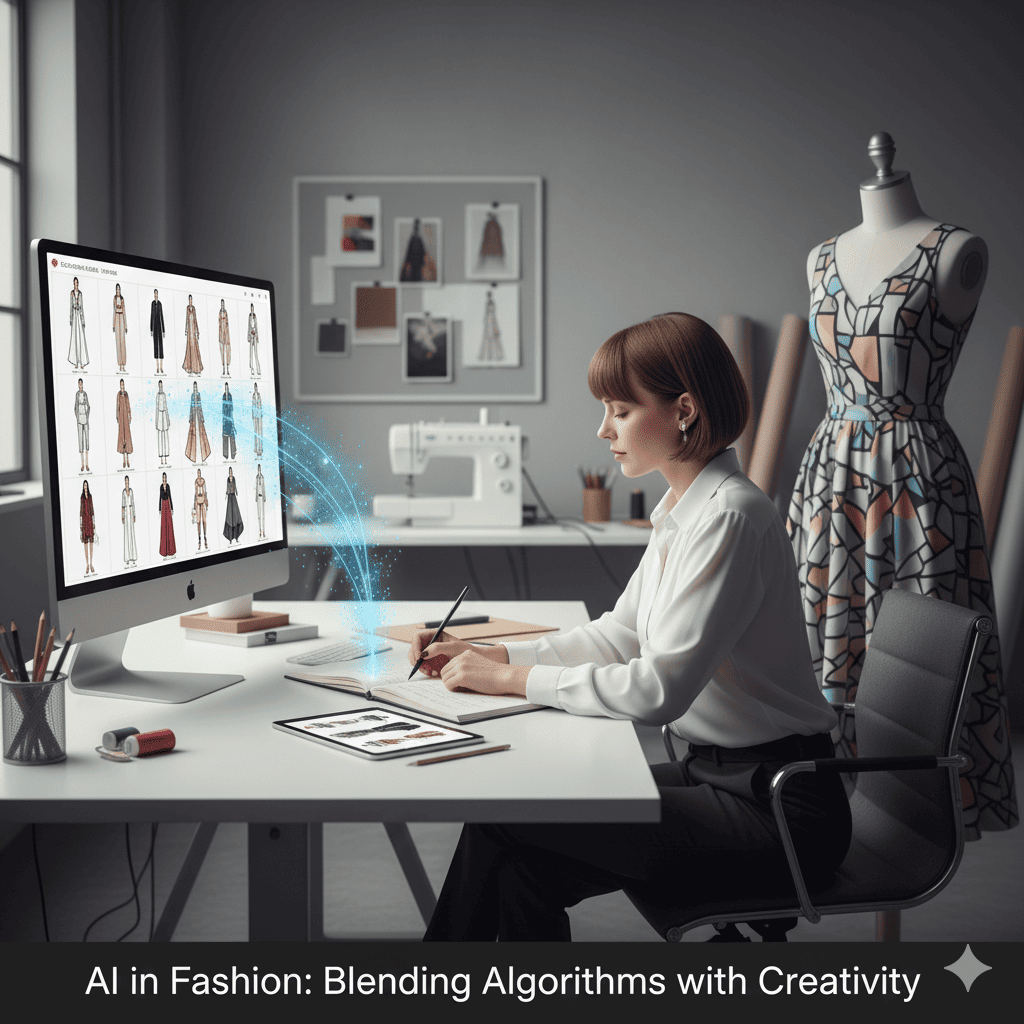
The fashion industry has always been at the forefront of innovation, constantly pushing boundaries and redefining what’s possible in design and creativity. Today, we’re witnessing a revolutionary transformation as artificial intelligence enters the runway, fundamentally changing how fashion is conceived, created, and consumed. AI in fashion isn’t just a fleeting trend—it’s reshaping the entire industry from design studios to retail floors, creating a new paradigm where human creativity meets machine intelligence.
1. The Digital Revolution: Understanding AI in Fashion
The integration of AI in fashion represents one of the most significant technological shifts the industry has experienced since the invention of the sewing machine. Artificial intelligence, with its ability to process vast amounts of data, recognize patterns, and generate creative solutions, is becoming an indispensable tool for designers, brands, and retailers alike.
AI in fashion encompasses various technologies including machine learning, computer vision, natural language processing, and generative algorithms. These technologies work together to analyze trends, predict consumer behavior, generate design concepts, and even create entirely new patterns and styles that human designers might never have imagined.
The fashion industry generates approximately 2.5 quintillion bytes of data daily, from social media posts and runway shows to retail transactions and customer feedback. This enormous volume of information was previously impossible to process effectively. However, AI in fashion now enables brands to harness this data, extracting meaningful insights that drive design decisions and business strategies.
Major fashion houses like Gucci, Prada, and Louis Vuitton are investing heavily in AI technologies. Even fast-fashion giants like Zara and H&M are leveraging AI in fashion to stay competitive in an increasingly digital marketplace. This widespread adoption signals that AI isn’t replacing human creativity—it’s amplifying it, providing designers with powerful tools to explore new creative territories.
2. Generative Design: How AI in Fashion Creates Original Patterns
One of the most exciting applications of AI in fashion is generative design, where algorithms create original patterns, textures, and silhouettes. Unlike traditional computer-aided design tools that simply assist human designers, generative AI actively participates in the creative process, producing designs that can surprise and inspire even the most experienced fashion professionals.
Generative adversarial networks (GANs) have become particularly popular in AI in fashion applications. These systems consist of two neural networks that work in tandem: one generates designs while the other evaluates them, creating a feedback loop that produces increasingly sophisticated results. The outcome is often unexpected combinations of colors, patterns, and forms that challenge conventional aesthetic boundaries.
Brands like Tommy Hilfiger have collaborated with IBM and the Fashion Institute of Technology to develop AI systems that analyze decades of runway data. By understanding what makes designs successful, these AI in fashion systems can generate new concepts that respect brand heritage while pushing creative boundaries. The AI studies silhouettes, color combinations, fabric choices, and styling details to create designs that feel both familiar and innovative.
Dutch designer Iris van Herpen, known for her avant-garde creations, has embraced AI in fashion to create intricate 3D-printed designs that would be impossible to produce through traditional methods. Her work demonstrates how AI can expand the vocabulary of fashion design, enabling creators to realize visions that were previously confined to imagination.
The creative process with AI in fashion typically begins with designers feeding the system parameters such as color palettes, fabric types, historical references, and stylistic preferences. The AI then generates hundreds or thousands of variations, which designers can refine, combine, or use as inspiration for entirely new directions. This collaborative approach between human and machine is redefining what it means to be a fashion designer in the 21st century.
3. Trend Forecasting: AI in Fashion Predicting What’s Next
Trend forecasting has traditionally been the domain of expert analysts who travel to fashion capitals, attend trade shows, and study cultural movements to predict what consumers will want months or years in advance. AI in fashion is revolutionizing this process by analyzing massive datasets from social media, e-commerce platforms, runway shows, and street style photography to identify emerging trends with unprecedented accuracy.
Companies like WGSN and Heuritech are pioneering AI in fashion trend forecasting by deploying computer vision algorithms that scan millions of Instagram photos, identifying patterns in colors, styles, and aesthetics. These systems can detect micro-trends before they reach mainstream awareness, giving brands a crucial competitive advantage in fast-moving markets.
AI in fashion trend forecasting goes beyond simply identifying what’s popular right now. Advanced machine learning models can predict how trends will evolve, estimating when they’ll peak and when they’ll decline. This predictive capability helps brands make smarter inventory decisions, reducing waste and improving profitability.
The democratization of trend information through AI in fashion is also changing power dynamics in the industry. Smaller brands and independent designers now have access to insights that were previously available only to major corporations with substantial research budgets. This leveling of the playing field is fostering greater diversity and innovation across the fashion landscape.
Fashion weeks in New York, Paris, Milan, and London generate enormous amounts of visual data. AI in fashion systems analyze these runway shows in real-time, identifying key themes, color stories, and silhouette trends. By cross-referencing this information with consumer search data and social media engagement, AI can predict which runway looks will translate into commercial success and which will remain purely artistic statements.
4. Personalization at Scale: AI in Fashion Customization
One of the most consumer-facing applications of AI in fashion is personalized shopping experiences and customization. Modern consumers expect products and services tailored to their individual preferences, and AI makes this possible at a scale previously unimaginable.
AI in fashion personalization engines analyze customer behavior, purchase history, browsing patterns, and even social media activity to understand individual style preferences. Platforms like Stitch Fix have built entire business models around AI-driven styling, where algorithms select clothing items for customers based on detailed style profiles and feedback loops.
Amazon’s Echo Look, though discontinued, demonstrated the potential of AI in fashion for in-home styling assistance. The device used computer vision to analyze outfit combinations and provide fashion advice based on current trends and the user’s style profile. While this particular product didn’t succeed, it pointed toward a future where AI fashion advisors become commonplace.
Virtual fitting rooms powered by AI in fashion are addressing one of online shopping’s biggest challenges: uncertainty about fit and appearance. Companies like Vue.ai and Metail create 3D body models of customers, allowing them to virtually try on clothing before purchasing. These systems use computer vision and machine learning to accurately represent how garments will fit different body types, reducing return rates and increasing customer satisfaction.
The luxury segment is also embracing AI in fashion personalization. Burberry has implemented AI-powered systems that recognize customers when they enter stores, providing sales associates with information about their preferences and purchase history. This enables a level of personalized service that enhances the luxury shopping experience while gathering valuable data for future design and marketing decisions.
5. Sustainable Fashion: How AI in Fashion Reduces Waste
The fashion industry is one of the world’s largest polluters, responsible for significant water consumption, chemical usage, and textile waste. AI in fashion is emerging as a powerful tool for creating a more sustainable industry by optimizing production, reducing waste, and enabling circular fashion models.
Overproduction is a major sustainability challenge in fashion. Brands often manufacture far more products than they sell, leading to massive waste. AI in fashion demand forecasting helps solve this problem by predicting with greater accuracy how much of each item will sell. By analyzing historical sales data, current trends, weather patterns, and economic indicators, AI systems help brands produce closer to actual demand.
Material innovation is another area where AI in fashion contributes to sustainability. Researchers are using machine learning to discover new sustainable fabrics and optimize existing ones. AI can analyze the properties of various natural and synthetic materials, predicting which combinations will produce desired characteristics like durability, comfort, and environmental friendliness.
AI in fashion is also facilitating the growth of circular economy models. Computer vision systems can sort used clothing for recycling more efficiently than human workers, identifying fabric types and quality levels. This enables more effective textile recycling, keeping materials in use longer and reducing the need for virgin resources.
Brands like H&M are using AI in fashion to optimize their supply chains, reducing transportation emissions and energy consumption. Machine learning algorithms identify inefficiencies in manufacturing and distribution networks, suggesting improvements that reduce environmental impact while maintaining or improving profitability.
The concept of “on-demand” fashion, where items are produced only after they’re ordered, is enabled by AI in fashion technologies that optimize small-batch production. This model dramatically reduces waste while allowing for greater customization, representing a fundamental shift from the traditional fashion industry’s volume-based approach.
6. Virtual Fashion: AI in Fashion in Digital Spaces
As virtual and augmented reality technologies mature, AI in fashion is creating entirely new categories of digital clothing and accessories. Virtual fashion exists purely in digital spaces—on social media, in video games, or in virtual worlds—and never requires physical production.
Digital fashion houses like The Fabricant and DressX are pioneering this space, creating stunning virtual garments that can be “worn” in photos or avatars. AI in fashion enables the creation of these digital designs, which can defy physical constraints like gravity, material properties, or even anatomical limitations. This opens unprecedented creative possibilities while having virtually zero environmental impact.
The gaming industry represents a massive market for AI in fashion. Games like Fortnite and Roblox have robust virtual fashion ecosystems where players spend real money on digital clothing and accessories for their avatars. AI in fashion systems help create, customize, and personalize these virtual items, which have become significant revenue streams for both game developers and fashion brands.
Luxury brands are entering the virtual fashion space through AI in fashion technologies. Gucci, Balenciaga, and Ralph Lauren have all launched virtual collections, recognizing that digital fashion represents not just a new revenue stream but an entirely new way for consumers to express identity and style in increasingly digital lives.
Non-fungible tokens (NFTs) have added another dimension to AI in fashion in digital spaces. Digital fashion items can be minted as NFTs, creating scarcity and ownership in the virtual world similar to physical collectibles. While the NFT market has experienced volatility, the underlying concept of digital fashion ownership continues to evolve.
AI in fashion is also enabling virtual fashion shows and presentations. During the COVID-19 pandemic, many brands experimented with digital runway shows created using AI and computer graphics. These virtual presentations can be more elaborate and creative than physical shows, unbound by real-world physics or budget constraints for physical sets and production.
7. Smart Manufacturing: AI in Fashion Production Optimization
Beyond design and retail, AI in fashion is transforming manufacturing processes, making them more efficient, flexible, and responsive to market demands. Smart factories equipped with AI-powered systems represent the future of fashion production.
Computer vision systems in AI in fashion manufacturing can inspect quality with greater consistency and accuracy than human workers. These systems identify defects in fabrics, check stitching quality, and ensure that finished garments meet specifications. This reduces waste from defective products and maintains consistent quality standards across large production runs.
Automated cutting systems using AI in fashion optimize fabric usage, arranging pattern pieces to minimize waste. Traditional cutting might waste 15-20% of fabric, but AI-optimized cutting can reduce this to under 5%, representing significant material and cost savings while reducing environmental impact.
AI in fashion is enabling more flexible manufacturing systems that can quickly adapt to changing demands. Instead of committing to large production runs months in advance, factories with AI-powered systems can produce smaller batches of diverse products, responding more quickly to emerging trends and customer preferences.
Predictive maintenance is another application of AI in fashion manufacturing. Machine learning algorithms analyze data from production equipment to predict when machines will need maintenance, preventing unexpected breakdowns that can disrupt production schedules. This keeps factories running smoothly and efficiently.
Robotics and automation, guided by AI in fashion systems, are taking over repetitive and physically demanding tasks in garment production. This doesn’t necessarily mean fewer jobs, but rather a shift toward higher-skilled positions that focus on oversight, programming, and quality assurance rather than repetitive manual labor.
8. Challenges and Ethical Considerations of AI in Fashion
While AI in fashion offers tremendous opportunities, it also raises important challenges and ethical questions that the industry must address. Understanding these issues is crucial for developing AI systems that benefit all stakeholders.
Data privacy is a significant concern with AI in fashion. Personalization requires collecting detailed information about consumers’ preferences, body measurements, and shopping behaviors. Brands must implement robust data protection measures and transparent policies about how customer information is used and stored.
The question of creativity and authorship becomes complex with AI in fashion. When an algorithm generates a design, who owns the intellectual property? Is it the company that owns the AI, the programmers who created it, the designers who guided it, or does the AI itself have some claim? These questions are currently being debated in legal systems around the world.
AI in fashion systems can perpetuate biases present in their training data. If an AI is trained primarily on images of thin, white models, it may not perform well for diverse body types and skin tones. Ensuring that AI in fashion systems are inclusive requires conscious effort to create diverse, representative training datasets.
Job displacement is a concern as AI in fashion automates tasks previously performed by humans. While AI creates new roles, it may eliminate others, particularly in manufacturing and retail. The industry needs to consider how to support workers through this transition, providing retraining and education for new AI-adjacent roles.
The environmental impact of AI itself deserves consideration. Training large AI in fashion models requires significant computational power, which consumes energy and generates carbon emissions. While AI can make fashion more sustainable in many ways, its own environmental footprint must be managed responsibly.
9. The Future: What’s Next for AI in Fashion
The trajectory of AI in fashion points toward even more integration between human creativity and machine intelligence. Several emerging trends suggest where the industry is heading in the coming years.
Emotionally intelligent AI in fashion systems are on the horizon. These would understand not just functional requirements but also the emotional and psychological aspects of fashion—how clothing makes people feel, the messages they want to communicate, and the identity they wish to project. Such systems could provide recommendations that resonate on deeper personal levels.
Holographic fashion shows and augmented reality presentations represent the next evolution of AI in fashion in digital spaces. Imagine attending a fashion show from your living room through AR glasses, where virtual models walk through your space wearing digital creations that could be instantly purchased and either physically delivered or added to your digital wardrobe.
AI in fashion will likely enable even more radical customization, where every garment is uniquely designed for its wearer. Advanced body scanning, combined with generative design and automated manufacturing, could make truly bespoke clothing accessible at mass-market prices.
The integration of AI in fashion with other technologies like biotechnology could lead to smart textiles that adapt to environmental conditions or monitor health metrics. AI would design these materials and the garments made from them, creating fashion that’s not just aesthetically pleasing but functionally adaptive.
Collaborative design platforms powered by AI in fashion may democratize fashion creation, allowing anyone to design clothing with AI assistance and have it manufactured on demand. This could fundamentally disrupt traditional fashion business models, shifting power from large corporations to individual creators and consumers.
10. Embracing the AI in Fashion Revolution
The integration of AI in fashion represents neither the end of human creativity nor a mere technological gimmick—it’s a fundamental evolution in how fashion is conceived, created, and consumed. The most successful approaches combine the computational power and pattern-recognition capabilities of AI with the emotional intelligence, cultural understanding, and aesthetic judgment that only humans possess.
For fashion professionals, AI in fashion offers tools to enhance their creativity, not replace it. Designers can explore more possibilities, manufacturers can work more efficiently, retailers can serve customers more personally, and consumers can express themselves more authentically. The key is viewing AI as a collaborator rather than a competitor.
The fashion industry has always been about transformation—transforming fabrics into garments, transforming bodies into statements, transforming culture into commerce. AI in fashion is simply the latest chapter in this ongoing story of transformation, providing new tools for creative expression and business innovation.
As we look toward the future, AI in fashion will continue to evolve, becoming more sophisticated, more accessible, and more integrated into every aspect of the fashion ecosystem. The runway looks of tomorrow are being designed today by a partnership between human imagination and algorithmic intelligence—a collaboration that promises to make fashion more creative, more sustainable, more personal, and more exciting than ever before.
Also read this:
7 Realistic Ways to Get Paid to Travel in 2025: Turn Your Wanderlust Into Income
How to Turn 1 Video Into 50 Pieces of Content (AI Workflow)
6 Game-Changing AI Trends 2025 — How They’ll Revolutionize Work, Life & Business