
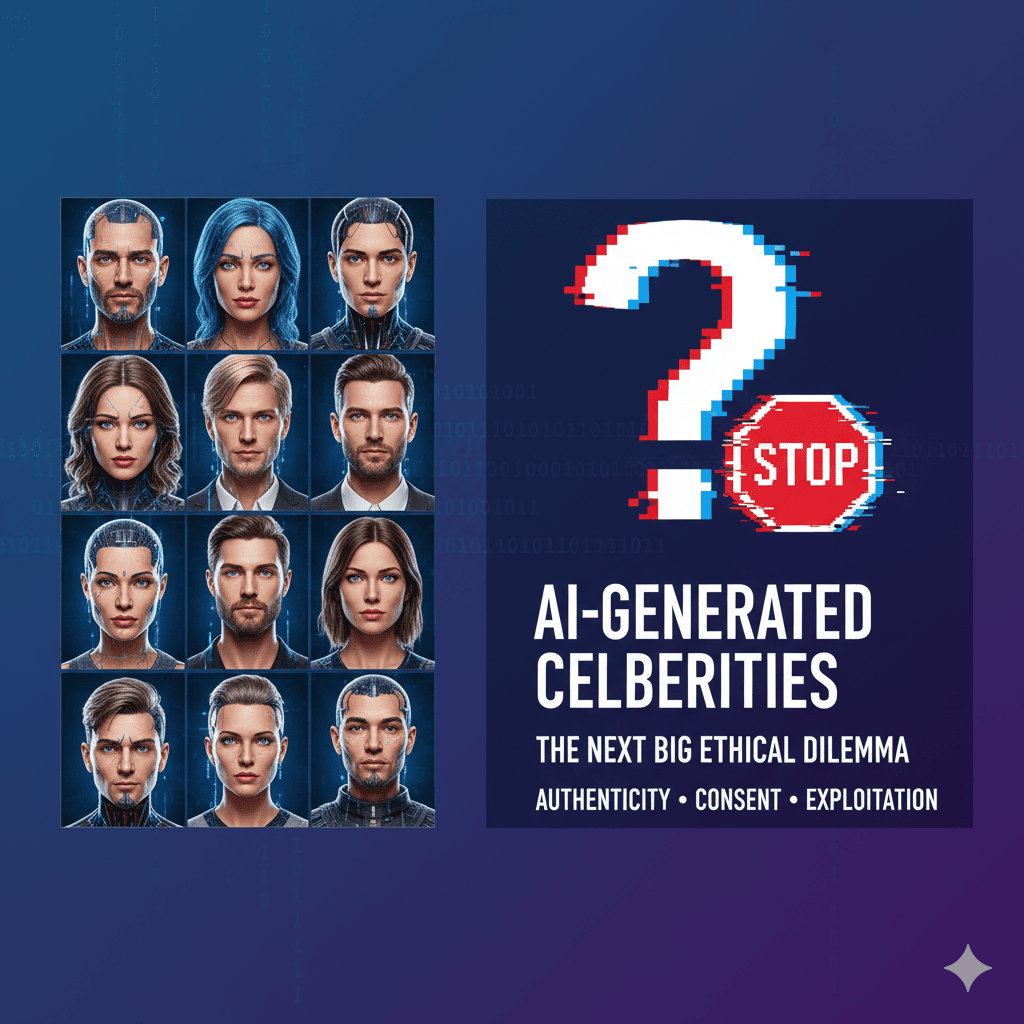
The entertainment industry is experiencing a paradigm shift that challenges our fundamental understanding of fame, identity, and authenticity. AI-generated celebrities—virtual influencers, digital personas, and synthetic performers created entirely through artificial intelligence—are capturing millions of followers, securing brand endorsements, and generating substantial revenue. These digital entities look, sound, and behave like real people, yet they exist solely within computer systems. As they become increasingly indistinguishable from human celebrities, AI-generated celebrities are forcing society to confront profound ethical questions about authenticity, representation, labor, and the very nature of celebrity itself.
1. The Rise of AI-Generated Celebrities: A New Era of Digital Stardom
AI-generated celebrities have evolved from simple computer graphics into sophisticated digital beings with distinct personalities, backstories, and fan bases. These virtual influencers are not merely marketing tools—they’ve become cultural phenomena that challenge traditional notions of celebrity and influence.
The journey toward AI-generated celebrities began with CGI characters in films and video games, but the breakthrough came when creators started positioning these digital entities as independent personalities with their own social media presence. Lil Miquela, one of the pioneering AI-generated celebrities, emerged on Instagram in 2016 with a carefully crafted persona as a 19-year-old Brazilian-American model and musician living in Los Angeles. With over 3 million followers, she has collaborated with major brands like Prada, Calvin Klein, and Samsung, earning an estimated $10 million annually.
What makes modern AI-generated celebrities particularly compelling is their ability to maintain consistent personas across platforms while engaging with audiences in seemingly authentic ways. These digital entities post daily updates, share opinions on social issues, respond to comments, and even create controversies—all carefully orchestrated by teams of writers, artists, and AI specialists working behind the scenes.
The technology powering AI-generated celebrities has advanced dramatically. Early virtual influencers required extensive manual rendering for each image or video. Today, machine learning algorithms can generate photorealistic images, natural-sounding voices, and even spontaneous-seeming responses to current events. Generative adversarial networks (GANs) create images so convincing that distinguishing them from photographs of real people becomes increasingly difficult.
The economic appeal of AI-generated celebrities to brands and entertainment companies is substantial. Unlike human celebrities, digital personas don’t age, experience scandals (unless planned), demand salary increases, or have scheduling conflicts. They can appear in multiple locations simultaneously, speak any language fluently, and maintain perfect brand alignment. This control and predictability make AI-generated celebrities attractive investments for companies seeking reliable brand ambassadors.
2. The Technology Behind AI-Generated Celebrities: How They’re Made
Understanding the ethical implications of AI-generated celebrities requires examining the sophisticated technology that brings them to life. The creation process involves multiple AI systems working in concert to produce believable digital humans.
Visual creation of AI-generated celebrities typically starts with 3D modeling software that creates the basic structure of the digital person. Artists design facial features, body proportions, and physical characteristics. However, modern AI-generated celebrities increasingly rely on machine learning models trained on thousands of human images to generate photorealistic faces that don’t belong to any real person. These systems can create unique individuals with consistent appearances across different angles, lighting conditions, and expressions.
Deepfake technology plays a controversial role in AI-generated celebrities. While the term often has negative connotations, the same technology that enables malicious deepfakes also powers legitimate virtual influencers. Neural networks learn to map facial expressions and movements, allowing AI-generated celebrities to appear in videos with realistic emotions and gestures. The ethical distinction lies in transparency—legitimate virtual influencers clearly identify as digital creations, while harmful deepfakes deceive by impersonating real people without consent.
Voice synthesis gives AI-generated celebrities their distinctive sounds. Modern text-to-speech AI can generate natural-sounding voices with appropriate emotional inflection, accents, and personality quirks. Some AI-generated celebrities even release music, with AI systems composing melodies, generating lyrics, and producing entire songs without human musical input beyond initial direction.
Natural language processing enables AI-generated celebrities to engage with followers through comments and messages. While human teams still oversee most interactions, AI chatbots increasingly handle routine engagements, maintaining the celebrity’s voice and personality. Advanced systems can generate contextually appropriate responses that feel personal and spontaneous, further blurring the line between artificial and authentic interaction.
The infrastructure supporting AI-generated celebrities requires significant computational resources and human expertise. Teams of 3D artists, writers, social media managers, and AI specialists collaborate to maintain the illusion of a singular, autonomous personality. This behind-the-scenes reality complicates questions about authorship, creativity, and labor in the age of digital celebrities.
3. Authenticity Crisis: AI-Generated Celebrities and the Question of Realness
The proliferation of AI-generated celebrities challenges fundamental assumptions about authenticity in celebrity culture. For generations, celebrity status derived from talent, achievement, or at least from being a real person whose genuine experiences audiences could relate to. AI-generated celebrities complicate this relationship by presenting fictional personas as if they were real individuals.
Research indicates that many followers of AI-generated celebrities don’t realize they’re engaging with artificial entities. A study found that approximately 42% of people who followed virtual influencers believed they were real humans with heavy photo editing rather than entirely digital creations. This confusion raises ethical questions about transparency and informed consent in parasocial relationships.
The authenticity paradox of AI-generated celebrities becomes even more complex when considering that traditional celebrities also present carefully curated personas. Human celebrities employ teams of stylists, publicists, and social media managers to craft their public images. In this context, are AI-generated celebrities fundamentally different, or are they simply more honest about their constructed nature?
Some creators of AI-generated celebrities argue that their digital personas are more authentic than human celebrities because they openly acknowledge their artificial nature. Lil Miquela’s team has been transparent about her digital origins, framing her as a character or artistic project rather than attempting to deceive audiences. This transparency, they argue, makes the relationship more honest than traditional celebrity culture’s carefully maintained illusions.
However, critics contend that even with disclosure, AI-generated celebrities promote unrealistic beauty standards and perpetuate harmful stereotypes. These digital entities typically embody conventional attractiveness with flawless skin, perfect proportions, and curated lifestyles that no real person could achieve. When audiences—especially young people—internalize these standards without fully understanding that they’re engaging with impossible ideals, the psychological impact can be significant.
The influence of AI-generated celebrities on social media authenticity extends beyond individual psychology to affect platform ecosystems. As synthetic content becomes more sophisticated and prevalent, the line between real and artificial content blurs, potentially eroding trust in all digital content. This authenticity crisis has implications for journalism, personal relationships, and democratic discourse.
4. Economic Disruption: How AI-Generated Celebrities Impact Human Workers
The rise of AI-generated celebrities represents a significant economic disruption in the entertainment and influencer industries. As brands allocate marketing budgets to virtual personalities, questions arise about the displacement of human influencers, models, and entertainers.
Traditional influencers and content creators have built careers through years of relationship-building with audiences, developing authentic voices, and creating original content. AI-generated celebrities can replicate aspects of this work with greater efficiency and lower long-term costs. A virtual influencer never gets sick, never experiences burnout, never demands renegotiation of contracts, and never develops opinions that might conflict with brand values.
The modeling industry faces particular disruption from AI-generated celebrities. Major fashion brands have already employed virtual models for campaigns, reducing demand for human models. While top-tier models with established names may be insulated, emerging models and those in the middle tier of the industry face increased competition from AI-generated celebrities who can “wear” any outfit perfectly without photoshoots, travel, or associated costs.
Voice actors and musicians also face competition from AI-generated celebrities. As voice synthesis technology improves, virtual influencers can narrate content, provide voiceovers, and even release music albums. Hatsune Miku, a Japanese virtual singer, has performed to sold-out concerts worldwide as a hologram, demonstrating the commercial viability of synthetic entertainers in the music industry.
However, the economics of AI-generated celebrities are more complex than simple replacement narratives suggest. Creating and maintaining a successful virtual influencer requires substantial human labor—3D artists, animators, writers, social media strategists, and AI specialists. These represent different jobs rather than eliminated jobs, suggesting a transformation of entertainment labor rather than its wholesale elimination.
Some human influencers and celebrities are adapting by creating their own digital counterparts. These AI versions can maintain social media presence when the human is unavailable, attend virtual events in different time zones simultaneously, or appear in content that would be dangerous or impossible for a real person. In this model, AI-generated celebrities augment human celebrity rather than replacing it.
The long-term economic impact of AI-generated celebrities remains uncertain. As the novelty factor diminishes, will audiences continue engaging with virtual personalities, or will they gravitate back toward human authenticity? Will AI-generated celebrities remain niche marketing tools, or will they fundamentally reshape celebrity culture? These questions will determine the extent of economic disruption across entertainment industries.
5. Representation and Diversity: AI-Generated Celebrities and Identity Politics
AI-generated celebrities exist in a complex space regarding representation and diversity. On one hand, they offer opportunities to increase visibility for underrepresented groups without relying on a limited pool of human celebrities. On the other hand, they risk appropriating identities without the lived experiences that give authentic representation its power.
Some AI-generated celebrities have been specifically designed to represent diverse ethnic backgrounds, body types, and gender identities. Creators argue this increases representation in entertainment and advertising, particularly in industries where human representation has been limited. A brand can create a virtual influencer of any ethnicity or background without concerns about finding willing human representatives or navigating complex identity politics.
However, critics argue that AI-generated celebrities provide only superficial diversity—the appearance of representation without substance. When a virtual influencer is designed to appear as a specific race or ethnicity, who is that representation serving? The communities ostensibly being represented, or the brands seeking diversity credentials without genuine commitment? Unlike human celebrities from marginalized communities who can speak from lived experience, AI-generated celebrities have no authentic connection to the identities they embody.
The creation teams behind AI-generated celebrities often lack diversity themselves, raising questions about who has the authority to create digital representations of various identities. When predominantly white, Western teams design virtual influencers meant to represent diverse backgrounds, the result can perpetuate stereotypes and cultural appropriation even when intentions are positive.
Several controversies have highlighted these tensions. Lil Miquela, presented as Brazilian-American and biracial, sparked debates about whether a digital entity can meaningfully represent mixed-race identity. Critics argued that her creation appropriates the aesthetic and cultural cachet of being a person of color while her creators (a Los Angeles tech startup) benefit economically without the lived challenges of that identity.
Some advocates see potential for AI-generated celebrities to represent identities and experiences rarely seen in mainstream media. Virtual influencers could embody disabled experiences, LGBTQ+ identities, or other marginalized perspectives in ways that expand representation. However, this potential depends on authentic involvement from these communities in the creation process and genuine commitment to more than superficial representation.
The question of who controls AI-generated celebrities and whose stories they tell will determine whether they advance or hinder meaningful diversity and representation. Without careful attention to these dynamics, virtual influencers risk becoming digital blackface—appropriating the appearance of diversity while continuing to exclude authentic voices from marginalized communities.
6. Legal and Regulatory Challenges of AI-Generated Celebrities
The rapid development of AI-generated celebrities has outpaced legal frameworks designed for human entertainers and traditional media. This gap creates significant uncertainty around rights, responsibilities, and regulations governing virtual influencers.
Intellectual property law struggles to accommodate AI-generated celebrities. Who owns the rights to a virtual influencer’s image, voice, and personality? Is it the AI company that provided the generation tools, the artists who designed the appearance, the writers who crafted the personality, or the company that funded the project? Current copyright law wasn’t designed for collaborative AI-human creative works, creating ambiguity that will require either judicial interpretation or legislative action to resolve.
Advertising regulations present another challenge for AI-generated celebrities. When virtual influencers promote products, existing disclosure requirements designed for human endorsers may not clearly apply. Must AI-generated celebrities disclose that they haven’t actually used products they promote? Since they can’t use physical products, is their endorsement inherently deceptive? Regulatory agencies worldwide are beginning to address these questions, but comprehensive frameworks remain in development.
Liability issues surrounding AI-generated celebrities raise complex questions. If a virtual influencer makes false claims, promotes dangerous behavior, or causes harm, who is legally responsible? The AI system, the company that owns it, individual team members, or some combination? Traditional celebrity liability frameworks assume human agency and intent, which don’t clearly map onto artificial entities controlled by corporate teams.
Right of publicity laws protect human celebrities from unauthorized commercial use of their name, image, and likeness. However, AI-generated celebrities raise inverse questions: can virtual influencers claim publicity rights? If someone creates a similar-looking virtual character, has anyone’s rights been violated? Some jurisdictions are beginning to recognize that companies can have protectable interests in their virtual creations, but the extent and boundaries of these rights remain unclear.
The potential for AI-generated celebrities to imitate real people without consent poses serious legal and ethical challenges. While legitimate virtual influencers disclose their artificial nature, the same technology could create unauthorized digital replicas of real celebrities or private individuals. Some jurisdictions have passed laws specifically addressing deepfakes and digital impersonation, but enforcement remains challenging, especially across international borders.
Data privacy regulations intersect with AI-generated celebrities in unexpected ways. These virtual entities collect substantial data about their followers through interactions and engagement patterns. Who has rights to this data? How should privacy protections apply when people believe they’re interacting with a real person but are actually engaging with an AI system? These questions become particularly pressing as AI-generated celebrities incorporate more sophisticated AI that learns from and adapts to individual users.
7. Psychological Impact: How AI-Generated Celebrities Affect Audiences
The psychological effects of AI-generated celebrities on audiences, particularly young people, represent a critical ethical concern. Parasocial relationships—one-sided emotional connections people form with media personalities—take on new dimensions when the personality in question doesn’t exist as a real person.
Research on traditional celebrity culture demonstrates that parasocial relationships can be psychologically beneficial when they provide positive role models and inspiration. However, they can also promote unrealistic standards, foster social comparison that damages self-esteem, and encourage unhealthy emotional investment in one-sided relationships. AI-generated celebrities may intensify these negative effects while diminishing positive ones.
The perfect, curated lives presented by AI-generated celebrities can exacerbate social comparison and self-esteem issues. Unlike human celebrities whose flaws and struggles occasionally surface despite careful image management, virtual influencers can maintain absolutely perfect personas indefinitely. They never have bad skin days, never gain weight, never experience genuine relationship struggles, and never face authentic challenges. For audiences comparing their real lives to these impossible standards, the psychological impact can be severe.
Adolescents and young adults appear particularly vulnerable to the influence of AI-generated celebrities. During developmental periods when identity formation and social comparison are especially salient, exposure to virtual influencers who embody impossible ideals may contribute to body image issues, anxiety, and depression. The fact that many followers don’t realize these influencers are artificial compounds the problem, as the comparison feels like it’s with real peers rather than fictional creations.
Some researchers suggest that AI-generated celebrities might offer psychological benefits by being more openly constructed than human celebrities. If audiences understand they’re engaging with creative projects rather than real people, parasocial relationships might be healthier because they’re based on transparent artifice rather than false intimacy. However, this potential benefit depends on clear disclosure and audience awareness—conditions not always present in practice.
The interactive capabilities of AI-generated celebrities add another psychological dimension. As AI becomes more sophisticated at responding to individual users, these interactions may feel increasingly personal and meaningful. Users might develop emotional attachments to virtual influencers who seem to respond directly to them, creating relationships that feel reciprocal but are actually one-sided and commercially motivated.
Mental health professionals are beginning to study these dynamics, but comprehensive understanding of how AI-generated celebrities affect psychological wellbeing remains limited. As these entities become more prevalent and technologically sophisticated, ongoing research and potentially therapeutic interventions may be necessary to help individuals navigate relationships with virtual personalities in healthy ways.
8. Creative Expression vs. Exploitation: The Artistry of AI-Generated Celebrities
AI-generated celebrities exist in tension between artistic expression and commercial exploitation. Some creators frame virtual influencers as art projects—contemporary explorations of identity, media, and reality in the digital age. Others see them primarily as marketing tools designed to generate profit through calculated audience manipulation.
From an artistic perspective, AI-generated celebrities represent a legitimate evolution in digital art and storytelling. Creating a believable virtual personality with consistent appearance, voice, and character across thousands of interactions requires creativity, technical skill, and artistic vision. The teams behind successful AI-generated celebrities are producing complex, multimedia artworks that engage audiences in novel ways and provoke important questions about authenticity, identity, and the nature of celebrity itself.
The narrative dimension of AI-generated celebrities can be genuinely creative. Some virtual influencers have elaborate backstories, character development arcs, and storylines that unfold over months or years through social media posts. This represents a new form of serialized storytelling that blurs boundaries between fiction and social media reality, creating immersive experiences that traditional media cannot replicate.
However, the commercial motivations behind most AI-generated celebrities complicate claims to pure artistic expression. These virtual personalities typically exist primarily to sell products or promote brands. Their personalities, values, and content are carefully calibrated to maximize engagement and commercial appeal rather than artistic integrity or social value. In this context, AI-generated celebrities are essentially sophisticated advertising vehicles dressed in artistic trappings.
The exploitation dimension becomes particularly concerning when AI-generated celebrities target vulnerable audiences without adequate transparency. Young followers who don’t understand that they’re being marketed to by carefully constructed commercial entities are susceptible to influence that bypasses normal advertising skepticism. This raises questions about whether commercial virtual influencers should face stricter regulations than traditional advertising.
Some artists are exploring AI-generated celebrities as commentary on celebrity culture itself. By creating self-aware virtual influencers that explicitly address their artificial nature and the absurdities of influencer culture, these creators use the medium to critique it. This meta-approach positions AI-generated celebrities as social commentary rather than straightforward commercial exploitation.
The line between art and exploitation in AI-generated celebrities often depends on transparency, intent, and execution. Projects that openly acknowledge their commercial nature, provide value to audiences beyond product promotion, and engage with the ethical complexities of virtual influencers occupy different moral territory than those that simply use AI to create more effective advertising without regard for broader implications.
9. The Future of Fame: What AI-Generated Celebrities Mean for Celebrity Culture
AI-generated celebrities may fundamentally transform how society understands and engages with fame, celebrity, and public personalities. The implications extend far beyond marketing and entertainment to touch on questions of human achievement, aspiration, and cultural values.
Traditional celebrity culture has been based on recognition of human achievement, talent, beauty, or at least interesting personality traits. People become famous because they excel at something—acting, music, sports—or because their life story captures public imagination. AI-generated celebrities decouple fame from human achievement, creating a system where entities become famous simply through strategic creation and marketing rather than any accomplishment by an actual person.
This decoupling raises philosophical questions about what celebrity means and why society values it. If fame can be programmed and manufactured completely artificially, does it retain the cultural significance it has traditionally held? Or does it become merely another commodity, stripped of the aspirational or inspirational qualities that made celebrity culture meaningful?
AI-generated celebrities may democratize fame by making it accessible to anyone with the technical skills or resources to create a virtual influencer. No longer must aspiring celebrities have exceptional talent, connections, or even willingness to be publicly visible themselves. Anyone can create a digital proxy to pursue fame on their behalf. This could be seen as either liberating—expanding access to celebrity culture—or dystopian—replacing authentic human achievement with artificial manipulation.
The hybrid model—where human celebrities create AI versions of themselves—may represent the future of fame. These digital twins could maintain public presence while the human celebrity retains privacy, attend multiple events simultaneously, or continue “living” after the human’s death. This raises unsettling questions about posthumous digital resurrection and who controls a celebrity’s legacy when their digital version can continue indefinitely.
Young people growing up with AI-generated celebrities as normal may develop entirely different relationships with fame and celebrity culture than previous generations. They might be more skeptical of authenticity claims, more comfortable with artificial personalities, or more focused on the entertainment value of celebrity rather than treating famous individuals as aspirational figures. These attitudinal shifts could reshape entertainment industries, political discourse, and social dynamics in ways difficult to predict.
AI-generated celebrities may also affect how real human celebrities operate. If virtual influencers can provide perfectly controlled brand messaging without human unpredictability, will brands increasingly prefer them? Will human celebrities need to compete by becoming more artificial themselves—more carefully controlled, less authentic, more algorithm-optimized? The competitive pressure from AI-generated celebrities might push human celebrities toward exactly the kind of inauthentic behavior that virtual influencers represent.
10. Navigating the Ethics: Toward Responsible AI-Generated Celebrities
As AI-generated celebrities become increasingly prevalent and sophisticated, establishing ethical frameworks for their creation and deployment becomes essential. Multiple stakeholders—creators, platforms, brands, regulators, and audiences—bear responsibility for ensuring these technologies develop in ways that benefit society rather than exploit it.
Transparency represents the most fundamental ethical requirement for AI-generated celebrities. Virtual influencers should clearly and consistently disclose their artificial nature in ways that audiences can easily understand. This transparency should be prominent—not buried in profile descriptions or fine print—and should be repeated frequently to account for new followers who may not have seen initial disclosures. Platforms like Instagram and TikTok should develop standardized disclosure mechanisms for AI-generated content that make artificial nature immediately apparent.
Advertising and endorsement regulations need updating to address AI-generated celebrities explicitly. When virtual influencers promote products, regulations should require clear disclosure that they haven’t actually used or experienced what they’re endorsing. Brands working with AI-generated celebrities should face the same or stricter scrutiny as those working with human influencers, with penalties for deceptive practices that exploit audience confusion about artificial entities.
Representation and diversity standards for AI-generated celebrities should ensure that virtual influencers representing marginalized identities are created with substantial input from those communities. Companies creating diverse virtual personalities should demonstrate commitment to authentic representation beyond superficial aesthetic choices, including employment practices and community engagement that benefit the groups being represented.
Age restrictions and content guidelines for AI-generated celebrities targeting or likely to reach young audiences deserve particular attention. Given the psychological vulnerabilities of children and adolescents, virtual influencers that appeal to these demographics should face restrictions on advertising practices, content types, and interaction mechanisms. Educational initiatives should help young people develop media literacy skills for critically evaluating artificial personalities.
Intellectual property and rights frameworks need development to clarify ownership, control, and liability for AI-generated celebrities. Clear legal standards would reduce uncertainty, protect legitimate creators, and provide recourse when virtual influencers are used harmfully. These frameworks should balance encouraging innovation with protecting individuals and society from exploitation or harm.
Research funding and academic study of AI-generated celebrities should be prioritized to better understand their psychological, social, and cultural impacts. Evidence-based understanding of how virtual influencers affect various populations will enable more informed policy decisions and help identify areas requiring intervention or regulation.
Industry self-regulation, while not sufficient alone, can complement governmental regulation. Trade associations and platform companies should develop best practice standards for AI-generated celebrities, creating accountability mechanisms and ethical guidelines that exceed minimum legal requirements. Companies that demonstrate commitment to responsible practices should be recognized and rewarded in the marketplace.
Ultimately, the ethical challenges posed by AI-generated celebrities reflect broader questions about technology, authenticity, and human values in the digital age. These virtual personalities force confrontation with uncomfortable questions about what society values in celebrity culture, how technology should be used in entertainment and commerce, and what responsibilities creators and companies bear toward audiences. The answers developed to these questions will shape not just the future of virtual influencers but the broader relationship between humanity and increasingly sophisticated artificial intelligence.
Also read this:
How to Turn 1 Video Into 50 Pieces of Content (AI Workflow)
AI Travel Planners: How Smart Trips Are Changing the Way We Explore in 2025
AI in Fashion: How Algorithms Are Designing the Next Runway Looks