
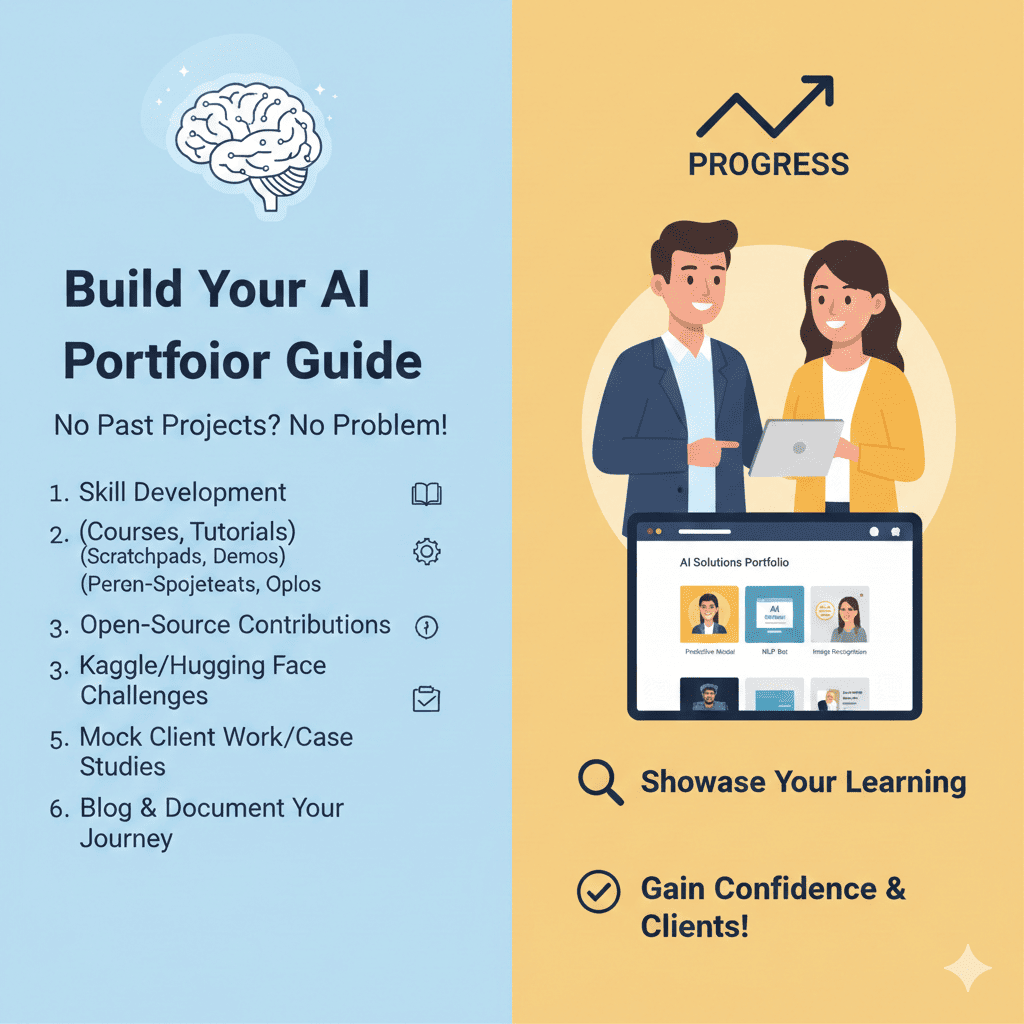
Build an AI Freelance Portfolio Breaking into the AI freelancing world without prior work experience might seem like an impossible challenge. You need clients to build a portfolio, but clients want to see your portfolio before hiring you. This classic catch-22 stops many talented beginners before they even start. However, the truth is that you don’t need previous paid projects to create a compelling AI freelance portfolio that attracts high-quality clients.
The AI industry is expanding rapidly, with businesses across every sector seeking AI solutions. From chatbot development to machine learning implementations, the demand for AI freelancers has never been higher. The key to breaking into this lucrative field isn’t having years of experience—it’s demonstrating your capabilities through strategic portfolio construction.
This comprehensive guide will walk you through proven strategies to build a professional AI freelance portfolio from scratch, even if you’ve never worked with a single client. You’ll learn how to create portfolio pieces that showcase your skills, position yourself as a credible expert, and land your first paying projects.
1. Understanding What Makes a Strong AI Freelance Portfolio
Before diving into creation, you need to understand what potential clients look for in an AI freelance portfolio. Unlike traditional portfolios that simply display finished work, an AI portfolio must demonstrate both technical competence and business acumen.
Key elements clients evaluate:
- Technical proficiency across relevant AI tools and frameworks
- Problem-solving approach and methodology
- Clear documentation and communication skills
- Understanding of real-world business applications
- Results and measurable outcomes from your projects
- Code quality and best practices implementation
Your portfolio should tell a story about each project: the problem you solved, your approach, the technologies used, and the results achieved. This narrative structure helps potential clients visualize how you’d handle their specific challenges.
Common portfolio mistakes to avoid:
- Including too many similar projects that don’t show range
- Poor documentation or unclear project descriptions
- Focusing solely on technical details without business context
- Using generic projects without personalization or creativity
- Neglecting visual presentation and user experience
Remember that your AI freelance portfolio is often your first impression. It should be polished, professional, and immediately communicate your value proposition to potential clients.
2. Creating Spec Projects That Solve Real Problems
Spec projects are self-initiated works created specifically for your portfolio. The secret to effective spec projects is treating them exactly like client work—with thorough research, clear objectives, and professional execution.
How to identify valuable spec project ideas:
- Research common pain points in industries you want to serve
- Browse freelancing platforms to see what clients frequently request
- Analyze competitors’ portfolios to identify gaps you can fill
- Join AI and tech communities to understand trending challenges
- Follow industry news to spot emerging problems requiring AI solutions
Start by selecting 3-5 diverse project ideas that showcase different aspects of your AI expertise. For example, you might create a natural language processing tool, a predictive analytics dashboard, a computer vision application, an AI-powered chatbot, and a recommendation system.
Project development framework:
Define the problem with specific parameters and constraints. Document your research process, including data sources and industry context. Create a detailed project brief as if a client commissioned the work. Develop the solution using professional coding standards and best practices. Test thoroughly and document results with metrics and visualizations. Write a comprehensive case study explaining your process and outcomes.
Each spec project in your AI freelance portfolio should include technical documentation, code samples hosted on GitHub, visual demonstrations through screenshots or videos, measurable results or performance metrics, and a detailed explanation of your decision-making process.
3. Contributing to Open Source AI Projects
Open source contributions provide legitimate proof of your skills while connecting you with the broader AI community. These contributions carry significant weight because they’re publicly verifiable and often reviewed by experienced developers.
Strategic approaches to open source contribution:
Begin with documentation improvements for popular AI libraries. Many established projects need better tutorials, clearer explanations, or updated guides. This entry point requires less technical depth while demonstrating communication skills and attention to detail.
Progress to bug fixes and minor feature implementations. Browse project issue trackers for “good first issue” or “beginner-friendly” tags. Solving these problems shows problem-solving ability and code quality.
Finding the right projects:
Focus on established AI frameworks like TensorFlow, PyTorch, Scikit-learn, Hugging Face Transformers, or LangChain. These projects have active communities and clear contribution guidelines.
Your contribution process should include:
- Thoroughly reading contribution guidelines and code of conduct
- Starting with small, manageable contributions to understand the workflow
- Engaging respectfully with maintainers and other contributors
- Documenting your contributions with clear commit messages
- Showcasing your best contributions in your portfolio with context
When featuring open source work in your AI freelance portfolio, don’t just list contributions. Explain the impact of your work, challenges you overcame, and skills you demonstrated. Include links to merged pull requests and any recognition from project maintainers.
4. Building AI Tools That Solve Your Own Problems
Creating tools to solve your personal challenges generates authentic portfolio pieces with genuine use cases. This approach is particularly effective because your passion for the solution shines through in your work.
Identifying personal problem-solving opportunities:
Examine your daily routines for repetitive tasks that AI could automate. Consider information management challenges like organizing research or summarizing content. Think about creative blocks where AI assistance could enhance productivity. Analyze decision-making processes that could benefit from data-driven insights.
Example personal AI projects:
Develop a personal email classifier that automatically categorizes and prioritizes messages. Build a content research assistant that aggregates and summarizes articles on specific topics. Create a smart calendar optimizer that suggests ideal meeting times based on your productivity patterns. Design a personal finance advisor using machine learning to predict expenses and recommend savings strategies.
Project documentation for portfolio presentation:
Write a compelling “before and after” narrative showing the problem and its solution. Include quantifiable metrics demonstrating improvement. Provide technical architecture diagrams explaining your implementation. Share code samples highlighting your best work. Create video demonstrations showing the tool in action.
These authentic projects in your AI freelance portfolio demonstrate initiative, creativity, and the ability to identify valuable AI applications—exactly what clients seek when hiring freelancers.
5. Replicating and Improving Existing AI Solutions
Studying successful AI implementations and creating your own versions is an excellent learning exercise that generates portfolio-worthy work. This approach lets you demonstrate both technical skills and analytical thinking.
Selecting projects to replicate:
Choose well-known AI applications like recommendation engines similar to Netflix or Spotify. Study chatbot implementations from customer service leaders. Analyze image recognition systems used in popular apps. Examine sentiment analysis tools for social media monitoring.
The improvement approach:
Don’t simply copy existing solutions—add your unique perspective. Focus on a specific niche or industry the original doesn’t serve. Implement additional features that enhance functionality. Optimize for performance, cost, or user experience. Create better documentation or more intuitive interfaces.
Presenting replications professionally:
Clearly state your inspiration and give credit to the original. Emphasize your unique contributions and improvements. Explain your technical choices and how they differ from the original. Demonstrate superior results through comparative metrics. Show how your version solves problems the original doesn’t address.
This strategy for your AI freelance portfolio proves you can learn from industry leaders while bringing innovative thinking to established concepts.
6. Creating Educational Content and Tutorials
Teaching others solidifies your knowledge while establishing you as an expert. Educational content serves double duty—building your portfolio and attracting potential clients through value-first marketing.
Content formats that showcase AI expertise:
Write detailed blog posts explaining complex AI concepts in accessible language. Record video tutorials walking through AI project implementation. Create comprehensive GitHub repositories with well-documented example projects. Design infographics visualizing AI workflows and architectures. Develop interactive Jupyter notebooks demonstrating specific techniques.
Strategic content topics:
Focus on practical applications rather than pure theory. Address common beginner mistakes and how to avoid them. Compare different approaches to solving the same AI problem. Break down recent AI research papers into actionable insights. Share troubleshooting guides for popular AI frameworks.
Maximizing portfolio value:
Publish content on Medium, Dev.to, or your personal blog. Share tutorials on YouTube or technical platforms. Host code repositories on GitHub with thorough README files. Cross-reference educational content throughout your portfolio. Include metrics like views, engagement, or community feedback.
Quality educational content in your AI freelance portfolio demonstrates deep understanding, communication skills, and commitment to the field—all attractive qualities to potential clients.
7. Participating in AI Competitions and Hackathons
Kaggle competitions, hackathons, and AI challenges provide structured environments to develop portfolio projects while benchmarking your skills against other practitioners.
Major platforms and opportunities:
Kaggle offers thousands of datasets and competitions across all AI domains. DrivenData focuses on social impact projects using data science. AIcrowd hosts diverse AI and machine learning challenges. Zindi specializes in African data science competitions. Company-specific hackathons from tech giants like Google, Microsoft, and Meta.
Strategic participation approach:
Start with completed competitions to learn from winning solutions. Join ongoing competitions in your target niche or industry. Form teams to learn collaborative skills and tackle complex challenges. Focus on documentation and explanation, not just rankings. Even mid-tier placements demonstrate real capability.
Portfolio presentation of competition work:
Detail your approach, experimentation process, and final methodology. Compare your results against benchmarks and explain performance gaps. Highlight unique techniques or innovative approaches you employed. Include visualizations of your analysis and results. Link to competition pages and your ranking when favorable.
Competition projects strengthen your AI freelance portfolio by providing third-party validation of your skills and demonstrating your ability to work within constraints and deadlines.
8. Offering Free or Discounted Services Strategically
Strategic pro bono work can fill your portfolio while building relationships, but this approach requires careful boundaries to avoid being exploited.
Finding the right opportunities:
Target nonprofits or small businesses in industries you want to specialize in. Connect with startups that might become paying clients as they grow. Offer specific, limited-scope projects rather than ongoing support. Choose projects that will challenge you and showcase new skills.
Setting clear expectations:
Define exact deliverables and timeline from the beginning. Limit the number of revision rounds. Retain full rights to showcase the work in your portfolio. Request testimonials and case study participation. Make clear this is portfolio-building work, not your standard offering.
Maximizing portfolio value:
Treat discounted projects with full professional standards. Document everything as you would for paying clients. Request detailed feedback and testimonials. Take before-and-after metrics to demonstrate impact. Use these projects to refine your service packages and pricing.
When featuring pro bono work in your AI freelance portfolio, present it identically to paid work—clients don’t need to know the financial arrangement. Focus on results, complexity, and professional execution.
9. Showcasing Side Projects and Personal Experiments
Not every portfolio piece needs to be a complete, polished product. Experimental work demonstrates curiosity, learning agility, and cutting-edge awareness—all valuable traits for AI freelancers.
Types of experimental projects:
Implement newly published research papers or techniques. Experiment with beta releases of AI tools and frameworks. Create proof-of-concept demonstrations for emerging technologies. Conduct comparative analyses of different AI approaches. Build minimal viable products testing innovative ideas.
Presentation strategy:
Frame experiments as research or exploration rather than finished products. Clearly state learning objectives and outcomes. Discuss what worked, what didn’t, and why. Connect experiments to practical applications or future possibilities. Show your thought process and technical curiosity.
Selection criteria:
Include experiments that showcase technical depth beyond basic applications. Choose projects demonstrating awareness of industry trends. Select work that differentiates you from other freelancers. Highlight experiments leading to unexpected insights or discoveries.
Experimental projects in your AI freelance portfolio signal that you’re actively engaged with the field’s evolution and committed to continuous learning.
10. Building a Professional Portfolio Website
Your portfolio’s presentation matters as much as its content. A well-designed website makes your work accessible, professional, and memorable.
Essential portfolio website elements:
A clear value proposition immediately communicating your specialization. A compelling “About” section establishing credibility and personality. A projects showcase with filtering options by category or technology. Detailed case studies for your strongest work. Testimonials and social proof when available. A straightforward contact mechanism for potential clients.
Technical implementation options:
Use portfolio builders like Webflow, Wix, or Squarespace for quick setup. Build custom sites with modern frameworks like Next.js or Gatsby. Deploy on GitHub Pages for developer-focused portfolios. Consider WordPress with portfolio themes for flexibility. Ensure mobile responsiveness and fast loading times.
Content optimization:
Write clear, benefit-focused descriptions for each project. Use professional screenshots, diagrams, and videos. Implement proper SEO for relevant keywords including AI freelance portfolio. Include prominent calls-to-action guiding visitors to contact you. Regularly update with new projects and remove outdated work.
Portfolio structure best practices:
Lead with your strongest, most relevant work for target clients. Group projects by industry, technology, or problem type. Include code snippets demonstrating clean, well-commented code. Link to live demos, GitHub repositories, and related content. Provide downloadable case studies or project summaries.
Your portfolio website is the central hub of your AI freelance portfolio—invest time in making it professional, navigable, and conversion-focused.
11. Leveraging Academic Projects and Coursework
If you’ve completed AI courses, bootcamps, or degree programs, your academic work can form a solid portfolio foundation with some strategic adaptation.
Transforming academic work into portfolio pieces:
Extend class projects beyond minimum requirements with additional features. Apply course concepts to real-world datasets or scenarios. Rebuild course projects using production-grade tools and practices. Create comprehensive documentation explaining real-world applications. Package multiple related assignments into cohesive case studies.
Projects worth featuring:
Capstone projects demonstrating multiple integrated skills. Independent research or thesis work on novel AI applications. Group projects where you can clearly articulate your specific contributions. Assignments applying AI to actual business or social problems. Projects receiving recognition or awards from instructors.
Professional presentation:
Minimize academic jargon and focus on practical applications. Emphasize results and insights over theoretical concepts. Restructure academic reports into client-friendly case studies. Remove obvious signs this was coursework unless prestigious institution. Supplement with additional analysis or implementation beyond requirements.
Academic projects strengthen your AI freelance portfolio by demonstrating formal training and foundational knowledge, especially when enhanced with professional polish.
12. Creating a Strategic Portfolio Presentation
With projects completed, strategic presentation transforms good work into a compelling AI freelance portfolio that converts visitors into clients.
Portfolio organization strategies:
Arrange projects by relevance to your target market, not chronologically. Feature 5-7 diverse, high-quality projects rather than everything you’ve created. Create different portfolio versions for different client types or industries. Update regularly, removing weaker projects as you complete stronger ones.
Case study structure:
Begin with a clear problem statement and context. Describe your research and planning process. Explain your technical approach and tool choices. Showcase key features with visual demonstrations. Present measurable results and outcomes. Reflect on challenges and learning moments. Conclude with potential next steps or expansions.
Visual elements:
Use consistent branding across all portfolio materials. Include architecture diagrams and flowcharts explaining technical implementation. Create before-and-after comparisons showing impact. Embed demo videos or interactive elements. Use data visualizations to communicate results effectively.
Social proof integration:
Feature testimonials from open source collaborators or recipients of free work. Include metrics like GitHub stars, article views, or competition rankings. Display certifications, course completions, or relevant credentials. Mention any media coverage, speaking engagements, or community recognition.
A strategically presented AI freelance portfolio guides potential clients through your capabilities while building confidence in your expertise and professionalism.
Conclusion
Building an AI freelance portfolio without previous client work is entirely achievable through strategic project creation, community engagement, and professional presentation. The key is understanding that a portfolio’s purpose isn’t just displaying what you’ve done—it’s demonstrating what you can do for future clients.
Start by creating 3-5 diverse spec projects addressing real problems in your target industries. Supplement these with open source contributions, educational content, or competition participation. Present everything professionally through a well-designed portfolio website with detailed case studies.
Remember that your first AI freelance portfolio doesn’t need to be perfect—it needs to be good enough to land your first client. Once you complete paid projects, you’ll continuously refine and strengthen your portfolio. The most important step is starting now with the resources and knowledge you already possess.
Your unique perspective, problem-solving approach, and commitment to quality will differentiate your portfolio from countless others. Focus on demonstrating genuine value, clear communication, and professional execution. With a strategic AI freelance portfolio, you’ll transform from a beginner with no clients into a sought-after AI freelancer with a thriving business.
Also read this:
How to Monetize AI Skills Through High-Paying Service-Based Work in 2026
How to Make Money Offering AI Integration Services to Non-Technical Clients
Best AI Opportunities for Freelancers in 2026 to Increase Monthly Income Fast