
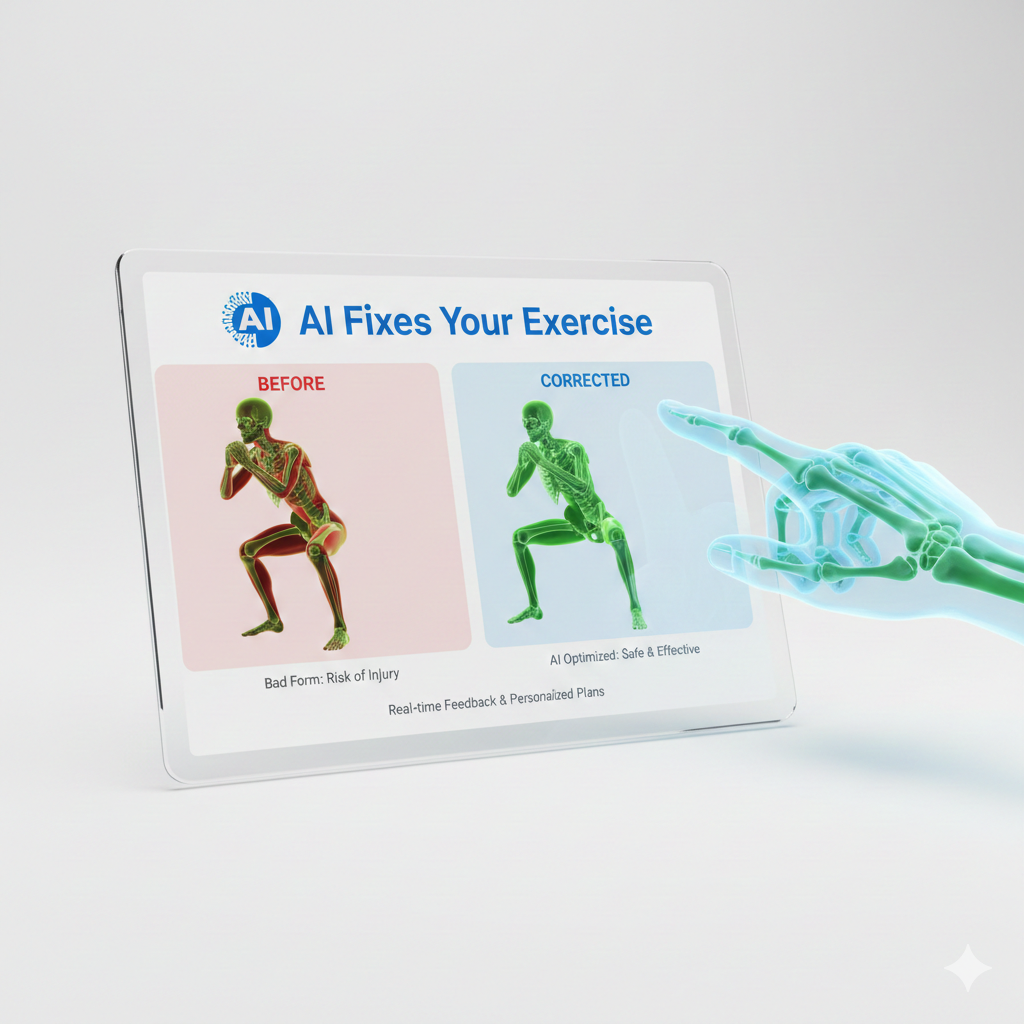
Proper exercise form is the cornerstone of effective training and injury prevention. For decades, this crucial aspect of fitness was only available through expensive personal trainers or experienced gym partners who could watch and correct your movements. Today, groundbreaking computer vision technology is changing everything. AI Fixes Your Exercise form in real-time using nothing more than your smartphone or laptop camera, bringing professional-grade form correction into your living room.
This technological revolution means you no longer need to guess whether you’re performing exercises correctly or risk injury from poor technique. The same artificial intelligence that powers facial recognition and self-driving cars now analyzes your workout movements with remarkable precision, providing instant feedback that helps you train safer and more effectively than ever before.
1. The Science Behind AI Form Correction: Understanding Computer Vision Technology
The technology that allows AI Fixes Your Exercise form relies on sophisticated computer vision algorithms and machine learning models trained on millions of movement patterns. Understanding how this technology works helps you appreciate its capabilities and limitations.
Pose Estimation and Skeletal Tracking
At the heart of AI form correction is pose estimation technology. When you exercise in front of your camera, the AI identifies key anatomical landmarks on your body including shoulders, elbows, wrists, hips, knees, and ankles. The system creates a skeletal model of your body in real-time, tracking the position and movement of each joint throughout your exercise.
This skeletal tracking happens dozens of times per second, creating a continuous stream of data about your body position. The AI doesn’t need special markers or sensors attached to your body. Instead, it uses advanced neural networks trained to recognize human anatomy from regular camera footage, even in varying lighting conditions and from different angles.
Movement Pattern Analysis
Once the AI has mapped your skeletal structure, it analyzes how your body moves through each exercise. The system compares your movement patterns against ideal biomechanical models stored in its database. These reference models represent optimal form for thousands of different exercises, developed through collaboration with physical therapists, sports scientists, and experienced trainers.
AI Fixes Your Exercise form by identifying deviations from these ideal patterns. The system measures joint angles, tracks range of motion, monitors movement speed, and evaluates symmetry between left and right sides of your body. This comprehensive analysis happens instantly, allowing for real-time feedback during your workout.
Machine Learning and Pattern Recognition
The AI systems that power form correction continuously improve through machine learning. As millions of users perform exercises, the AI learns to recognize a wider variety of body types, movement patterns, and common form mistakes. This collective learning makes the technology increasingly accurate and nuanced in its feedback over time.
The machine learning models can distinguish between intentional exercise variations and actual form errors. They recognize that different body proportions may require slight adjustments to standard form cues, and they account for flexibility limitations that might affect how certain exercises look without compromising safety or effectiveness.
2. Real-Time Feedback Mechanisms: How AI Communicates Corrections
The value of AI form correction lies not just in detecting errors but in communicating corrections effectively. AI Fixes Your Exercise form through various feedback mechanisms designed to help you adjust your technique without interrupting your workout flow.
Visual Overlay and Highlighting
Many AI fitness applications display a skeletal overlay on your live camera feed, showing exactly where your joints are positioned. When the system detects a form issue, it highlights the problematic area in a different color. You might see your knee highlighted in red during a squat if it’s caving inward, or your lower back marked when it rounds during a deadlift.
This visual feedback is intuitive and immediate. You can see exactly what needs correction without having to interpret verbal cues. Some advanced systems draw guide lines showing where your body should be positioned, creating a visual target for you to match.
Audio Cues and Voice Coaching
While exercising, watching the screen constantly isn’t always practical. AI Fixes Your Exercise form through audio cues that alert you to problems without requiring visual attention. The system might say “lower your hips” during a plank when it detects your hips rising too high, or “chest up” during a squat when you’re folding forward excessively.
These audio cues are timed precisely to the moment when correction is needed. The AI uses natural language processing to deliver instructions in clear, actionable terms that help you adjust your position immediately. Advanced systems even vary their coaching style based on user preferences, offering more detailed explanations for beginners and concise cues for experienced exercisers.
Haptic Feedback Integration
Some AI fitness platforms integrate with smartwatches or fitness bands that provide haptic feedback through vibrations. When the system detects a form issue, it sends a vibration to your wearable device. Different vibration patterns can indicate different types of corrections, creating a tactile feedback loop that doesn’t require you to look at a screen or listen for audio cues.
Post-Exercise Analysis and Reports
After completing your workout, AI Fixes Your Exercise performance is summarized in detailed reports. These analyses show you which exercises had form issues, how frequently problems occurred, and whether your form improved or deteriorated as you fatigued. You can review video clips of specific repetitions where form broke down, helping you understand patterns in your technique that need attention.
3. Common Exercise Form Errors AI Can Detect and Correct
The breadth of form issues that AI Fixes Your Exercise technology can identify is impressive. From fundamental bodyweight movements to complex compound lifts, AI systems recognize and correct numerous common errors.
Squat Form Corrections
Squats are among the most analyzed exercises in AI fitness applications. The technology monitors knee tracking to ensure your knees follow the direction of your toes rather than caving inward. It checks squat depth, verifying you reach appropriate depth for your goals while maintaining neutral spine position. The AI detects weight shift patterns, alerting you if you’re favoring one side or shifting your weight onto your toes.
Hip positioning is another focus area. AI Fixes Your Exercise form by ensuring your hips descend properly rather than shooting backward excessively or staying too high. The system also monitors torso angle, preventing excessive forward lean that could stress your lower back.
Push-Up and Plank Analysis
For push-ups and planks, AI systems focus heavily on body alignment. They detect sagging hips, which reduce core engagement and can strain the lower back. The technology identifies piking hips, which makes the exercise easier but less effective. Elbow position is monitored to ensure proper shoulder mechanics and optimal chest engagement.
During push-ups specifically, AI Fixes Your Exercise depth and ensures you’re lowering to an appropriate level. The system tracks whether you’re maintaining consistent depth across repetitions or if fatigue is causing your range of motion to decrease.
Deadlift Safety Monitoring
Deadlifts are technically demanding exercises where form is critical for safety. AI systems monitor spine position throughout the movement, immediately alerting you if your lower back rounds or overextends. The technology tracks bar path to ensure vertical movement close to your body rather than swinging away from you.
Hip and shoulder timing is analyzed to prevent lifting primarily with your back rather than engaging your legs properly. AI Fixes Your Exercise form by ensuring your hips and shoulders rise at appropriate rates, maintaining proper leverage throughout the lift.
Overhead Press and Row Corrections
For overhead pressing movements, AI monitors shoulder and elbow alignment to prevent impingement risk. The system ensures you’re pressing vertically rather than forward, checks for excessive back arching, and monitors that you achieve full overhead extension without compensatory movements.
During rowing exercises, AI Fixes Your Exercise by monitoring shoulder blade retraction, preventing excessive momentum or swinging, and ensuring you’re pulling to the appropriate position for the specific row variation you’re performing.
4. Setting Up Your Space for Optimal AI Form Analysis
To get the most accurate feedback from AI form correction technology, proper setup of your camera and exercise space is essential. Small adjustments to your environment can significantly improve the system’s ability to track your movements.
Camera Positioning and Angles
The camera angle dramatically affects how well AI Fixes Your Exercise form. For most exercises, positioning your camera at hip height provides the best view of your body mechanics. The camera should be far enough away to capture your entire body with a small amount of space above your head and below your feet.
Side angles work best for exercises where front-to-back movement is critical, such as squats, deadlifts, and lunges. Front angles are ideal for movements where lateral symmetry matters, like planks, push-ups, and bilateral exercises. Some AI systems guide you through optimal camera placement for each exercise type.
Lighting Considerations
Adequate lighting is crucial for accurate pose estimation. AI Fixes Your Exercise technology works best in well-lit environments where your body outline is clearly visible against the background. Avoid backlighting situations where you appear as a silhouette, as this makes it difficult for the AI to identify anatomical landmarks.
Natural lighting from windows or overhead lights generally works well. If your space has poor lighting, consider adding a simple ring light or lamp positioned to illuminate you from the front or side rather than from behind.
Background and Contrast
A clean, uncluttered background helps the AI focus on your body rather than processing visual noise from complex surroundings. The system works most accurately when there’s clear contrast between you and your background. Wearing clothing that contrasts with your background color improves tracking accuracy.
Avoid exercising in front of mirrors when using AI form correction, as the reflection can confuse the pose estimation algorithm. Similarly, exercising in spaces where other people are moving in the background may cause tracking issues.
Space Requirements
Different exercises require different amounts of space. AI Fixes Your Exercise form more accurately when your entire body remains in frame throughout the movement. Ensure you have enough room to perform exercises fully while staying within the camera’s field of view. For exercises with significant movement like burpees or jumping jacks, position yourself farther from the camera to maintain full body visibility.
5. Customization and Personalization: Teaching AI Your Body
While AI Fixes Your Exercise form using general biomechanical principles, the most advanced systems allow customization for individual differences in anatomy, flexibility, and training goals.
Initial Assessment and Calibration
Many AI fitness platforms begin with assessment movements that help the system understand your body proportions, flexibility limitations, and current skill level. You might perform basic movements like overhead reaches, bodyweight squats, or flexibility tests while the AI analyzes your capabilities.
This calibration process allows AI Fixes Your Exercise form based on realistic expectations for your body. The system learns if you have limited ankle mobility that affects squat depth, shoulder tightness that influences overhead movements, or asymmetries between sides that need accommodation.
Injury History and Limitations
Advanced AI systems allow you to input injury history or movement restrictions. If you have a prior shoulder injury, the system adjusts its form expectations for overhead movements, providing modified cues that protect vulnerable areas while still promoting proper technique within your capabilities.
AI Fixes Your Exercise form while respecting your limitations, suggesting exercise modifications when standard form might aggravate existing issues. The AI might recommend a specific grip width for pressing movements if you have shoulder concerns or suggest depth limitations for squats if you have knee issues.
Progressive Form Development
As your mobility improves and movement patterns develop, the AI adjusts its standards accordingly. What might have been acceptable form when you started training becomes subject to higher expectations as you progress. AI Fixes Your Exercise form with increasingly refined feedback, helping you continually improve your technique rather than settling for “good enough.”
Goal-Specific Form Variations
Different training goals sometimes require form variations. Powerlifters performing low-bar squats have different optimal form than Olympic weightlifters doing high-bar squats. Bodybuilders might intentionally use slightly different technique than strength athletes. Advanced AI systems recognize these distinctions and provide feedback appropriate to your specified goals.
6. Integration with Smart Equipment and Wearables
The capabilities of AI Fixes Your Exercise technology expand significantly when integrated with smart fitness equipment and wearable devices, creating a comprehensive feedback ecosystem.
Smart Weight Equipment
Connected dumbbells and barbells with built-in sensors provide data about weight distribution, bar path, and lifting speed that complements visual form analysis. When the AI combines camera-based pose estimation with equipment data, it gains a more complete picture of your movement quality.
This integration allows AI Fixes Your Exercise form with insights that vision alone cannot provide. The system might detect that you’re shifting weight unevenly between hands during a press, even if this isn’t visually obvious, or identify that your lifting speed is inconsistent between the concentric and eccentric phases of a movement.
Heart Rate and Effort Monitoring
Wearable heart rate monitors provide context about your exertion level during exercises. If AI Fixes Your Exercise form and notices technique breaking down as your heart rate spikes, it understands that fatigue is likely the cause. The system might recommend longer rest periods or reduced training volume before form deteriorates.
This physiological data helps the AI distinguish between form issues caused by lack of skill versus those resulting from fatigue or insufficient recovery. The feedback becomes more sophisticated and actionable when biomechanical analysis is combined with physiological metrics.
Motion Sensors and IMUs
Inertial measurement units worn on limbs or embedded in clothing provide detailed data about acceleration, rotation, and orientation that enhances camera-based tracking. These sensors capture subtle movement details that might be missed by visual analysis alone.
When sensors detect problematic movement patterns, AI Fixes Your Exercise form with specific cues addressing the identified issue. The combination of visual tracking and sensor data creates redundancy that improves accuracy and reduces false positive corrections.
Smart Mirrors and Dedicated Hardware
Specialized fitness mirrors with built-in cameras and displays are optimized for form correction. These devices eliminate setup hassle and provide consistent camera angles designed specifically for exercise analysis. The larger display makes visual feedback easier to see during workouts.
These dedicated systems often include additional sensors and processing power that enable more sophisticated analysis than smartphone-based solutions. AI Fixes Your Exercise form with greater precision when using purpose-built hardware designed specifically for this application.
7. Privacy and Security Considerations with Camera-Based AI
Using camera technology for fitness tracking raises legitimate privacy concerns. Understanding how AI Fixes Your Exercise platforms handle your video data helps you make informed decisions about which services to trust.
Local Processing vs Cloud Analysis
Some AI systems process video entirely on your device, meaning your workout footage never leaves your phone or computer. This local processing offers maximum privacy since your exercise videos aren’t transmitted to external servers. However, local processing requires more powerful device hardware and may limit the sophistication of AI analysis.
Other platforms upload video to cloud servers where more powerful AI models analyze your movements. Cloud-based processing can provide more accurate feedback but requires you to trust the service provider with your video data. Reputable services encrypt video during transmission and storage.
Data Retention Policies
Understanding how long AI Fixes Your Exercise platforms retain your video data is important. Some services delete video immediately after analysis, keeping only aggregate movement data and correction statistics. Others store video temporarily for your review, then delete it after a specified period. Some platforms allow you to download your workout videos for personal records.
Review the data retention policies of any AI fitness service you consider using. Understand whether you can request deletion of your data and how the company responds to such requests.
Permission and Control Settings
Quality AI fitness applications provide granular control over what data is collected and how it’s used. You should be able to disable camera access, opt out of data sharing for AI improvement purposes, or restrict what types of analysis are performed on your workouts.
AI Fixes Your Exercise form more effectively when you’re comfortable with the technology, which requires feeling confident about your privacy protections. Don’t hesitate to use privacy-focused settings even if they slightly reduce functionality.
Sharing and Social Features
Many AI fitness platforms include social features that allow sharing workout clips or form comparisons. While these features can be motivating, ensure you understand what you’re sharing and who can view it. Look for platforms that make sharing opt-in rather than default, giving you explicit control over what footage becomes visible to others.
8. Accuracy and Limitations: What AI Can and Cannot Do
While AI Fixes Your Exercise technology is remarkably capable, understanding its limitations helps you use it effectively and know when human expertise is still valuable.
Strengths of AI Form Analysis
AI excels at consistent, objective observation. Unlike human trainers who may miss subtle issues or have attention limits, AI monitors every repetition with equal focus. The technology never gets distracted, tired, or biased. It processes movement data far faster than human observation allows, detecting issues that might escape even experienced eyes.
AI Fixes Your Exercise form with consistency across all sessions. The same standards apply whether you’re working out at six in the morning or eleven at night, whether it’s your first set or your tenth. This consistency helps you develop reliable movement patterns over time.
Current Technical Limitations
Camera-based pose estimation has accuracy limits. Very fast movements may exceed the camera frame rate, causing the AI to miss crucial movement details. Exercises performed at unusual angles to the camera may result in reduced tracking accuracy. Overlapping body parts can confuse pose estimation algorithms.
Baggy clothing can obscure body position, making it harder for AI Fixes Your Exercise systems to accurately track joint positions. Some exercises are simply difficult to analyze from a single camera angle and may require multiple views for comprehensive form assessment.
Contextual Understanding Gaps
AI systems lack the contextual understanding that experienced trainers provide. A human trainer might recognize that your squat form is breaking down because you have tight hip flexors and recommend specific mobility work. The AI knows your form is problematic but may not understand the underlying cause or provide comprehensive solutions.
AI Fixes Your Exercise technique based on visual observation, but it doesn’t feel what you feel. If an exercise causes pain despite appearing correct visually, human judgment is necessary to identify the problem. AI cannot assess internal sensations, subtle discomfort, or the qualitative aspects of movement that influence injury risk.
When Human Expertise Is Still Essential
Serious injuries, complex movement disorders, and sport-specific technical skills often require human expertise beyond current AI capabilities. While AI Fixes Your Exercise form for common movements effectively, specialized applications like Olympic lifting technique refinement or rehabilitation from major injuries benefit from hands-on coaching.
Consider AI form correction as a powerful tool that complements rather than completely replaces human coaching. The ideal approach for many people combines regular AI-guided training with periodic check-ins with qualified fitness professionals.
9. Practical Applications: Who Benefits Most from AI Form Correction
AI Fixes Your Exercise form benefits various types of exercisers, though some groups gain particular advantages from this technology.
Home Workout Enthusiasts
People training at home without access to trainers or training partners benefit enormously from AI form correction. The technology provides the guidance and feedback that makes home training effective and safe. You gain confidence that you’re exercising correctly despite training alone.
AI Fixes Your Exercise technique even when you’re working out in your living room at midnight. This accessibility removes the uncertainty that prevents many people from training effectively at home.
Beginners Learning Movement Patterns
New exercisers developing fundamental movement skills gain tremendous value from immediate, consistent feedback. The AI helps you build correct movement patterns from the beginning rather than ingraining poor form that requires correction later.
Beginners often don’t know what correct form feels like. AI Fixes Your Exercise technique by providing external reference points that help you develop kinesthetic awareness and understanding of proper positioning.
Experienced Athletes Refining Technique
Even advanced exercisers benefit from objective form analysis. You might have subtle technique issues that have escaped your notice or developed gradually over time. AI provides unbiased assessment that can identify optimization opportunities.
AI Fixes Your Exercise form at the margins, helping you refine already good technique into excellent technique. For experienced athletes, these small improvements can translate to better performance and reduced injury risk over time.
People Returning from Injury
Individuals returning to training after injury can use AI form correction to ensure they’re moving safely as they rebuild capacity. The technology provides reassurance that you’re maintaining proper form while progressing your training appropriately.
AI Fixes Your Exercise patterns that might stress recovering tissues, helping you return to full activity more confidently and potentially reducing re-injury risk.
Budget-Conscious Fitness Seekers
For people who want personalized coaching but cannot afford regular personal training sessions, AI form correction provides professional-level feedback at a fraction of the cost. This democratization of form analysis makes effective training accessible regardless of financial resources.
10. The Future of AI Form Correction: Emerging Technologies
The field of AI exercise analysis continues to evolve rapidly. Future developments will make AI Fixes Your Exercise technology even more powerful and accessible.
Advanced Biometric Integration
Future systems will integrate more comprehensive biometric data including muscle activation patterns measured through wearable EMG sensors, force production monitored through smart flooring, and even real-time biomechanical stress calculations. This data will enable AI to provide unprecedented insights into movement quality and injury risk.
AI Fixes Your Exercise form not just based on visual appearance but on comprehensive understanding of what’s happening inside your body during movement. This integration will dramatically improve the precision of feedback and exercise recommendations.
Virtual and Augmented Reality Applications
VR and AR technologies will transform how AI Fixes Your Exercise systems present feedback. Imagine wearing AR glasses that display holographic form cues in your visual field during workouts, or VR environments where you exercise alongside an AI avatar demonstrating perfect technique in real-time.
These immersive technologies will make form correction more intuitive and engaging while maintaining the analytical power of AI assessment.
Predictive Injury Prevention
As AI systems accumulate more data about movement patterns and their long-term outcomes, they’ll develop predictive capabilities for injury risk. The system might recognize subtle movement patterns that correlate with future injury development and proactively suggest corrections before problems arise.
AI Fixes Your Exercise form not just to optimize today’s workout but to protect your long-term movement health, identifying and addressing issues before they manifest as injuries.
Personalized Biomechanical Modeling
Future AI systems will create individualized biomechanical models for each user, accounting for your unique anatomy, injury history, and movement preferences. These personalized models will enable far more sophisticated analysis than current one-size-fits-all approaches.
The technology will understand that what constitutes optimal form for your specific body might differ from general recommendations, providing truly customized guidance that maximizes your training effectiveness.
Integration with Genetic and Biological Data
Emerging research into how genetics influence optimal training approaches may eventually inform AI form correction. Your system might recognize that your genetic profile suggests certain movement patterns or training intensities will be more effective or safer for you specifically.
Maximizing Your Success with AI Form Correction
To get the most value from AI technology, approach it strategically. Start by familiarizing yourself with the system during simple exercises before using it for complex movements. Pay attention to the feedback patterns you receive and actively work on the corrections suggested rather than merely noting them.
AI Fixes Your Exercise form most effectively when you engage with the technology as an active learning tool rather than passive monitoring. Review your post-workout form reports to identify recurring issues that need focused attention. Consider recording specific exercises from multiple angles periodically to get comprehensive form assessment.
Combine AI feedback with education about proper form principles. Understanding why certain positioning matters helps you implement corrections more effectively. The AI shows you what needs to change, but learning the underlying biomechanics helps you understand how to make those changes successfully.
Remember that form improvement is progressive. Don’t expect perfection immediately, and don’t let pursuit of perfect form prevent you from training consistently. The AI provides feedback to guide gradual improvement, not to paralyze you with analysis.
Conclusion: Embracing the Future of Exercise Technique
The ability of AI Fixes Your Exercise form using just a camera represents one of the most democratizing technological advances in fitness history. Professional-grade movement analysis that was once available only to elite athletes or wealthy clients is now accessible to anyone with a smartphone.
This technology addresses one of the fundamental barriers to effective fitness training by providing the feedback necessary to exercise safely and effectively without requiring expensive personal training or gym memberships. Whether you’re a complete beginner learning basic movements or an experienced athlete refining advanced technique, AI form correction offers valuable guidance.
As the technology continues to evolve, its capabilities will expand further, providing even more sophisticated analysis and personalized feedback. The future of fitness training is one where everyone has access to intelligent, responsive coaching that helps them move better, train smarter, and achieve their goals more effectively.
Also read this
AI Fitness Coaches That Design Perfect Workouts for Your Goals: The Future of Personal Training