
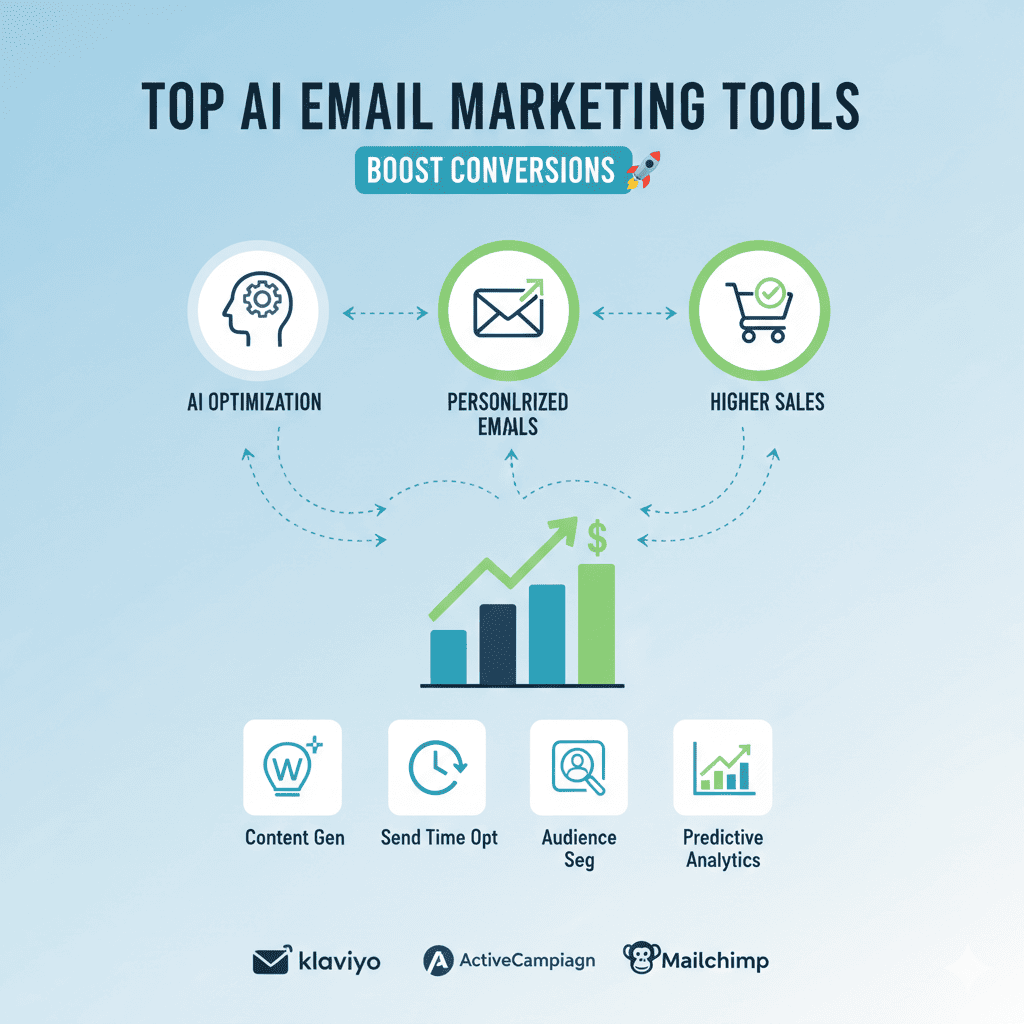
Email marketing remains one of the most powerful channels for driving conversions, with an average ROI of $42 for every dollar spent. However, in today’s competitive digital landscape, traditional email marketing strategies are no longer enough. Enter AI Email Marketing Tools – sophisticated platforms that leverage artificial intelligence to optimize every aspect of your email campaigns, from content creation to send time optimization.
The integration of artificial intelligence into email marketing has revolutionized how businesses connect with their audiences. AI Email Marketing Tools can analyze vast amounts of data, predict customer behavior, personalize content at scale, and continuously optimize campaigns for better performance. Whether you’re a small business owner or a marketing professional at an enterprise company, these tools can help you achieve higher open rates, click-through rates, and ultimately, conversions.
In this comprehensive guide, we’ll explore the top AI Email Marketing Tools available today, their key features, and how they can transform your email marketing strategy to boost conversions significantly.
Why AI Email Marketing Tools Are Essential for Modern Businesses
Before diving into specific tools, it’s important to understand why AI Email Marketing Tools have become indispensable for businesses looking to maximize their email marketing ROI.
Traditional email marketing often relies on broad segmentation and manual A/B testing, which can be time-consuming and limited in scope. AI transforms this approach by:
- Analyzing customer behavior patterns to predict the best times to send emails
- Personalizing content based on individual preferences and past interactions
- Optimizing subject lines using natural language processing
- Segmenting audiences automatically based on hundreds of data points
- Predicting customer churn and triggering re-engagement campaigns
- Generating compelling copy that resonates with specific audience segments
- Automating workflows based on complex behavioral triggers
The result? Higher engagement rates, improved deliverability, and significantly better conversion rates compared to traditional email marketing methods.
1. Phrasee – AI-Powered Language Optimization
Phrasee stands out as one of the most specialized AI Email Marketing Tools focused entirely on optimizing email language. This platform uses advanced natural language generation and machine learning to create subject lines, body copy, and calls-to-action that drive higher engagement.
Key Features:
Deep Learning Language Models: Phrasee’s AI has been trained on millions of marketing messages, learning what language patterns drive the best results across different industries and audiences.
Brand Voice Customization: The platform learns your brand’s unique voice and tone, ensuring all AI-generated content aligns perfectly with your brand identity while still optimizing for performance.
Real-Time Optimization: Unlike traditional A/B testing that might take days or weeks, Phrasee continuously learns and optimizes in real-time, adapting to changing audience preferences.
Multilingual Capabilities: The AI can generate and optimize content in multiple languages, making it ideal for global brands.
Why It Boosts Conversions:
Phrasee has consistently demonstrated its ability to outperform human-written copy, with clients reporting up to 95% confidence that AI-generated subject lines will outperform control groups. By removing human bias and relying on data-driven language optimization, brands see average open rate increases of 2-10% and click rate improvements of up to 15%.
2. Seventh Sense – AI Send Time Optimization
Seventh Sense is one of the most powerful AI Email Marketing Tools for optimizing when your emails get delivered. This platform integrates with HubSpot and Marketo to analyze individual engagement patterns and deliver emails at the optimal time for each recipient.
Key Features:
Individual Send Time Optimization: Rather than sending all emails at once, Seventh Sense analyzes when each individual subscriber is most likely to engage and schedules delivery accordingly.
Email Frequency Optimization: The AI determines the ideal email frequency for each subscriber, preventing fatigue and unsubscribes while maximizing engagement.
Deliverability Enhancement: By sending emails when recipients are most active, the platform improves engagement signals that positively impact sender reputation and inbox placement.
Throttling and Pacing: For large sends, the AI intelligently throttles delivery to maintain optimal deliverability and avoid triggering spam filters.
Why It Boosts Conversions:
Timing is everything in email marketing. Studies show that engagement rates can vary by 50% or more depending on when an email is delivered. Seventh Sense users typically see 7% higher open rates and 18% higher click rates compared to standard batch-and-blast sending. This improved engagement directly translates to higher conversion rates.
3. Persado – AI-Powered Emotional Language
Persado is among the most sophisticated AI Email Marketing Tools available, using artificial intelligence to generate emotionally engaging content that motivates action. The platform analyzes which emotional triggers, narratives, and descriptions drive the best results for specific audiences.
Key Features:
Emotion AI: Persado’s proprietary AI understands the emotional impact of different words and phrases, crafting messages that resonate on a psychological level.
Dynamic Content Generation: The platform can create millions of content variations, testing and learning which combinations drive the best results.
Cross-Channel Consistency: Beyond email, Persado optimizes language across SMS, push notifications, and digital ads, ensuring consistent emotional resonance across all touchpoints.
Performance Prediction: Before sending, the AI predicts how each message variation will perform, allowing marketers to launch campaigns with confidence.
Why It Boosts Conversions:
Persado focuses on the emotional and psychological drivers of consumer behavior. Companies using Persado have reported conversion rate increases of 15-40% by leveraging emotionally optimized language that connects with customers on a deeper level. The platform has generated over $1 billion in incremental revenue for its clients.
4. Optimove – AI-Driven Customer Journey Orchestration
Optimove represents a new generation of AI Email Marketing Tools that go beyond individual campaigns to orchestrate entire customer journeys. This platform uses AI to predict customer behavior and automatically trigger personalized email campaigns at critical moments.
Key Features:
Predictive Micro-Segmentation: The AI automatically creates thousands of micro-segments based on customer behavior, preferences, and predicted lifetime value.
Self-Optimizing Campaigns: Campaigns continuously optimize themselves based on real-time performance data, adjusting content, timing, and targeting automatically.
Churn Prediction: The platform identifies customers at risk of churning and automatically triggers retention campaigns designed to re-engage them.
Multi-Channel Orchestration: While email is a core component, Optimove coordinates campaigns across email, SMS, mobile push, and other channels for maximum impact.
Why It Boosts Conversions:
By treating email as part of a holistic customer journey rather than isolated campaigns, Optimove helps brands increase customer lifetime value by an average of 25-30%. The platform’s ability to predict next-best actions and automate personalized responses at scale dramatically improves conversion rates throughout the customer lifecycle.
5. Mailchimp with AI Features – All-in-One Platform
Mailchimp has evolved from a simple email service provider into one of the most accessible AI Email Marketing Tools for businesses of all sizes. The platform has integrated various AI features that make sophisticated email marketing accessible to non-technical users.
Key Features:
Creative Assistant: AI-powered design recommendations help create visually appealing emails that align with your brand.
Send Time Optimization: The platform analyzes subscriber engagement patterns to recommend optimal send times.
Subject Line Helper: AI suggests improvements to subject lines based on best practices and predicted performance.
Content Optimizer: The AI analyzes your email content and provides recommendations to improve engagement and deliverability.
Predictive Segmentation: Automatically identify subscribers most likely to purchase and target them with specific campaigns.
Why It Boosts Conversions:
Mailchimp’s AI features democratize advanced email marketing capabilities, allowing small businesses and startups to compete with larger enterprises. Users leveraging AI features report 9-14% higher open rates and better overall campaign performance. The platform’s ease of use means teams can implement AI-driven strategies quickly without extensive training.
6. Braze – AI-Powered Customer Engagement
Braze is one of the most comprehensive AI Email Marketing Tools for enterprise brands, offering sophisticated AI capabilities for creating highly personalized customer experiences across email and other channels.
Key Features:
Intelligent Selection: AI automatically selects the best message variant for each user based on their preferences and behavior.
Intelligent Timing: The platform determines the optimal time to send messages to each individual user.
Intelligent Channel: AI decides which channel (email, push, SMS, etc.) is most likely to generate engagement from each user.
Predictive Churn: Machine learning models identify users at risk of churning and trigger automated retention campaigns.
Canvas Flow: Visual journey builder with AI-powered branching that adapts customer paths based on real-time behavior.
Why It Boosts Conversions:
Braze’s AI capabilities enable true 1:1 personalization at scale. Enterprise clients using Braze’s AI features report 27% higher customer retention rates and significantly improved conversion rates. The platform’s ability to orchestrate personalized experiences across multiple channels creates more touchpoints for conversion.
7. ActiveCampaign – AI-Powered Automation
ActiveCampaign combines email marketing with CRM and automation, making it one of the most versatile AI Email Marketing Tools for small to medium-sized businesses. The platform’s AI features focus on predicting customer behavior and automating personalized responses.
Key Features:
Predictive Sending: AI determines the best time to send emails to each contact based on their engagement history.
Predictive Content: The platform automatically shows different content to different segments based on what’s most likely to drive engagement.
Win Probability: AI calculates the likelihood of closing deals and suggests next-best actions for sales teams.
Site Messaging: AI-powered on-site messages that coordinate with email campaigns for consistent messaging.
Automated Segmentation: Machine learning automatically groups contacts based on behavior and attributes.
Why It Boosts Conversions:
ActiveCampaign’s AI features help businesses create sophisticated automation workflows that respond intelligently to customer behavior. Users report 70% higher conversion rates when using predictive sending compared to traditional scheduling. The platform’s affordability makes advanced AI capabilities accessible to growing businesses.
8. HubSpot Marketing Hub – Integrated AI Marketing
HubSpot Marketing Hub has integrated AI throughout its platform, making it one of the most comprehensive AI Email Marketing Tools for businesses seeking an all-in-one marketing solution.
Key Features:
Content Assistant: AI-powered writing tool that helps create email copy, subject lines, and CTAs optimized for engagement.
Predictive Lead Scoring: Machine learning analyzes which leads are most likely to convert, helping prioritize email outreach.
Smart Send Times: AI analyzes individual contact engagement patterns to determine optimal send times.
A/B Testing Automation: The platform automatically runs A/B tests and selects winning variants without manual intervention.
Behavioral Automation: AI triggers email sequences based on complex behavioral patterns and predictive analytics.
Why It Boosts Conversions:
HubSpot’s integrated approach means email marketing works seamlessly with other marketing channels, creating a unified customer experience. Companies using HubSpot’s AI features report 23% more qualified leads and higher conversion rates throughout the funnel. The platform’s CRM integration ensures email campaigns are informed by complete customer data.
9. Klaviyo – AI for E-commerce Email Marketing
Klaviyo has become the go-to platform for e-commerce brands, offering AI Email Marketing Tools specifically designed to drive online sales and customer retention.
Key Features:
Predictive Analytics: AI predicts customer lifetime value, churn risk, and next purchase date, enabling proactive campaigns.
Smart Send Time: Machine learning determines the optimal time to send emails to each individual subscriber.
Product Recommendations: AI-powered product recommendation engine that personalizes email content based on browsing and purchase history.
Flow Optimization: The platform automatically optimizes automated flows based on performance data.
Benchmarking: AI compares your performance against industry benchmarks and suggests improvements.
Why It Boosts Conversions:
Klaviyo’s AI is specifically tuned for e-commerce, understanding the unique challenges of online retail. E-commerce brands using Klaviyo’s AI features report 30-50% of their revenue coming from email marketing, with AI-driven product recommendations generating 15-25% of email revenue. The platform’s deep integration with e-commerce platforms enables real-time personalization that drives immediate purchases.
10. Drift Email – Conversational AI Email Marketing
Drift Email brings conversational marketing principles to email, making it one of the most innovative AI Email Marketing Tools for B2B companies. The platform uses AI to create email experiences that feel like natural conversations rather than marketing messages.
Key Features:
Conversational Landing Pages: Emails link to AI-powered landing pages that adapt based on visitor behavior and responses.
Intent Detection: AI analyzes email engagement and website behavior to detect buying intent and trigger personalized follow-ups.
Automated Qualification: The platform automatically qualifies leads through conversational emails and routes them appropriately.
Meeting Scheduling: AI-powered assistant that coordinates meeting scheduling directly through email conversations.
Revenue Acceleration: Machine learning identifies accounts showing buying signals and prioritizes them for email outreach.
Why It Boosts Conversions:
Drift’s conversational approach to email marketing generates 3-5x higher response rates compared to traditional email campaigns. The platform’s ability to create personalized, two-way conversations at scale helps B2B companies shorten sales cycles and increase conversion rates by 25-35%.
How to Choose the Right AI Email Marketing Tools for Your Business
With so many powerful AI Email Marketing Tools available, selecting the right platform for your business requires careful consideration of several factors:
Business Size and Complexity: Enterprise organizations with complex customer journeys may benefit from comprehensive platforms like Braze or Optimove, while small businesses might find Mailchimp or ActiveCampaign more appropriate.
Industry Focus: E-commerce businesses should prioritize platforms like Klaviyo with specialized e-commerce AI features, while B2B companies might prefer Drift or HubSpot.
Budget: AI Email Marketing Tools range from affordable solutions like ActiveCampaign ($29/month) to enterprise platforms that cost thousands monthly. Consider not just the base price but the ROI potential.
Integration Requirements: Ensure the platform integrates seamlessly with your existing tech stack, including CRM, e-commerce platform, analytics tools, and other marketing software.
Technical Expertise: Some platforms require significant technical knowledge to maximize their AI capabilities, while others offer user-friendly interfaces that non-technical marketers can master quickly.
Specific AI Capabilities: Identify which AI features matter most to your business – send time optimization, content generation, predictive analytics, or automation – and prioritize platforms strong in those areas.
Best Practices for Using AI Email Marketing Tools
Implementing AI Email Marketing Tools effectively requires more than just signing up for a platform. Here are essential best practices to maximize your success:
Start with Clean Data: AI is only as good as the data it learns from. Ensure your subscriber lists are clean, properly segmented, and enriched with relevant behavioral and demographic data.
Set Clear Goals: Define specific, measurable objectives for your AI email marketing efforts, whether that’s improving open rates, increasing revenue per email, or reducing churn.
Allow Time for Learning: Most AI Email Marketing Tools require a learning period to gather sufficient data and optimize performance. Don’t expect instant results; give the AI at least 2-4 weeks to learn patterns.
Monitor and Adjust: While AI automates many processes, human oversight remains crucial. Regularly review performance metrics and adjust strategies based on insights the AI provides.
Test Continuously: Even with AI optimization, continue running strategic tests to explore new approaches and validate AI recommendations.
Maintain Brand Voice: While AI can optimize language for performance, ensure all content aligns with your brand identity and values. Customize AI settings to respect brand guidelines.
Combine AI with Human Creativity: The best results come from pairing AI’s analytical capabilities with human creativity and strategic thinking. Use AI to handle optimization and personalization while humans focus on strategy and creative concepts.
Respect Privacy: As AI enables more sophisticated personalization, ensure all data collection and usage complies with privacy regulations like GDPR and CCPA.
Measuring Success with AI Email Marketing Tools
To truly understand the impact of AI Email Marketing Tools on your conversions, track these key metrics:
Open Rate Improvement: Compare AI-optimized campaigns against baseline performance to measure the impact of subject line optimization and send time intelligence.
Click-Through Rate (CTR): Monitor how AI-driven content personalization affects engagement levels and click behavior.
Conversion Rate: The ultimate measure of success – track how many email recipients complete desired actions, whether purchases, sign-ups, or downloads.
Revenue Per Email: Particularly important for e-commerce, this metric shows the direct financial impact of your AI email marketing efforts.
Customer Lifetime Value: AI tools that optimize the entire customer journey should demonstrably increase CLV over time.
Time Savings: Quantify how much time your team saves through AI automation, and redirect those resources to strategic initiatives.
Deliverability Rates: AI-driven send time optimization and frequency management should improve deliverability metrics over time.
Unsubscribe Rate: Effective AI personalization should reduce unsubscribe rates by delivering more relevant content at appropriate frequencies.
The Future of AI Email Marketing Tools
The evolution of AI Email Marketing Tools continues to accelerate, with several exciting trends emerging:
Hyper-Personalization: Future AI tools will create truly individualized email experiences, with every element – from imagery to copy to offers – uniquely tailored to each recipient.
Voice and Visual AI: Integration of voice AI for audio content in emails and visual AI for dynamic image personalization will create richer email experiences.
Predictive Customer Journeys: AI will not just react to customer behavior but predict entire customer journeys, proactively orchestrating email campaigns that guide customers toward conversion.
Advanced Natural Language Generation: AI will create more sophisticated, human-like email content that maintains brand voice while optimizing for performance.
Cross-Channel Intelligence: AI will seamlessly coordinate email with other channels, creating unified experiences that drive higher conversion rates across all touchpoints.
Privacy-First Personalization: As privacy regulations evolve, AI will enable sophisticated personalization using privacy-preserving technologies and first-party data.
Conclusion: Transforming Email Marketing with AI
AI Email Marketing Tools have fundamentally transformed how businesses approach email marketing, moving from broad segmentation and manual optimization to sophisticated, data-driven personalization at scale. The platforms covered in this guide represent the best available solutions for businesses seeking to boost email conversions through artificial intelligence.
Whether you’re a small business just starting with email marketing or an enterprise organization with complex customer journeys, there’s an AI Email Marketing Tool suited to your needs. The key is selecting a platform that aligns with your business goals, integrating it properly with your existing systems, and allowing the AI time to learn and optimize.
The results speak for themselves: businesses leveraging AI Email Marketing Tools consistently report higher open rates, improved click-through rates, and significantly better conversion rates compared to traditional email marketing approaches. As AI technology continues to evolve, these tools will become even more powerful, making them essential for any business serious about maximizing email marketing ROI.
Also read this:
How to Create Content Faster Using AI