
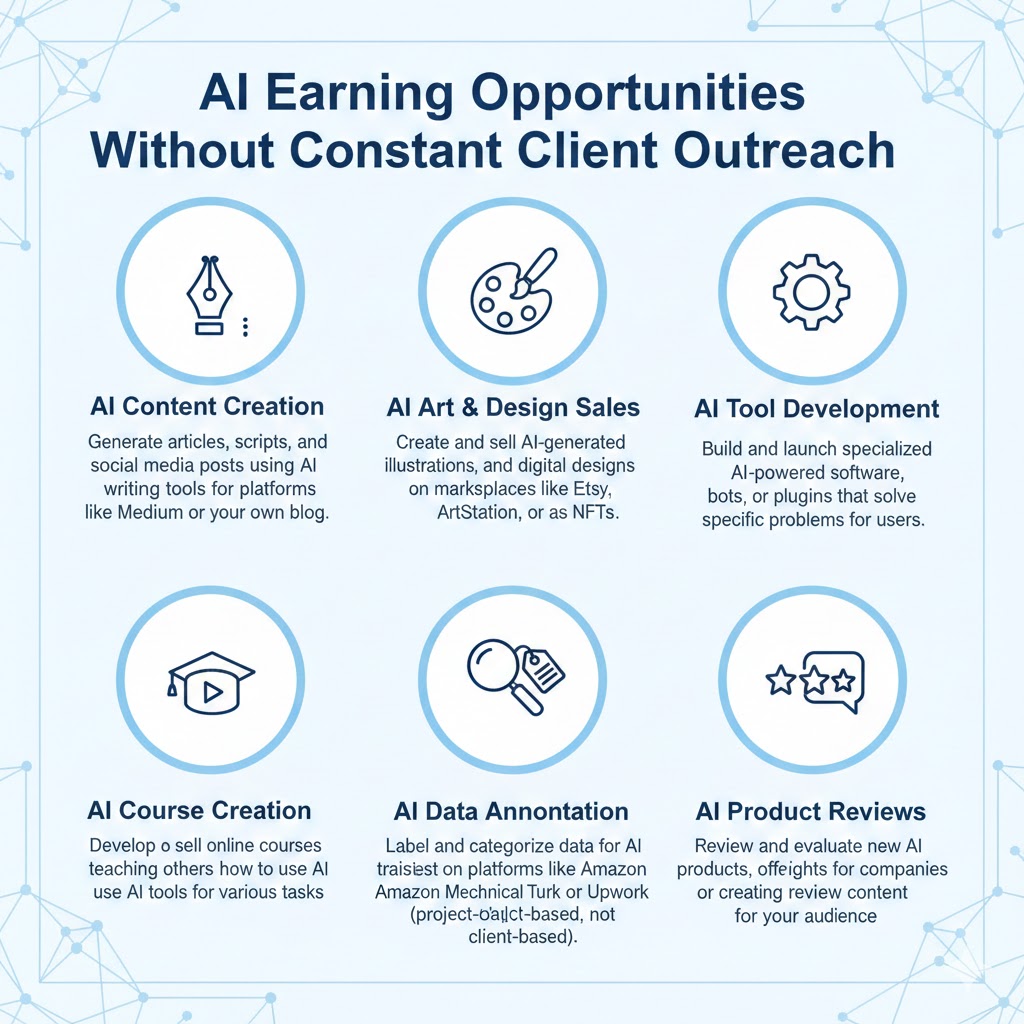
The artificial intelligence revolution has created unprecedented wealth-building possibilities, but most entrepreneurs approach these opportunities the wrong way. They build service businesses that demand endless networking, pitch meetings, and client acquisition efforts. The exhausting cycle of constant outreach becomes a treadmill that consumes energy without building lasting value. However, a different category of AI Earning Opportunities exists where revenue flows from systems, products, and platforms rather than perpetual sales activities.
These sustainable AI Earning Opportunities share common characteristics: they generate income through automated systems, create value that compounds over time, leverage digital distribution to reach customers without active selling, and build assets that appreciate rather than depleting with each transaction. This fundamental shift transforms how you generate income from AI expertise, replacing the feast-or-famine cycle with predictable, scalable revenue streams.
The difference between traditional AI consulting and these opportunities is profound. Consulting requires continuously finding new clients to replace completed projects. In contrast, the AI Earning Opportunities outlined here create income streams that persist and grow without proportional increases in acquisition effort. You build once and earn repeatedly, focusing energy on improving offerings rather than perpetually hunting for the next client.
1. AI-Powered SaaS Products with Self-Service Models
The Product-Led Growth Advantage
Software-as-a-Service represents one of the most powerful AI Earning Opportunities available because customers discover, evaluate, and purchase without requiring sales conversations. Product-led growth strategies rely on the product itself to drive acquisition, reducing or eliminating outreach requirements while scaling revenue efficiently.
AI capabilities enhance SaaS products by delivering superior results with less user effort. Intelligent automation, predictive features, and personalized experiences create competitive advantages that attract customers organically through product quality and word-of-mouth rather than aggressive marketing.
High-Potential AI SaaS Categories
Content Generation Platforms
Build SaaS tools that generate marketing copy, social media content, email sequences, or blog articles using AI. These platforms solve persistent problems for businesses that need continuous content but lack time or writing expertise. Subscription models generate recurring revenue as customers depend on tools for ongoing content needs.
Successful content generation platforms focus on specific niches rather than attempting to serve everyone. A platform specializing in real estate listing descriptions or e-commerce product descriptions commands higher prices and attracts customers more efficiently than generic writing tools. Specialization creates expertise perception and reduces competition.
Data Analysis and Visualization Tools
Create AI-powered analytics platforms that transform complex data into actionable insights automatically. Businesses generate massive data volumes but struggle to extract meaningful patterns. Your platform makes analysis accessible to non-technical users, expanding market reach beyond data scientists to business managers and entrepreneurs.
Integration capabilities determine platform stickiness. Connect with popular data sources like Google Analytics, Shopify, Salesforce, or accounting software. When customers integrate your platform with core business systems, switching costs increase and retention improves dramatically.
Automated Customer Communication Systems
Develop AI chatbot platforms or email automation systems with intelligent personalization capabilities. Businesses recognize that personalized communication increases engagement but lack resources to customize interactions manually. Your platform automates personalization at scale, delivering value that justifies monthly subscription fees.
Offer industry-specific templates and pre-trained models that accelerate customer implementation. The faster customers achieve initial value, the more likely they continue subscriptions long-term. Focus on time-to-value optimization rather than feature quantity.
Revenue Model Implementation
Price SaaS products using tiered subscription models that align costs with customer value received. Entry tiers attract small businesses with limited budgets while premium tiers serve larger organizations requiring advanced features or higher usage limits. This structure maximizes total addressable market while capturing appropriate value from different customer segments.
Implement annual billing options with discounts that improve cash flow and increase retention. Customers paying annually show stronger commitment and cancel less frequently than monthly subscribers. The discount compensates for upfront payment while improving your financial position.
2. AI Model Marketplaces and Template Libraries
Building Reusable AI Assets
Creating and selling pre-trained AI models, prompt templates, or automation workflows represents lucrative AI Earning Opportunities with minimal ongoing sales effort. You develop assets once then sell them repeatedly through digital marketplaces that handle discovery, transactions, and delivery automatically.
The key to marketplace success lies in solving specific, recurring problems better than generic solutions. Rather than offering general-purpose models, create specialized assets for particular industries, use cases, or platforms. Specificity commands premium pricing and generates better customer reviews that drive organic sales.
Profitable Marketplace Offerings
Industry-Specific Prompt Libraries
Compile comprehensive prompt collections for specific professions or industries. Marketers need prompts for campaign creation, customer research, and content strategy. Developers need prompts for code review, documentation generation, and debugging assistance. Legal professionals need prompts for contract analysis and legal research.
Organize prompts into logical categories with clear documentation explaining when and how to use each. Include examples showing inputs and expected outputs. This professional presentation differentiates premium products from free prompt collections shared online.
Pre-Trained Custom Models
Develop specialized AI models for specific tasks that many businesses face. Image classification models for product quality control, sentiment analysis models for customer feedback, or entity recognition models for document processing save customers months of development time and substantial costs.
Offer models in multiple formats compatible with popular frameworks and platforms. Providing deployment flexibility increases potential customer base. Include detailed documentation covering model capabilities, limitations, training data characteristics, and integration instructions.
Automation Workflow Templates
Create complete automation workflows using platforms like Make, Zapier, or custom APIs that leverage AI capabilities. Businesses want solutions, not building blocks. Pre-built workflows that accomplish specific objectives attract customers willing to pay for time savings and proven functionality.
Package workflows with comprehensive setup guides, video tutorials, and support documentation. The easier implementation becomes, the more customers purchase and successfully deploy your offerings, leading to positive reviews and repeat purchases.
Maximizing Marketplace Revenue
List products on multiple marketplaces to maximize exposure. Platforms like Gumroad, AppSumo, GitHub Marketplace, or industry-specific marketplaces each provide access to different customer segments. Diversification reduces platform dependency while increasing total sales volume.
Implement tiered pricing with basic, professional, and enterprise versions. Basic versions prove value and attract price-sensitive customers. Professional versions include advanced features or support. Enterprise versions offer customization, priority support, or usage rights for large organizations.
Develop product ecosystems where customers who purchase one offering need complementary products. A customer buying prompt libraries for social media might also need templates for analytics reports or email campaigns. Cross-selling opportunities increase customer lifetime value without additional acquisition costs.
3. Educational Products and AI Training Programs
The Evergreen Content Advantage
Educational products represent exceptional AI Earning Opportunities because they generate passive income long after creation. Record courses once then sell them indefinitely through automated platforms. Quality educational content maintains relevance for years, especially when teaching fundamental concepts rather than rapidly changing tools.
The AI skills gap creates enormous demand for practical training. Businesses need employees who understand AI capabilities and limitations. Professionals want to enhance careers with AI expertise. Entrepreneurs seek practical knowledge for implementing AI in their ventures. This diverse demand supports multiple educational product types across different price points.
High-Value Educational Offerings
Comprehensive Video Courses
Create detailed courses teaching specific AI implementation skills. Focus on practical application rather than theoretical understanding. Students want to build working solutions, not just understand concepts. Courses showing how to implement customer service chatbots, automate business processes, or analyze data with AI tools attract eager buyers.
Structure courses in progressive modules that build competency systematically. Include practical exercises, real-world examples, and downloadable resources. High production quality matters less than clear instruction and actionable content. Many successful courses use simple screen recordings with clear explanations.
Implementation Blueprints and Frameworks
Develop comprehensive frameworks for implementing AI solutions in specific contexts. A blueprint for deploying AI in e-commerce businesses, manufacturing operations, or professional services provides structure that reduces implementation risk and accelerates results. These frameworks command premium prices because they compress months of trial-and-error into proven processes.
Include detailed documentation, checklists, templates, and case studies demonstrating framework effectiveness. The more complete and actionable your blueprint, the higher price it justifies and the more testimonials you receive from successful implementations.
Membership Communities with Ongoing Education
Build membership communities that provide continuous AI education and implementation support. Members pay monthly or annually for access to regular training updates, implementation workshops, and peer community. This model generates recurring revenue while building a engaged audience for future product launches.
Deliver consistent value through weekly training sessions, monthly implementation challenges, or quarterly strategy workshops. The ongoing nature of artificial intelligence development ensures you never lack relevant content topics. Community members also create value for each other through shared experiences and collaborative problem-solving.
Distribution and Pricing Strategies
Host courses on established platforms like Teachable, Thinkific, or Udemy to leverage their existing traffic and credibility. While platforms take percentage fees, they eliminate technical hosting responsibilities and provide marketing exposure. Alternatively, self-host courses using membership platforms to retain full revenue and customer relationships.
Price educational products based on transformation value rather than production costs. A course enabling someone to command higher salary or build a profitable business justifies prices from five hundred to several thousand dollars. Budget-conscious customers accept higher prices when clear ROI is demonstrated.
Implement payment plans that make premium courses accessible while improving cash flow. Offering three or six monthly payments reduces purchase friction for customers while maintaining total revenue. Payment plans also improve completion rates as financial commitment encourages follow-through.
4. AI-Enhanced Digital Products and Tools
Creating Valuable Digital Assets
Digital products enhanced with AI capabilities represent versatile AI Earning Opportunities that sell through automated systems without active promotion. These products solve specific problems efficiently, creating customer value that generates organic growth through satisfaction and recommendations.
The advantage of AI-enhanced digital products lies in their superior capabilities compared to static alternatives. Traditional templates require manual customization. AI-enhanced versions adapt automatically to user inputs, delivering personalized results with minimal effort. This enhanced utility commands premium pricing.
Profitable Digital Product Categories
Intelligent Document Templates
Develop document templates that use AI to customize content based on user inputs. Business plan templates that generate industry-specific sections, grant proposal templates that tailor language to funding priorities, or contract templates that adapt terms to jurisdiction requirements save users substantial time while improving quality.
Create templates for documents with high monetary value. A business plan template used for seeking funding justifies a higher price than a template for internal use. Resume templates targeting executives command more than those for entry-level positions. Price reflects the economic impact of the document’s purpose.
Automated Report Generators
Build tools that transform raw data into formatted reports automatically. Financial report generators for small businesses, marketing analytics reports for agencies, or operational dashboards for managers solve recurring needs. The automated nature means customers purchase once then use repeatedly, creating strong satisfaction and referral likelihood.
Focus on specific industries or use cases rather than generic reporting. An automated report generator for Amazon FBA sellers has clearer value proposition than general e-commerce reporting. Specialization allows you to include industry-specific metrics, benchmarks, and insights that generic tools cannot provide.
Interactive Calculators and Assessment Tools
Create AI-powered calculators that help users make complex decisions. ROI calculators for marketing investments, pricing optimization tools for products, or financial planning calculators for retirement provide immediate value. Users share useful calculators, creating viral growth potential without advertising spend.
Monetize through premium versions with advanced features, lead generation for complementary services, or sponsorship from relevant businesses. Some calculators generate sufficient traffic that advertising revenue alone justifies development effort.
Distribution and Monetization
Sell digital products through your own website using tools like Gumroad, SendOwl, or WooCommerce. Direct sales maximize profit margins and provide complete customer data for email marketing and future product launches. Alternatively, use marketplaces for additional exposure while accepting reduced margins.
Implement freemium models where basic versions are free but advanced features require payment. Free versions drive adoption and demonstrate value, converting a percentage to paying customers. This model works particularly well for tools with clear upgrade paths from basic to advanced functionality.
Create product bundles that increase average transaction value. Customers interested in business planning templates likely want financial projection templates and pitch deck templates. Bundling related products at discounted prices increases revenue per customer while providing perceived value.
5. Affiliate Marketing and AI Tool Partnerships
Low-Effort Revenue Streams
Affiliate marketing represents one of the most accessible AI Earning Opportunities because it requires no product creation, customer support, or fulfillment responsibilities. You simply connect potential customers with relevant AI tools and earn commissions on resulting sales. Well-established affiliate programs provide all necessary marketing materials, tracking systems, and payment processing.
The AI industry offers exceptional affiliate opportunities due to high product values and generous commission structures. Many AI SaaS companies offer recurring commissions on subscription revenue, creating long-term income from single referrals. A customer subscribing to a two-hundred-dollar monthly service might generate twenty to fifty dollars in monthly commissions for years.
Effective Affiliate Strategies
Comprehensive Comparison Content
Create detailed comparisons of AI tools in specific categories. Content comparing AI writing assistants, customer service chatbots, or data analysis platforms attracts users actively researching purchase decisions. These high-intent visitors convert to affiliate sales at elevated rates compared to casual traffic.
Make comparisons genuinely useful by testing tools personally and providing honest assessments of strengths, weaknesses, and ideal use cases. Authenticity builds trust that increases conversion rates and generates repeat visits. Biased reviews optimizing for highest commission percentages damage credibility and reduce long-term earnings.
Tutorial and Implementation Content
Develop tutorials showing how to accomplish specific objectives using particular AI tools. A comprehensive guide to building customer service chatbots using a specific platform provides value while naturally including affiliate links. Users following tutorials have high purchase intent and strong conversion potential.
Video tutorials often outperform written content for tool-focused content. Screen recordings demonstrating actual tool usage help viewers understand capabilities better than descriptions alone. Upload tutorials to YouTube for additional traffic sources and longevity.
Curated Resource Lists
Build and maintain curated lists of AI tools for specific purposes or industries. Lists of best AI tools for small business marketing, essential AI resources for writers, or recommended AI platforms for data analysts attract organic search traffic. Regular updates keep content current and maintain search rankings.
Email curated lists to subscribers regularly, updating them about new tools, capability improvements, or pricing changes. This ongoing value keeps your audience engaged and generates continuous affiliate revenue from tool recommendations.
Maximizing Affiliate Income
Focus on tools with recurring commission structures rather than one-time payments. A single referral generating monthly commissions creates compounding income as your referral base grows. This model aligns with the passive income objectives of sustainable AI Earning Opportunities.
Negotiate higher commission rates with companies whose tools you promote effectively. Once you demonstrate ability to drive significant sales, many companies offer increased rates, exclusive promotions, or other incentives. Strategic partnerships amplify earnings without increasing effort.
Diversify across multiple affiliate programs to reduce dependence on any single company or product category. AI tool markets evolve rapidly with new entrants and capability improvements. Diversification protects income streams when specific tools lose relevance or change commission structures.
6. Licensing AI-Generated Content and Media
Creating Scalable Digital Assets
Generating and licensing AI-created content represents innovative AI Earning Opportunities with minimal maintenance requirements. AI tools now produce high-quality images, music, video elements, and written content that businesses need for marketing, presentations, and digital products. Licensing these assets through stock platforms generates passive income as customers discover and purchase your content.
The advantage of AI-generated content lies in production scalability. Traditional content creation limits output to hours available. AI generation removes this constraint, allowing vast content libraries that increase earning potential proportionally. Larger portfolios generate more sales through increased discoverability and broader keyword coverage.
Profitable Content Licensing Approaches
AI-Generated Stock Photography and Illustrations
Create extensive libraries of AI-generated images for specific niches. Business-themed images for presentations, lifestyle images for marketing materials, or abstract designs for graphic design projects all find consistent demand. Upload to multiple stock platforms like Shutterstock, Adobe Stock, or specialized illustration marketplaces.
Focus on underserved niches where traditional photography is expensive or logistically challenging. Conceptual business illustrations, diverse representation in corporate settings, or seasonal imagery optimized for specific industries can outperform generic content in both sales volume and price per download.
Music and Audio Elements
Generate background music, sound effects, or audio loops using AI composition tools. Content creators, game developers, and marketers need royalty-free audio constantly. Quality AI-generated audio provides cost-effective alternatives to expensive music licensing or custom composition.
Categorize audio meticulously with detailed tags describing mood, tempo, instruments, and use cases. Accurate categorization improves discoverability and sales. Create variations of successful tracks to expand catalog efficiently.
Written Content and Templates
Produce and license written content like social media posts, email templates, or article outlines. While less common than image licensing, written content markets exist for businesses needing ready-made copy. Package content in themed collections that serve specific industries or purposes.
Ensure AI-generated text undergoes human editing for quality assurance and unique value addition. Pure AI output without refinement faces increasing competition as tools become widely accessible. Your editing and curation create differentiation.
Optimization for Licensing Revenue
Upload content consistently to maintain portfolio growth and platform visibility. Many stock platforms reward regular contributors with improved search placement and promotional opportunities. Consistency also compounds earnings as catalog size increases.
Research trending topics and seasonal demand patterns to guide content creation. Producing holiday-themed content months in advance positions your work for seasonal sales spikes. Trending topic content capitalizes on current interest while competition remains lower.
Analyze sales data to identify best-performing content characteristics. Double down on successful themes, styles, or subjects while discontinuing underperforming approaches. This data-driven optimization improves earnings efficiency over time.
7. Automated AI Service Platforms
Building Self-Service Solutions
Automated service platforms that handle customer interactions, delivery, and payment processing without your involvement represent ultimate AI Earning Opportunities for passive income. These platforms solve specific problems through AI capabilities, operating continuously without requiring your active participation in individual transactions.
The distinction between traditional services and automated platforms is fundamental. Services require your time for each customer transaction. Automated platforms handle unlimited customers simultaneously, creating revenue scalability impossible with manual service delivery.
Viable Automated Platform Models
AI-Powered Analysis Services
Create platforms where customers upload data and receive automated AI analysis. Resume analysis services that provide improvement recommendations, business plan evaluation platforms that identify weaknesses, or website audit services that suggest optimization opportunities operate without manual review of each submission.
Charge per analysis or offer subscription models for unlimited assessments. Pricing should reflect value provided rather than your minimal per-transaction costs. A business plan analysis that improves funding success is worth hundreds of dollars despite minimal processing costs.
Automated Consultation Platforms
Build AI chatbots that provide specialized consultation in specific domains. Legal document review chatbots, marketing strategy advisors, or technical troubleshooting assistants deliver value through conversational interfaces. Customers pay for access or per-session fees.
Train chatbots extensively on domain-specific knowledge to provide genuinely useful guidance. Generic responses fail to deliver sufficient value for monetization. Specialization and accuracy determine customer satisfaction and willingness to pay.
Personalized Content Generation Services
Develop platforms generating customized content based on user inputs. Services creating personalized workout plans, customized meal plans, or individualized learning curricula for specific subjects deliver high value through AI-powered personalization. The automated nature allows serving unlimited customers.
Include delivery mechanisms that enhance perceived value. Rather than simple text outputs, generate formatted PDFs, interactive web pages, or mobile app experiences. Professional presentation increases willingness to pay and reduces refund requests.
Technical Implementation Considerations
Design user interfaces emphasizing simplicity and clarity. Customers should understand exactly what they will receive and how to provide necessary inputs. Confusion increases support burden and contradicts passive income objectives.
Implement robust error handling and input validation. Automated platforms cannot afford frequent failures that generate support tickets. Extensive testing across diverse inputs ensures reliability that maintains reputation without constant intervention.
Establish automated payment processing and content delivery systems. Integration with payment processors like Stripe enables instant transactions while content delivery systems send results automatically. This complete automation eliminates manual transaction processing.
8. AI-Powered Membership Sites and Subscriptions
Building Recurring Revenue Communities
Membership sites offering ongoing AI-generated value represent premium AI Earning Opportunities combining community building with automated content delivery. Members pay monthly or annually for access to continuously updated resources, tools, or insights. The subscription model creates predictable revenue while community aspects increase retention and reduce churn.
AI capabilities enable membership sites to deliver personalized value at scale, differentiating them from static content libraries. Dynamic content generation, personalized recommendations, and intelligent resource curation provide ongoing reasons for membership continuation.
Successful Membership Site Models
AI-Enhanced Research and Insights Communities
Create membership sites delivering regular AI-assisted research on specific industries or topics. Members receive weekly reports analyzing trends, competitor activities, market opportunities, or emerging technologies. AI handles data aggregation and initial analysis while you provide strategic interpretation.
Industries with rapid change and fragmented information sources particularly value curated intelligence. Technology sectors, regulatory environments, or emerging markets generate consistent demand for organized insights that save members research time.
Tool Access and Template Libraries
Offer membership sites providing access to growing libraries of AI-powered tools and templates. Members use different tools for various projects, creating ongoing value from single subscription. Regular addition of new tools maintains excitement and justifies continued membership.
Include both general-purpose and specialized tools serving specific use cases. Broad tool variety attracts diverse members while specialized tools provide deep value for specific needs. This combination maximizes both acquisition and retention.
Implementation Support and Community
Build memberships combining educational content with implementation support and peer community. Members receive regular training on new AI capabilities, implementation frameworks for business applications, and community forums for sharing experiences. This comprehensive approach creates high perceived value.
Host regular live events like monthly workshops, quarterly planning sessions, or annual virtual summits. Live interactions strengthen community bonds and increase retention significantly compared to content-only memberships.
Retention and Growth Strategies
Deliver new value consistently through weekly content additions, monthly feature releases, or quarterly program updates. Consistency maintains engagement and reduces cancellation risk. The perception of continuous improvement encourages long-term commitment.
Implement onboarding sequences that guide new members to initial value quickly. Members achieving early wins continue subscriptions at higher rates than those who struggle initially. Structured onboarding paths reduce time-to-value and improve retention.
Collect feedback regularly to understand member needs and satisfaction. Addressing concerns proactively prevents cancellations while implementing requested features increases loyalty. Members appreciate when feedback influences site development.
Conclusion: Choosing Your AI Income Path
The AI Earning Opportunities outlined here share fundamental advantages over traditional client service models. They generate income through systems rather than individual transactions, scale without proportional time investment, and build compounding value through network effects, content accumulation, or platform improvement. These characteristics create sustainable income streams that grow while demanding less exhausting client acquisition efforts.
Selecting the right opportunity depends on your existing skills, available capital, and personal preferences. Creating SaaS products requires significant technical capability and upfront investment but offers highest revenue potential. Educational products leverage existing expertise with moderate development effort. Affiliate marketing requires minimal investment but depends on audience building for substantial income.
The most successful approach often combines multiple AI Earning Opportunities that reinforce each other. An educational course establishes expertise that drives affiliate recommendations. A membership site provides platform for launching digital products. A SaaS tool creates audience for educational content. This ecosystem approach diversifies income while creating synergies that accelerate growth.
Begin by selecting one opportunity aligned with your strengths and market position. Develop it to profitability before expanding to additional income streams. The temptation to pursue everything simultaneously dilutes effort and delays meaningful results. Focused execution on single opportunities creates foundation for sustainable, diversified income.
The AI Earning Opportunities landscape continues expanding as artificial intelligence capabilities advance and adoption accelerates. Early movers establishing positions in valuable niches build advantages that compound over time. The question is not whether these opportunities exist but whether you will act decisively to capture them. The passive income possibilities are real. Your challenge is transforming possibility into reality through strategic action.
Also read this:
AI Performance Monitoring Services: How to Earn Recurring Income From Businesses
10 Profitable AI Service Niches Built on Client Retention, Not Lead Generation
AI Agency Services That Automate Manual Operations for Businesses