
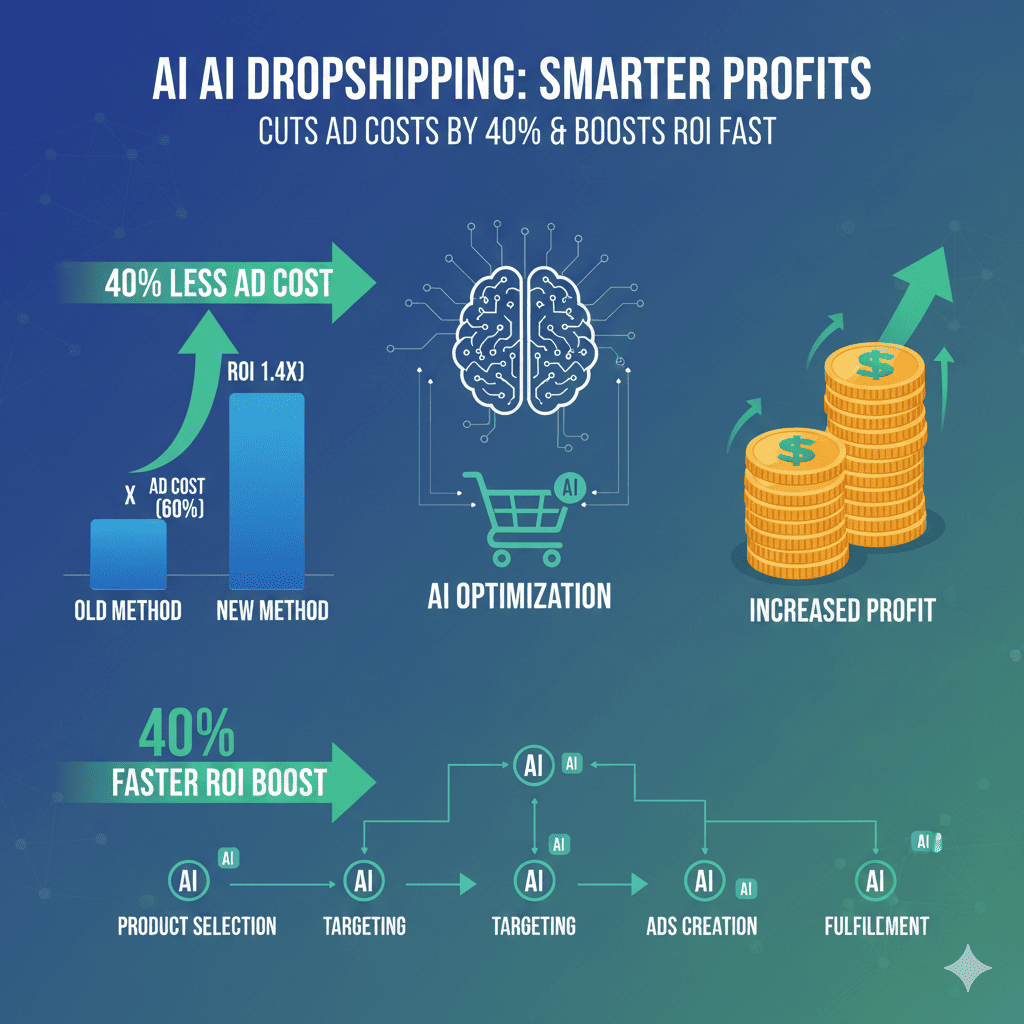
The dropshipping landscape has transformed dramatically with artificial intelligence integration. Business owners who once struggled with inefficient ad spending and unpredictable returns are now discovering how AI Dropshipping Cuts Ad Costs while simultaneously improving profit margins. This comprehensive guide reveals the exact mechanisms behind this revolution and provides actionable strategies for implementing AI-driven solutions in your dropshipping business.
1. Understanding the AI Dropshipping Revolution
The traditional dropshipping model often suffered from trial-and-error marketing approaches that drained budgets without guaranteeing results. Entrepreneurs would spend thousands testing different products, audiences, and ad creatives before finding a winning combination. The integration of artificial intelligence has fundamentally changed this equation.
The Traditional Dropshipping Challenge
Conventional dropshipping businesses faced several critical obstacles. Manual product research consumed countless hours with inconsistent results. Ad targeting relied heavily on guesswork and basic demographic information. Creative testing required substantial investment before identifying effective designs. Customer data analysis remained superficial at best, missing crucial behavioral patterns that could inform better decision-making.
How AI Changes Everything
Artificial intelligence brings unprecedented precision to every aspect of dropshipping operations. Machine learning algorithms analyze millions of data points in seconds, identifying patterns invisible to human observers. Predictive analytics forecast market trends before they fully emerge, giving early adopters significant competitive advantages. Automated optimization continuously adjusts campaigns based on real-time performance metrics, eliminating wasted ad spend on underperforming elements.
2. The 40% Cost Reduction Mechanism Explained
Understanding how AI Dropshipping Cuts Ad Costs requires examining the specific technological mechanisms at work. The 40% reduction isn’t arbitrary; it’s the result of multiple optimization layers working simultaneously.
Precision Audience Targeting
AI-powered platforms analyze user behavior across millions of touchpoints to create hyper-specific audience segments. Traditional targeting might reach 100,000 people with a 2% conversion rate. AI narrows this to 20,000 people with a 10% conversion rate, delivering the same conversions while spending 80% less on impressions that won’t convert.
Machine learning models identify micro-behaviors that indicate purchase intent. Someone who viewed similar products three times in the past week, spent more than two minutes on product pages, and engaged with related social content shows dramatically higher conversion probability than someone matching basic demographic criteria alone.
Dynamic Bid Optimization
Real-time bid adjustments ensure you never overpay for ad placements. AI systems monitor auction dynamics across advertising platforms, automatically adjusting bids based on conversion likelihood, time of day, device type, and dozens of other variables. When competition for ad space decreases during certain hours, AI lowers bids while maintaining visibility. When high-intent users appear online, the system increases bids strategically to capture these valuable opportunities.
Creative Performance Prediction
Before spending thousands on A/B testing, AI analyzes creative elements to predict performance. Computer vision algorithms evaluate images for attention-grabbing elements, color psychology, composition effectiveness, and emotional resonance. Natural language processing assesses ad copy for persuasiveness, clarity, and alignment with target audience preferences.
This predictive capability means you launch campaigns with creatives already optimized for success, rather than burning budget discovering what doesn’t work.
3. Smart Product Selection Through AI Analytics
Product selection makes or breaks dropshipping businesses. Choosing trending products early maximizes profit potential, while jumping on saturated trends wastes resources. AI Dropshipping Cuts Ad Costs significantly by ensuring you promote products with genuine market demand and manageable competition.
Trend Prediction Algorithms
AI systems scan social media platforms, search engines, e-commerce marketplaces, and news sources to identify emerging trends. Unlike humans who might spot trends weeks after they begin, AI detects subtle signals in search volume increases, social mention patterns, and engagement metrics that indicate a trend forming.
These systems distinguish between fleeting fads and sustainable product opportunities. Machine learning models trained on historical trend data recognize patterns associated with products that maintain profitability for months versus those that crash within weeks.
Competitive Gap Analysis
AI identifies market opportunities by analyzing competitor positioning, pricing strategies, and customer satisfaction levels. If existing sellers focus on one demographic while search data shows demand from another segment, AI flags this gap as a high-opportunity niche.
The technology also evaluates ad saturation levels. When too many advertisers promote the same product, costs rise while conversion rates fall. AI warns you before entering oversaturated markets, preventing wasted investment in unwinnable advertising battles.
Profit Margin Optimization
Beyond identifying popular products, AI calculates realistic profit margins accounting for advertising costs, supplier pricing, shipping expenses, and platform fees. The system recommends products where healthy margins remain achievable even after accounting for competitive ad costs.
4. Automated Ad Campaign Management
Manual campaign management creates inefficiencies that inflate costs unnecessarily. Human marketers can monitor limited data points and adjust campaigns a few times daily at best. AI operates continuously, making thousands of micro-adjustments that compound into substantial cost savings.
Continuous A/B Testing
AI runs perpetual split tests across ad elements: headlines, images, calls-to-action, descriptions, and landing page variations. Rather than testing one variable at a time over weeks, AI simultaneously evaluates multiple combinations, rapidly identifying winning formulas.
The system automatically allocates more budget to high-performing variants while reducing spend on underperformers. This dynamic allocation ensures your budget constantly flows toward the most effective ads without requiring manual intervention.
Cross-Platform Optimization
Modern consumers interact with brands across multiple platforms before purchasing. AI tracks customer journeys across Facebook, Instagram, TikTok, Google, and other channels, understanding which platform combinations drive conversions most efficiently.
Instead of managing each platform separately, AI orchestrates unified campaigns that leverage each platform’s strengths. The system might use TikTok for initial awareness among younger demographics, Instagram for showcasing product aesthetics, and Google for capturing high-intent search traffic, all while maintaining coordinated messaging and optimizing total customer acquisition cost.
Budget Allocation Intelligence
AI continuously analyzes ROI across campaigns, ad sets, and individual ads, automatically reallocating budget to maximize overall returns. If one campaign generates conversions at $15 while another achieves $25, the system gradually shifts budget toward the more efficient option.
This dynamic budgeting responds to real-time performance fluctuations. When a campaign’s effectiveness drops due to audience fatigue or market changes, AI reduces its budget before significant waste occurs. Conversely, when opportunities emerge, the system capitalizes quickly without requiring manual approval.
5. AI-Powered Customer Insights for Better Targeting
Understanding your customers deeply allows for messaging that resonates emotionally and logically. AI Dropshipping Cuts Ad Costs substantially by ensuring every ad reaches people most likely to purchase, with messaging tailored to their specific motivations.
Behavioral Pattern Recognition
AI analyzes browsing patterns, purchase histories, content engagement, and social interactions to create detailed customer profiles. These profiles extend far beyond demographics to include psychographic attributes: values, interests, lifestyle preferences, and purchasing triggers.
The technology identifies correlations humans might miss. Perhaps customers who purchase within two hours of first visiting your site share specific behavioral characteristics. AI recognizes these patterns and prioritizes similar prospects in future targeting.
Predictive Customer Lifetime Value
Not all customers offer equal long-term value. AI predicts which prospects will become repeat buyers versus one-time purchasers. This allows you to allocate higher acquisition costs for high-lifetime-value customers while maintaining strict cost controls for one-time buyers.
The system analyzes factors like initial order value, product category, engagement level, and response to marketing communications to forecast future purchase behavior. This intelligence informs bidding strategies that maximize long-term profitability rather than optimizing solely for immediate conversions.
Personalization at Scale
AI enables individualized ad experiences for thousands of prospects simultaneously. Dynamic creative optimization automatically adjusts ad elements based on viewer characteristics. Someone interested in fitness sees product applications emphasizing health benefits, while fashion-focused viewers see styling possibilities.
This personalization extends to ad timing. AI learns when individual users typically browse and make purchases, scheduling ad delivery for maximum impact. Someone who shops during lunch breaks sees your ads between 12-1 PM, while evening browsers receive exposure during their typical browsing windows.
6. Inventory and Supplier Management Enhancement
Advertising effectiveness depends partly on operational efficiency. Late shipments, stockouts, and quality issues devastate ad ROI by generating refunds, negative reviews, and customer acquisition costs without corresponding revenue.
Demand Forecasting
AI predicts product demand based on current advertising performance, seasonal patterns, trend trajectories, and external factors like weather or cultural events. Accurate forecasting prevents stockouts during high-demand periods while avoiding excess inventory carrying costs.
When AI detects accelerating demand for a product, it alerts you to scale inventory before running out. Conversely, declining trend indicators prompt inventory reduction before you’re stuck with unsellable stock.
Supplier Performance Analytics
AI monitors supplier metrics including fulfillment speed, product quality, customer satisfaction, and communication responsiveness. The system identifies which suppliers consistently deliver positive customer experiences and recommends prioritizing their products in your advertising.
Poor supplier performance destroys ad ROI by necessitating refunds and generating negative reviews that increase future acquisition costs. AI helps you avoid these issues by steering you toward reliable partners.
Automated Order Management
Smart systems integrate with suppliers to automatically route orders, track shipments, and handle customer communications. This automation reduces operational overhead, allowing you to scale advertising profitably without proportionally increasing support staff.
7. ROI Acceleration Through Conversion Optimization
Reducing ad costs represents only half the equation. AI Dropshipping Cuts Ad Costs while simultaneously improving conversion rates, creating a double benefit that dramatically accelerates ROI.
Landing Page Optimization
AI analyzes visitor behavior on landing pages, identifying friction points that prevent conversions. Heat mapping reveals which elements attract attention and which get ignored. Session recordings show where users hesitate or abandon.
The technology automatically tests layout variations, copy modifications, image selections, and call-to-action placements. Winning combinations get implemented automatically, continuously improving conversion rates without manual intervention.
Checkout Flow Enhancement
Cart abandonment devastates dropshipping profitability. AI identifies abandonment triggers: unexpected shipping costs, complicated checkout processes, limited payment options, or trust concerns. The system recommends specific fixes based on data analysis rather than guesswork.
Dynamic pricing strategies can be implemented where AI adjusts shipping costs or offers strategic discounts to borderline customers showing abandonment signals, recovering sales that would otherwise be lost.
Retargeting Intelligence
Not every visitor converts on first contact. AI orchestrates sophisticated retargeting sequences that re-engage prospects at optimal moments with personalized messaging. Someone who abandoned a cart sees ads featuring the specific products they considered, potentially with a limited-time incentive.
The system determines optimal retargeting frequency, preventing ad fatigue while maintaining visibility. It also identifies when prospects are ready to convert, increasing ad intensity during these high-probability windows.
8. Real-World Implementation Strategies
Understanding theory is valuable, but practical implementation determines actual results. These proven strategies help you leverage AI effectively in your dropshipping business.
Start With Data Integration
Effective AI requires quality data. Connect all your platforms: ad accounts, analytics tools, e-commerce platform, customer service systems, and supplier databases. Comprehensive data integration allows AI to identify insights impossible to spot when information remains siloed.
Most modern AI tools offer integrations with major platforms. Ensure proper tracking implementation, including pixel installation, conversion tracking, and attribution setup. Incomplete tracking undermines AI effectiveness by providing insufficient data for optimization.
Choose the Right AI Tools
The AI landscape includes specialized tools for different functions. Consider platforms offering ad optimization, product research tools with AI-powered trend analysis, customer data platforms with predictive analytics, and comprehensive marketing automation suites with AI features.
Evaluate tools based on your specific needs and budget. Entry-level entrepreneurs might start with affordable single-purpose tools, while established businesses benefit from comprehensive platforms despite higher costs. Most importantly, prioritize tools offering transparent reporting so you understand how AI makes decisions.
Maintain Human Oversight
AI excels at data analysis and optimization but requires human judgment for strategy and creativity. Review AI recommendations before implementation, especially for major strategic decisions. Monitor performance metrics regularly to ensure AI systems operate as intended.
Use AI insights to inform creative direction while maintaining brand voice and values. The technology should enhance human decision-making, not replace it entirely.
Iterate and Optimize Continuously
AI effectiveness improves over time as systems accumulate more data and learn from results. Initial performance may not reflect full potential. Give AI tools sufficient time and data to optimize before judging effectiveness.
Regularly review performance reports, identifying which AI features deliver the most value. Double down on high-impact applications while reconsidering features that underperform expectations.
9. Measuring Success and Scaling Results
Quantifying AI impact ensures you’re achieving promised benefits and identifies opportunities for further optimization.
Key Performance Indicators
Track cost per acquisition before and after AI implementation. A successful transition should show 25-40% reduction within three months. Monitor conversion rates across the funnel: click-through rates on ads, landing page conversion rates, and checkout completion rates.
Evaluate customer lifetime value trends. Effective AI targeting should attract higher-quality customers with greater long-term value. Track return on ad spend monthly, comparing AI-optimized campaigns against previous performance.
Attribution Modeling
Understand which touchpoints contribute to conversions. AI attribution models provide more accurate credit allocation than simple last-click attribution, revealing true campaign effectiveness. This clarity prevents cutting successful campaigns that contribute to conversions indirectly.
Scaling Profitably
Once AI demonstrates consistent performance improvements, scale investment strategically. Increase advertising budgets gradually while monitoring efficiency metrics. Effective AI should maintain or improve efficiency even as spending increases, unlike traditional campaigns where performance often degrades at scale.
Expand into new markets or product categories using AI insights about customer preferences and market opportunities. The technology that optimized your initial offering can identify and capitalize on adjacent opportunities.
10. Common Pitfalls and How to Avoid Them
Even powerful AI tools can underperform without proper implementation. Avoid these frequent mistakes that undermine potential benefits.
Over-Reliance on Automation
AI handles optimization superbly but requires strategic direction. Entrepreneurs who completely abdicate decision-making to AI miss opportunities requiring human creativity and judgment. Maintain active involvement in product selection, brand positioning, and creative direction.
Insufficient Testing Periods
AI needs data to optimize effectively. Entrepreneurs who expect immediate results often abandon AI tools prematurely. Allow minimum 30-day testing periods before evaluating effectiveness. Some optimizations require 60-90 days to manifest fully.
Ignoring Data Quality
AI algorithms are only as good as their input data. Poor tracking implementation, incomplete customer data, or siloed information limits AI effectiveness. Invest time ensuring clean, comprehensive data flows to AI systems.
Neglecting Creative Quality
AI optimizes distribution and targeting but cannot compensate for poor creative. Invest in high-quality product photography, compelling ad copy, and professional landing pages. AI amplifies creative effectiveness but cannot create it from nothing.
Conclusion: The Competitive Advantage of AI-Powered Dropshipping
The dropshipping market grows increasingly competitive as entry barriers lower. Differentiation comes not from product selection alone but from operational efficiency and marketing effectiveness. AI Dropshipping Cuts Ad Costs while improving targeting precision, conversion rates, and customer acquisition quality.
Businesses implementing AI solutions gain compound advantages. Lower acquisition costs increase profit margins, providing capital for aggressive scaling. Better targeting attracts higher-quality customers with greater lifetime value. Automated optimization frees entrepreneurs to focus on strategy and growth rather than manual campaign management.
The 40% cost reduction achievable through AI Dropshipping Cuts Ad Costs strategies represents more than simple savings. Combined with improved conversion rates and better customer selection, total ROI improvements often exceed 100-200%. This transformation converts struggling dropshipping ventures into highly profitable operations.
Success requires choosing appropriate AI tools, implementing them properly, maintaining human oversight for strategic decisions, and allowing sufficient time for optimization. The businesses that embrace these technologies today will dominate their niches tomorrow, while those clinging to manual processes face increasingly difficult competitive environments.
The question is no longer whether to implement AI in your dropshipping business, but how quickly you can do so effectively. The competitive advantages are too substantial to ignore, and the costs of delay grow daily as competitors adopt these transformative technologies. Start small if necessary, but start now. Your future profitability depends on the decisions you make today.
Also read this:
AI Hardware Benchmarks 2025: Fastest Chips, GPUs & Cloud Platforms Ranked
How AI Is Transforming Healthcare in 2025: Diagnostics, Treatment & Patient Care Innovations
Small Business AI Guide 2025: Best Low-Budget AI Tools That Actually Work