
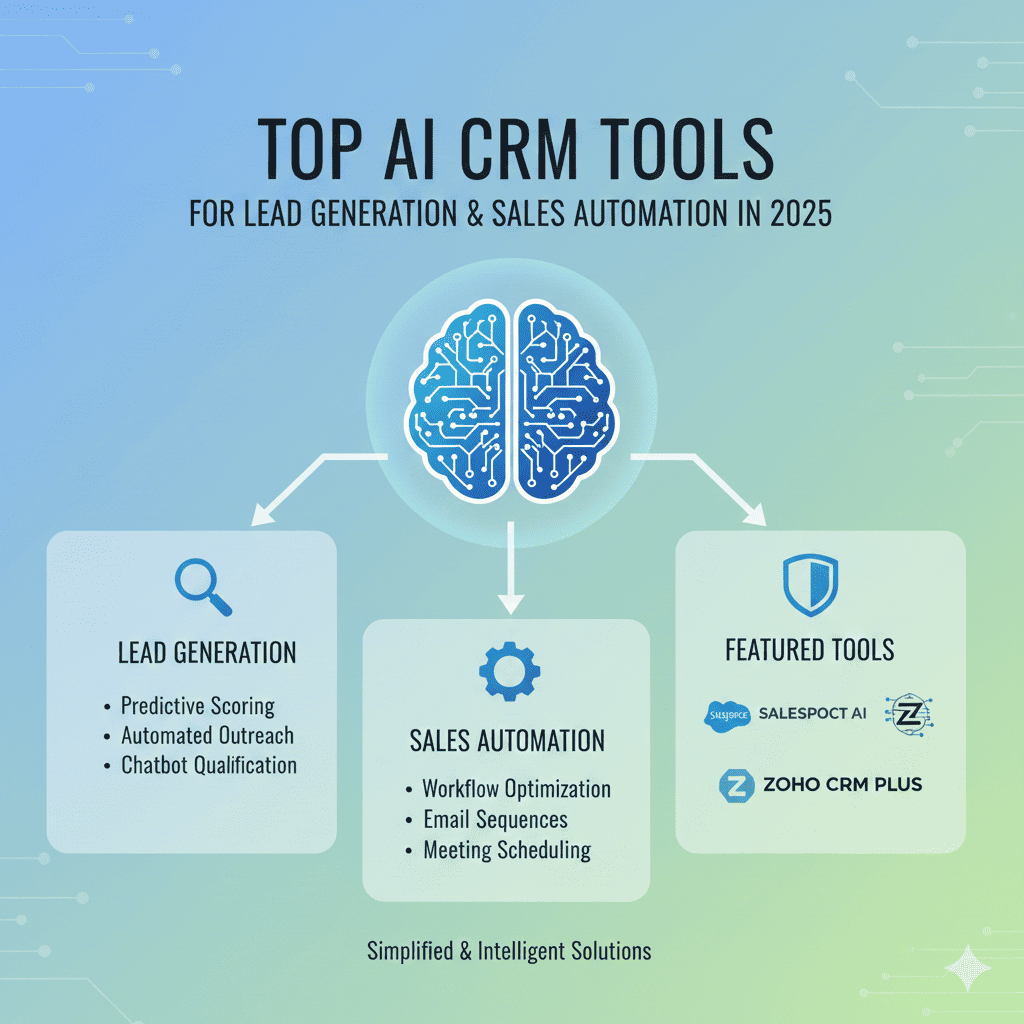
The customer relationship management landscape has transformed dramatically with artificial intelligence integration. Sales teams that once spent hours on manual data entry, lead qualification, and follow-up coordination now leverage AI CRM Tools for Lead Generation that automate these processes while delivering unprecedented insights. This comprehensive guide explores the most powerful AI-enhanced CRM platforms available in 2025, revealing how they revolutionize lead generation and sales automation for businesses of all sizes.
1. The Evolution of CRM Through Artificial Intelligence
Traditional CRM systems served primarily as digital filing cabinets, storing customer information without actively contributing to sales success. Modern AI CRM Tools for Lead Generation transform this passive repository model into intelligent systems that predict, recommend, and execute actions driving revenue growth.
From Data Storage to Predictive Intelligence
Early CRM platforms required sales teams to manually input every interaction, update opportunity stages, and remember follow-up tasks. Human error, inconsistent data entry, and forgotten activities undermined these systems’ value. AI revolutionizes this paradigm by automatically capturing interactions, analyzing communication patterns, and predicting outcomes based on historical data.
Machine learning algorithms identify which prospects are most likely to convert, when deals risk stalling, and what actions correlate with successful closings. This predictive capability transforms CRM from a historical record into a forward-looking strategic tool.
The Competitive Imperative
Companies implementing AI-powered CRM systems gain measurable advantages over competitors using traditional approaches. Research shows that businesses leveraging AI in sales processes see conversion rate improvements of thirty to fifty percent while reducing the sales cycle length by similar margins. These improvements compound over time, creating substantial competitive moats.
Small and mid-sized businesses particularly benefit from AI augmentation. Technologies that once required enterprise budgets and dedicated data science teams are now accessible through user-friendly platforms with affordable subscription pricing.
Key Capabilities Defining Modern AI CRM
The best AI CRM Tools for Lead Generation share several core capabilities. Natural language processing analyzes email and call content, extracting insights without manual tagging. Predictive lead scoring ranks prospects by conversion likelihood using dozens of behavioral and demographic signals. Automated workflow engines execute complex multi-step processes triggered by specific conditions. Intelligent recommendations suggest next-best actions for each opportunity based on patterns from successful deals.
2. HubSpot CRM: Comprehensive AI-Powered Platform
HubSpot has evolved from marketing automation roots into a full-featured CRM platform with sophisticated AI capabilities accessible to businesses across size and sophistication levels.
Intelligent Lead Scoring and Prioritization
HubSpot’s AI analyzes every touchpoint in your customer journey, assigning predictive lead scores based on engagement patterns, demographic fit, and behavioral signals. The system identifies which prospects demonstrate purchase intent through subtle patterns invisible to manual observation.
Sales teams receive prioritized lists showing which leads warrant immediate attention versus those requiring additional nurturing. This intelligent prioritization ensures high-value opportunities receive appropriate resources while preventing time waste on low-probability prospects.
Conversation Intelligence Features
The platform’s conversation intelligence tools analyze sales calls and meetings, providing coaching insights and identifying successful tactics. AI detects when sales representatives deviate from proven messaging, miss key qualifying questions, or fail to address common objections effectively.
These insights inform both individual coaching and broader sales strategy refinement. Patterns emerging across multiple conversations reveal messaging that resonates versus approaches that consistently underperform.
Automated Email Sequences with AI Optimization
HubSpot’s sequence capabilities allow automated email outreach with AI-powered send-time optimization. The system analyzes individual recipient engagement patterns, scheduling messages for when each prospect is most likely to open and respond.
AI also suggests content improvements based on historical performance data. If specific subject lines or call-to-action phrases correlate with higher response rates, the system recommends incorporating these elements into future communications.
Predictive Deal Insights
For opportunities in your pipeline, HubSpot’s AI predicts closing probability and identifies factors influencing outcomes. If deals with certain characteristics historically close at lower rates, the system alerts you to potential challenges requiring additional attention or strategy adjustments.
3. Salesforce Einstein: Enterprise-Grade AI Integration
Salesforce pioneered cloud-based CRM and continues leading through its Einstein AI platform, offering sophisticated capabilities for organizations requiring advanced functionality.
Einstein Lead Scoring
Salesforce Einstein analyzes your historical data to identify patterns correlating with successful conversions. The AI considers hundreds of variables including demographic information, engagement history, company characteristics, and behavioral patterns.
Lead scores update continuously as new information arrives, ensuring sales teams always work with current assessments rather than static rankings that quickly become outdated.
Opportunity Insights and Win Probability
Einstein evaluates every deal in your pipeline, calculating win probability based on opportunity characteristics, historical patterns, and current engagement levels. Sales managers gain visibility into pipeline health without relying solely on representative assessments that often reflect optimism more than reality.
The system flags deals requiring intervention, suggesting specific actions likely to improve outcomes based on what worked in similar situations previously.
Einstein Activity Capture
Manual activity logging disappears with Einstein Activity Capture, which automatically syncs emails, calendar events, and other interactions into Salesforce. The AI intelligently associates activities with relevant contacts and opportunities, maintaining complete interaction history without data entry burden.
This automation ensures CRM data accuracy while freeing sales time for actual selling rather than administrative record-keeping.
Einstein Forecasting
Predictive forecasting capabilities analyze pipeline composition, historical close rates, and seasonality patterns to generate accurate revenue projections. These forecasts help leadership make informed decisions about resource allocation, hiring needs, and strategic investments.
4. Pipedrive: AI-Powered Simplicity for Growing Teams
Pipedrive focuses on user-friendly design combined with powerful AI features, making it ideal for small to medium businesses seeking sophisticated capabilities without complexity.
Smart Contact Data Enhancement
Pipedrive’s AI automatically enriches contact records with publicly available information, eliminating manual research time. When you add a new lead, the system pulls company details, social profiles, and relevant news, providing comprehensive context for personalized outreach.
This automatic enrichment ensures sales teams enter every conversation fully informed about prospect circumstances and priorities.
Sales Assistant Recommendations
The Sales Assistant feature uses machine learning to suggest daily activities based on your pipeline status, past behaviors, and successful patterns. These recommendations might include which deals need attention, contacts requiring follow-up, or opportunities showing warning signs of stalling.
Rather than letting representatives determine priorities subjectively, AI provides data-driven guidance ensuring critical activities receive timely attention.
Email Tracking and Engagement Analytics
Pipedrive tracks email opens, link clicks, and attachment views, providing visibility into prospect engagement levels. The AI identifies patterns in this engagement data, flagging leads showing increased interest or deals losing momentum.
Sales teams can time follow-ups optimally, reaching out when prospects demonstrate active interest rather than following arbitrary schedules disconnected from actual engagement signals.
Workflow Automation Capabilities
Visual workflow builders allow creating sophisticated automation without coding knowledge. These workflows trigger based on specific conditions, executing actions like sending emails, creating tasks, updating fields, or notifying team members automatically.
AI suggests workflow optimizations based on usage patterns and outcome data, helping teams continually refine processes for maximum efficiency.
5. Zoho CRM: Artificial Intelligence for Every Budget
Zoho offers comprehensive CRM functionality with impressive AI features called Zia, delivering enterprise capabilities at prices accessible to smaller organizations.
Zia Voice Assistant
Zia functions as a voice-activated assistant, allowing sales representatives to interact with CRM through natural language commands. Team members can ask questions about pipeline status, create tasks, update records, or retrieve information hands-free.
This conversational interface particularly benefits mobile users managing CRM functions while traveling or between meetings.
Predictive Sales Analytics
Zia analyzes historical data to identify the best times to contact leads, predict deal outcomes, and suggest optimal actions for advancing opportunities. The AI detects patterns in successful sales cycles, providing playbooks that newer representatives can follow while learning.
Anomaly detection capabilities flag unusual patterns requiring investigation, such as deals taking unexpectedly long or leads dropping out of nurture sequences at higher-than-normal rates.
Automated Lead Distribution
Intelligent lead routing automatically assigns incoming leads to appropriate sales representatives based on territory, expertise, workload, or custom criteria. This ensures prompt follow-up while optimizing resource allocation across the team.
The AI can also implement round-robin distribution with weighted assignments, giving top performers higher lead volumes while ensuring newer team members receive opportunities to develop skills.
Email Sentiment Analysis
Zia analyzes email communications for sentiment, identifying when prospects express enthusiasm, concerns, or frustration. This emotional intelligence helps sales teams respond appropriately, addressing concerns before they derail opportunities or capitalizing on positive momentum.
6. Monday Sales CRM: Visual Pipeline with Smart Automation
Monday.com’s approach to CRM emphasizes visual pipeline management enhanced by intelligent automation features that streamline repetitive tasks.
Customizable Automation Recipes
Monday offers pre-built automation recipes addressing common sales scenarios while allowing complete customization for unique requirements. These automations handle lead assignment, follow-up reminders, data updates, and cross-platform integrations without technical expertise.
The platform’s AI suggests automation opportunities based on your team’s manual activities, identifying repetitive patterns that could be automated for efficiency gains.
Integration Hub Capabilities
Monday’s integration ecosystem connects with hundreds of business tools, creating unified workflows across your technology stack. AI-powered integration suggestions identify beneficial connections based on the tools your team uses and common workflow patterns.
Data synchronization happens automatically, ensuring information consistency across platforms without manual updates or exports.
Collaborative Deal Management
The platform’s visual interface allows team collaboration on complex deals, with AI highlighting which opportunities need attention and suggesting team member assignments based on expertise and availability.
Activity feeds provide complete transparency into deal progression, ensuring nothing falls through communication cracks in team-based selling environments.
Performance Analytics Dashboard
Customizable dashboards present key performance indicators with AI-generated insights highlighting trends, anomalies, and opportunities. Rather than simply displaying numbers, the system explains what metrics mean and suggests actions based on the data.
7. Freshsales: AI-Driven Customer Engagement
Freshworks’ CRM platform Freshsales combines traditional CRM functionality with Freddy AI, delivering intelligent customer engagement capabilities.
Freddy AI Lead Scoring
Freddy analyzes lead behavior and characteristics, assigning scores reflecting conversion likelihood. The AI continuously learns from your specific conversion patterns, becoming more accurate over time as it processes additional outcome data.
Sales teams receive notifications when lead scores change significantly, indicating shifts in engagement or qualification status requiring attention.
Intelligent Email Campaigns
Freshsales’ AI optimizes email campaigns by analyzing subject lines, content, and send times for maximum engagement. The system A/B tests automatically, identifying winning variations and applying learnings to future communications.
Personalization recommendations suggest relevant content for different segments based on their characteristics and previous engagement patterns.
Deal Insights and Predictions
Freddy provides insights for every opportunity, predicting close dates, identifying risks, and recommending actions to advance deals. These predictions account for typical sales cycle lengths, current opportunity characteristics, and engagement momentum.
Sales managers use these insights for accurate forecasting and resource allocation decisions.
Built-In Phone and Email
Integrated communication channels allow calling and emailing directly from the CRM interface, with AI automatically logging all interactions and extracting key information for record updates. This seamless integration eliminates context switching while ensuring complete activity capture.
8. Copper: Gmail-Native CRM with AI Enhancement
Copper positions itself as the CRM for Google Workspace users, offering deep Gmail and Google Calendar integration with AI-powered automation.
Automatic Contact and Company Creation
Copper’s AI monitors your email interactions, automatically creating contact and company records when you communicate with new prospects. The system enriches these records with publicly available information, maintaining current CRM data without manual entry.
This automation particularly benefits teams managing high contact volumes where manual CRM maintenance becomes overwhelming.
Relationship Strength Scoring
The platform analyzes communication frequency, recency, and sentiment to score relationship strength with each contact. This scoring helps identify relationships requiring nurturing and flags contacts where engagement has declined.
Sales teams can proactively maintain important relationships rather than discovering they’ve lost touch only after opportunities evaporate.
Pipeline Automation
Visual pipeline management combined with intelligent automation moves deals through stages based on triggered conditions. When prospects complete specific actions, the system automatically advances opportunities while assigning appropriate follow-up tasks.
This ensures consistent process execution across the team while reducing manual pipeline management overhead.
Activity Capture from Gmail
All Gmail interactions automatically associate with relevant CRM records, maintaining complete communication history. The AI identifies which contacts and opportunities each email relates to, even when multiple parties are involved in conversations.
9. Implementing AI CRM Successfully
Selecting powerful AI CRM Tools for Lead Generation represents only the first step. Successful implementation requires strategic approaches maximizing value while avoiding common pitfalls.
Data Quality Foundation
AI algorithms are only as good as the data they analyze. Before implementing AI features, audit your existing CRM data for completeness, accuracy, and consistency. Clean up duplicate records, standardize field formats, and fill information gaps.
Establish data quality standards and processes ensuring ongoing maintenance. Poor data quality undermines AI effectiveness, producing unreliable predictions and recommendations that erode user trust.
User Adoption Strategies
Technology delivers no value if teams don’t use it consistently. Involve sales representatives in CRM selection and implementation, addressing concerns and incorporating feedback. Provide comprehensive training focusing on how AI features make their jobs easier rather than just explaining technical functionality.
Demonstrate quick wins showing immediate value from AI capabilities. When representatives experience predictive lead scoring identifying hot prospects or automated data entry saving hours weekly, adoption accelerates organically.
Gradual Feature Rollout
Rather than enabling all AI features simultaneously, implement capabilities progressively. Start with foundational features like activity capture and lead scoring before advancing to complex automation workflows and predictive analytics.
This phased approach prevents overwhelming users while allowing each feature to demonstrate value before introducing additional capabilities. Success with initial features builds confidence supporting adoption of more advanced functionality.
Continuous Optimization
AI systems improve through ongoing refinement. Regularly review AI recommendations and predictions against actual outcomes, identifying areas where algorithms need adjustment. Most platforms allow customizing AI models based on your specific data and business requirements.
Gather user feedback about AI feature effectiveness, implementing suggestions that improve daily workflow efficiency. This iterative optimization ensures your CRM evolves continuously rather than stagnating after initial implementation.
10. Measuring AI CRM Impact
Quantifying the value delivered by AI CRM Tools for Lead Generation ensures continued investment and identifies optimization opportunities.
Lead Conversion Metrics
Track lead-to-opportunity and opportunity-to-customer conversion rates before and after AI implementation. Effective AI should improve these rates by helping representatives focus on higher-quality prospects and take optimal actions at each stage.
Analyze conversion rate improvements by lead source, representative, and product line to identify where AI delivers greatest impact and where additional optimization might be needed.
Sales Cycle Length
AI automation should reduce the time required to progress opportunities from initial contact through closed deals. Measure average sales cycle duration before and after implementation, looking for meaningful reductions.
Investigate which automation workflows and AI features contribute most to cycle time reduction, doubling down on high-impact capabilities.
Representative Productivity
Quantify time saved through automation and intelligent features. Survey representatives about hours previously spent on administrative tasks now handled by AI. Calculate the monetary value of this recaptured time applied to revenue-generating activities.
Track activity metrics like emails sent, calls completed, and meetings scheduled. AI enabling higher activity volumes typically correlates with improved results.
Forecast Accuracy
Compare revenue forecasts generated by AI predictions against actual results. Improving forecast accuracy enables better business planning, resource allocation, and strategic decision-making.
Measure prediction accuracy for lead scoring and deal outcome probabilities. As AI systems learn from your specific data, accuracy should improve continuously.
11. Integration Strategies for Maximum Value
The most powerful AI CRM Tools for Lead Generation function as central hubs connecting your entire sales technology ecosystem.
Marketing Automation Integration
Connect your CRM with marketing automation platforms like HubSpot Marketing, Marketo, or Pardot. This integration enables seamless lead handoff from marketing to sales while maintaining complete visibility into prospect journey history.
AI leverages marketing engagement data for more accurate lead scoring and personalized sales outreach informed by which content prospects consumed and campaigns they engaged with.
Communication Platform Connections
Integrate email platforms, phone systems, and messaging tools with your CRM. These connections enable automatic activity capture while providing representatives with unified communication interfaces eliminating context switching.
AI analyzes communications across channels, building comprehensive engagement profiles that inform optimal outreach timing and channel selection.
Business Intelligence Tools
Connect CRM data with analytics platforms like Tableau, Power BI, or Looker for advanced reporting and visualization. These integrations enable sophisticated analysis combining CRM data with financial, operational, and market information.
AI can analyze these combined datasets for insights impossible when examining CRM data in isolation, revealing correlations between sales performance and external factors.
Customer Success Platform Integration
For businesses with recurring revenue models, connecting CRM with customer success platforms provides visibility into the complete customer lifecycle. AI analyzes patterns correlating sales process characteristics with long-term customer retention and lifetime value.
These insights inform lead qualification and sales strategy, helping teams focus on prospects likely to become long-term, high-value customers rather than optimizing solely for initial conversion.
12. Future Trends in AI-Powered CRM
The evolution of AI CRM Tools for Lead Generation continues accelerating. Understanding emerging trends helps businesses prepare for coming capabilities and make forward-looking technology decisions.
Generative AI for Content Creation
Next-generation CRM platforms incorporate generative AI that drafts personalized emails, creates presentation content, and generates proposals tailored to specific opportunities. This technology analyzes successful historical communications, replicating effective approaches while customizing for individual prospects.
Sales representatives focus on strategy and relationship building while AI handles content creation that previously consumed significant time.
Advanced Conversational AI
Voice and chat-based CRM interaction will become increasingly sophisticated, allowing representatives to manage opportunities, retrieve information, and execute tasks through natural conversation rather than navigating interfaces.
These conversational AI assistants understand context, remember previous interactions, and proactively surface relevant information without explicit requests.
Predictive Market Intelligence
AI will increasingly incorporate external market data, competitive intelligence, and economic indicators into predictions and recommendations. CRM systems will alert sales teams when market conditions create opportunities for specific prospects or when external events might impact deal progression.
This external data integration provides strategic context enhancing internal historical pattern analysis.
Autonomous Sales Actions
The most advanced systems will execute routine sales actions autonomously with minimal human oversight. AI might schedule meetings, send follow-up communications, update opportunity stages, or even negotiate terms for straightforward transactions.
Human sales professionals will focus on complex deals requiring creativity, relationship building, and strategic thinking while AI handles routine interactions and administrative tasks.
Conclusion: Choosing the Right AI CRM for Your Business
The landscape of AI CRM Tools for Lead Generation offers powerful options for businesses across industries and sizes. Success requires matching tool capabilities with specific business requirements rather than simply selecting the most feature-rich or popular platform.
Start by defining your critical needs. Do you require deep customization, straightforward setup, specific industry functionality, or particular integration capabilities? Evaluate platforms against these requirements rather than generic feature checklists.
Consider your team’s technical sophistication. Some platforms offer extensive customization requiring technical expertise while others prioritize simplicity at the expense of flexibility. Match tool complexity to your team’s capabilities and available implementation resources.
Budget considerations extend beyond subscription costs. Factor in implementation time, training requirements, integration expenses, and ongoing maintenance needs. The cheapest subscription might ultimately cost more when accounting for total ownership expenses.
Take advantage of free trials and demos before committing. Involve actual users in evaluation processes, gathering feedback about interface usability, feature accessibility, and workflow fit. Tools that delight during sales presentations sometimes frustrate during daily use.
The right AI CRM Tools for Lead Generation transform sales operations from manual, inconsistent processes into efficient, scalable systems delivering predictable results. These platforms don’t just store customer information; they actively contribute to revenue growth through intelligent automation, predictive insights, and strategic recommendations.
Your competitors are implementing these technologies today. The question isn’t whether to adopt AI-powered CRM but which platform to implement and how quickly you can leverage its capabilities to drive measurable business results. The competitive advantages available through strategic CRM implementation are substantial and growing. Your future sales success depends on the decisions you make today about embracing these transformative technologies.
Also read this:
12 AI Automation Workflows Every Small Business Should Use
Start a Profitable AI-Automated Dropshipping Business in 2025
Best AI Tools for Dropshipping: Product Research, Ads & Automation