
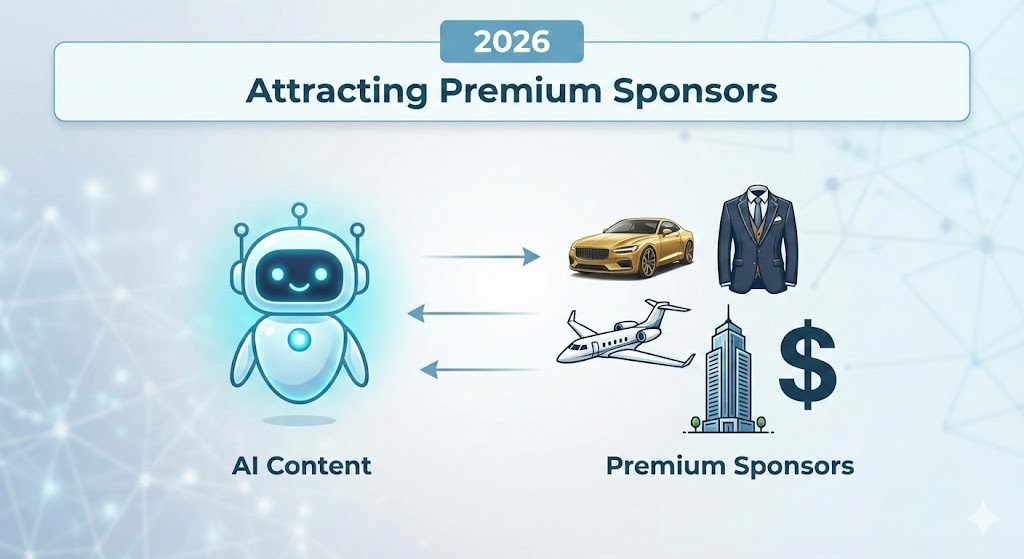
The digital landscape has undergone a seismic shift, and at the center of this transformation lies artificial intelligence. As we navigate through 2026, one trend has become impossible to ignore: AI Content Is Attracting Premium Sponsors at an unprecedented rate. This phenomenon isn’t just changing how content is created—it’s revolutionizing the entire sponsorship economy.
Premium brands that once exclusively partnered with traditional media outlets and celebrity influencers are now allocating significant portions of their marketing budgets to AI-powered content platforms. The reason? These platforms deliver what sponsors crave most: precision targeting, measurable engagement, and scalability that human-only operations simply cannot match.
The fusion of artificial intelligence and content creation has opened doors to sponsorship opportunities that were unimaginable just a few years ago. From personalized video content that adapts to viewer preferences in real-time to AI-generated podcasts that maintain consistent quality across thousands of episodes, the possibilities have expanded exponentially.
1. The Evolution of Content Sponsorship in the AI Era
The journey from traditional sponsorship models to AI-driven partnerships represents one of the most significant shifts in digital marketing history. Understanding this evolution is crucial for anyone looking to capitalize on the current landscape.
Traditional Sponsorship Models and Their Limitations
Traditional content sponsorship relied heavily on broad demographic targeting and estimated reach metrics. Sponsors would partner with content creators based on subscriber counts, general audience demographics, and gut feelings about brand alignment. This approach, while functional, left massive gaps in precision and accountability.
The measurement tools available were rudimentary at best. Sponsors had to trust Nielsen ratings, estimated impression counts, and self-reported analytics that often painted an incomplete picture. Return on investment remained a mysterious calculation, with attribution models that struggled to connect sponsorship dollars to actual conversions.
Human creators faced natural limitations in content production capacity. Even the most prolific influencers could only produce a finite amount of content, which restricted the potential reach and frequency of sponsored messages. This scarcity model inflated costs while limiting options for sponsors seeking broader coverage.
How AI Technology Changed the Game
The introduction of sophisticated AI tools transformed content creation from a labor-intensive craft into a scalable, data-driven operation. Machine learning algorithms can now analyze millions of data points to understand what content resonates with specific audience segments, enabling unprecedented personalization.
AI content systems can operate continuously, producing high-quality material around the clock without fatigue or creative burnout. This capability allows sponsored content to maintain consistent presence across multiple platforms simultaneously, something impossible for human-only teams to achieve at the same cost point.
Real-time optimization has become a defining feature of AI-powered content platforms. Sponsored messages can be tested, refined, and adapted based on immediate audience feedback, creating feedback loops that continuously improve performance. This dynamic approach delivers results that static traditional campaigns cannot match.
The Convergence of Quality and Quantity
One of the most compelling developments in the AI content space is the elimination of the historic trade-off between quality and quantity. Advanced language models and creative AI systems now produce content that meets or exceeds professional standards while operating at massive scale.
AI Content Is Attracting Premium Sponsors because it solves the quality-scale paradox. Brands can now maintain their high standards for creative excellence while simultaneously reaching audiences across dozens of channels and formats. This combination was previously available only to mega-corporations with unlimited budgets.
The personalization capabilities of modern AI systems mean that each piece of sponsored content can be tailored to individual viewer preferences, viewing history, and behavioral patterns. This level of customization creates more engaging experiences that drive better results for sponsors while providing more relevant content to audiences.
2. Why Premium Brands Are Investing in AI Content Platforms
The migration of advertising dollars toward AI content platforms isn’t a temporary trend—it represents a fundamental realignment of marketing strategy based on concrete business advantages.
Superior Targeting and Audience Segmentation
Modern AI systems can process and analyze consumer data with a sophistication that makes traditional demographic targeting look primitive. These platforms identify micro-segments within audiences based on behavioral patterns, consumption habits, psychographic profiles, and predictive indicators that humans would never notice.
Premium sponsors gain access to targeting capabilities that allow them to reach the exact consumer profile they’re seeking. Instead of wasting impressions on irrelevant viewers, every sponsored message reaches someone with a high probability of interest in the product or service. This efficiency dramatically improves cost per acquisition metrics.
The machine learning models powering these platforms continuously learn and adapt. They identify which audience segments respond best to different messaging approaches, then automatically optimize delivery to maximize engagement. This self-improving system provides sponsors with better results over time without requiring additional investment.
Measurable ROI and Performance Analytics
The analytics capabilities of AI content platforms have solved one of advertising’s oldest problems: proving return on investment. Every interaction, click, view, and conversion is tracked and attributed with precision that traditional media could never achieve.
Sponsors receive detailed dashboards showing exactly how their investment performs across multiple dimensions. They can see not just impression counts, but engagement quality, time spent with content, sentiment analysis, and downstream conversion behaviors. This transparency builds confidence and justifies continued investment.
Advanced attribution modeling connects sponsored content exposure to eventual purchase decisions, even when the path to conversion involves multiple touchpoints across different platforms. This holistic view of the customer journey demonstrates the true value of sponsorship investment in ways that were previously impossible to quantify.
Cost Efficiency and Scalability
The economics of AI content creation offer compelling advantages for sponsors seeking maximum impact from their marketing budgets. Production costs for AI-generated content are fractional compared to traditional video production, photoshoots, or professional writing services.
This cost efficiency doesn’t require sponsors to sacrifice reach or quality. AI Content Is Attracting Premium Sponsors precisely because it delivers premium results at accessible price points. Brands can test multiple creative approaches, iterate rapidly, and scale successful campaigns without the financial risk associated with traditional production models.
Scalability extends beyond just volume—it encompasses geographic expansion, language localization, and platform adaptation. AI systems can automatically adapt sponsored content for different markets, translating and culturally customizing messages without requiring separate production budgets for each region.
Brand Safety and Content Control
Premium brands have stringent requirements around brand safety and message consistency. AI content platforms offer unprecedented control over how sponsored messages appear and the contexts in which they’re delivered.
Advanced content moderation systems ensure that sponsored material never appears alongside inappropriate or controversial content. These AI-powered safety measures scan for potential brand risks in real-time, providing protection that manual review processes cannot match in speed or comprehensiveness.
Sponsors also gain greater control over message consistency across all touchpoints. AI systems can be programmed with brand guidelines, ensuring that every piece of sponsored content adheres to approved messaging frameworks, tone requirements, and visual standards. This consistency strengthens brand identity while minimizing reputation risk.
3. Types of AI Content Commanding Premium Sponsorships
The diversity of AI-generated content formats has created multiple avenues for premium sponsorship opportunities, each with unique characteristics and advantages.
Personalized Video Content and Streaming
AI-powered video generation has evolved from novelty to sophisticated tool capable of producing broadcast-quality content. These systems create personalized video experiences that adapt to individual viewer preferences, viewing history, and even real-time reactions.
Premium sponsors in the automotive, luxury goods, and technology sectors have embraced AI video platforms because they enable product showcases that adapt to viewer interests. A potential customer interested in performance features sees different content than someone prioritizing safety or fuel efficiency, all within the same sponsored video framework.
The production speed of AI video systems allows sponsors to respond to trends, news events, and cultural moments with relevant content in hours rather than weeks. This agility creates opportunities for timely brand insertion that traditional production schedules could never accommodate.
AI-Generated Podcasts and Audio Content
The podcast industry has been transformed by AI voices that sound increasingly natural and by content generation systems that can produce informative, entertaining audio at scale. AI Content Is Attracting Premium Sponsors into the podcast space because these platforms can maintain consistent publishing schedules across hundreds of niche topics.
Financial services companies, educational platforms, and B2B brands have found particular success with AI podcast sponsorships. These audiences often consume content during commutes or workouts when they’re receptive to longer-form sponsored messages delivered within relevant topic discussions.
Dynamic ad insertion powered by AI ensures that sponsored messages remain current and contextually appropriate, even in evergreen content. The technology can swap out dated product references, update pricing information, or modify calls-to-action without requiring re-recording of entire episodes.
Interactive AI Chatbots and Virtual Experiences
Conversational AI has opened entirely new categories of sponsored content experiences. Brands can now sponsor AI assistants that help users solve problems, answer questions, or complete tasks while subtly incorporating product information and recommendations.
Travel companies sponsor AI travel planning assistants that guide users through destination research while highlighting sponsored hotels, activities, and services. The recommendations feel natural and helpful rather than intrusive, creating positive associations with sponsor brands.
Virtual showrooms and AI-guided shopping experiences represent premium sponsorship opportunities that blend utility with promotion. Users receive genuine value from the AI interaction while sponsors gain extended engagement time and purchase intent signals that inform future marketing efforts.
Synthetic Influencers and Virtual Brand Ambassadors
Digital influencers powered by AI have attracted massive followings and, consequently, premium sponsorship deals. These virtual personalities maintain consistent brand messaging, never face personal scandals, and can appear in multiple places simultaneously.
Fashion and beauty brands have been early adopters of synthetic influencer sponsorships, recognizing that these digital personas can model products without the logistical constraints of working with human models. The AI influencers can instantly change outfits, hairstyles, and settings, providing sponsors with unlimited creative flexibility.
The always-on nature of AI influencers means they can engage with audiences around the clock across global time zones. This constant availability drives engagement metrics that human influencers cannot match, delivering greater value for sponsorship investments.
Data Visualization and Infographic Content
AI systems excel at transforming complex data into compelling visual narratives. Financial institutions, research organizations, and technology companies sponsor AI-generated data visualization content that helps audiences understand complicated topics while associating sponsors with expertise and thought leadership.
These visualizations update automatically as new data becomes available, ensuring sponsored content remains current without requiring manual updates. The evergreen nature of these content pieces provides long-term value for sponsors beyond the typical lifespan of traditional sponsored posts.
Interactive data experiences allow audiences to explore information at their own pace, with sponsored messaging integrated throughout the discovery journey. This engagement model creates deeper connections between audiences and sponsor brands than passive consumption of traditional advertising.
4. The Technology Infrastructure Behind Sponsored AI Content
Understanding the technological foundation of AI content platforms reveals why they deliver such compelling value to premium sponsors.
Advanced Natural Language Processing
The language models powering AI content creation have achieved remarkable sophistication in understanding context, maintaining consistent voice, and generating human-like text across diverse formats. These systems can adapt writing style to match different brand personalities while maintaining grammatical accuracy and readability.
Sponsors benefit from this linguistic flexibility because their messages can be tailored to different audience segments without sounding generic or forced. The AI understands subtle nuances in language that resonate with specific demographics, professional groups, or interest communities.
Multilingual capabilities embedded in modern language models enable sponsors to reach global audiences without the traditional costs of translation services and localized content production. The AI maintains message consistency across languages while adapting for cultural context and regional preferences.
Computer Vision and Image Generation
AI image generation has progressed from producing abstract art to creating photorealistic commercial imagery indistinguishable from professional photography. This capability allows sponsors to visualize products in unlimited contexts and settings without physical photoshoots.
Product placement within AI-generated visual content occurs seamlessly, with items integrated naturally into scenes rather than appearing as obvious insertions. This subtlety increases viewer receptivity while maintaining the authenticity that premium brands require.
Video synthesis technologies combine multiple visual elements—AI-generated backgrounds, product renders, and synthetic characters—into cohesive sponsored content. The production quality rivals traditional video advertising while the production timeline and costs are dramatically reduced.
Predictive Analytics and Machine Learning
The intelligence layer analyzing content performance determines which sponsored messages succeed and which fall flat. Machine learning algorithms process millions of engagement signals to identify patterns that predict content success before publication.
Sponsors gain predictive insights about which creative approaches will resonate with target audiences, reducing the trial-and-error traditionally required in campaign development. This foresight minimizes wasted production effort and accelerates time to effective campaigns.
The continuous learning nature of these systems means that every sponsored content piece contributes data that improves future performance. Over time, the AI develops increasingly accurate models of what works for specific sponsor brands and audience combinations.
Blockchain and Verification Systems
As concerns about AI-generated misinformation have grown, blockchain-based verification systems have emerged to authenticate sponsored content and track its provenance. Premium sponsors value these transparency measures because they protect brand reputation and build audience trust.
Smart contracts automate sponsorship agreements and payment terms, creating efficiency while ensuring compliance. The immutable record of content creation and distribution provides sponsors with audit trails that verify campaign delivery and performance.
NFT technologies enable unique, collectible sponsored content that creates additional value for audiences. Limited edition AI-generated art or virtual items sponsored by premium brands have become sought-after digital assets, extending sponsor reach beyond traditional advertising metrics.
5. Success Stories: Brands Winning with AI Content Sponsorships
Real-world examples demonstrate the tangible results that AI Content Is Attracting Premium Sponsors has generated across industries.
Luxury Automotive Brand Campaign
A leading European automotive manufacturer partnered with an AI content platform to create personalized vehicle showcase experiences. The AI system generated thousands of unique videos highlighting different vehicle features based on viewer preferences detected through browsing behavior and previous interactions.
The campaign achieved engagement rates three times higher than the brand’s traditional video advertising while reducing production costs by sixty-five percent. More importantly, test drive requests increased by forty-two percent among viewers who engaged with the AI-generated content compared to control groups exposed to standard advertising.
The success stemmed from the AI’s ability to emphasize the specific features each prospect cared about most—performance enthusiasts saw track footage and acceleration data, while family-oriented buyers viewed safety features and cargo capacity demonstrations. This personalization created relevance that generic advertising could never achieve.
Financial Services Educational Content
A multinational bank sponsored an AI-powered financial education platform that generated personalized learning content for users at different stages of financial literacy. The AI adapted explanations, examples, and recommendations based on user knowledge level, goals, and economic circumstances.
Over eighteen months, the sponsored platform attracted more than two million users who spent an average of forty-seven minutes engaging with the educational content. Brand awareness studies showed eighty-three percent positive brand association among platform users compared to fifty-six percent in the general population.
The sponsorship generated measurable business results beyond brand metrics—thirty-four percent of active platform users eventually opened accounts with the sponsoring bank, with customer acquisition costs seventy percent lower than traditional marketing channels. The educational approach built trust that translated directly into business relationships.
Consumer Electronics Product Launch
A major consumer electronics company used AI-generated content to support a global product launch across forty-seven countries simultaneously. The AI system created localized announcement videos, product demonstrations, and tutorial content in thirty-one languages, all maintaining consistent brand messaging.
The launch campaign reached three hundred million people in its first week, with eighty-nine percent of exposure coming through AI-generated content. The production timeline for this global campaign was three weeks—a traditional production approach would have required six months and three times the budget.
Pre-order numbers exceeded projections by fifty-seven percent, with attribution analysis crediting the breadth and speed of the AI content campaign as primary drivers. The company’s CMO publicly credited the AI sponsorship strategy with transforming their product launch capabilities.
Fashion Brand Virtual Showroom
A luxury fashion house created an AI-powered virtual showroom where visitors interacted with synthetic brand ambassadors who provided styling advice and product information. The experience used computer vision to analyze visitor preferences and suggest items matching their aesthetic.
The virtual showroom attracted high-intent visitors who spent an average of twenty-three minutes in the experience—dramatically longer than typical e-commerce browsing sessions. Conversion rates from virtual showroom visitors reached eleven percent compared to two percent from standard website traffic.
AI Content Is Attracting Premium Sponsors like this fashion brand because the technology creates immersive brand experiences that drive both engagement and commerce. The virtual showroom continues operating years after launch, with the AI continuously learning and improving its recommendations without additional development costs.
6. Challenges and Considerations for AI Content Sponsorships
Despite the compelling advantages, sponsors must navigate several important challenges when working with AI content platforms.
Maintaining Authenticity and Brand Voice
One primary concern for premium brands involves ensuring AI-generated content maintains authentic brand voice and doesn’t sound generic or robotic. The most sophisticated AI systems require extensive training on brand guidelines, previous content, and voice characteristics to achieve consistency.
Sponsors must invest time in properly configuring AI systems and reviewing initial outputs to ensure quality standards are met. This upfront investment pays dividends over time as the AI learns and improves, but it requires commitment that some brands underestimate.
The balance between AI efficiency and human creative oversight remains important. Most successful sponsored AI content strategies involve human creative directors who guide overall strategy and review AI outputs rather than attempting fully automated content creation without any human involvement.
Disclosure and Transparency Requirements
Regulatory frameworks around AI-generated content and sponsored material continue evolving. Premium brands prioritize compliance with disclosure requirements to maintain consumer trust and avoid regulatory penalties.
Clear labeling of AI-generated sponsored content has become industry standard practice among responsible platforms. This transparency actually builds trust with audiences who appreciate honesty about content origins rather than attempts to disguise AI involvement.
The Federal Trade Commission and international regulatory bodies have issued guidance requiring clear disclosure of both AI generation and commercial relationships. Sponsors who implement transparent disclosure policies report that audiences respond positively when the AI-generated content delivers genuine value.
Quality Control and Brand Safety
Ensuring consistent quality across high-volume AI content output requires robust review processes. While AI systems have become remarkably reliable, they occasionally produce unexpected results that could embarrass sponsors if published without review.
Leading AI content platforms implement multi-layer quality assurance that combines automated checks, spot reviews by human moderators, and sponsor approval workflows for sensitive content. These safeguards protect brand reputation while maintaining the efficiency advantages of AI production.
Brand safety concerns extend beyond the content itself to the contexts where it appears. Sponsors need assurances that their AI-generated content won’t be displayed alongside inappropriate material or in environments that conflict with brand values. Advanced content adjacency controls address these concerns through real-time monitoring and placement restrictions.
Intellectual Property and Rights Management
The legal landscape surrounding AI-generated content ownership and usage rights continues developing. Premium sponsors require clear contractual terms about who owns AI-generated sponsored content and how it can be used both during and after sponsorship terms.
Questions about copyright protection for AI-generated works remain partially unresolved in many jurisdictions. Sponsors should work with legal counsel specializing in intellectual property and technology law to ensure their interests are protected in sponsorship agreements.
Training data sources for AI systems have raised concerns about potential copyright infringement. Sponsors should verify that the AI platforms they work with use appropriately licensed training data and provide indemnification against intellectual property claims.
Measuring Long-Term Brand Impact
While AI content platforms excel at providing detailed engagement metrics, some premium sponsors want deeper understanding of long-term brand building effects beyond immediate performance indicators.
Traditional brand studies—awareness tracking, perception surveys, and brand lift measurements—remain important complements to the granular analytics provided by AI platforms. The most sophisticated sponsorship strategies combine both approaches for comprehensive impact assessment.
The challenge involves isolating the specific contribution of AI-generated sponsored content from other marketing activities. Multi-touch attribution models and incrementality testing help sponsors understand the unique value their AI content investments deliver.
7. The Future of AI Content Sponsorship
Looking ahead, several emerging trends will shape how AI Content Is Attracting Premium Sponsors in the years to come.
Hyper-Personalization at Scale
The next generation of AI content systems will create truly individualized sponsored experiences where no two users see identical content. These systems will consider thousands of variables about each viewer to craft perfectly tailored sponsored messages.
This extreme personalization will raise the bar for sponsor expectations around relevance and performance. Brands that master hyper-personalized AI content will achieve engagement rates that make current benchmarks look modest, creating competitive pressure throughout industries.
Privacy-preserving technologies like federated learning will enable personalization without centralized data collection, addressing consumer privacy concerns while maintaining the effectiveness that sponsors require. This technical innovation will help sustain long-term audience acceptance of personalized sponsored content.
Integration with Emerging Platforms
As virtual reality, augmented reality, and spatial computing platforms mature, AI-generated sponsored content will expand into these immersive environments. Premium brands will sponsor virtual worlds, AI-guided experiences, and augmented reality overlays that blend digital and physical realities.
The metaverse—despite hype cycles—continues developing as a meaningful platform for branded experiences. AI will play a central role in populating these virtual spaces with engaging sponsored content that adapts to user behavior and preferences in real-time.
Wearable devices and ambient computing interfaces will create new touchpoints for AI-generated sponsored content. Voice-based AI assistants will incorporate sponsored recommendations and information naturally within conversational interactions, opening entirely new categories of sponsorship opportunity.
Enhanced Creativity and Artistic Expression
Contrary to fears that AI would reduce content to formulaic outputs, emerging creative AI tools are expanding artistic possibilities. Sponsors will work with AI systems that push creative boundaries and generate genuinely innovative content that human creators alone might never conceive.
Collaborative human-AI creative processes will become standard practice, with human creative directors working alongside AI systems that suggest novel approaches, generate multiple variations instantly, and help explore creative directions efficiently. This partnership will produce sponsored content that is both more creative and more effective.
The distinction between AI-generated and human-created content will blur as hybrid workflows become universal. Sponsors will focus less on how content is created and more on whether it achieves desired outcomes and maintains quality standards.
Ethical AI and Responsible Sponsorship
As AI capabilities grow more powerful, ethical considerations will become increasingly important to premium sponsors. Brands will differentiate themselves through commitments to responsible AI use that respects consumer privacy, avoids manipulation, and contributes positively to society.
Industry standards for ethical AI content creation will emerge, with certification programs and best practice frameworks that sponsors can reference. Premium brands will seek partnerships with platforms that demonstrate leadership in responsible AI development and deployment.
The conversation will shift from whether to use AI-generated sponsored content to how to use it in ways that serve all stakeholders—sponsors, platforms, content creators, and audiences. This maturity will strengthen the long-term sustainability of the AI content sponsorship ecosystem.
Conclusion
The evidence is clear and compelling: AI Content Is Attracting Premium Sponsors because it solves fundamental challenges that have constrained digital marketing for decades. The combination of precision targeting, measurable performance, cost efficiency, and creative flexibility creates value propositions that traditional content sponsorship models cannot match.
Premium brands across industries have moved beyond experimental AI content budgets to making these platforms central to their marketing strategies. The success stories span automotive, financial services, consumer electronics, fashion, and virtually every other category, demonstrating the broad applicability of AI content sponsorship.
The technology continues advancing rapidly, with each generation of AI systems delivering better quality, more sophisticated personalization, and deeper analytics. Sponsors who establish expertise with AI content platforms now position themselves for sustained competitive advantages as these capabilities expand.
Challenges remain around authenticity, transparency, quality control, and legal frameworks, but the industry is actively addressing these concerns through best practices, technological solutions, and regulatory compliance. Responsible approaches to AI content sponsorship build consumer trust while delivering business results.
The future promises even more exciting developments as AI systems become more creative, personalized content reaches unprecedented levels of relevance, and new platforms create additional sponsorship opportunities. Brands that embrace this evolution thoughtfully will thrive in the AI-powered content landscape.
For marketing executives, media buyers, and brand managers, the question is no longer whether AI content deserves a place in sponsorship strategies, but rather how quickly and effectively their organizations can adapt to capitalize on these powerful new capabilities. The premium sponsors leading this charge are already seeing the results that confirm this transformation is just beginning.
Also read this:
Most Underrated Tech Trend Right Now That Will Shape the Next Wave of Innovation
AI-Focused Content Attracts High-Value Sponsors and Premium Brand Deals in 2026
The Best Tech Content Model for Long-Term Revenue: Building Sustainable Tech Publishing Businesses