
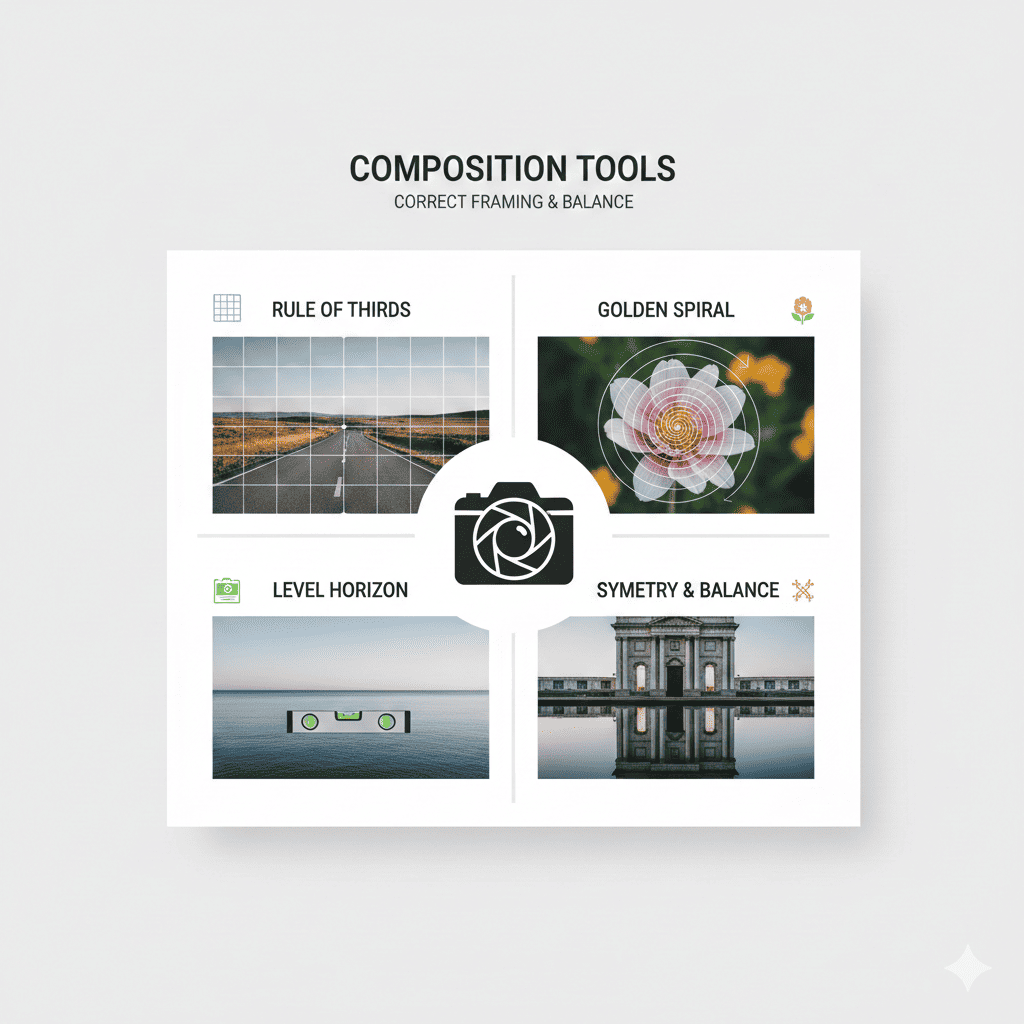
Composition Tools That Correct Framing & Balance In the split second between pressing the shutter and capturing an image, countless compositional elements converge—or fail to align. Professional photographers spend years developing an eye for perfect framing, but even veterans miss subtle balance issues in the heat of shooting. Enter artificial intelligence: sophisticated Composition Tools That Correct Framing & Balance automatically, turning compositionally flawed images into perfectly balanced masterpieces in seconds.
1. The Composition Challenge in Modern Photography
Understanding why photographers struggle with composition helps explain why Composition Tools That Correct Framing & Balance have become essential for contemporary imaging workflows.
The Pressure of Real-Time Shooting
Wedding photographers capture 3,000-5,000 images during a single event, making split-second compositional decisions under intense pressure. Portrait photographers manage client interactions while simultaneously evaluating backgrounds, lighting, and framing. Event photographers navigate chaotic environments where compositional control is limited.
In these scenarios, even skilled photographers produce images with tilted horizons, distracting background elements, awkward subject placement, or imbalanced compositions. The pace of modern photography makes perfection impossible—until now.
The Cost of Compositional Errors
Poorly composed images require extensive manual correction in post-production or get discarded entirely, wasting shooting time and reducing deliverable image counts. For commercial photographers, compositional issues can mean client dissatisfaction and lost contracts. Real estate photographers lose listings when room proportions appear distorted or spaces feel unbalanced.
The financial impact extends beyond immediate losses. Photographers who consistently deliver compositionally superior work command premium pricing, attract higher-end clients, and generate more referrals. Composition quality directly correlates with business success.
Traditional Correction Limitations
Manual composition correction in editing software requires expertise and time. Straightening horizons, adjusting crops for better balance, removing distracting elements, and correcting perspective distortion can consume 2-5 minutes per image. For a photographer processing 500 images weekly, that’s 16-40 hours of tedious correction work.
Moreover, manual corrections are subjective and inconsistent. A photographer’s compositional decisions vary based on fatigue, mood, and evolving aesthetic preferences, creating inconsistent results across a portfolio.
2. How AI Understands and Corrects Composition
Modern composition tools that correct framing and balance leverage sophisticated algorithms that understand visual harmony at a fundamental level.
Computer Vision and Compositional Analysis
AI systems analyze images using computer vision algorithms trained on millions of professionally composed photographs. These algorithms identify key compositional elements including subject position, rule of thirds alignment, leading lines, symmetry patterns, negative space distribution, and visual weight balance.
The AI recognizes compositional principles that human photographers learn through years of study—golden ratio placement, balance of visual elements, directional flow, and hierarchical arrangement. It evaluates these factors simultaneously, identifying compositional weaknesses that might escape even trained human observers.
Machine Learning from Master Photographers
Training data for these AI systems comes from curated collections of award-winning photography, museum-archived images, and work by recognized masters. The algorithms learn what makes compositions compelling by studying patterns across diverse photographic genres.
This training enables AI to understand context-dependent composition rules. What works for landscape photography differs from portrait composition, and the AI adapts its corrections based on subject matter, genre conventions, and stylistic considerations.
Real-Time Processing Capabilities
Modern AI composition tools operate in real-time or near-real-time, analyzing and correcting images as they’re captured or imported. This speed comes from optimized algorithms running on powerful GPUs, processing complex compositional analysis in milliseconds rather than minutes.
The technology has reached a point where photographers can receive instant feedback during shooting, with AI-powered camera apps providing live composition suggestions through the viewfinder. Post-capture, these same algorithms batch-process thousands of images automatically.
Intelligent Correction Strategies
Rather than applying rigid compositional rules, sophisticated AI systems understand creative intent and stylistic variation. The algorithms distinguish between intentional compositional choices and errors, preserving artistic decisions while correcting technical flaws.
The AI considers multiple potential corrections for each image, evaluating trade-offs between different compositional improvements. It might determine that straightening a horizon sacrifices important subject placement, choosing instead to maintain subject position while accepting a slight tilt—a nuanced decision reflecting genuine compositional understanding.
3. Leading AI Composition Correction Tools
Several platforms now offer composition tools that correct framing and balance with varying specializations and capabilities.
Adobe Sensei in Lightroom and Photoshop
Adobe’s AI platform, Sensei, powers intelligent composition features across Creative Cloud applications. In Lightroom, the Auto Straighten function uses AI to detect and correct horizon tilt, perspective distortion, and vertical alignment issues with remarkable accuracy.
Photoshop’s Content-Aware Crop extends canvas intelligently when straightening creates empty corners, filling gaps with contextually appropriate content. The AI analyzes surrounding image areas and generates seamless extensions that maintain compositional integrity.
Adobe’s Subject Select feature identifies main subjects automatically, enabling rapid recomposition through intelligent cropping suggestions. The AI proposes multiple crop options that improve rule of thirds placement, eliminate distracting edge elements, and optimize aspect ratios for different delivery formats.
For photographers processing large volumes, Lightroom’s AI-powered auto settings analyze each image’s compositional needs individually, applying customized corrections rather than universal adjustments. This intelligence produces more refined results than traditional batch processing.
Luminar Neo’s Composition AI
Skylum’s Luminar Neo includes dedicated Composition AI tools that go beyond simple straightening. The platform analyzes entire compositional structures, identifying balance issues across the frame.
The Relight AI feature redistributes light to enhance compositional balance, brightening underexposed subjects and managing distracting bright spots that disrupt visual flow. This lighting adjustment serves compositional purposes, guiding viewer attention to intended focal points.
Composition Tools That Correct Framing & Balance Luminar’s Structure AI enhances or reduces detail in specific areas, using composition analysis to determine where increased definition strengthens the image and where it creates distraction. The AI makes these decisions based on compositional hierarchy, ensuring primary subjects receive emphasis while supporting elements remain subordinate.
The platform’s upcoming Composition Suggestions feature will provide real-time recommendations for improving framing, suggesting specific crops and reframing options that align with classical compositional principles while respecting the image’s unique characteristics.
Perfectly Clear by EyeQ
Perfectly Clear specializes in intelligent, automated image correction with strong composition analysis capabilities. The platform’s auto-correction algorithms evaluate compositional balance as part of overall image optimization.
The system automatically straightens images, corrects perspective distortion, and adjusts crops to improve subject placement. What distinguishes Perfectly Clear is its holistic approach—compositional corrections integrate with tonal adjustments, color optimization, and sharpening to create comprehensively improved images.
For high-volume photographers, Perfectly Clear processes thousands of images with consistent compositional standards, eliminating the variability inherent in manual correction. The AI maintains your aesthetic preferences while ensuring technical compositional excellence across entire shoots.
PhotoLemur’s Smart Composition
PhotoLemur focuses on accessibility, providing professional-grade compositional corrections through an interface requiring minimal user expertise. The AI analyzes uploaded images automatically, applying appropriate corrections without requiring manual adjustment.
The platform’s composition correction considers genre-specific requirements, applying different compositional standards to portraits, landscapes, architecture, and product photography. This contextual intelligence ensures corrections enhance rather than undermine the image’s purpose.
PhotoLemur’s batch processing capabilities make it particularly valuable for photographers dealing with large image volumes. The AI maintains consistent compositional quality across entire sessions, creating cohesive portfolios with unified visual standards.
Fotor’s AI Composition Tools
Fotor provides cloud-based composition correction accessible from any device. The platform’s AI Enhance feature includes intelligent cropping suggestions that improve compositional balance with one-click application.
Fotor’s Background Removal tool serves compositional purposes by eliminating distracting elements that disrupt visual balance. The AI identifies compositionally problematic background elements and removes them cleanly, allowing isolated subjects to be recomposed against optimal backgrounds.
The platform’s AI-powered template system analyzes your images and suggests optimal layouts for different presentation formats, from social media posts to print portfolios. This extends composition correction beyond individual images to multi-image presentations.
4. Specific Compositional Problems AI Solves
Composition tools that correct framing and balance address numerous specific issues that plague photographers across all genres.
Horizon Alignment and Perspective Correction
Tilted horizons represent one of the most common and distracting compositional errors. AI detection algorithms identify horizon lines even in complex scenes with multiple horizontal elements, correcting tilt to within 0.1 degrees of true level.
Perspective correction addresses converging verticals in architectural photography, where buildings appear to lean backward when photographed with upward camera angles. The AI identifies vertical structures, corrects perspective distortion while preserving natural appearance, and crops optimally to maintain compositional balance after correction.
These corrections traditionally required careful manual adjustment and often sacrificed significant image area. AI systems minimize crop loss by intelligently determining optimal correction amounts that balance perspective accuracy against image preservation.
Rule of Thirds Optimization
AI composition tools analyze subject placement relative to rule of thirds gridlines, identifying when primary subjects occupy compositionally weak positions. The algorithms suggest or automatically apply crops that position key elements on thirds intersections or along gridlines.
The intelligence extends beyond mechanical rule application. The AI recognizes when subjects intentionally occupy central positions for symmetry or impact, when background elements merit consideration in framing decisions, and when multiple subjects require balanced placement across the frame.
For images with off-center subjects already approaching optimal placement, the AI applies minimal adjustments that refine rather than dramatically alter composition, respecting the photographer’s original vision while enhancing technical execution.
Negative Space Management
Effective negative space usage separates amateur from professional photography. AI systems analyze the distribution of empty space around subjects, identifying when cramped framing creates claustrophobia or excessive space diminishes subject presence.
The algorithms suggest crops that optimize negative space ratios, considering subject direction and implied motion. A portrait subject gazing left receives more space on the left side of the frame, following the compositional principle of leading room. Action shots gain space in the direction of motion, creating dynamic tension.
This negative space intelligence operates automatically, with AI-corrected compositions exhibiting the sophisticated space management that traditionally required experienced artistic judgment.
Visual Weight Balance
Images feel unbalanced when visual weight concentrates in one area, creating compositional tension that distracts rather than engages. AI tools analyze tonal distribution, color saturation concentrations, detail density, and subject placement to assess overall visual weight distribution.
Correction strategies include suggesting crops that balance weight distribution, recommending selective adjustments that redistribute visual emphasis, and identifying problematic elements that disrupt balance. Some advanced systems automatically apply subtle dodging and burning to achieve better compositional equilibrium.
This analysis operates at a sophistication level difficult for even professional photographers to consciously evaluate, yet the results produce images that simply feel more balanced and comfortable to view.
Distracting Element Identification
Composition Tools That Correct Framing & Balance Compositional balance suffers when background elements, edge intrusions, or random objects pull attention from primary subjects. AI-powered composition tools identify these distractions through saliency mapping—algorithms that predict where viewer attention naturally gravitates.
When distracting elements appear in predicted attention zones, the AI flags them and suggests corrections. Options include cropping to eliminate edge distractions, content-aware removal of background elements, or selective blur application that reduces distraction prominence while maintaining scene context.
This automated distraction management catches issues photographers miss during shooting, when attention focuses on subjects rather than compositional periphery.
5. Implementing AI Composition Tools in Your Workflow
Maximizing benefits from composition tools that correct framing and balance requires strategic workflow integration rather than ad-hoc application.
Import-Stage Automation
Configure AI composition tools to analyze images during import, flagging compositional issues immediately. This early identification allows you to prioritize correction efforts and identify patterns in your shooting that create consistent compositional challenges.
Many tools support automated correction application during import, with images arriving in your editing library already straightened, cropped for optimal composition, and compositionally balanced. This automation eliminates an entire correction phase from traditional workflows.
Set correction aggressiveness based on shooting conditions and creative intent. Documentary and photojournalistic work might receive minimal automated correction to preserve authentic framing, while commercial and portrait work benefits from more aggressive automated optimization.
Genre-Specific Correction Profiles
Create separate correction profiles for different photography genres. Your portrait profile might prioritize subject-focused crops and balanced negative space, while landscape profiles emphasize horizon straightening and foreground-background balance.
Architecture profiles can apply aggressive perspective correction, product photography profiles optimize centered symmetrical compositions, and wedding profiles might use more conservative corrections that preserve documentary authenticity while correcting obvious technical errors.
These profiles allow the same AI tools to serve diverse photographic purposes without compromising genre-specific compositional requirements. The AI adapts its correction strategy to match your shooting context.
Batch Processing with Quality Control
For high-volume workflows, batch process entire sessions through AI composition correction, then implement spot-check quality control. Review 10-15% of corrected images to verify AI performance and catch edge cases where automated corrections miss the mark.
This sampling approach provides quality assurance without requiring manual review of every image, balancing efficiency with accuracy. When issues appear in sampled images, review related images more carefully and adjust AI settings if patterns emerge.
Most photographers find that after calibration, AI composition corrections require manual adjustment in fewer than 5% of images—a dramatic improvement over traditional workflows requiring manual attention to every single frame.
Creative Override Strategies
Preserve creative control by treating AI suggestions as recommendations rather than mandates. Review automated corrections before final delivery, overriding when AI choices conflict with artistic intent.
Many platforms support approval workflows where AI applies corrections non-destructively, allowing easy reversion to original framing. This safety net encourages aggressive use of AI automation while maintaining creative authority.
Document instances where you override AI recommendations, creating feedback that helps some systems learn your preferences and make better future suggestions aligned with your aesthetic sensibilities.
6. Advanced Compositional Corrections
Sophisticated composition tools that correct framing and balance now address complex compositional challenges beyond basic straightening and cropping.
Dynamic Range and Compositional Flow
Advanced AI tools analyze how tonal distribution affects compositional flow, identifying when extreme contrast disrupts visual progression through the frame. The algorithms suggest or automatically apply graduated adjustments that guide viewer attention along intended compositional paths.
This might involve darkening busy backgrounds to emphasize subjects, lightening shadowed areas that create compositional dead zones, or managing highlight distribution to create rhythmic visual patterns. These adjustments serve compositional rather than purely tonal purposes, using light distribution as a compositional tool.
The AI understands how human vision processes scenes, prioritizing high-contrast and detailed areas. By managing these attention magnets, the tools direct viewer focus according to compositional hierarchy.
Color-Based Compositional Balance
Color distribution significantly impacts compositional balance, with warm colors advancing visually and cool colors receding. AI composition tools analyze color weight distribution, identifying when color imbalances disrupt intended compositional flow.
Corrections might include selective desaturation of distracting color spots, color grading that harmonizes overall palette, or luminosity adjustments that balance color visual weight. These subtle modifications dramatically improve compositional cohesion without obvious manipulation.
The AI considers color theory principles—complementary color balance, analogous color harmony, and accent color placement—applying sophisticated color management that enhances compositional structure.
Depth Perception and Layering
Compositional depth comes from clear foreground, midground, and background separation. AI tools analyze depth cues including scale progression, atmospheric perspective, and overlap relationships, identifying when depth perception weakens compositional impact.
Corrections might involve selective sharpening that enhances foreground emphasis, graduated clarity adjustments that strengthen atmospheric perspective, or strategic vignetting that reinforces depth progression. These interventions strengthen three-dimensional perception within two-dimensional images.
Advanced systems can even suggest focus stacking strategies for future shoots, analyzing depth-of-field limitations that prevented optimal depth rendering in the current image.
Gestalt Principles Application
AI composition tools trained on psychological principles of visual perception apply Gestalt theories—proximity, similarity, continuity, closure, and figure-ground relationships—to evaluate and correct composition.
The algorithms identify when elements unintentionally group due to proximity, when similarity creates confusion between subject and background, or when continuity lines lead attention away from intended focal points. Correction suggestions address these perceptual issues, creating compositions that work with rather than against human visual processing.
This psychology-based approach produces images that feel intuitively “right” to viewers without their conscious awareness of why, tapping into fundamental perception principles.
7. Measuring Composition Improvement Impact
Quantifying benefits from composition tools that correct framing and balance helps justify workflow investment and optimize tool utilization.
Time Savings Calculation
Track time spent on manual composition correction before and after AI implementation. Most photographers report 60-80% reduction in correction time, translating to 10-15 hours weekly for high-volume professionals.
Calculate this time savings at your hourly rate to determine monthly value. A photographer earning $100 hourly who saves 12 hours weekly through automation gains $4,800 monthly in productive time—dramatically exceeding typical AI tool subscription costs.
Composition Tools That Correct Framing & Balance These calculations don’t account for consistency improvements, reduced decision fatigue, or capacity to accept additional bookings enabled by workflow efficiency gains.
Client Satisfaction Metrics
Monitor client satisfaction scores, revision requests, and approval rates before and after implementing AI composition tools. Photographers consistently report improved client satisfaction when delivering compositionally refined images.
Track metrics including percentage of images selected by clients from delivered galleries, print purchase rates, and unsolicited positive feedback. Compositional improvements typically increase client selection rates by 15-25%, directly impacting revenue for photographers with usage-based or print sales business models.
Revision request frequency often drops 40-60% when AI ensures consistent compositional quality, reducing time spent on reshoots and additional editing.
Portfolio Quality Enhancement
Objectively assess portfolio quality improvement by submitting work to juried competitions, pursuing publication opportunities, or soliciting peer review. Many photographers report increased competition success after implementing AI composition tools.
The consistency of compositional quality across your portfolio creates stronger overall impressions, even if individual image improvements appear subtle. Galleries without compositional weak points command more attention than collections with sporadic excellence interrupted by flawed images.
This quality elevation can justify premium pricing, attract higher-caliber clients, and open doors to editorial and commercial opportunities previously inaccessible.
Business Growth Correlation
Track business metrics including booking rates, average transaction values, referral frequency, and social media engagement before and after systematic AI composition tool adoption. While many factors influence these metrics, compositional quality improvements consistently correlate with business growth.
Photographers implementing comprehensive AI composition workflows report average revenue increases of 20-35% within 12 months, driven by combinations of increased capacity, improved client satisfaction, and enhanced market positioning.
8. Common Mistakes and How to Avoid Them
Even powerful composition tools that correct framing and balance produce suboptimal results when misused or misunderstood.
Over-Reliance on Automation
The most common mistake is uncritical acceptance of all AI suggestions. While these tools are sophisticated, they lack contextual understanding that only human photographers possess. Blindly applying automated corrections can eliminate intentional creative choices or miss nuances the AI doesn’t recognize.
Solution: Review AI corrections before finalizing images, particularly for high-stakes projects. Treat the AI as a highly skilled assistant rather than infallible authority, maintaining creative control while leveraging its computational capabilities.
Incorrect Genre Calibration
Applying portrait-optimized composition correction to landscape images or using architectural correction settings for documentary work produces inappropriate results. AI tools perform best when properly calibrated for specific photographic contexts.
Solution: Invest time in configuring genre-specific profiles that align AI behavior with your stylistic and compositional requirements for different photography types. This initial investment pays dividends in long-term workflow efficiency and result quality.
Neglecting AI Training
Many AI composition tools improve through user feedback and additional training. Photographers who never provide correction examples or feedback miss opportunities to customize AI behavior to their specific aesthetic preferences.
Solution: Dedicate time monthly to review a sample of AI-corrected images, providing feedback when corrections miss your preferences. Most platforms incorporate this feedback to improve future performance, creating increasingly personalized assistance.
Ignoring Technical Limitations
AI composition tools can’t recover missing information or correct fundamental shooting errors. Attempting to salvage badly executed images through AI correction produces artificial-looking results that highlight rather than hide original flaws.
Solution: Use AI as workflow enhancement rather than shooting crutch. Maintain strong fundamental technique while leveraging AI to refine good images into great ones, rather than attempting to rescue unsalvageable captures.
9. Future Developments in AI Composition Technology
The technology behind composition tools that correct framing and balance continues evolving rapidly, with emerging capabilities that will further transform photographic workflows.
Predictive Shooting Assistance
Upcoming AI systems will provide real-time composition guidance during shooting, overlaying optimal framing suggestions in electronic viewfinders or on smartphone screens. This technology will help photographers execute better compositions initially, reducing post-production correction needs.
The AI will analyze scenes before capture, identifying optimal shooting positions, framing choices, and compositional approaches based on subject matter and lighting conditions. This elevates AI from correction tool to collaborative creative partner.
Style Transfer and Compositional Adaptation
Emerging technologies will allow photographers to apply compositional styles from reference images to their own work. Want your portraits to exhibit the compositional sophistication of Annie Leibovitz or your landscapes to capture the balance of Ansel Adams? AI will analyze master compositions and adapt those principles to your images.
This technology democratizes access to world-class compositional expertise, accelerating learning curves and enabling stylistic experimentation without years of trial and error.
Multi-Image Compositional Coherence
Future AI tools will analyze entire photo series or galleries, ensuring compositional coherence across collections rather than optimizing images individually. The AI will manage visual rhythm, variety, and progression across sequences, creating portfolio-level compositional sophistication.
This capability will particularly benefit wedding photographers, photojournalists, and anyone creating narrative image sequences where individual image quality matters less than collective impact.
Augmented Reality Composition Previews
AR technology will enable photographers to visualize AI-suggested composition corrections in real-time during client consultations or personal reviews. See exactly how an alternative crop would look printed and framed on a gallery wall, or preview multiple compositional variations simultaneously.
This visualization eliminates uncertainty about correction decisions, making it easier to evaluate AI suggestions and commit to final compositions with confidence.
Conclusion: Elevating Your Compositional Excellence
Composition Tools That Correct Framing & Balance represent more than convenient shortcuts—they’re fundamental advances in photographic capability. These technologies encode centuries of compositional wisdom into algorithms that operate at speeds and consistency levels impossible for human photographers to match manually.
The transformation isn’t about replacing artistic vision but amplifying it. AI handles technical compositional refinements, freeing you to focus on the creative elements that remain uniquely human—emotional connection, storytelling, decisive moment recognition, and artistic interpretation.
Photographers who embrace these tools don’t become less skilled; they become more productive, more consistent, and more capable of realizing their creative visions without technical limitations. The Composition Tools That Correct Framing & Balance instantly available today remove barriers between conception and execution, allowing your best artistic instincts to shine through technically flawless presentations.
Also read this:
AI Creates Cinematic Portrait Styles: The Future of Automated Cinematic Portrait Photography