
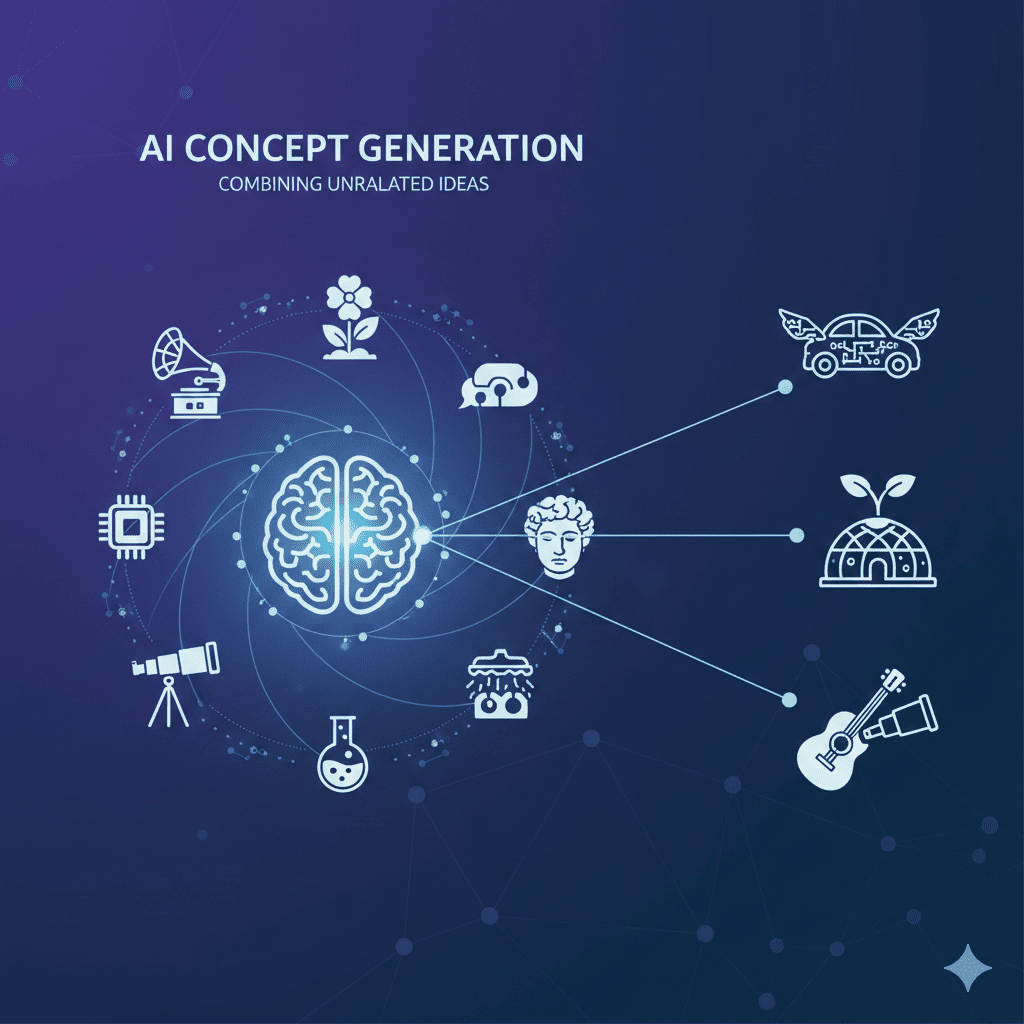
Innovation has always been humanity’s greatest asset, driving progress from the wheel to the smartphone. But innovation doesn’t happen in a vacuum. The most groundbreaking discoveries throughout history have emerged from unexpected connections between seemingly unrelated fields. Johannes Gutenberg combined wine press technology with coin punching to create the printing press. The Wright brothers applied bicycle mechanics to solve the problem of human flight. Steve Jobs merged calligraphy with computing to revolutionize personal computers.
Today, we stand at the threshold of a new era where artificial intelligence is mastering this same creative process. AI combines unrelated ideas from vast domains of knowledge to generate novel concepts, solutions, and innovations at a scale and speed that surpasses human capability. This isn’t science fiction or distant future speculation—it’s happening right now, transforming industries, accelerating research, and redefining what’s possible in creative and scientific endeavors.
Understanding how AI combines unrelated ideas reveals not just the mechanics of machine intelligence but fundamental insights into the nature of creativity itself. This article explores the mechanisms, applications, implications, and future of AI-driven conceptual synthesis.
1. The Science Behind Conceptual Combination
Vector Space Representations
At the heart of AI’s ability to combine ideas lies a mathematical framework called vector space representation. Every concept, word, image, or piece of information that AI processes gets converted into a multi-dimensional vector—essentially a point in mathematical space. Similar concepts cluster together, while different concepts sit farther apart.
What makes this powerful is that relationships between concepts are preserved as mathematical relationships between vectors. The famous example “king – man + woman = queen” demonstrates this property. AI combines unrelated ideas by performing mathematical operations on these vectors, discovering connections that aren’t obvious in the original form of the information.
These vector spaces can represent not just words but entire documents, images, sounds, chemical compounds, or any data type. An AI system can place a medical diagnosis, a painting style, a musical chord progression, and a chemical reaction all in the same mathematical space, enabling cross-domain connections impossible for humans to perceive directly.
Attention Mechanisms and Cross-Domain Pattern Recognition
Modern AI systems use attention mechanisms that allow them to identify which parts of different concepts are most relevant to each other. When combining ideas from medicine and architecture, for instance, attention mechanisms help the AI focus on structural principles in both domains rather than superficial features.
These mechanisms enable AI to process multiple streams of unrelated information simultaneously, finding subtle patterns and correlations. A system might notice that branching patterns in blood vessels resemble efficient distribution networks in logistics, or that protein folding problems share mathematical properties with origami design.
The attention mechanism essentially asks: “Which aspects of concept A are most relevant to concept B?” This selective focus enables meaningful combination rather than random mashing of ideas. It’s the difference between genuine innovation and nonsensical output.
Transfer Learning Across Domains
Transfer learning allows AI systems trained on one type of problem to apply that knowledge to completely different domains. An AI trained to recognize patterns in natural language might transfer those skills to analyzing musical compositions or identifying patterns in financial data.
This cross-pollination of learned knowledge mirrors how human experts often make breakthroughs by applying insights from their hobbies or unrelated fields to their primary work. The difference is that AI combines unrelated ideas from thousands or millions of domains simultaneously, operating at a scale no human mind can match.
2. How AI Discovers Non-Obvious Connections
Mining Massive Datasets for Hidden Relationships
AI systems can analyze billions of documents, research papers, patents, and data points to find connections that human researchers would never discover simply because the relevant information is scattered across too many specialized fields. A cardiologist might never read architecture journals, but an AI system can identify relevant connections between the two.
Research in materials science, for example, involves understanding properties across chemistry, physics, and engineering. AI combines unrelated ideas from all these fields, discovering that techniques from one subdomain can solve problems in another. This has led to discoveries of new materials with unexpected properties by combining known elements in configurations suggested by AI analysis of disparate research.
The key advantage is comprehensiveness. While human experts develop deep knowledge in narrow areas, AI can maintain shallow but broad knowledge across thousands of fields, positioning it uniquely to spot cross-domain opportunities.
Latent Space Exploration
Between any two concepts in AI’s mathematical representation lies a continuous space of intermediate possibilities. When AI combines unrelated ideas like “medieval castle” and “eco-friendly housing,” it doesn’t just mash them together—it explores the latent space between them, finding gradual transitions and hybrid concepts that blend features from both.
This latent space exploration generates concepts that are genuinely novel yet coherent. The AI might propose designs incorporating castle-like thermal mass for passive temperature regulation, defensive features reinterpreted as privacy screening, or fortress aesthetics combined with green roofs and sustainable materials.
Traversing latent space allows AI to generate not just one combination but entire spectrums of possibilities, each slightly different, allowing human collaborators to select the most promising directions for development.
Analogical Reasoning at Scale
Humans excel at analogical thinking—recognizing that problem A resembles problem B and applying solutions from one to the other. AI supercharges this capability by identifying analogies across vast knowledge bases. It might notice that traffic flow optimization shares mathematical properties with blood circulation, or that social network dynamics resemble ecosystem interactions.
These analogies aren’t superficial metaphors but deep structural similarities. When AI identifies that two problems share underlying patterns, it can transfer solution strategies from one domain to another, often producing innovative approaches that domain experts wouldn’t consider because they’re anchored in conventional thinking within their field.
3. Real-World Applications Across Industries
Drug Discovery and Medical Innovation
Pharmaceutical research traditionally took years and billions of dollars to produce new drugs. AI combines unrelated ideas from molecular biology, chemistry, existing drug compounds, and disease mechanisms to propose novel therapeutic molecules that human researchers might never consider.
AI systems have suggested repurposing existing drugs for new diseases by identifying molecular similarities between different conditions. They’ve proposed combining features from multiple drug candidates to create more effective treatments with fewer side effects. Some AI-discovered compounds work through entirely novel mechanisms suggested by the AI’s analysis of cross-domain data.
In one notable case, an AI system combined knowledge about antibiotic mechanisms with information about cancer cell metabolism to propose a cancer treatment approach inspired by antibacterial strategies. This cross-pollination between oncology and infectious disease research opened new therapeutic avenues.
Product Design and Innovation
Consumer product companies use AI to combine design elements from unrelated products, creating innovative hybrids. An AI might combine features from sports equipment with office furniture to create ergonomic work tools, or merge concepts from outdoor gear with children’s toys to develop new recreational products.
The process involves feeding the AI parameters like functionality requirements, aesthetic preferences, and material constraints, then letting it explore combinations of design elements from diverse product categories. Human designers can then refine and develop the most promising AI-generated concepts.
This approach has led to products that traditional design thinking wouldn’t produce because human designers tend to stay within category boundaries. AI combines unrelated ideas without the cognitive constraints of conventional thinking, suggesting truly novel form factors and feature combinations.
Architecture and Urban Planning
Architects are using AI to combine principles from nature, historical architecture styles, and modern engineering to create innovative building designs. An AI might blend Gothic cathedral structural principles with biomimetic forms inspired by natural organisms and modern sustainable building techniques.
In urban planning, AI combines concepts from ecology, sociology, transportation engineering, and economics to propose city designs that optimize multiple objectives simultaneously. It might suggest neighborhood layouts inspired by ant colony organization or traffic patterns modeled on river network efficiency.
These aren’t just aesthetic mashups—the AI identifies functional principles from each domain that genuinely improve the final design. A building might incorporate termite mound-inspired ventilation systems, load distribution patterns from tree structures, and space utilization strategies from Japanese minimalism.
Scientific Research and Discovery
Perhaps the most exciting application is in scientific research itself. AI combines unrelated ideas from different scientific disciplines to propose new experiments, theories, and research directions. Systems have suggested physics experiments by analyzing patterns in completely different fields, proposed new mathematical theorems by combining techniques from separate branches of mathematics, and identified research opportunities at the intersection of previously distinct disciplines.
The AI doesn’t just combine existing knowledge—it generates hypotheses about connections that haven’t been explored. A system analyzing climate science and epidemiology might suggest investigating how climate patterns influence disease spread through mechanisms nobody had considered because the relevant expertise existed in separate research communities.
4. Creative Applications in Arts and Media
Music Composition and Sound Design
AI music systems combine elements from wildly different genres, cultural traditions, and time periods to create novel musical ideas. They might blend baroque counterpoint with electronic dance music structures, or combine traditional Indian raga patterns with jazz harmony.
What makes this interesting isn’t just the genre fusion—musicians have done that for decades—but the depth of the combinations. AI combines unrelated ideas at multiple levels simultaneously: rhythmic patterns from one tradition, harmonic progressions from another, timbral qualities from a third, and formal structures from a fourth, creating music that’s genuinely original rather than simple pastiche.
Sound designers use AI to combine acoustic properties from natural sounds, synthesized tones, and recorded music to create entirely new sonic textures. An AI might blend the resonance characteristics of a wooden room with the attack envelope of a percussive sound and the harmonic content of a vocal timbre, producing sounds impossible to create through conventional synthesis.
Visual Arts and Design
AI art systems combine visual elements, styles, techniques, and concepts from across art history and beyond. They can merge the brushwork of impressionism with the composition principles of Islamic geometric art and the color theory of modern abstract expressionism.
More intriguingly, these systems can incorporate non-visual concepts into visual art. An AI might create artwork that visually represents a musical piece, a mathematical equation, and an emotional concept simultaneously, finding visual forms that embody all three.
The results often surprise even experienced artists because the AI identifies visual connections between concepts that human artists wouldn’t perceive. It might notice that the patterns in a poet’s metaphors share structural similarities with certain geometric forms, leading to visual art that authentically represents the poetry in unexpected ways.
Storytelling and Narrative Construction
AI writing systems combine narrative structures from different literary traditions, character archetypes from various cultures, plot devices from multiple genres, and thematic elements from disparate sources to generate novel story concepts.
A system might combine the cyclical narrative structure of indigenous storytelling with the character dynamics of Greek tragedy, the pacing of thriller genres, and thematic concerns from contemporary social issues. The result is story frameworks that feel fresh precisely because they draw from sources that aren’t typically combined.
AI combines unrelated ideas in storytelling by identifying deep structural patterns rather than surface elements. It recognizes that a particular plot structure from 19th-century Russian literature might work perfectly for a science fiction story when the underlying emotional beats are preserved while changing the setting and specifics.
5. The Mechanism of Creative Synthesis
Constraint Satisfaction Across Multiple Domains
When AI combines unrelated ideas, it’s solving a complex constraint satisfaction problem. Each domain contributes certain requirements and possibilities. The AI searches for solutions that satisfy constraints from all domains simultaneously—a form of optimization that becomes exponentially more complex with each added domain.
This is similar to how an architect must simultaneously satisfy structural requirements, aesthetic goals, budget constraints, building codes, and client preferences. AI extends this to dozens or hundreds of constraint categories from multiple unrelated fields, finding solutions that optimize across all of them.
The system explores combinations, evaluates how well each satisfies the various constraints, and iteratively refines toward optimal solutions. This process can generate thousands of candidate combinations, with the best ones balancing competing demands from different domains in innovative ways.
Emergent Properties from Combination
One of the most fascinating aspects of AI conceptual combination is emergence—when combining ideas A and B produces properties that neither possessed individually. This mirrors chemical reactions where combining elements creates compounds with entirely new properties.
When AI combines unrelated ideas from quantum physics and computer science, it doesn’t just create a simple mixture—it can discover quantum computing principles. When combining neuroscience with machine learning, it doesn’t just apply one to the other—it generates insights about both fields and creates new approaches that advance both disciplines.
These emergent properties are why AI combination is genuinely creative rather than merely derivative. The output contains information and capabilities that weren’t present in the inputs, much like how water’s wetness isn’t a property of individual hydrogen and oxygen atoms.
Probabilistic Generation and Variation
AI systems don’t just produce one combination—they generate distributions of possibilities. For any conceptual combination task, the AI can produce variations ranging from conservative blends that stay close to the source ideas, to radical departures that barely resemble either original concept.
This probabilistic approach mirrors biological evolution and human brainstorming. By generating many variations, the system ensures that at least some will be viable and potentially superior to obvious combinations. Users can then select which variations to develop further, creating an iterative refinement process.
The ability to generate controlled variation means that AI combines unrelated ideas not in a single predetermined way but explores the entire space of possible combinations, increasing the likelihood of finding truly innovative solutions.
6. Advantages Over Human Conceptual Combination
Scale and Speed
While a human expert might combine insights from three or four fields they’re familiar with, AI systems can simultaneously process information from thousands of domains. A researcher might spend years learning enough about a second field to identify relevant connections. An AI can analyze millions of documents across hundreds of fields in hours.
This scale advantage means AI can find connections that would require dozens of human lifetimes to discover through conventional research. The speed enables rapid iteration—testing thousands of conceptual combinations to identify promising directions, then refining those directions through additional combinations.
Freedom from Cognitive Biases
Humans suffer from numerous cognitive biases that limit conceptual combination. We anchor on familiar solutions, we’re influenced by recent experiences, we struggle to truly think outside our expertise, and we’re constrained by cultural assumptions about which ideas belong together.
AI combines unrelated ideas without these limitations. It doesn’t know that “respectable scientists don’t combine astrology with physics” or that “serious composers don’t mix polka with funeral dirges.” This freedom allows it to explore combinations that humans would self-censor before even considering them seriously.
Some of history’s greatest innovations were initially dismissed as absurd precisely because they violated conventional thinking about which ideas belong together. AI’s lack of such social constraints positions it to find the absurd-but-actually-brilliant combinations that humans overlook.
Comprehensive Cross-Referencing
Human memory is limited and associative. We can’t mentally cross-reference every piece of knowledge we possess with every other piece. AI systems maintain explicit mathematical relationships between all concepts in their knowledge base, enabling exhaustive cross-referencing.
This comprehensive connectivity means that any piece of information can potentially connect with any other piece. A fact about marine biology might connect to a problem in telecommunications not because they’re obviously related but because they share abstract mathematical patterns that the AI’s representation makes explicit.
7. Challenges and Limitations
The Coherence Problem
Not all combinations of unrelated ideas produce meaningful results. Many combinations are nonsensical, impractical, or simply useless. AI combines unrelated ideas prolifically, but much of what it generates is garbage. Distinguishing viable innovative combinations from meaningless mashups remains challenging.
Human judgment is currently necessary to evaluate AI-generated combinations. Experts must assess whether a novel combination genuinely solves a problem or creates value, or whether it’s merely novel without being useful. This evaluation bottleneck limits the practical application of AI conceptual combination.
Developing better evaluation frameworks—potentially using additional AI systems to assess the output of creative AI—is an active research area. The goal is automated assessment of conceptual combinations based on criteria like feasibility, utility, novelty, and elegance.
Context and Domain Knowledge Gaps
While AI can identify mathematical patterns and structural similarities across domains, it may lack the deep contextual knowledge that experts possess. A combination that looks promising based on abstract patterns might be impractical for reasons the AI doesn’t understand because it lacks tacit knowledge about how things actually work in a given field.
This is why the most effective applications involve human-AI collaboration, where AI generates possibilities and humans apply contextual judgment. The AI’s pattern-matching complements human expertise, creating a partnership more powerful than either alone.
Attribution and Originality Questions
When AI combines unrelated ideas from existing sources, questions arise about originality and credit. If an AI combines concepts from three different researchers’ work to create something new, who deserves credit? These aren’t just academic questions—they have implications for patents, copyrights, and scientific credit.
Current intellectual property frameworks weren’t designed for AI-generated combinations of human ideas. Legal systems struggle with determining whether AI-generated combinations constitute derivative works or genuine inventions. These challenges will require new frameworks for understanding creativity and ownership.
8. The Future of AI-Human Creative Collaboration
Augmented Creativity
The future isn’t AI replacing human creativity but augmenting it. Humans will work with AI systems that generate conceptual combinations, which humans then evaluate, refine, and implement. This collaboration leverages AI’s breadth and speed while preserving human judgment, taste, and contextual understanding.
Creative professionals increasingly use AI as an ideation partner—a system that suggests directions and combinations they wouldn’t have considered, which they then develop using their expertise. This augmented approach increases creative productivity while maintaining human agency and artistic vision.
Democratization of Innovation
As AI tools for conceptual combination become more accessible, innovation becomes less dependent on having advanced degrees or access to elite institutions. An independent inventor can use AI to combine knowledge from fields they’ve never studied, identifying opportunities that previously required teams of specialists.
This democratization could accelerate innovation by empowering people who have important problems to solve but lack conventional credentials. A farmer might use AI to combine agricultural knowledge with materials science and engineering to develop improved irrigation systems. A teacher might combine pedagogical research with game design and psychology to create better learning tools.
Accelerating Scientific Progress
Perhaps the most significant impact will be in scientific research. AI combines unrelated ideas from the vast corpus of published research, identifying connections between papers whose authors have never communicated. This could solve a major problem in modern science—the increasing difficulty for researchers to keep track of developments even within their own specialties, let alone across disciplines.
AI systems are already helping scientists discover overlooked connections in existing literature, suggesting new experiments that combine techniques from different fields, and identifying potential research collaborations between specialists who work in apparently unrelated areas but whose work shares deep connections.
9. Philosophical Implications for Understanding Creativity
Is Combination Sufficient for Creativity?
The success of AI in combining unrelated ideas raises fundamental questions about creativity itself. If creativity is essentially novel combination of existing elements—as some theories suggest—then AI might be genuinely creative rather than merely mimicking creativity.
Alternatively, if creativity requires consciousness, intentionality, or other qualities AI lacks, then AI combines unrelated ideas in ways that are creative-adjacent but not truly creative. This debate has implications beyond philosophy—it affects how we value AI-generated work, how we define artistic expression, and how we understand human uniqueness.
The Role of Randomness and Serendipity
Much of AI’s conceptual combination involves controlled randomness—probabilistic generation that produces unpredictable results. This mirrors the role of chance in human creativity, where accidental discoveries and random inspirations often lead to breakthroughs.
The question is whether randomness is a bug or a feature of creativity. Is the ideal creative process one that systematically explores all possibilities, or one that incorporates irreducible chance? AI’s ability to modulate between systematic exploration and random combination may help answer this question.
Value of Surprising Connections
What makes certain conceptual combinations feel insightful rather than arbitrary? When AI combines unrelated ideas, some combinations feel revelatory while others seem forced. Understanding this distinction could illuminate the nature of insight itself.
Research suggests that the most valued combinations are those that seem obvious in retrospect but weren’t obvious beforehand—they reveal a connection that “should have been noticed” but wasn’t. AI’s ability to identify such connections by analyzing abstract patterns might represent a computational approach to generating genuine insight.
Conclusion: The Synthesis Revolution
The ability of AI combines unrelated ideas represents more than a technological achievement—it’s a fundamental shift in how innovation happens. For the first time in history, we have tools that can systematically explore the combinatorial space of human knowledge, identifying connections that would take many lifetimes to discover through conventional means.
This capability will accelerate progress across every domain of human endeavor. In science, AI will suggest experiments combining techniques from distant fields. In technology, it will propose products merging features from unrelated categories. In the arts, it will generate works blending traditions that have never been combined. In business, it will identify opportunities at the intersection of separate industries.
The implications extend beyond practical applications to philosophical questions about the nature of creativity, intelligence, and innovation. If AI can combine ideas creatively, what distinguishes human creativity? If machines can generate novel concepts, how do we define originality? These questions will shape our understanding of ourselves as much as our technology.
As these systems become more sophisticated and accessible, we’re entering an era where the limiting factor in innovation shifts from discovering connections to evaluating and implementing them. The challenge won’t be generating new ideas—AI will produce those in abundance—but choosing which ideas to pursue and having the judgment to distinguish brilliant from merely novel.
The future belongs to those who can effectively collaborate with AI in this creative process, leveraging machine-generated combinations while applying human wisdom, judgment, and contextual understanding. AI combines unrelated ideas with superhuman breadth and speed, but humans provide the meaning, purpose, and vision that transform combinations into innovations that matter.
This partnership between human creativity and artificial synthesis may be the most productive collaboration in history, enabling breakthroughs that neither humans nor AI could achieve alone. As we master this collaboration, we’ll unlock solutions to challenges that have long seemed intractable and create innovations we haven’t yet imagined. The synthesis revolution is just beginning, and its ultimate impact may exceed even the most optimistic predictions.
Also read this:
Why AI Will Become the Default Interface for the Internet in the Next 5 Years
AI Feature Improves Typing Speed: The Revolutionary Technology That’s Changing How We Type