
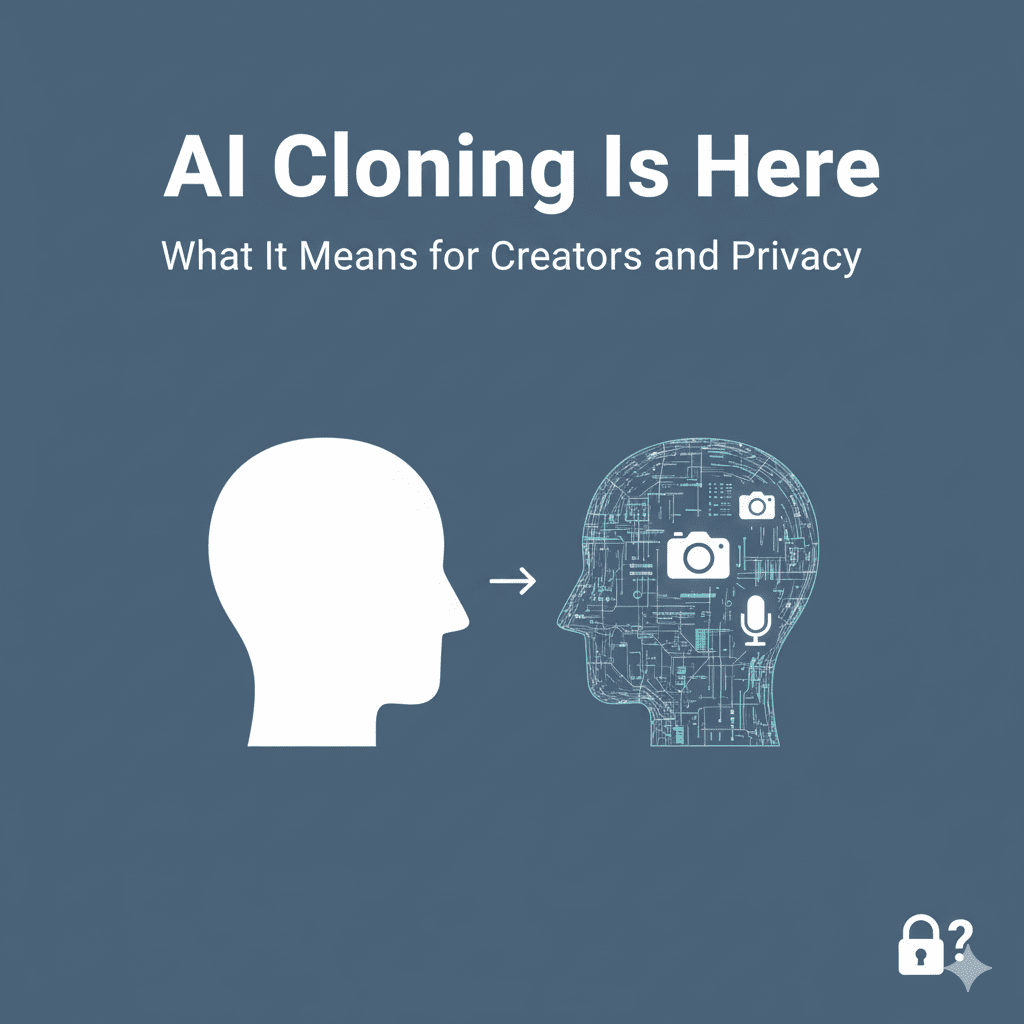
Imagine waking up to find that “you” have been answering emails, attending meetings, and creating content—while you were sleeping. Not a clone in the sci-fi sense, but something arguably more powerful: a digital twin that thinks like you, talks like you, and works like you.
Welcome to 2025, where AI cloning isn’t science fiction anymore—it’s reality. And it’s simultaneously the most exciting and most terrifying development in technology today.
From influencers making thousands of dollars with AI versions of themselves to business leaders deploying digital doubles to attend Zoom calls, AI cloning technology is reshaping what it means to be “you” in the digital age. But with this incredible power comes profound questions about identity, consent, privacy, and control.
This isn’t just about technology anymore. This is about the future of human identity itself.
What Exactly Is AI Cloning?
Let’s start with the basics. AI cloning involves using deep-learning algorithms to create hyper-realistic digital replicas of a person. These clones can mimic your voice, appearance, writing style, communication patterns, personality quirks, and decision-making processes.
Modern AI clones fall into several categories:
Voice Clones: AI that replicates your vocal characteristics, tone, accent, and speaking style. Most top tools today can clone a voice in under 5 minutes using just 30 seconds of clean audio.
Visual Clones: Digital avatars that look like you, from simple 2D images to full-body avatars that can walk around in video, due out before the end of 2025.
Conversational Clones: Interactive AI that can answer questions, provide advice, and engage in dialogue as if they were you—trained on your communication history and knowledge base.
Behavioral Clones: Systems that learn your decision-making patterns, work habits, and preferences to act on your behalf in digital environments.
The technology behind AI cloning combines natural language processing, computer vision, deep learning, and generative AI to create digital representations that are increasingly indistinguishable from the real person.
The AI Cloning Revolution Is Already Here
The explosive growth of AI cloning isn’t something coming in the future—it’s happening right now, at a pace that’s frankly astonishing.
Meta began testing AI chatbots based on popular Instagram creators in 2024, with about 50 creators partnering with Meta to create AI versions of themselves that fans can chat with. Mark Zuckerberg’s vision? Eventually enabling every creator and even every small business to build an AI clone of themselves for enhanced customer engagement.
The numbers tell a compelling story about this revolution:
Caryn Marjorie, a 23-year-old Snapchat influencer with millions of followers, collaborated with a tech firm to develop an AI chatbot of herself that fans could pay to interact with. The result? Her virtual clone made $72,000 in the first week by engaging fans at $1 per minute.
Think about that for a second. $72,000 in one week. From an AI version of herself that worked 24/7 without fatigue, without breaks, and without ever getting sick.
Tyler Denk, founder of newsletter startup Beehiiv, recently released his own Delphi-created AI clone, making it free for subscribers of his personal newsletter. His “DenkBot” can converse via text and speech, and has been trained on everything he’s ever written, all social media posts, every podcast interview, and support documentation.
The voice cloning market is projected to reach $16.2 billion by 2032, signaling that this isn’t a passing trend—it’s a fundamental shift in how we interact digitally.
Why Creators Are Rushing to Build AI Clones
The appeal of AI cloning for creators, entrepreneurs, and businesses is undeniable. Here’s why everyone from influencers to CEOs is jumping on board:
1. Unprecedented Scalability
The most obvious benefit? You can literally be in multiple places at once. For busy professionals, an AI doppelgänger could be like having an army of interns who all know exactly what you know. It can attend meetings or calls you can’t make, and report back.
Imagine speaking at a client workshop while simultaneously drafting a strategy brief. For marketers juggling clients and content, that’s not just helpful—it’s transformative.
2. Monetization While You Sleep
Your AI clone can generate income 24/7 without you lifting a finger. Influencers are using AI clones to interact with fans, answer questions, and provide personalized advice—all automatically, all the time.
Content creators can scale their expertise without scaling their time. One person can now serve thousands of customers simultaneously through their digital twin.
3. Consistency Across Platforms
Your AI clone never has a bad day. It doesn’t get tired, frustrated, or overwhelmed. It provides the same quality interaction whether it’s the first conversation of the day or the thousandth.
For businesses, this means consistent brand representation and customer experience regardless of volume.
4. Democratizing Expertise
Companies like Delphi AI offer services to create and host digital clones. The company sells time with digital clones of wellness icon Deepak Chopra, leadership coach Brendon Burchard, and other celebrities to scale and monetize their personal outreach.
This means expertise that was once accessible to only a privileged few can now reach anyone, anywhere, at affordable prices.
5. Content Creation Efficiency
For creators producing daily content across multiple platforms, AI cloning is a game-changer. Your clone can adapt content to different formats, maintain consistent voice across platforms, and generate variations without quality drop.
6. Enhanced Customer Service
Businesses are deploying AI clones to handle customer inquiries, provide personalized recommendations, and solve problems—all while maintaining a human touch that pure chatbots can’t match.
The Dark Side: AI Cloning Privacy and Security Concerns
But here’s where things get complicated—and honestly, terrifying. The same technology that empowers creators also creates unprecedented risks.
The Consent Crisis
A friend informed someone he had cloned them by feeding blog posts, podcast transcripts, and personality quirks into AI, creating a digital twin that thinks, writes, and could possibly sit on advisory boards in their place.
The question that haunted him: Was this flattering and fun, or creepy theft of intellectual prowess?
Anyone could secretly use free online tools to create digital twins of other individuals without permission. Yes, even you. Right now. Without your knowledge or consent.
When a person’s voice is cloned without permission or informed consent, it has the potential to be used and exploited in harmful ways, creating ethical or legal dilemmas.
The Fraud Epidemic
AI cloning has become a powerful tool for scammers, and the results are devastating:
In the United Arab Emirates, scammers used the voice of a company director to facilitate a $51 million theft.
In Australia, scammers used AI to pose as Queensland Premier Steven Miles in an attempt to deceive people into making fraudulent Bitcoin investments.
Voice-cloning frauds are targeting children and teenagers as well. In one instance in the United States, fraudsters impersonated a teenager to fool her parents into believing she had been abducted.
There was a case where fraudsters used voice cloning technology to impersonate a CEO and steal over $243,000.
The Identity Theft Problem
Three seconds of audio is sufficient to produce a voice clone with an 85% match to the original. Think about how much audio of you exists online—videos, podcasts, social media stories, voice messages.
Scammers gather voice samples from websites like TikTok and YouTube. AI then processes the audio and generates new speech that sounds exactly like the target.
Your voice is out there. And anyone with basic technical skills can clone it.
The “Digital Immortality” Dilemma
Companies now allow one to easily create a digital clone of themselves by feeding a series of images and voice recordings. This essentially creates digital immortality, allowing loved ones to interact with representations of those who died.
But here’s the uncomfortable question: Although one can give consent to creating a digital clone of themselves before their physical death, they are unable to give consent to the actions the digital clone may take.
People who decide to use digital technologies in end-of-life situations are already in a very difficult point in their lives. Clone technology might simply make it harder for them.
The Misinformation Catastrophe
With deepfakes and digital cloning, the creation of a cloned digital version can be used to create a fake image, an avatar, or a fake video or audio of a person that cannot be easily differentiated from the real person it is purported to represent.
In an era where “seeing is believing” no longer applies, how do we trust anything we see or hear online?
The Data Privacy Nightmare
AI voice models analyze voice data which is classified as biometric data. Biometric data is highly sensitive and unique to everyone.
Once your biometric data is cloned and in the wild, you can’t change it like you can change a password. Your voice, your face, your mannerisms—they’re permanent identifiers. If compromised, they’re compromised forever.
The Legal and Ethical Minefield
The laws governing AI cloning are struggling to keep up with the technology’s rapid advancement.
The Copyright Gray Area
Creating digital clones requires not only the data of the person but also the creator’s input of how the digital clone should act or move, creating a gray area for copyright laws.
Who owns your AI clone? If someone creates a digital twin of you using publicly available content, do you have any legal recourse?
The Right of Publicity
With the current lack of legislations to protect individuals against potential malicious use of digital cloning, the right of publicity may be the best way to protect individuals in a legal setting.
The right of publicity gives individuals autonomy when it comes to controlling their own voice, appearance, and other aspects that make up their identity. But enforcement remains challenging.
Emerging Regulations
AI systems thrive on massive data sets for training and improving performance, often involving personal and sensitive information. Increased reliance on AI raises concerns about data misuse that crosses ethical boundaries.
Regulatory frameworks are emerging:
The EU AI Act categorizes AI applications into risk levels and implements varying degrees of oversight. High-risk AI used in critical areas faces strict regulatory requirements.
GDPR in Europe provides data privacy guidelines that include protection against unauthorized voice and image cloning.
No one can legally use or monetize your voice clone without your permission. Celebrity voices are off-limits unless licensed. Some countries are drafting “voice rights” laws similar to image rights.
But enforcement across borders remains extremely difficult, and bad actors often operate in jurisdictions with weak protections.
How AI Cloning Technology Actually Works
Understanding the mechanics of AI cloning helps demystify both its capabilities and limitations:
Voice Cloning Process
Voice clones rely on a combination of technologies, the essential ones being natural language processing and text-to-speech. The former helps voice clones understand and interpret text input, while the latter converts written text into spoken words.
Voice cloning solutions are pre-trained on vast datasets of human speech containing recordings of diverse speakers, which helps AI algorithms learn different accents, tones, and styles. During fine-tuning, voice cloning algorithms are honed based on the voice samples of a specific person.
The result? From just a few seconds of audio, Cartesia can capture even the most nuanced of accents.
Visual Cloning Process
To create a 2D clone, an AI model takes an existing image of a person as input and generates a new image that mirrors their appearance. This process involves encoding facial features, expressions, and textures using computer vision and deep learning.
Conversational Clone Creation
They train custom AI models on an individual’s writing, along with their appearances on videos and podcasts, to create a digital double. That digital double can be texted, called, and even video-chatted with.
The system learns not just what you say, but how you say it, including your reasoning patterns, communication style, and domain expertise.
Behavioral Replication
Interactive clones exist to answer people’s questions. They’re a bit like a website’s FAQ page come alive. They use AI to determine what kind of emotion best fits the words of the script.
Advanced clones can even anticipate needs based on patterns in your behavior and decision-making history.
The Major Players in AI Cloning Technology
Several platforms are leading the AI cloning revolution, each with different specialties:
ElevenLabs
The gold standard for voice cloning. ElevenLabs requires you to submit an audio clip where you verbally confirm that you own the voice and consent to its cloning, setting important ethical precedents.
Many creators report that ElevenLabs captures not just how they sound, but how they feel when they speak—crucial for emotional storytelling.
Delphi AI
Delphi’s customers include writers who want to scale their expertise in an interactive way, with one of the company’s top use cases being for business leaders and CEOs.
Meta’s Creator AI
In September, Mark Zuckerberg announced Creator AI, which allows influencers to digitally clone themselves. These clones have realistic faces and voices, with responses generated by AI.
Synthesia
Specializes in video avatars that follow scripts and use AI to determine appropriate emotions. Companies use these avatars for training videos and customer service.
Respeecher
Trusted by top-tier Hollywood studios and global corporations, their voice cloning technology ensures the utmost security for sensitive data, adhering to the highest standards of privacy and data protection.
HeyGen
Focuses on AI-generated video with avatar creation and voice cloning, prioritizing ethical use and user privacy.
How to Protect Yourself from AI Cloning Threats
Given the risks, how can individuals and businesses protect themselves?
For Individuals
1. Control Your Digital Footprint: Be mindful about what audio and video of yourself you share publicly. Every recording is potential training data for someone’s AI clone of you.
2. Use Voice Authentication Carefully: Biometric authentication with liveness detection can distinguish between a real person speaking and an AI-generated voice. But never rely solely on voice for security.
3. Establish Family Code Words: Create verification phrases or questions that only family members would know. This protects against voice cloning scams targeting loved ones.
4. Stay Informed: The more people understand how voice cloning works, the easier it is to spot red flags.
5. Verify Unusual Requests: If someone asks for money or sensitive information, verify through a separate communication channel, even if the voice sounds right.
For Businesses
1. Implement Multi-Factor Authentication: Companies relying on voice recognition should consider multi-factor authentication for extra protection.
2. Employee Training: Educate staff about AI cloning threats and establish verification protocols for sensitive transactions.
3. Detection Tools: Ircam Amplify developed the AI Speech Detector to combat the growing threat of voice deepfakes. This tool identifies cloned voices in audio files with 98% accuracy without needing a reference voice sample.
4. Clear Policies: Develop policies around creating and using AI clones within your organization, including consent requirements and acceptable use guidelines.
5. Legal Protections: Include clauses in contracts about unauthorized cloning and establish clear ownership of any clones created.
For Creators Building Ethical Clones
1. Always Get Consent: Creators should seek explicit consent when using cloned voices, especially in scenarios where the cloned voice is used for commercial or public purposes.
2. Be Transparent: Clearly label when people are interacting with an AI clone rather than the real person.
3. Implement Script Approval: Implement a rigorous script approval process to ensure that recorded content aligns with ethical guidelines, preventing creation of harmful or misleading content.
4. Secure Storage: Protect the training data and models used to create your clone with encryption and strict access controls.
5. Plan for Misuse: Have procedures ready for if your clone is compromised or used unethically.
The Future of AI Cloning: What’s Coming Next
The AI cloning landscape is evolving rapidly. Here’s what experts predict for the near future:
Real-Time Translation with Original Voice
Speak in English, hear it back in French in your voice. This technology will break down language barriers while maintaining personal communication style.
Voice NFTs and Creator Rights
Monetize your voice as a digital asset through Voice NFTs and Creator Rights systems. Your voice could become intellectual property that you license, similar to music or images.
Hyper-Personalized Content
Imagine an AI show hosted in your voice, daily. Personalized podcasts, news broadcasts, and educational content tailored to you and delivered in voices you trust.
Advanced Detection Systems
Tighter platform moderation with fake voice detection tools emerging. The arms race between creation and detection technology will intensify.
Truecaller is developing technology that detects computer-generated voices in incoming calls to counter AI-generated voice scams, viewing 2025 as a pivotal year.
Full-Body Interactive Avatars
Full-body avatars that can walk around in video are due out before the end of 2025. Soon, AI clones won’t just be talking heads—they’ll be complete digital representations.
Dating Concierge Clones
The founder of online dating app Bumble has imagined a world where your dating concierge AI clone could go and date for you with another dating concierge. Whether this sounds convenient or dystopian probably depends on your perspective!
Digital Ghosts
Google recently published a paper investigating what happens to AI clones when their human counterparts die, describing such clones as “generative ghosts”.
This raises profound philosophical questions about identity, consciousness, and what it means to truly “die” in the digital age.
The Philosophical Questions AI Cloning Forces Us to Confront
Beyond the practical concerns, AI cloning raises fundamental questions about human identity and existence:
What defines “you”? If an AI can replicate your communication style, decision-making patterns, and personality, what makes the “real” you unique?
Where is the line between tool and entity? At what point does an AI clone become sophisticated enough that we should consider it something more than just software?
What happens to authenticity? The future world could be full of digital doubles, talking to people and to each other. Perhaps this will dull real human relationships. Or maybe the value of real connection will increase.
Who are you responsible for? If your AI clone gives bad advice, makes harmful recommendations, or violates someone’s rights, are you liable?
Right now, “we’re all just guinea pigs,” says one expert. “We’re experimenting on ourselves here.”
Practical Use Cases: When AI Cloning Makes Sense
Despite the concerns, there are legitimate, beneficial uses for AI cloning technology:
For Busy Executives
AI clones can handle routine meetings, answer standard questions, and provide preliminary analysis—freeing human time for high-value strategic work.
For Educators
Teachers can clone themselves to provide 24/7 student support, answer common questions, and deliver personalized feedback at scale.
For Content Creators
Scale expertise and interaction without burning out. Serve more community members while maintaining work-life balance.
For Language Learning
Preserve languages by creating AI clones of native speakers, allowing future generations to learn from authentic sources.
For Medical Consultation
Doctors can deploy AI clones for preliminary assessments, patient education, and follow-up questions, extending their reach.
For Historical Preservation
Create interactive AI clones of historical figures for educational purposes, bringing history to life for students.
For Accessibility
Voice cloning helps people who have lost their voice due to illness recreate their original sound, maintaining their identity.
The Bottom Line: Navigating the AI Cloning Era
Here’s what it comes down to: AI cloning is here, it’s powerful, and it’s not going away. Like any transformative technology, it’s neither inherently good nor bad—it’s a tool whose impact depends entirely on how we use it.
The technology offers unprecedented opportunities: ✅ Scalability beyond human limitations ✅ Democratization of expertise ✅ New revenue streams for creators ✅ Enhanced accessibility and education ✅ Preservation of human knowledge and personality
But it also presents serious risks: ⚠️ Identity theft and fraud ⚠️ Privacy violations ⚠️ Misinformation and manipulation ⚠️ Consent violations ⚠️ Erosion of authentic human connection
AI won’t replace authentic creators—it will amplify them. But only the ethical and transparent ones will thrive long-term.
Your Action Plan: Responsible AI Cloning in 2025
Whether you’re considering creating an AI clone or simply want to protect yourself, here’s your action plan:
If You’re Creating an AI Clone:
Week 1:
- Research platforms and ethical guidelines
- Identify specific use cases for your clone
- Document consent and intended uses
Week 2:
- Choose your platform based on needs and ethics
- Gather training data (writing samples, recordings, etc.)
- Review privacy policies and data handling
Week 3:
- Create your initial clone
- Test thoroughly with trusted individuals
- Establish clear boundaries and guidelines
Week 4+:
- Launch with transparent disclosure
- Monitor for misuse
- Iterate based on feedback
- Maintain security protocols
If You’re Protecting Against Cloning:
Immediate Actions:
- Audit your online presence and reduce unnecessary voice/video exposure
- Establish family verification protocols
- Enable multi-factor authentication everywhere
- Educate yourself on current AI cloning capabilities
Ongoing Practices:
- Verify unusual requests through multiple channels
- Stay informed about new AI cloning threats
- Support legislation protecting individual rights
- Use detection tools when suspicious
The Final Word on AI Cloning
We’re standing at a remarkable inflection point in human history. AI cloning technology allows us to transcend traditional limitations of time, space, and human capacity. We can now scale our expertise, preserve our knowledge, and extend our impact in ways previous generations couldn’t imagine.
But this power comes with profound responsibility.
Voice cloning tools in 2025 are a creative superpower—and a moral responsibility.
The question isn’t whether AI cloning will change the world—it already has. The question is: How will we shape this technology to enhance human flourishing rather than diminish it?
Will we use AI cloning to democratize expertise and create abundance? Or will we allow it to erode trust, violate privacy, and undermine authentic human connection?
The answer depends on the choices we make right now—as creators, as consumers, as citizens, and as human beings navigating an increasingly digital existence.
AI cloning technology is here. The future of identity, creativity, and privacy is being written today. The only question that remains is: What role will you play in shaping that future?
Your digital double might already be out there. The question is: Who’s controlling it?
Also read this:
The ‘Quiet Cash Movement’: Making Money Without Going Viral (And Why It’s Smarter Than Chasing Fame)
The Secret Behind Faceless YouTube Channels (And How They’re Making Millions)
Why Everyone Is Building Personal AI Assistants (And Why You Should Too)